The 80/20 MHT-CET Physics Syllabus Checklist and Revision Order
A source-linked MHT-CET Physics checklist that separates the State CET Cell’s syllabus rules from an editorial revision route.
6 chapters · Updated Sep 17, 2026 · By Rahul Jeewani
- 80/20
- Approximate Std XII and Std XI syllabus weightage
In brief
For MHT-CET 2026, study the whole Std XII Physics syllabus and only 10 named Std XI Physics units. The State CET Cell assigns approximately 80% syllabus weightage to Std XII and 20% to Std XI, while any revision sequence is editorial guidance, not an official order.
The official rule is whole Std XII plus a named Std XI subset
The MHT-CET 2026 Physics syllabus is not a generic “Class 11 and 12 Physics” label. The official rule is more specific: questions are based on SCERT Maharashtra’s syllabus, with the whole Std XII Physics syllabus included and only a stated group of Std XI Physics units included. The same document assigns approximately 80% syllabus weightage to Std XII and 20% to Std XI.
That distinction changes how you audit your preparation. A complete checklist needs one section for every Std XII chapter in your current Maharashtra textbook, then a separate section containing only the named Std XI units below. Do not quietly add every other Std XI chapter because another course, book or video playlist includes it. Extra study can be useful for understanding, but it is not evidence that a chapter is part of the stated MHT-CET 2026 scope.
The official source also identifies the questions as mainly application-based, with no negative marking. A syllabus checklist therefore tracks more than whether a lecture was watched. It should leave space for concept review, MCQ practice and error review for each included item. The State CET Cell’s 2026 syllabus and marking scheme is the source document to keep beside the checklist.
Takeaway: MHT-CET 2026 Physics means all Std XII Physics plus only the named Std XI subset.
The ten Std XI units deserve their own checklist
Create ten checkboxes for Std XI Physics, using the State CET Cell’s wording:
- Vectors
- Error Analysis
- Motion in a plane
- Laws of Motion
- Gravitation
- Thermal properties of matter
- Sound
- Optics
- Electrostatics
- Semiconductors
Keep Vectors and Error Analysis as separate checklist lines because the official document names them separately. This is useful when you are checking whether a course has covered the stated scope rather than relying on broad labels such as “mechanics” or “modern Physics”. It also prevents an easy error: treating a full Class XI course outline as the official MHT-CET list.
The list tells you what is included. It does not rank these units, assign each unit a percentage, or tell you the sequence in which to revise them. A chapter-wise priority chart can be a study aid, but it is not an official weightage table unless it is published by the State CET Cell. The official 2026 syllabus file is explicit about the named Std XI Physics units and the standard-level split.
Takeaway: Track these ten Std XI items exactly, and do not mistake the list for an official priority order.
Use the Std XII chapter index to check complete coverage
For Std XII, the State CET Cell’s rule is “whole syllabus”, so the practical task is to check every chapter in the current Maharashtra Physics textbook. SCERT Maharashtra’s Std XII Physics supporting material indexes these 16 chapter labels: Rotational Dynamics; Mechanical Properties of Fluids; Kinetic Theory of Gases and Radiation; Thermodynamics; Oscillations; Superposition of Waves; Wave Optics; Electrostatics; Current Electricity; Magnetic Fields due to Electric Current; Magnetic Materials; Electromagnetic Induction; AC Circuits; Dual Nature of Radiation and Matter; Structure of Atoms and Nuclei; and Semiconductor Devices.
Use the index as a coverage audit. Mark each chapter only after you can identify the notes or lecture, complete a first practice set and record the questions you missed. A completed lecture list alone cannot show whether the whole syllabus has been revised.
The SCERT index is useful for naming the tracker rows, while the State CET Cell document remains the authority for the MHT-CET 2026 scope. SCERT Maharashtra’s Std XII Physics material provides the chapter-label index used here.
Takeaway: A whole-Std-XII rule needs a chapter-by-chapter tracker, not a single “Class 12 done” box.
Read the 80/20 split without turning it into chapter weightage
The official paper design gives Physics 10 Std XI MCQs and 40 Std XII MCQs, with one mark per Physics question. Physics sits alongside Chemistry in Paper II, so the official Paper II total is 100 marks in 90 minutes. This means a useful revision plan gives more time to the complete Std XII checklist while keeping the named Std XI units active.
Where the Physics questions sit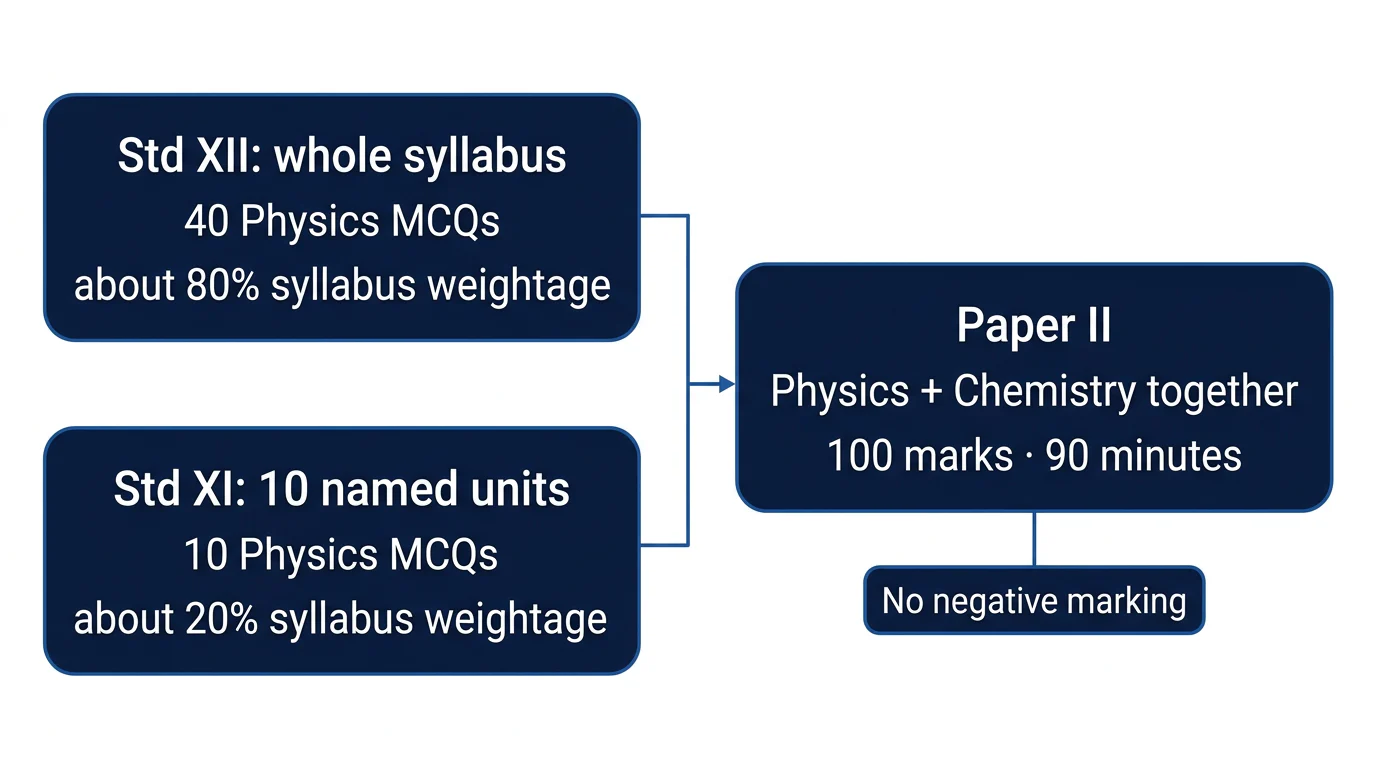
The 80/20 figure is a syllabus-weightage guideline, not a promise that each chapter will appear in a fixed pattern. For example, it cannot tell you that a particular chapter will contribute a certain number of marks in your shift. Avoid building a pass-or-fail plan around unofficial chapter percentages.
A safer timing decision is simple: finish the entire Std XII coverage audit first, then make sure the ten named Std XI units are not left as an afterthought. In the examination, remember that Physics timing cannot be separated from Chemistry timing because both subjects share Paper II. The State CET Cell’s marking scheme provides the question split, marks and duration.
Takeaway: The official split supports Std XII-first revision, but it does not create official chapter priorities.
Use a revision order that is clearly editorial
Use this four-pass sequence as an editorial revision route, not as a State CET Cell instruction. First, organise the Std XI foundation into Vectors and Error Analysis; Motion in a plane, Laws of Motion and Gravitation; then Thermal properties of matter, Sound and Optics; then Electrostatics and Semiconductors. Second, work through the Std XII mechanics, thermal and wave chapters. Third, revise the Std XII electricity and magnetism chapters. Fourth, finish Dual Nature of Radiation and Matter, Structure of Atoms and Nuclei, and Semiconductor Devices.
This route is designed to make your checklist easier to execute. It is not evidence that one unit carries more official marks than another. If a chapter is incomplete, return it to the relevant pass instead of moving it into a vague backlog.
If you prefer structured material, RG Lectures’ public MHT-CET course information lists lectures, PYQs, modules, Class XI coverage and chapter-wise tests. Use those features to fill a confirmed checklist gap, not as a substitute for checking the official scope. RG Lectures’ course overview describes those listed learning components.
Takeaway: Label every revision sequence as editorial guidance, even when it is useful.
Keep a change log beside the printable checklist
Put three fields at the top of a printable checklist: source document, academic-year references and review date. The current technical-education syllabus document was published for AY 2026–27 on 21 November 2025. It refers to Std XII 2025–26 and Std XI 2024–25. The previous official file referred to Std XII 2024–25 and Std XI 2023–24.
The named Std XI Physics list is unchanged between those two official files. That is a useful change-log entry because it distinguishes a rollover in the referenced school years from a change in the stated Std XI unit names. Your checklist can therefore show “named Std XI list checked” and “current Std XII textbook checked” as separate review tasks.
Do not copy a year from an old coaching PDF onto a new checklist. Download the current State CET Cell syllabus file, compare the named Std XI list with the prior file and verify the current Std XII textbook before beginning a new preparation cycle. The official 2025 syllabus file provides the prior release for this comparison.
Takeaway: A dated change log prevents an old syllabus reference from becoming a new study plan.
Go deeper
Frequently asked
Yes. The State CET Cell states that MHT-CET 2026 questions cover the whole Std XII Physics syllabus prescribed by SCERT Maharashtra for the 2025–26 academic year, alongside a specifically named Std XI subset.
No. Physics and Chemistry together form Paper II, which carries 100 marks and has a 90-minute duration. The official scheme allocates Physics questions within that combined paper, so your timing plan must account for both subjects.
No. The State CET Cell publishes the syllabus scope, question split and marking scheme, but it does not prescribe a chapter-by-chapter revision sequence. The order here is an editorial study route designed to organise the official checklist.
The 2026 State CET Cell syllabus document provides the Std XI and Std XII split and the question allocation by standard. It does not provide official percentage weightage for individual Physics chapters, so treat chapter-priority charts elsewhere cautiously.
Choose a Physics study format after you finish the checklist
Explore the currently listed MHT-CET courses when you want structured lectures, PYQs and chapter-wise tests.
Explore MHT-CET courses