Which Online JEE Physics Coaching Fits Your Schedule?
Compare online JEE Physics coaching by timetable flexibility, teacher access, doubts, and MHT-CET fit for Maharashtra students.

For Maharashtra PCM students, the choice is not simply live versus recorded. The 180-minute PCM format requires 150 questions, so a course has to leave room for both conceptual Physics and timed practice.
The right online JEE Physics coaching is the one whose schedule, problem level, and doubt system you can use consistently. Live microbatches suit students who need direct interaction; recorded programmes suit changing timetables; hybrid programmes add catch-up access. Before enrolling, verify the batch teacher, class time, cohort cap, Advanced practice, and doubt-response process.
We built this comparison for Maharashtra students balancing school, HSC preparation, MHT-CET, and JEE ambitions. It focuses on usable access to a teacher and a timetable you can actually sustain.
Which Delivery Model Fits the Way You Learn?
The format should solve your biggest constraint. If you regularly stop at a difficult Mechanics or Electrodynamics step and need to talk it through, interaction matters more than a huge lecture library. If school timings move around, catch-up access matters more than a fixed live timetable.
JEE Advanced is a separate standard from passive video completion. Its official exam rules require two compulsory three-hour papers and say questions test comprehension, reasoning, and analytical ability. That is why an Advanced-focused course needs more than chapter videos.
Live Microbatches
A live microbatch can work well when you need to interrupt, ask why a method failed, and attempt a problem aloud. The trade-off is timetable rigidity. Before choosing it, ask for the class days, start time, replay policy, and the maximum number of students in your actual group.
Large Live Cohorts
Large live groups can provide structure and regular teaching, particularly for students who can study independently between sessions. Their weak point is not automatically teaching quality. It is whether a student can get a meaningful answer after class instead of joining a long question queue.
Recorded Courses and Solo Support
Recorded lessons work when the student’s week is unpredictable, but only if missed work remains accessible and doubts go to a real person. Solo tutoring is best when one topic, one deadline, or one schedule problem needs focused help. For a closer look at support systems, read our live-doubt comparison.
How Should You Match Coaching to School, HSC, and CET?
A sustainable plan starts with the hours you already owe to school, homework, travel, boards, and sleep. We recommend placing the batch into a real seven-day calendar before comparing its faculty claims, because a missed lecture sequence can become a larger problem than a slightly less polished platform.
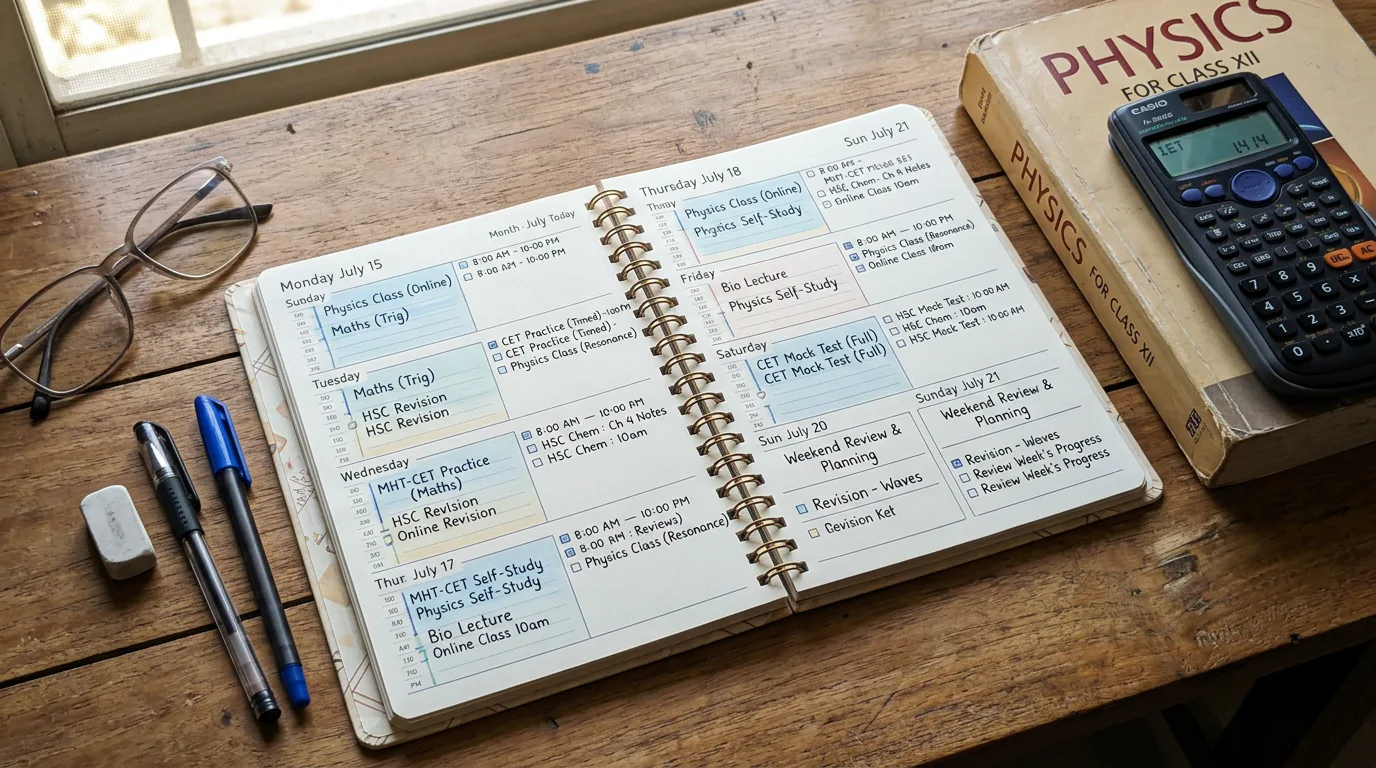
If school occupies weekdays, recordings or a hybrid system are often safer than a live-only routine. If HSC revision is urgent, keep board-style derivations and numericals protected rather than pretending every evening can hold Advanced-level problem sets. Our HSC support guide can help set that boundary.
Use this decision path when short-listing:
- Fixed school evenings: Choose only a batch with a posted class window that does not repeatedly clash.
- Irregular school or travel: Prioritise replay access, a catch-up rule, and a named doubt route.
- CET as the immediate priority: Reserve timed Physics and Chemistry practice for the first 90-minute block.
- Weekend availability: Check that doubt support and test review exist on the days you can actually use them.
Before treating an evening as available, add travel, meals, assignments, and revision buffers to the calendar. A timetable that only works on a perfect week will not survive board deadlines, mock tests, or school events.
Our current MHT-CET 2027 batch lists recordings and full syllabus coverage, but a student should still confirm the current schedule and support process before enrolment. Flexibility is not a label. It is the ability to return after an interruption without losing the lesson sequence or the chance to ask about it.
How Can You Test Whether Personal Attention Is Real?
“Personalised attention” should describe an observable system, not a slogan. We look for proof that the student can reach the person teaching the batch, receive feedback after a weak test, and understand what to do next.
Use a Five-Point Attention Rubric
Score each option as verified, partly verified, or not publicly stated.
- Written cohort cap: A stated maximum is stronger than a generic small-batch promise.
- Live questioning: Confirm whether students can ask the actual Physics teacher during or after class.
- Named doubt owner: Know who answers doubts, not only where doubts are posted.
- Response window: Ask when a student can reasonably expect a reply and what happens when a doubt remains unresolved.
- Weak-test follow-up: Look for error diagnosis, targeted practice, and a later check-in.
Know What Does Not Count
A chat group does not prove teacher access. More recorded videos do not prove feedback. A well-known faculty profile does not prove that person teaches your batch. The useful question is simple: “If I make the same error in a timed test twice, who notices and what changes?”
| Priority | Likely Gain | Likely Trade-Off | Proof To Request |
|---|---|---|---|
| Small cohort | More opportunities to speak | Fewer timetable choices | Written student cap |
| Teacher choice | More teaching-style options | Less continuity | Actual batch-teacher assignment |
| Recordings | Easier catch-up | Less immediate correction | Doubt turnaround process |
| Solo help | Targeted remediation | Higher cost | Session scope and review cadence |
Our personal-attention framework uses this evidence-first approach. The best option is not always the smallest cohort. It is the one where access, feedback, and scheduling work together.
How Do You Verify Faculty, Trials, and Advanced Practice?
Faculty verification begins with the actual batch, not an advertisement. Ask who will teach Physics, whether that person remains assigned through the course, and whether the same teacher handles problem-solving, doubts, and test discussion. A sample lecture should show how the teacher moves from principle to decision-making, not only how quickly they reach an answer.

Run a Real Sample-Lecture Test
Watch a lesson from the teacher assigned to the batch. Then solve three unfamiliar questions from the same topic without replaying the answer. If you cannot identify why a method works, the teaching style may not fit, even if the lecture felt clear in the moment.
Test the Doubt Process
Submit one genuine doubt during a trial or preview. Note who responds, whether the response explains the reasoning, and whether there is a next step if the first explanation does not help. This is more useful than asking whether “doubt support” exists.
Separate CET Speed from Advanced Depth
Use Advanced problems to practise reasoning, then use CET-format tests to practise pace. MHT-CET has no negative marking, while JEE Advanced can apply negative marks for some questions. Our mock-test guide explains why the test format should match the decision you need to make.
A trial should also confirm recordings, access duration, device use, refund terms, and test review. If the provider cannot explain those basics before payment, it cannot yet be a confident schedule fit.
Why RG Lectures Deserves a Closer Look
At RG Lectures, we do not want Maharashtra students to choose Physics support by a headline alone. Our current MHT-CET 2027 listing states full syllabus coverage, Class 11 basics, recordings, a named instructor, and course access through 31 May 2027. It does not publish every comparison field in this article, so we encourage families to ask us directly about the actual class window, recordings, doubt route, and whether the course matches a student’s Advanced ambition. That is the standard we use for our own course as well as any alternative: fit must be visible before payment. If your first priority is MHT-CET Physics, school-compatible study, and a clear set of questions to ask before choosing, begin by reviewing our current courses and compare the details against your weekly timetable. We built a preview so you can inspect learning materials before committing, then seek answers at our courses.
FAQs on Online JEE Physics Coaching
Do Recordings Make an Online Physics Course Flexible?
Recordings work when lessons remain available, doubts reach a real person, and you can follow a catch-up plan after school interruptions without losing test feedback.
Do Small Batches Guarantee Personal Attention?
Small batches matter when the published cap gives you room to ask questions, the named teacher handles them, and weak-test feedback produces specific next work.
Can One Plan Support Both MHT-CET and JEE Advanced?
Use Advanced problems to test reasoning and MHT-CET tests to rehearse pace. A programme should label tests, explain errors, and protect a manageable weekly routine.
What Should I Ask Before Paying for a Course?
Ask who teaches your batch, when classes meet, whether recordings remain available, who answers doubts, and how the programme responds when a timed test goes badly.