Calorimetry Numericals for MHT-CET: The Water Equivalent Check
Calorimetry rests on one rule: in an insulated setup, heat lost by the hot body equals heat gained by the cold body plus the calorimeter. A six-step checker keeps mixture numericals right.

By Rahul Jeewani, Founder · Updated 11 Nov 2026
Key takeaways
- Calorimetry numericals use one equation: heat lost by the hot bodies = heat gained by the cold bodies, with the calorimeter counted among the cold bodies.
- The calorimeter enters as its water equivalent W, the mass of water that would take in the same heat as the calorimeter for the same temperature change. You add W to the mass of the cold water.
- A larger W pulls the final temperature towards the cold water's temperature. For 200 g of water at 80 °C mixed with 100 g at 20 °C, W = 0, 20 and 50 g give 60.0, 57.5 and 54.3 °C.
- Four slips are the easiest ways to lose marks in calorimetry numericals (our recommendation: check these first): the calorimeter's starting temperature, the sign of ΔT, calories versus joules, and grams versus kilograms.
In this article
- 1Calorimetry in MHT-CET Physics: the one-line answer
- 2The 6-step Numerical Checker
- 3Which setup is it?
- 4Four slips that cost marks in calorimetry numericals
- 5Worked examples
- 6Mixing with and without a calorimeter
- 7Finding the water equivalent
- 8Phase change: does all the ice melt?
- 9Practice questions
- 10Learn this chapter with RG Lectures
- 11Frequently asked questions
Many calorimetry numericals go wrong in the setup, before any arithmetic starts. The principle is one line, but there are several places to slip. You can forget the calorimeter, give a temperature to the wrong body, or mix a calorie with a joule.
The error is also bigger than it looks. Pour 200 g of water at 80 °C onto 100 g of water at 20 °C. If you ignore the calorimeter, you get 60.0 °C. If the calorimeter absorbs as much heat as 50 g of water, you get 54.3 °C. Both answers look sensible, but they are 5.7 °C apart, far enough to land on a different option.
This page gives you a six-step checker for Std XI mixture problems and a table for picking the right setup. It also has three worked examples with every step shown, and practice questions to test yourself. Padhna aasaan hai, once the setup becomes a habit.
Calorimetry in MHT-CET Physics: the one-line answer
Calorimetry means measuring heat exchange, and its one rule is that heat lost by the hot bodies equals heat gained by the cold bodies, including the calorimeter, provided nothing escapes to the surroundings. In MHT-CET (the Maharashtra Health and Technical Common Entrance Test), it sits in Std XI Physics, Chapter 7, Thermal Properties of Matter. Std XI means Class 11 of the Maharashtra State Board.
A calorimeter is an insulated metal container with a stirrer, in which bodies at different temperatures exchange heat. For each body, the heat exchanged is
Q = m × c × (temperature change)
Here m is the mass and c is the specific heat, which is the heat needed to raise 1 g of the material by 1 °C. For water, c = 1 cal/g °C. The final temperature T is the one at which the heat lost equals the heat gained.
This page is about the Std XI mixing method. Chemistry coffee-cup and bomb-calorimeter work, where you measure the heat of a reaction or a fuel, is a different, college-level setup. It is not covered here.
The 6-step Numerical Checker
Run these six steps on every mixture numerical, in this order:
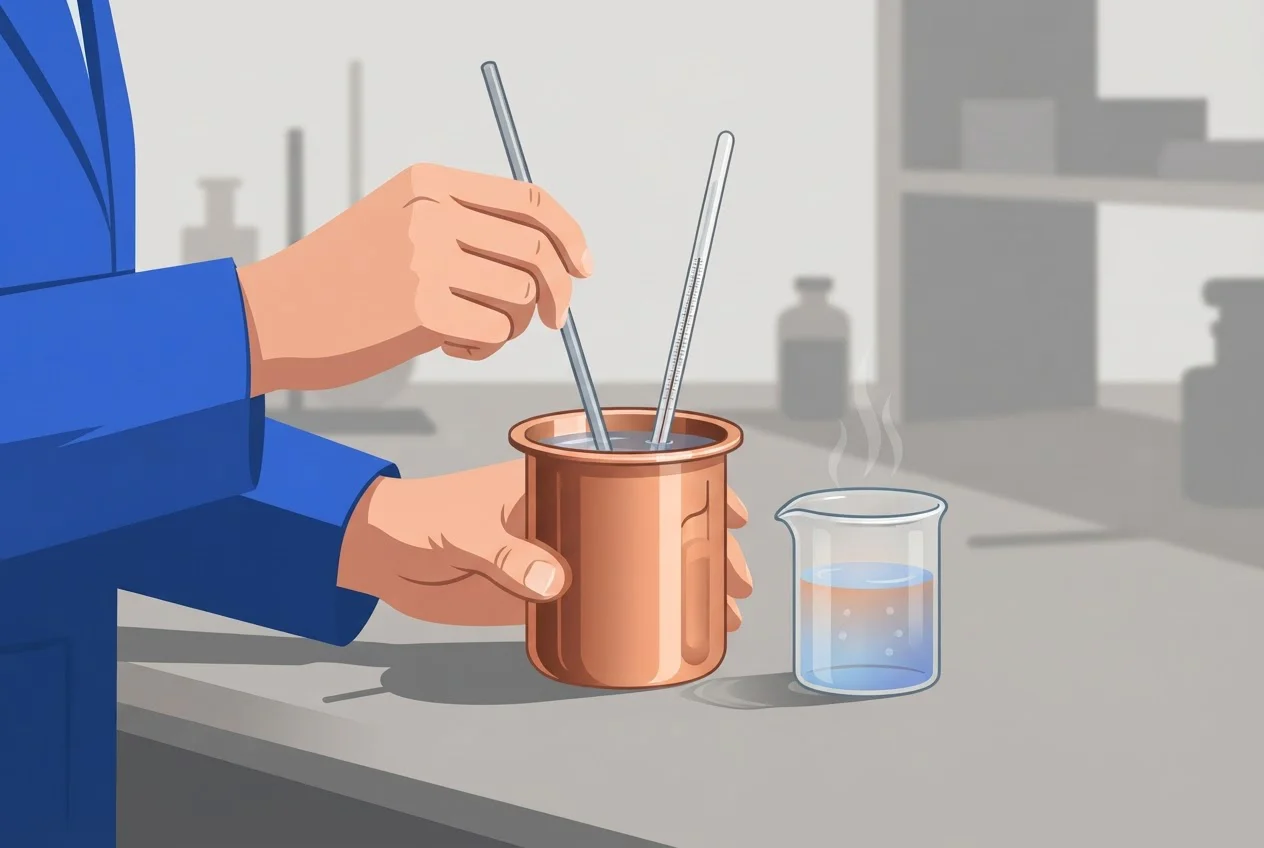
- List every body that changes temperature.Count the hot water, the cold water, the calorimeter (and the stirrer if its mass is given), and any ice.
- Write each body's starting temperature in °C.The calorimeter starts at the temperature of the cold water already inside it.
- Convert the calorimeter into water.Its water equivalent is W = m × s, where m is its mass and s is its specific heat in cal/g °C. Water is 1 on this scale, so W comes out in grams of water. Add W to the mass of the cold water.
- Write each heat with a positive temperature difference.Heat lost is m × c × (hot start − T). Heat gained is m × c × (T − cold start).
- Set heat lost equal to heat gainedand solve for the unknown.
- Test the answer.Pass: T lies between the lowest and highest starting temperatures, and all units match. Fail: T falls outside that range, or you mixed units. Go back to steps 2 and 4.
For a multiple-choice question (MCQ), use step 6 before you even calculate. The final temperature must lie between the two starting temperatures. A larger water equivalent W pulls it closer to the cold water's temperature, so an option near the hot temperature is wrong whenever W is large.
Which setup is it?
Pick the row that matches your question, then add only what that row asks for.
| Setup | What you add to the equation | How to recognise it |
|---|---|---|
| Mixing liquids, calorimeter ignored | Nothing extra (W = 0) | "Negligible heat capacity of the vessel" or "heat capacity of the container is ignored". An insulated vessel alone does not mean W = 0 |
| Mixing with a calorimeter | W = m × s added to the cold water's mass | A calorimeter mass and material are given, or W is given |
| Phase change (ice, steam) | Latent heat: m × L for the mass that changes state. First check whether all of it changes state | Ice, steam, "melts", "boils" |
| Chemistry setup (reaction or fuel heat) | Not a Std XI mixing problem | Coffee-cup, bomb calorimeter, heat of reaction |
Latent heat L is the heat needed to change 1 g of a substance from one state to another at constant temperature.
Four slips that cost marks in calorimetry numericals
The four slips are giving the calorimeter the wrong starting temperature, getting the sign of ΔT wrong, mixing calories and joules, and mixing grams and kilograms. For a general method that works on any physics numerical, see our guide to solving physics numericals step by step.
1. Giving the calorimeter the wrong starting temperature. The calorimeter has been sitting with the cold water, so it starts at the cold water's temperature. Treat it as a cold body, not a hot one. Giving it the hot temperature, or forgetting it, changes the answer by several degrees.
2. Getting the sign of ΔT wrong. ΔT is final minus initial. For a body that cools, that is negative. If you write m × c × ΔT on both sides of the equation with their signs, you can end up with a minus sign on one side only. In step 4 of the checker, use (hot start − T) for the hot body and (T − cold start) for the cold body. Both are then positive, and you equate them.
3. Mixing calories and joules. Water has c = 1 cal/g °C. In joules it is about 4.2 J/g °C, because 1 cal is about 4.2 J. Pick one unit system for the whole problem. If a problem gives both, convert before you substitute.
Some books use 4.2 and others 4.184 for the joule value. When you mix only water with water, the specific heat cancels, so the final temperature does not change. The choice changes heat values in joules by a factor of 4200 ÷ 4184 ≈ 1.004, about 0.4%.
4. Mixing grams and kilograms. Use grams with cal/g or J/g, and kilograms with J/kg. Latent heat of fusion for ice is 80 cal/g, which is 336 J/g or 3.36 × 10⁵ J/kg. For 80 g of ice, 80 × 336 = 26,880 J is correct, and so is 0.080 × 336,000 = 26,880 J. But 80 × 336,000 is 1,000 times too large.
Worked examples
Mixing with and without a calorimeter
Take 200 g of water at 80 °C poured into a calorimeter that already holds 100 g of water at 20 °C. The calorimeter starts at 20 °C, the temperature of the cold water. Let W be its water equivalent.
Heat lost by the hot water = 200 × 1 × (80 − T) Heat gained by the cold water and calorimeter = (100 + W) × 1 × (T − 20)
Setting them equal and solving:
T = [200 × 80 + (100 + W) × 20] ÷ (300 + W)

| Water equivalent W | Working | Final temperature | Drop from the W = 0 answer |
|---|---|---|---|
| 0 g | (16,000 + 2,000) ÷ 300 | 60.0 °C | none |
| 20 g | (16,000 + 2,400) ÷ 320 | 57.5 °C | 2.5 °C |
| 50 g | (16,000 + 3,000) ÷ 350 | 54.3 °C | 5.7 °C |
All three answers pass step 6, because each lies between 20 °C and 80 °C. That is why passing step 6 is not enough on its own. Step 1 has to catch the calorimeter.
Finding the water equivalent
Take 60 g of water at 75 °C added to a calorimeter holding 90 g of water at 15 °C. The calorimeter starts at 15 °C. The final temperature is 35 °C. Find W.
Heat lost = 60 × 1 × (75 − 35) = 60 × 40 = 2,400 cal Heat gained = (90 + W) × 1 × (35 − 15) = 20 × (90 + W)
Equating: 20 × (90 + W) = 2,400, so 90 + W = 120, and W = 30 g.
Check: (90 + 30) × 20 = 2,400 cal, which matches. The calorimeter absorbs as much heat as 30 g of water. In joules that is 30 × 4.2 = 126 J for each °C of temperature rise.
Phase change: does all the ice melt?
Take 80 g of ice at −10 °C dropped into 150 g of water at 40 °C. Treat the calorimeter's W as negligible. Use these values: specific heat of ice 0.5 cal/g °C, specific heat of water 1 cal/g °C, latent heat of fusion of ice 80 cal/g.
Do not assume the final temperature is above 0 °C. First check whether all the ice melts.
- Heat to warm the ice from −10 °C to 0 °C: 80 × 0.5 × 10 = 400 cal
- Heat to melt all the ice at 0 °C: 80 × 80 = 6,400 cal
- Heat the water can give up by cooling to 0 °C: 150 × 1 × 40 = 6,000 cal
The water has 6,000 cal, but warming and then melting all the ice needs 400 + 6,400 = 6,800 cal. So not all the ice melts, and the final temperature is 0 °C.
After the 400 cal is spent warming the ice, 6,000 − 400 = 5,600 cal is left for melting. Mass melted = 5,600 ÷ 80 = 70 g. Ice left = 80 − 70 = 10 g. The mixture ends at 0 °C, with 150 + 70 = 220 g of water and 10 g of ice.
If the water had more than 6,800 cal available, all the ice would melt. You would then solve for a final temperature above 0 °C with the same equation.
Practice questions
Treat each as an insulated setup. Use 1 cal/g °C for water and 80 cal/g for the latent heat of fusion of ice.
Q1. 300 g of water at 60 °C is mixed with 100 g of water at 20 °C. The vessel's heat capacity is negligible. The final temperature is: (a) 40 °C (b) 45 °C (c) 50 °C (d) 55 °C
Q2. A calorimeter of water equivalent 40 g holds 160 g of water at 20 °C. Then 100 g of water at 80 °C is added. The final temperature is: (a) 35 °C (b) 40 °C (c) 45 °C (d) 50 °C
Q3. 50 g of water at 60 °C is added to a calorimeter holding 50 g of water at 20 °C. The final temperature is 36 °C. The water equivalent of the calorimeter is: (a) 15 g (b) 20 g (c) 25 g (d) 30 g
Q4. 20 g of ice at 0 °C is added to 100 g of water at 20 °C. The vessel's heat capacity is negligible. The final temperature is about: (a) 0 °C (b) 3.3 °C (c) 6.7 °C (d) 10 °C
Answers: Q1 (c), Q2 (b), Q3 (c), Q4 (b).
Learn this chapter with RG Lectures
RG Lectures started in May 2018, and Rahul Jewaani (RG Sir) teaches MHT-CET Physics. If you'd like to work through chapters like this one with us, take a look at our store.
Learn MHT-CET Physics with RG Lectures
Frequently asked questions
Sources
- 1.Balbharati (Maharashtra State Bureau of Textbook Production and Curriculum Research), Physics, Standard XI, Chapter 7, Thermal Properties of Matter
- 2.State Common Entrance Test Cell, Maharashtra, MHT-CET syllabus and marking scheme
- 3.State Common Entrance Test Cell, Maharashtra, the body that conducts MHT-CET