Prism Formula for MHT-CET: Which of the Three Forms to Use
The prism formula means one of three relations: deviation = i + e − A for any ray, a sine ratio at minimum deviation, and A(μ − 1) for thin prisms only.

By Rahul Jeewani, Founder · Updated 20 Nov 2026

Key takeaways
The prism formula has three forms: δ = i + e − A works for any ray, μ = sin[(A + δm)/2] / sin(A/2) works only at minimum deviation, and δ = A(μ − 1) works only for thin prisms.
- At minimum deviation the ray passes symmetrically, so i = e, r = A/2 and i = (A + δm)/2. Read the clue words in the question to decide whether you are at that case.
- For μ = 1.5, our calculation shows the thin-prism shortcut is off by 0.48% at A = 10°, 4.39% at 30° and 19.31% at 60°. Use the exact formula above 10°.
- A silvered face that sends the ray back along its path and a ray that emerges normally are the same condition: r₂ = 0, so sin i = μ sin A.
In this article
- 1What is the prism formula, and which of its three forms do you need?
- 2Which prism formula does the clue in the question point to?
- 3How do you derive the prism formula δ = i + e − A?
- 4Why is the deviation smallest when i equals e?
- 5When can you use the thin prism formula A(μ − 1) safely?
- 6How do silvered-face and grazing-emergence numericals work out?
- 7Where do you practise these numericals with RG Sir?
- 8Frequently asked questions
Take a 60° glass prism with refractive index μ = 1.5. Its exact minimum deviation is 37.18°. Use the thin-prism shortcut A(μ − 1) and you get 30°. The prism, the ray and the physics are the same, and only the formula is wrong.
That is the real trouble with the prism formula. Textbooks, teachers and question papers use the name for three different relations. A numerical works only with the relation that matches its conditions. A student who has memorised the sine ratio will apply it to a ray that is not at minimum deviation, and the answer comes out wrong.
We also show with our own calculation where the thin-prism shortcut stops being safe. Here A is the angle of the prism, the angle between its two refracting faces. This page covers light passing through a prism, the Class 11 optics topic.
What is the prism formula, and which of its three forms do you need?
The prism formula is whichever of three relations fits your numerical: δ = i + e − A for any ray, μ = sin[(A + δm)/2] / sin(A/2) at minimum deviation, and δ = A(μ − 1) for a thin prism. Using the wrong one is how marks go missing.
First the symbols. i is the angle of incidence on the first face, and e is the angle of emergence from the second face. r₁ and r₂ are the angles of refraction inside the prism at those two faces. δ is the angle of deviation, the angle between the incoming and outgoing ray. δm is the minimum deviation, and μ is the refractive index of the prism material relative to its surroundings.
| Form | Formula | Holds when |
|---|---|---|
| General | δ = i + e − A | Any ray, any prism angle |
| Minimum deviation | μ = sin[(A + δm)/2] / sin(A/2) | i = e, so the ray passes symmetrically |
| Thin prism | δ = A(μ − 1) | A is small (we use under 10°) and incidence is small |
Maharashtra's Class 11 Physics textbook (Balbharati) treats prisms in Chapter 9, Optics, under analysis of prism, thin prisms and angular dispersion, according to Shaalaa's chapter listing. Check your own year's syllabus on the State CET Cell site and the Maharashtra HSC Board site.
Which prism formula does the clue in the question point to?
Read the clue words first and the numbers second. Each phrase in a prism question fixes a condition, and the condition fixes the formula. This is the table we would keep next to your notebook.
| Clue in the question | What it fixes | Use |
|---|---|---|
| i and e both given, not equal | Nothing special | δ = i + e − A |
| "Minimum deviation", "passes symmetrically", "ray parallel to base" | i = e, r = A/2 | δm = 2i − A and μ = sin[(A + δm)/2] / sin(A/2) |
| "Thin prism", "small angle", A of a few degrees | Small-angle approximation | δ = A(μ − 1) |
| "Immersed in water or liquid" (thin prism) | μ becomes μglass/μliquid | δ = A(μglass/μliquid − 1) |
| "Second face silvered, ray retraces its path" | The ray hits the silvered face at 90°, so r₂ = 0 and r₁ = A | μ = sin i / sin A |
| "Ray emerges normally from the second face" | Same: r₂ = 0, r₁ = A | sin i = μ sin A (thin prism: i = μA) |
| "Emergent ray just grazes the second face" | e = 90°, r₂ = critical angle θc | sin i = μ sin(A − θc) |
| "Red and violet rays", "dispersion" | Two values of μ | Angular dispersion = A(μV − μR) for a thin prism |
The two rows with r₂ = 0 are one idea, not two formulas. Once you see that, the silvered-face question stops looking like a separate chapter.
The dispersion row comes from subtracting two thin-prism results: A(μV − 1) − A(μR − 1) = A(μV − μR).
How do you derive the prism formula δ = i + e − A?
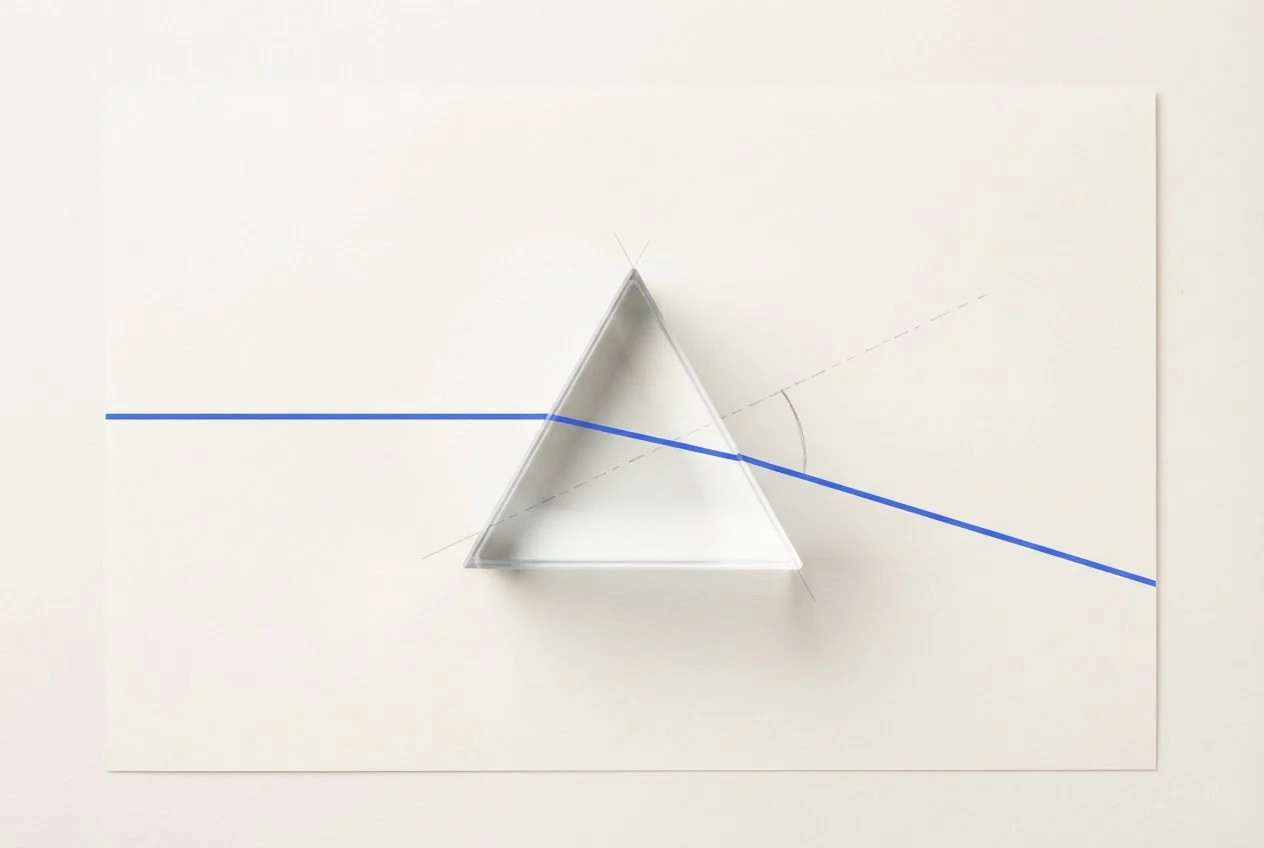
The general prism formula comes from adding the bending at each face and using one piece of geometry: the two angles of refraction inside the prism add up to the prism angle. Four lines get you there.
- At the first face the ray bends by (i − r₁). At the second face it bends by (e − r₂), both in the same direction.
- Total deviation: δ = (i − r₁) + (e − r₂) = i + e − (r₁ + r₂).
- The two normals to the faces and the ray inside the prism form a triangle with angles r₁, r₂ and 180° − A. So r₁ + r₂ = A.
- Substituting: δ = i + e − A.
This holds for every ray that gets through the prism. It needs no assumption about symmetry or small angles, which is why we call it the safe starting point. It has two unknowns on the right (i and e), so on its own it only helps when a question gives you both.
Why is the deviation smallest when i equals e?
Deviation reaches its minimum when i = e, because light paths are reversible. If a ray entering at angle i leaves at angle e, then a ray entering at e leaves at i, and both have the same deviation. Deviation plotted against i is a single U-shaped dip, so its lowest point sits exactly between the two: where i = e.
At that point everything becomes symmetric:
- r₁ = r₂, and since r₁ + r₂ = A, each equals r = A/2.
- δm = 2i − A, so i = (A + δm)/2.
- Snell's law at the first face gives μ = sin i / sin r = sin[(A + δm)/2] / sin(A/2).
For an isosceles or equilateral prism, the ray inside is then parallel to the base. This is the standard way a prism measures the refractive index of a material.
Worked numerical 1. A = 60°, μ = 1.5. Then sin[(60° + δm)/2] = 1.5 × sin 30° = 0.75, so (60° + δm)/2 = 48.59° and δm = 37.18°.
δm depends on the prism's μ (relative to its surroundings) and on A. It does not depend on how you aim the ray, because the minimum is wherever the ray settles at i = e. Since μ differs for each colour, δm differs for each colour as well.
Worked numerical 2. An equilateral prism (A = 60°) at minimum deviation has i = 50°. Then δm = 2 × 50° − 60° = 40°, and μ = sin 50° / sin 30° = 1.53.
When can you use the thin prism formula A(μ − 1) safely?
You can use A(μ − 1) safely when A is below about 10°. For μ = 1.5 at minimum deviation, our calculation puts the shortcut within 0.5% of the exact answer at 10°, and it falls apart for large prisms.
We computed the exact minimum deviation as δm = 2 arcsin(μ sin(A/2)) − A (the rearranged form of the minimum-deviation relation, also given on Wikipedia). We compared it with A(μ − 1) for μ = 1.5 and six values of A. The error is (exact − shortcut) / exact.
| A | Exact δm | A(μ − 1) | Shortcut error |
|---|---|---|---|
| 2° | 1.0002° | 1.0° | 0.02% |
| 4° | 2.0015° | 2.0° | 0.07% |
| 10° | 5.0240° | 5.0° | 0.48% |
| 20° | 10.1962° | 10.0° | 1.92% |
| 30° | 15.6886° | 15.0° | 4.39% |
| 60° | 37.1808° | 30.0° | 19.31% |
This is one glass (μ = 1.5) at minimum deviation, so treat the 10° cut-off as our recommendation, not a law. Above 10°, switch to the sine form. An equilateral prism is never a thin prism.
Worked numerical 3 (immersion). A thin glass prism (μ = 1.5) goes from air into water (μ = 1.33). The relative index drops from 1.5 to 1.5/1.33, so δ in water divided by δ in air = (1.5/1.33 − 1)/(1.5 − 1) = 0.2556. A prism that gives 4° in air gives about 1.02° in water. Immersion always reduces the deviation.
How do silvered-face and grazing-emergence numericals work out?
Both reduce to fixing r₂, the angle of refraction at the second face, and then applying Snell's law at the first face. Fix r₂ first, get r₁ = A − r₂, and then solve for i.
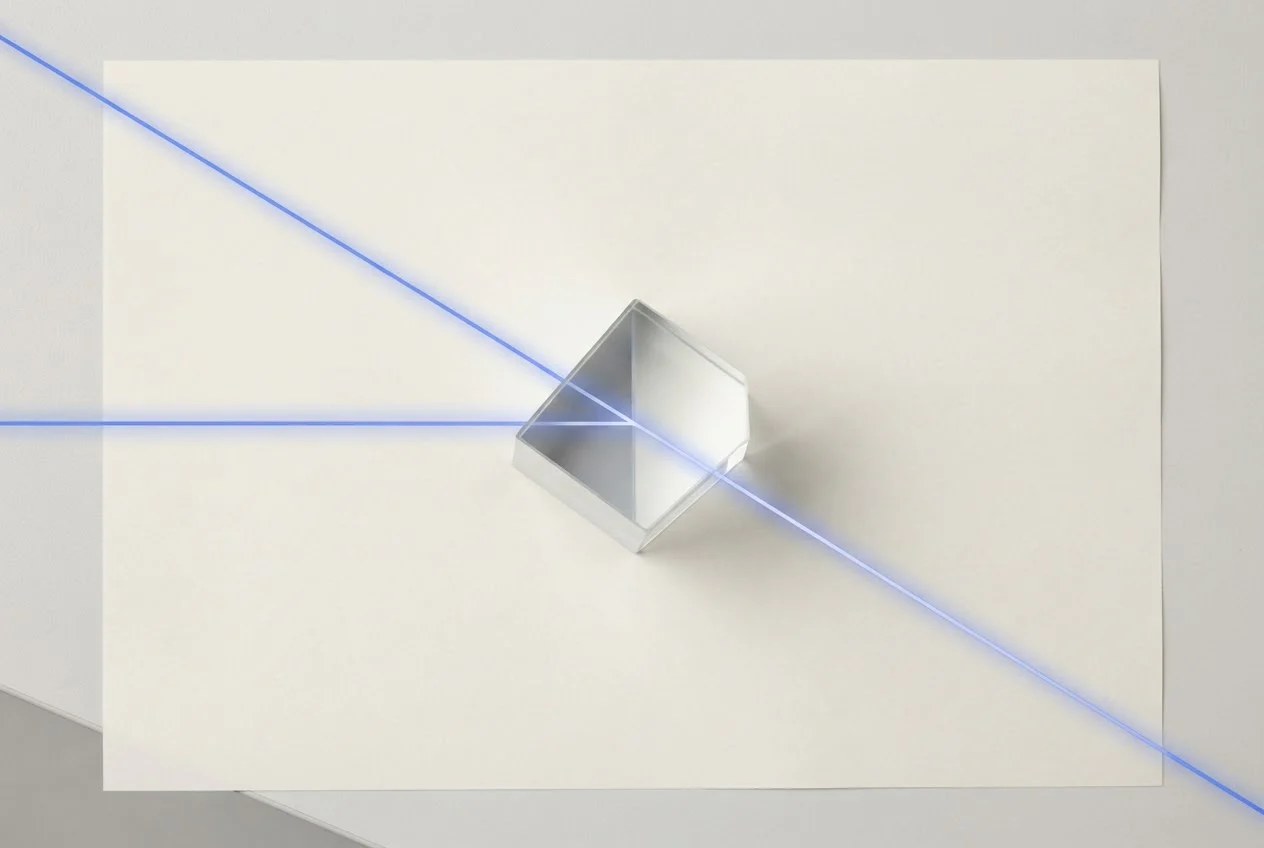
Silvered face (r₂ = 0). If the ray retraces its path after reflecting from the silvered second face, it must have struck that face at 90°. So r₂ = 0, r₁ = A, and sin i = μ sin A.
Worked numerical 4. μ = √2, A = 30°. sin i = √2 × 0.5 = 0.7071, so i = 45°.
Grazing emergence (e = 90°). The ray leaves along the second face, so r₂ equals the critical angle θc, where sin θc = 1/μ. Then r₁ = A − θc, and sin i = μ sin(A − θc), which simplifies to sin A √(μ² − 1) − cos A.
Worked numerical 5. Equilateral prism, μ = √3. Here sin θc = 1/√3, so θc = 35.26° and r₁ = 24.74°. Then sin i = 0.7247 and i = 46.4°. Rays arriving at a smaller angle hit the second face beyond the critical angle and are totally reflected, so they never emerge. Our page on total internal reflection walks through the critical-angle step.
The same limit caps the prism angle. For μ = 1.5, θc = 41.81°, so no ray can emerge once A reaches 2θc = 83.6°.
Our page on how to solve physics numericals shows the same fix-the-condition-first habit.
Where do you practise these numericals with RG Sir?
If you are in Class 11 and aiming at MHT-CET (Maharashtra Common Entrance Test) 2028, our MHTCET 2028 – Class 11th Physics Batch is taught by RG Sir (Rahul Jewaani). As of November 2026 it is priced at ₹1,212, listed at ₹1,569. You can see it on the MHTCET 2028 batch page.
If you sit the exam in 2027, our MHTCET 2027 – Long Term Batch is ₹1,632, listed at ₹1,999, as of November 2026. Optics numericals reward choosing the right formula first, which our note on MHT-CET physics difficulty covers. Prism numericals are Aasaan once you pick the formula first.
Want to test yourself first? Try our free MHT-CET physics mock test.
Practise prism numericals with RG Sir
Frequently asked questions
The Class 11 prism formula is δ = i + e − A for any ray. At minimum deviation it becomes μ = sin[(A + δm)/2] / sin(A/2). For a thin prism, it is δ = A(μ − 1). Which one you use depends on the conditions in the question.
Prism ka formula teen roop mein aata hai: δ = i + e − A (kisi bhi ray ke liye), μ = sin[(A + δm)/2] / sin(A/2) (minimum deviation par) aur δ = A(μ − 1) (patle prism ke liye, jahan A chhota ho).
Sources
- 1.Minimum deviation, Wikipedia
- 2.Balbharati Standard 11 Physics, Chapter 9 Optics, Shaalaa chapter listing
- 3.State CET Cell Maharashtra
- 4.Maharashtra HSC Board
- 5.RG Lectures store: MHTCET 2028 batch page
- 6.RG Lectures store: MHTCET 2027 batch page
- 7.Our own calculations: thin-prism error table, immersion ratio, silvered-face numerical, grazing-emergence angle and 83.6° limit