Total Internal Reflection: The 3-Step Check for Numericals
Total internal reflection occurs when light in a higher-index medium meets a lower-index medium at an angle above the critical angle, given by sin θc = n₂/n₁. Test the leaving face.

By Rahul Jeewani, Founder · Updated 10 Nov 2026
Key takeaways
- TIR needs two things together: the ray must be going from a higher refractive index (n₁) to a lower one (n₂), and its angle of incidence must be larger than the critical angle θc, where sin θc = n₂/n₁.
- Find the face the ray is leaving by before you calculate anything. In a prism, TIR happens at the glass-to-air face, never at the air-to-glass entry face.
- The critical angle belongs to a pair of media, not to a material. Glass to air is 41.8°, but glass to water is 62.7°. A 45° prism needs a refractive index above 1.414 in air and above about 1.89 in water.
- MHT-CET (Maharashtra Health and Technical Common Entrance Test) Physics questions carry 1 mark each with no negative marking, so an optics numerical is always worth attempting.
In this article
- 1What is total internal reflection and when does it happen?
- 2Which medium is n₁ in the critical angle formula?
- 3How do you test for TIR in three steps?
- 4Why does TIR happen at the second face of a prism, not the first?
- 5How does the critical angle change from one pair of media to another?
- 6Does a glass prism still reflect light totally under water?
- 7How do you solve a critical angle numerical for MHT-CET Physics?
- 8How can you build optics numerical skills early for MHT-CET Physics?
- 9Frequently asked questions
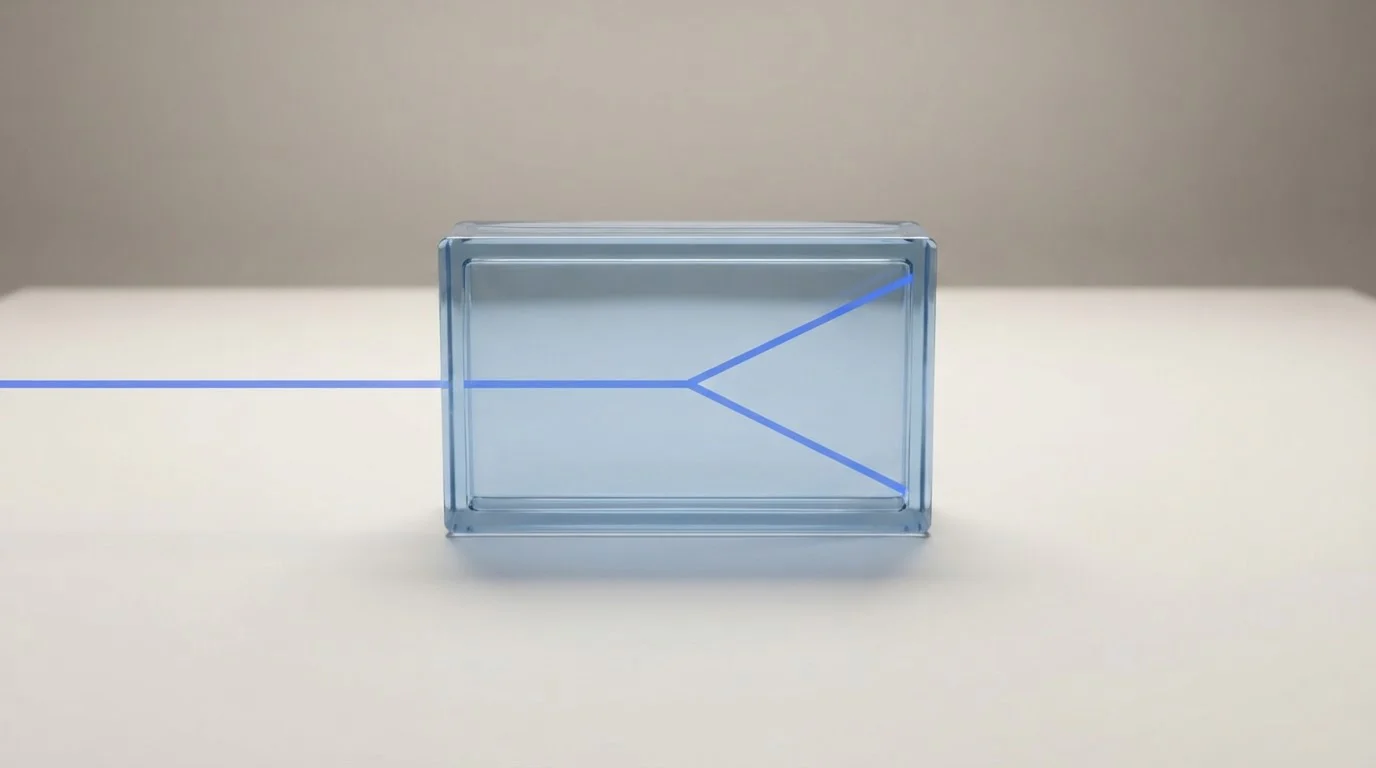
A right-angled glass prism that turns a ray through 90° in air stops doing so when it is dipped in water. The glass is the same and the ray meets the face at the same 45°. Only the critical angle moved, from 41.8° to 62.7°, and 45° now falls short of it.
That is where most total internal reflection (TIR) numericals go wrong. The definition is easy to learn. The marks go on which medium is n₁, which face the ray is leaving, and what changes when the surroundings change.
Below you get a three-step check that settles all three, a critical angle table you can reuse, and the prism-in-water case worked out in full. Every calculation uses the standard formula and textbook refractive indices, so you can repeat each one on a calculator in a minute.
Padhna Aasaan Hai once the method is fixed: ask the same three questions every time, whatever the diagram looks like.
What is total internal reflection and when does it happen?
Total internal reflection is the complete reflection of a light ray back into the medium it came from. It happens only when the ray is heading towards a lower refractive index and its angle of incidence is larger than the critical angle. The refractive index (n) measures how strongly a medium slows light. "Denser" in this topic means higher n, not heavier.
The critical angle (θc) is the angle of incidence for which the refracted ray would leave at 90° to the normal (the line at 90° to the surface), skimming along the boundary. OpenStax University Physics gives it as θc = sin⁻¹(n₂/n₁), valid when n₁ > n₂.
Beyond θc, Snell's law, the rule linking the angles on the two sides of a boundary (n₁ sin i = n₂ sin r), would need sin r to be above 1. That is impossible, so no refracted ray exists and all the light stays in the first medium. At exactly θc the refracted ray grazes the surface, so TIR starts just beyond the critical angle, not at it.
Which medium is n₁ in the critical angle formula?
n₁ is the medium the ray is travelling in when it reaches the boundary, and n₂ is the medium it is trying to enter. In sin θc = n₂/n₁, n₁ sits on the side of the angle θc and n₂ sits on the side of the 90° refracted ray. The ratio n₂/n₁ must come out below 1.
That last point is your built-in check. If you get a ratio above 1, you have swapped n₁ and n₂, or the ray is going from a lower index to a higher one. In the second case no critical angle exists at all.
The same glass can be n₁ in one question and n₂ in another. What matters is which side of the boundary the ray is on, not what the material is.
How do you test for TIR in three steps?
Name n₁ and n₂ at the face the ray is leaving, confirm n₁ is larger, then compare the angle of incidence with sin⁻¹(n₂/n₁). This takes under a minute and covers every standard TIR question. Run the steps in order and stop at the first fail.
| Step | What you do | Pass | Fail |
|---|---|---|---|
| 1. Find the leaving face | Write n₁ (the medium the ray is inside) and n₂ (the medium beyond that face) with their numbers | n₁ is the index of the medium the ray is travelling in just before it reaches that face, and n₂ is the index of the medium on the far side | The ray is going from air into glass, so you are on the entry face: move to the next face the ray hits |
| 2. Compare indices | Check n₁ > n₂ | Yes: go to step 3 | No: the ray refracts, there is no TIR, stop |
| 3. Compare angles | Work out θc = sin⁻¹(n₂/n₁), then compare with the angle of incidence i | i > θc: TIR. i = θc: grazing refracted ray, not TIR. i < θc: the ray refracts | If sin θc comes out above 1, go back to step 1: n₁ and n₂ are swapped |
Two slips cost the most marks here. The first is using an angle measured from the surface. The angle of incidence is always measured from the normal, so a ray making 30° with the surface has i = 60°. The second is inverting the ratio, which step 3's "above 1" test catches.
Why does TIR happen at the second face of a prism, not the first?
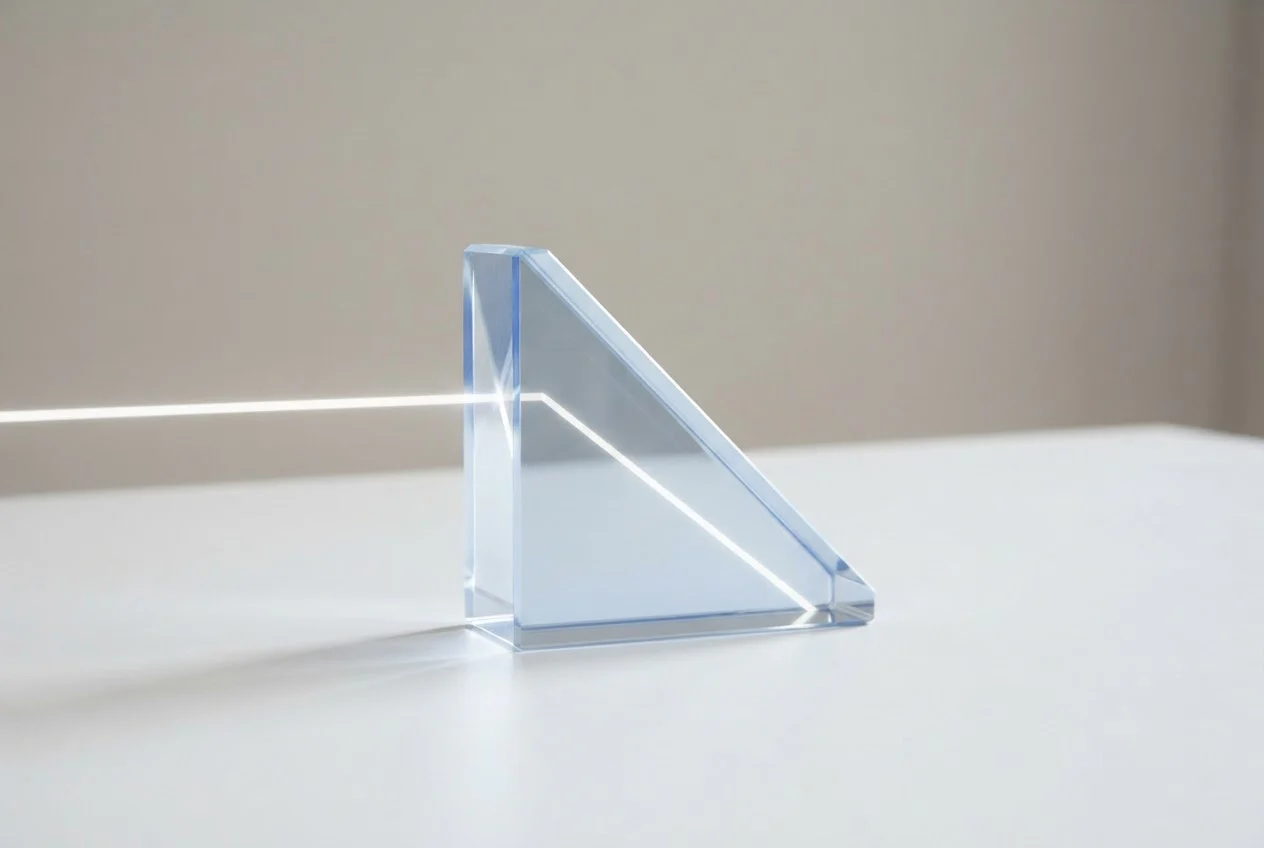
In a glass prism, TIR happens where the ray leaves the glass for air, because that is the only face where light goes from higher to lower index. At the entry face the ray goes from air into glass, which is lower to higher, so TIR cannot occur there.
Take a 45°-45°-90° prism with a ray entering one of the shorter faces at right angles. It goes straight in and meets the long face (the hypotenuse) at 45°.
- n₁ = 1.5 (glass), n₂ = 1 (air).
- sin θc = 1/1.5 = 0.667, so θc = 41.8°.
- 45° is larger than 41.8°, so the ray is totally reflected and turns through 90°.
How does the critical angle change from one pair of media to another?
The critical angle falls as n₁ rises and grows as n₂ rises. Glass to air is 41.8°, water to air 48.6°, diamond to air 24.4°, and glass to water 62.7°. Surrounding a material with something denser makes TIR harder, because θc moves closer to 90°.
| Ray goes from (n₁) | into (n₂) | sin θc = n₂/n₁ | θc |
|---|---|---|---|
| Glass (1.5) | Air (1) | 0.667 | 41.8° |
| Water (4/3) | Air (1) | 0.750 | 48.6° |
| Diamond (2.42) | Air (1) | 0.413 | 24.4° |
| Glass (3/2) | Water (4/3) | 0.889 | 62.7° |
| Diamond (2.42) | Water (4/3) | 0.551 | 33.4° |
Diamond's small critical angle means a large share of the rays inside meet a face beyond θc, which is why a cut diamond keeps bouncing light around instead of letting it out.
An optical fibre is the same test on the boundary between core (the glass centre) and cladding (the outer glass layer). For core 1.48 and cladding 1.45, our calculation gives θc = sin⁻¹(1.45/1.48) = 78.4°. Our page on the numerical aperture of an optical fibre works that fibre through.
Does a glass prism still reflect light totally under water?
No. A 45° prism of ordinary glass (n = 1.5) loses TIR in water, because its critical angle rises from 41.8° to 62.7°, above the 45° the ray meets the face at. Light then refracts out into the water instead of turning back.
The working, which is our calculation:
- A ray meeting the hypotenuse at 45° gets TIR only if θc is below 45°.
- θc < 45° means n₂/n₁ < sin 45° = 0.7071, so n₁ must be above n₂ ÷ 0.7071.
- In air, n₂ = 1, so n₁ must exceed √2 ≈ 1.414. Glass at 1.5 passes.
- In water, n₂ = 4/3, so n₁ must exceed 1.333/0.7071 = 1.89. Glass at 1.5 fails.
- Diamond at 2.42 passes in water: θc = 33.4°, below 45°.
If you take water as 1.33 instead of 4/3, the answers shift in the last digit: glass to water becomes 62.5° and the threshold 1.88. Use whichever value your question gives.
How do you solve a critical angle numerical for MHT-CET Physics?
Write n₁ and n₂, check the ratio is below 1, take the inverse sine, and compare angles. Two shapes of question come up often: indices given directly, and speeds or times given from which you first find n. The MHT-CET format rewards a fast routine.
Example 1: indices given. Glass has n = 3/2 and water has n = 4/3. Find the critical angle for a ray going from glass to water.
- n₁ = 3/2, n₂ = 4/3, and n₁ > n₂, so a critical angle exists.
- sin θc = (4/3) ÷ (3/2) = 8/9 = 0.889.
- θc = sin⁻¹(0.889) = 62.7°. Check: sin 62.7° is about 0.889.
Example 2: times given. A ray takes time t to cover a distance d in air and 4t to cover the same distance in a medium. Find the critical angle from that medium into air.
- n = c ÷ v = (d/t) ÷ (d/4t) = 4.
- sin θc = 1/4 = 0.25, so θc = 14.5°.
The MHT-CET 2026 information brochure from the State CET Cell, Maharashtra, states that Physics and Chemistry carry 1 mark per question and that there is no negative marking. The Physics, Chemistry and Mathematics paper has 150 questions in 180 minutes. Our recommendation: always attempt the optics numerical, and spend your first ten seconds on step 1 of the check. Our page on how to solve physics numericals covers the four-step habit behind it.
How can you build optics numerical skills early for MHT-CET Physics?
Start in Class 11 and drill the same check until it is automatic. Our MHTCET 2028 – Class 11th Physics Batch is taught by Rahul Jewaani (RG Sir) and covers the complete Class 11 syllabus in depth, with the basics and the link from Class 10 to Class 11.
The batch comes with live classes, notes, previous-year questions and mock tests. As of November 2026 it costs ₹1,212. Sitting MHT-CET in 2027? See the MHTCET 2027 batches in our store.
Once rays and critical angles feel easy, the next step is waves: our wave optics formulas page shows how to pick the right formula in three questions. If you are still choosing where to study Class 11, our guide to 11th science classes in Maharashtra lays out costs and picks.
Seriously, the method is the easy part.
Build optics skills with RG Lectures MHT-CET batches
Frequently asked questions
Sources
- 1.OpenStax University Physics Volume 3, section 1.4, Total Internal Reflection, OpenStax (Rice University)
- 2.MHT-CET 2026 Information Brochure, updated 10.02.2026, State CET Cell, Government of Maharashtra
- 3.MHTCET 2028 – Class 11th Physics Batch, RG Lectures