Lens Maker's Formula: Get the Sign of R₂ Right
The lens maker's formula gives a thin lens's focal length from its refractive index and two radii of curvature. The sign of the second radius decides the answer.

By Rahul Jeewani, Founder · Updated 8 Nov 2026

Key takeaways
- For a thin lens in air, 1/f = (μ − 1)(1/R₁ − 1/R₂). Decide the signs of R₁ and R₂ from where each centre of curvature lies, then substitute.
- A biconvex lens has R₁ positive, R₂ negative and f positive. A biconcave lens is the reverse. Two equal radii of the same sign cancel inside the bracket, so f comes out infinite.
- Medium changes the answer. In our worked example, a glass lens with μ = 1.5 and radii of 20 cm has f = 20 cm in air and about 79.8 cm in water.
- For a real N-BK7 plano-convex lens (Thorlabs LA1509) the formula gives 99.65 mm against a listed 100 mm, a gap of 0.35%.
In this article
- 1What is the lens maker's formula, and how do you apply it without a sign error?
- 2Why does R₂ come out negative for a biconvex lens?
- 3How do you use the lens maker's formula on a worked example and on a real catalogue lens?
- 4How does the focal length change when the lens sits in water?
- 5When does the lens maker's formula stop being accurate?
- 6How do we help you practise lens numericals for MHT-CET?
- 7Frequently asked questions
Substitute R₁ = 20 cm and R₂ = 20 cm for a glass biconvex lens and the bracket in the formula becomes zero. The focal length then comes out infinite, as if a visibly curved lens had stopped focusing light.
The formula is fine. As light meets them, the two faces of a biconvex lens curve in opposite directions, so their radii carry opposite signs. Memorising the formula takes a minute. Deciding the signs is where numericals are won or lost.
Below you get a four-step routine for the signs and a table covering the common lens shapes. Then come three worked checks: a textbook biconvex lens, the same lens in water, and a real catalogue lens whose listed focal length we can test. We also say when the formula stops being accurate. It is written for Class 11 and 12 students, including those aiming at MHT-CET (the Maharashtra Health and Technical Common Entrance Test).
What is the lens maker's formula, and how do you apply it without a sign error?
The lens maker's formula for a thin lens in air is 1/f = (μ − 1)(1/R₁ − 1/R₂). Here f is the focal length, μ is the refractive index of the lens material (written n in some books), and R₁ and R₂ are the radii of curvature of the first and second faces. A thin lens is one whose thickness is much less than the radii of curvature of both surfaces (OpenStax University Physics Volume 3, section 2.4).
The centre of curvature of a face is the centre of the sphere that face is part of. Use this four-step routine every time:
- Draw the lens with light travelling from left to right.
- Mark the centre of curvature of each face.
- For each face, a centre to the right of the face makes R positive and a centre to the left makes R negative. A flat face has an infinite radius, so its 1/R term is zero.
- Substitute the signed values, then test the result. For glass in air, a lens thicker at the centre must give positive f and a lens thinner at the centre must give negative f.
The Cartesian sign convention behind this takes distances to the right as positive and to the left as negative. Notes on the Maharashtra Board Class 11 Optics chapter use it (Digital Education notes on Chapter 9, Optics). Check it against your Balbharati textbook before an exam.
The same rule appears in OpenStax as "R is positive for a surface convex toward the object, and negative for a surface concave toward object". For light moving left to right, both wordings give the same signs.
| Lens shape (light enters face 1) | R₁ | R₂ | Sign of f (glass in air) |
|---|---|---|---|
| Biconvex | positive | negative | positive |
| Biconcave | negative | positive | negative |
| Plano-convex, curved face first | positive | ∞ (1/R₂ = 0) | positive |
| Plano-convex, flat face first | ∞ (1/R₁ = 0) | negative | positive |
| Plano-concave, curved face first | negative | ∞ (1/R₂ = 0) | negative |
| Plano-concave, flat face first | ∞ (1/R₁ = 0) | positive | negative |
| Meniscus (both faces bend the same way; the flatter face has the larger radius) | positive (convex face first) or negative (concave face first) | same sign as R₁ | positive if thicker at the centre, negative if thinner |
Why does R₂ come out negative for a biconvex lens?
R₂ is negative for a biconvex lens because the second face bulges away from the incoming light, so its centre of curvature lies to the left of the face, on the side the light came from. By the Cartesian convention, a centre on the left gives a negative radius.
The trap is that the lens is called convex, so students write both radii as positive. The word "convex" describes the whole lens. It does not give each face the same sign.
The minus sign in front of 1/R₂ in the formula then does the useful work. With R₁ = +20 and R₂ = −20, the bracket is 1/20 − 1/(−20) = 1/20 + 1/20 = 1/10. The two faces add their focusing effects.
There are two ways to get an infinite focal length by mistake. Both radii positive gives 1/20 − 1/20 = 0. Keeping R₂ = −20 but writing the bracket as 1/R₁ + 1/R₂ also gives 0. Equal radii of the same sign describe a curved shell of even thickness, which has no focusing power in the thin-lens approximation.
Our advice is to write the sign beside R₁ and R₂ before any number goes into the formula. Then check the sign of f against the lens shape in the table. That last check is where a sign slip shows up.
How do you use the lens maker's formula on a worked example and on a real catalogue lens?
For a glass biconvex lens with μ = 1.5 and radii of 20 cm, the formula gives f = +20 cm. This is a worked example.
1/f = (1.5 − 1)(1/20 + 1/20) = 0.5 × 0.1 = 0.05 per cm, so f = +20 cm.
An equiconvex lens of μ = 1.5 therefore has f equal to R, as the Maharashtra Class 11 notes also state. Make the same lens plano-convex with R₁ = +20 cm and a flat second face, and 1/f = 0.5 × (1/20) = 0.025 per cm. So f = 40 cm, which is 2R, again matching those notes.
Now test the formula on a real lens. The Thorlabs LA1509 is a plano-convex lens of N-BK7 glass. The 3D Optix catalogue copy of the Thorlabs specification lists R₁ = 51.5 mm, centre thickness 3.6 mm and an effective focal length of 100 mm at 587.6 nm (Thorlabs LA1509 parameters, 3D Optix catalogue). The Mark Optics copy of Schott's datasheet gives N-BK7 a refractive index nd of 1.51680 at that wavelength (Schott N-BK7 datasheet).
Here is our check. The curved face comes first, so R₂ is infinite.
f = R₁/(μ − 1) = 51.5 / 0.5168 = 99.65 mm.
That is 0.35 mm, or 0.35%, below the listed 100 mm. In this lens the 3.6 mm thickness does not change the effective focal length, because the second face is flat. We read the small gap as rounding in the catalogue's quoted radius and focal length. That reading is our inference, not something the sources state.
How does the focal length change when the lens sits in water?
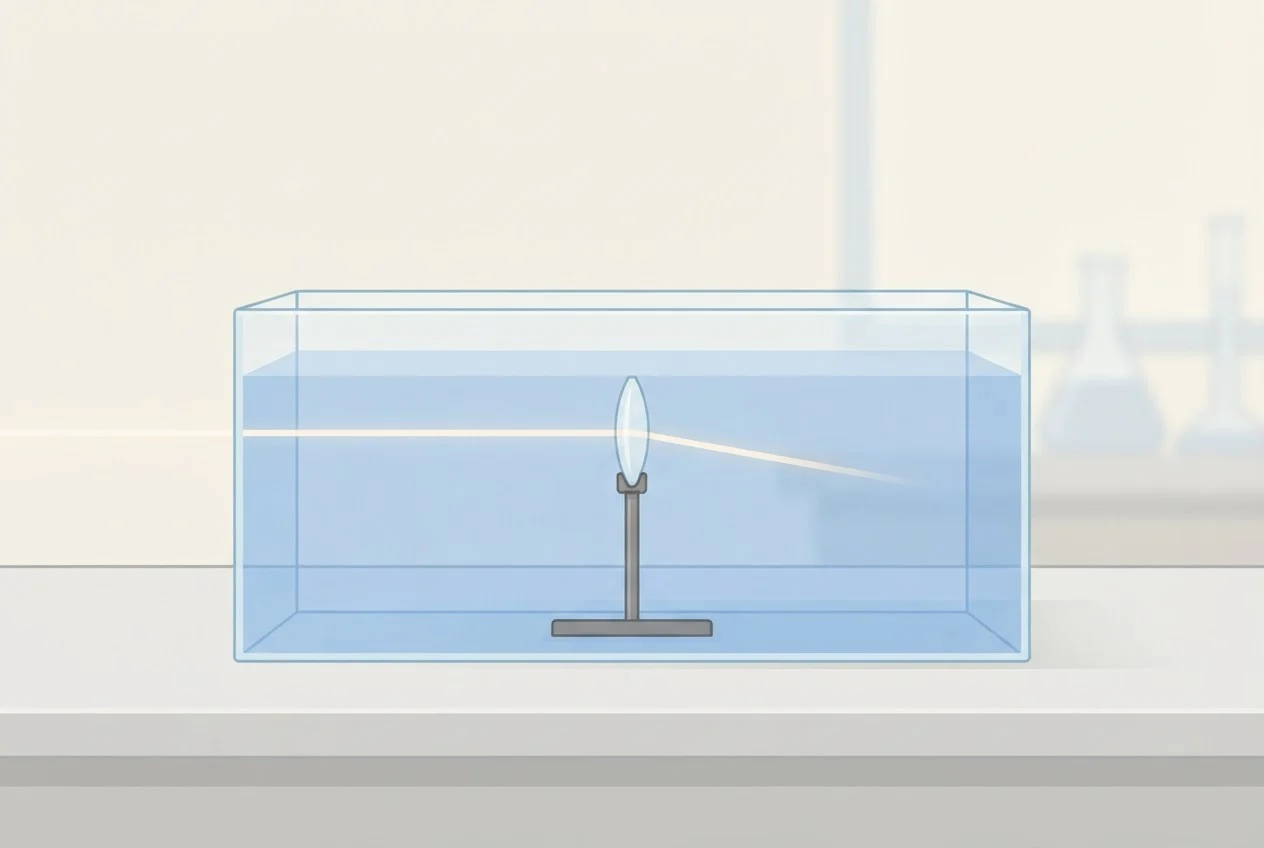
A glass lens in water has a longer focal length than in air, because the relevant quantity becomes the ratio of the lens index to the medium index. The general form is 1/f = (μ_lens/μ_medium − 1)(1/R₁ − 1/R₂). OpenStax writes the same equation as 1/f = (n₂/n₁ − 1)(1/R₁ − 1/R₂).
Take the biconvex lens above and place it in water, using 1.333 as the index of water (our assumption for this example). Then:
1/f = (1.5/1.333 − 1)(1/20 + 1/20) = 0.1253 × 0.1 = 0.01253 per cm, so f ≈ 79.8 cm.
The lens is about four times weaker: (1.5 − 1)/0.1253 ≈ 3.99. If the lens material has a lower index than the medium, the bracket (μ_lens/μ_medium − 1) goes negative and a convex-shaped lens diverges light.
When does the lens maker's formula stop being accurate?
The lens maker's formula stops being accurate when the lens is thick, when the surroundings differ on the two sides, or when you need a result to better than a fraction of a percent. The formula loses accuracy when the thickness is not small next to the radii of curvature. The form above also assumes the same medium on both faces.
Wavelength matters too, because μ changes with colour. Schott lists N-BK7 as nd = 1.51680 at 587.6 nm and ne = 1.51872 at 546.1 nm. Using ne in our LA1509 check gives 51.5 / 0.51872 = 99.28 mm, about 0.37 mm shorter than at 587.6 nm. So a quoted focal length is a number at one stated wavelength.
Everything here is ray optics, where light is a straight line bent at surfaces. Interference and diffraction are a different branch with different formulas, covered in our wave optics formulas page.
How do we help you practise lens numericals for MHT-CET?
We teach numericals as a fixed routine, and we recommend this one: write the signs, substitute, then check the sign of the answer. Our pages on how to solve physics numericals and on units and dimensions in Class 11 set out the same habit of checking before you move on.
Optics is one of the Class 11 Physics units MHT-CET draws on, as we list on our page about 11th science classes in Maharashtra. If you are in Class 11 and aiming at MHT-CET 2028, our MHT-CET 2028 Class 11th Physics Batch is taught by Rahul Jewaani (RG Sir). It teaches full Class 11 Physics from level zero, with theory and numericals, a bridge course covering what is needed for Class 12, two types of notes per chapter, and access until 30 June 2028. As of November 2026 the course page shows ₹1,212, down from ₹1,569.
Practise lens numericals for MHT-CET 2028
Frequently asked questions
Yes. Replace (μ − 1) with (μ_lens/μ_medium − 1). For a glass lens with μ = 1.5 in water, taking the index of water as 1.333, the focal length rises to about four times its value in air.