Wave Optics Formulas: Pick the Right One in Three Questions
Wave optics formulas for interference and diffraction follow from three questions: slits or single opening, bright or dark, and whether a medium or slab changed the setup. Polarisation needs separate lookups.

By Rahul Jeewani, Founder · Updated 14 Oct 2026
Key takeaways
- For interference and diffraction problems, choose the formula by asking how many openings the light passes through, whether the point is bright or dark, and whether a medium or slab changed the wavelength or the path. Polarisation and resolution are separate lookups in the 12-row table.
- The dark-fringe formula has two correct forms. (n + ½)λ with n starting at 0 and (2n − 1)λ/2 with n starting at 1 give the same fringe. Mixing a form with the wrong starting n is a frequent error.
- Putting the whole Young's setup in a liquid of refractive index μ divides the fringe width by μ. A slab over one slit does not change fringe width; it shifts the whole pattern.
- Learn one method plus a 12-row formula table, and check yourself on the NCERT exercises and past papers.
In this article
- 1What are the wave optics formulas you need, and when does each apply?
- 2How do you pick the right formula for interference and diffraction in three questions?
- 3How many openings does the light pass through?
- 4Is the point bright or dark?
- 5Did a medium or slab change the wavelength or the path?
- 6Why do books write the dark-fringe formula in two different ways?
- 7How do you apply the formulas to a Young's setup? A worked example
- 8Where do students lose marks in Wave Optics?
- 9Should you learn wave optics as formulas or as a method?
- 10How do we teach wave optics at RG Lectures?
- 11Frequently asked questions
A wave optics question rarely asks for a formula you have not seen. It asks for one you have seen with one thing changed: the apparatus sits in water, a glass slab covers one slit, or a single opening replaces two.
That change is where marks go, and every mark counts the same. The State CET Cell's MHT-CET 2026 information brochure sets the Physics, Chemistry and Mathematics paper at 150 questions in 180 minutes, with 1 mark for each Physics question and no negative marking. MHT-CET (Maharashtra Health and Technical Common Entrance Test) is the state entrance exam for engineering, pharmacy and agriculture admissions.
Below is a 12-row sheet organised by situation, a worked example you can redo on a calculator, and the five slips that cost marks, starting with the dark-fringe convention and single slit versus double slit.
NCERT (National Council of Educational Research and Training) is the reference for the formulas. Maharashtra HSC (Higher Secondary Certificate) students study the same ideas from their Balbharati Std XII Physics textbook.
What are the wave optics formulas you need, and when does each apply?
The table below has 12 rows covering Young's double slit, single-slit diffraction, intensity, polarisation and resolution. Find the situation in the question, then read across. Symbols: λ is wavelength, D is slit-to-screen distance, d is the gap between two slits, a is the width of one slit, μ is refractive index, β is fringe width (the spacing between neighbouring bright fringes).
Terms used in the table:
- Young's double slit: two narrow slits lit by one source, so that light interferes on a screen.
- Path difference: the extra distance one ray travels compared with the other.
- Diffraction: the spreading of light after it passes a narrow opening.
- Polaroid: a filter that passes one direction of vibration only.
- Malus' law: how the intensity changes as a second polaroid is rotated.
- Brewster's law: the angle of incidence at which reflected light is fully polarised.
| Situation | Formula | Watch out for |
|---|---|---|
| Bright fringe, double slit | Path difference = nλ, n = 0, 1, 2… Position x = nλD/d, n = 0, ±1, ±2… (either side of the centre) | Position is measured from the central bright fringe |
| Dark fringe, double slit | Path difference = (n + ½)λ, n = 0, 1, 2… Position x = (n + ½)λD/d | n starts at 0; see the convention section below |
| Fringe width | β = λD/d | Same spacing for bright and dark fringes |
| Whole setup in liquid | λ′ = λ/μ, so β′ = β/μ | Only if the slits and the whole path to the screen are in the liquid |
| Thin slab (thickness t, index μ) over one slit | Shift = (μ − 1)tD/d, towards the slab | The pattern moves; β is unchanged |
| Intensity from two equal sources | I = 4I₀cos²(φ/2), φ = phase difference | I₀ is the intensity of one source alone; the maximum is 4I₀, not 2I₀ |
| Incoherent sources (no fixed phase relation) | I = 2I₀ | No fringes at all |
| Single slit, dark fringes | a sinθ = nλ, n = ±1, ±2… | Uses slit width a, and n is never 0 |
| Single slit, central maximum width | 2λD/a | Twice as wide as a side fringe |
| Polaroid (Malus' law) | I = I₀cos²θ | I₀ is the polarised intensity reaching the polaroid. Unpolarised light of intensity I becomes I/2 after the first polaroid |
| Brewster's law | tan i_B = μ | Reflected light is fully polarised at this angle |
| Resolution, if your syllabus has it | Telescope: θ = 1.22λ/D_ap. Microscope: 0.61λ/(μ sinθ) | D_ap is the aperture diameter and θ in the microscope is the half-angle of the cone of light. The symbols in this row are not the Young's-setup ones |
The double-slit conditions, fringe positions, intensity formula and Malus' law are written out in NCERT's Class 12 Physics chapter 10, Wave Optics. The liquid and slab rows follow from two facts. Light keeps its frequency in a liquid but its speed falls to c/μ, so its wavelength becomes λ/μ. A slab of thickness t adds an extra optical path of (μ − 1)t to one ray, which shifts the pattern by that path multiplied by D/d.
Maharashtra students can find the Std XII Physics textbook in the Balbharati e-book library, and our HSC Physics formula sheet lists the board-wide relations.
How do you pick the right formula for interference and diffraction in three questions?
Ask three questions in order: how many openings the light passes through, whether the point is bright or dark, and whether a medium or slab changed the wavelength or the path. Write the answer to each before touching a calculator.
How many openings does the light pass through?
Count them in the problem. Two narrow slits mean interference, and the letter is d. One slit means diffraction, and the letter is a.
- Pass: you have written d or a next to your first line.
- Fail: you used one letter for both.
Is the point bright or dark?
Decide whether the path difference must be a whole number of wavelengths (bright) or a half-odd number (dark).
- Pass: you have written nλ or (n + ½)λ and stated what n starts at.
- Fail: you wrote a formula without n's starting value.
Did a medium or slab change the wavelength or the path?
Underline words like water, oil, liquid, slab, film or glass plate.
- Pass: for a liquid around everything, you replaced λ by λ/μ. For a slab, you used the shift formula and left β alone.
- Fail: you changed β for a slab.
Our recommendation: do this on every Wave Optics question for the first fortnight, even the easy ones. It helps avoid the slips below.
Why do books write the dark-fringe formula in two different ways?
Books differ because they start counting dark fringes from n = 0 or n = 1; both give the same positions if the starting n is matched to the form. NCERT writes dark fringes at x = (n + ½)λD/d with n = 0, 1, 2…, so the first dark fringe has n = 0. Other books write the path difference as (2n − 1)λ/2 with n = 1, 2, 3…, so the first dark fringe has n = 1. Check which form your own textbook uses before you substitute.
Take the third dark fringe from the centre on one side. In the NCERT form, n = 2 gives 2.5 × λD/d. In the other form, n = 3 gives (2 × 3 − 1)/2 = 2.5 times λD/d. The position is the same, 2.5β.
The rule we use in class: pick one form, write its starting n beside it, and convert any "mth dark fringe" in the question to that n before substituting. For bright fringe positions NCERT uses n = 0, ±1, ±2…, so the central bright fringe is n = 0 and the fourth bright fringe on one side is n = 4.
How do you apply the formulas to a Young's setup? A worked example
Apply a formula by writing the setup values, picking the row from the three questions, and changing one condition at a time. For λ = 600 nm, D = 1.5 m and d = 0.3 mm, fringe width is 3.0 mm, and water reduces it to 2.25 mm.
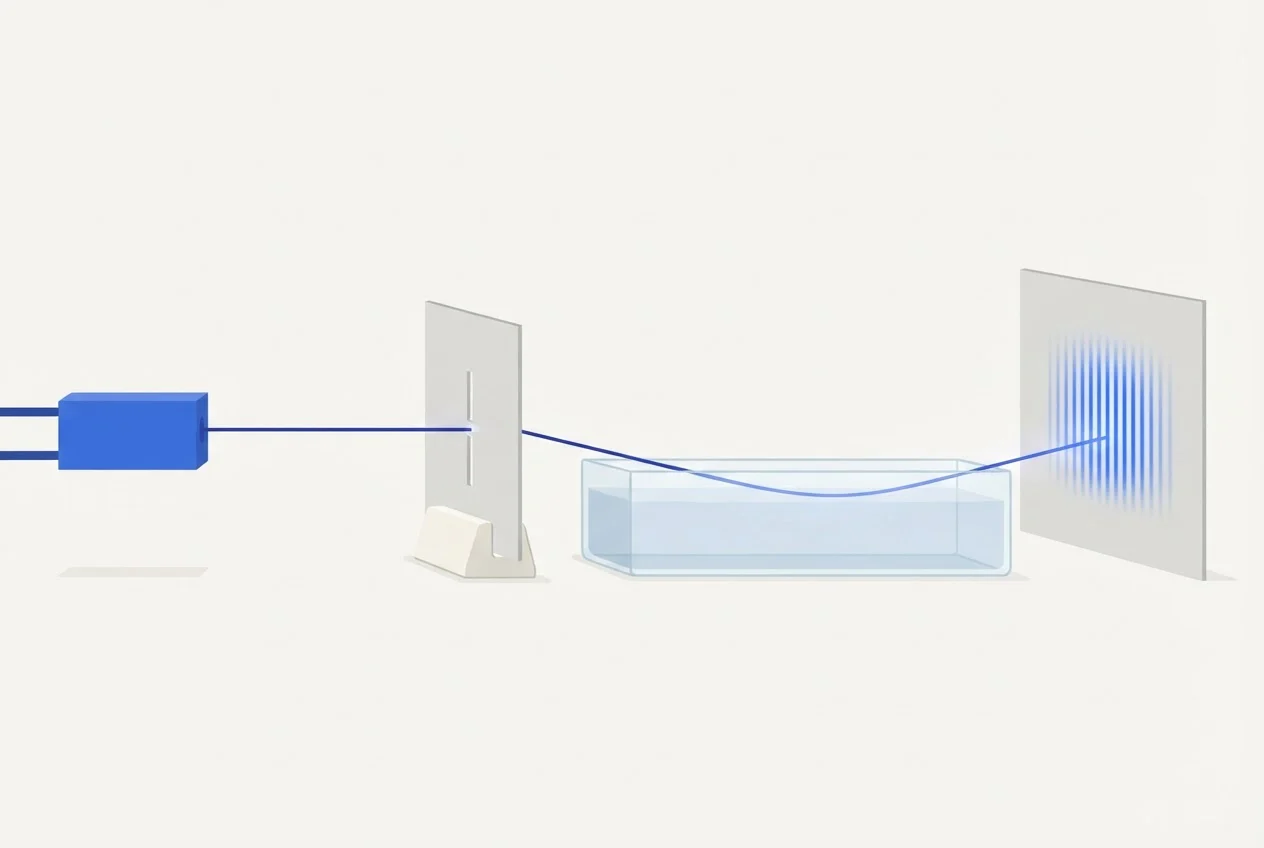
Take one Young's setup with λ = 600 nm, D = 1.5 m and d = 0.3 mm, and change one thing at a time.
| Question | Working | Answer |
|---|---|---|
| Fringe width in air | β = λD/d = (600 × 10⁻⁹ × 1.5) / (0.3 × 10⁻³) | 3.0 mm |
| Position of 4th bright fringe | 4β | 12 mm |
| Position of 3rd dark fringe | 2.5β | 7.5 mm |
| Whole setup in water, μ = 4/3 | β′ = β/μ = 3.0 / (4/3) | 2.25 mm |
| 10 µm glass slab, μ = 1.5, over one slit | (μ − 1)tD/d = 0.5 × 10 × 10⁻⁶ × 1.5 / (0.3 × 10⁻³) | 25 mm shift, about 8.3 fringe widths of the 3.0 mm fringe |
| Replace both slits by a single slit, a = 0.2 mm | 2λD/a = 2 × 600 × 10⁻⁹ × 1.5 / (0.2 × 10⁻³) | 9.0 mm central maximum |
| Intensity where path difference is λ/3 (NCERT exercise 10.5 setup) | φ = 2π/3, I = 4I₀cos²(π/3) = I₀ | One quarter of the maximum 4I₀ |
| Unpolarised light of intensity I through polaroids at 0°, 45°, 90° | I/2 × cos²45° × cos²45° = I/8 | 12.5% of I |
As a check on the formula chain, run it backwards on NCERT exercise 10.4: slits 0.28 mm apart, screen 1.4 m away, and the fourth bright fringe 1.2 cm from the centre. Then λ = xd/(4D) = (1.2 × 10⁻² × 0.28 × 10⁻³) / (4 × 1.4) = 600 nm. The exercise is in the NCERT chapter, and a result that lands on a clean visible wavelength is a good sign you used the right form.
Where do students lose marks in Wave Optics?
Five slips cost marks in Wave Optics numericals, and the three-question routine catches each one.
- Starting dark fringes at the wrong nUsing (n + ½) with n = 1 for the first dark fringe, or (2n − 1)/2 with n = 0, moves every answer by one fringe.
- Mixing d and aDouble-slit bright fringes use d and nλ. Single-slit dark fringes use a and nλ. The same-looking equation, with the opposite meaning, is the trap.
- Changing β for a slabA slab shifts every fringe by the same amount. Spacing stays λD/d.
- Dividing by μ when only part of the setup is in the liquidThe λ/μ rule holds when light travels through the liquid across the whole path to the screen.
- Slipping on intensityUnpolarised light halves at the first polaroid, and Malus' law applies from the second. Intensity goes as amplitude squared, so two equal sources give 4I₀ at a maximum, not 2I₀.
Should you learn wave optics as formulas or as a method?
Learn the interference and diffraction rows as one method, and the polarisation and resolution rows as separate results. The interference and diffraction rows follow from three ideas: path difference decides bright or dark, a medium changes the wavelength, and a slab adds extra path. Malus' law, Brewster's law and resolution are separate results to learn.
Practice should follow the same split. Work through the NCERT chapter's exercises 10.4 to 10.6, then the questions in NCERT's own Exemplar problems for Wave Optics, which include Brewster-angle and polaroid questions. After that, solve MHT-CET past papers topic by topic from our checked PYQ (previous year question) library.
Chapter-wise percentages for Wave Optics found online are estimates from past papers, so use them to decide where to practise, not to predict the next paper. Our note on MHT-CET Physics chapter weightage explains why such figures are historical rather than official.
How do we teach wave optics at RG Lectures?
Our MHTCET Physics recorded batch has the four-lecture Wave Optics block. Its preview page lists Wave Optics as four lectures plus a question bank, to be solved after lecture 4.
Our MHT-CET 2027 Long Term Batch is taught by Rahul Jewaani (RG Sir), with recordings you can replay before solving numericals. Padhna Aasaan Hai, but only if you practise each variation once.
See current fees on the RG Lectures batch fees and prices page.