Why MHT-CET Physics Chapter Weightage Is Historical, Not Official
Official documents set the class-level mix. Chapter shares require an auditable historical method.
5 chapters · Updated Sep 17, 2026 · By Rahul Jeewani
- 10 / 40
- Official 2026 Physics MCQs from Std XI / Std XII
- 90 min
- Official duration for the 2026 Physics-Chemistry paper
State CET Cell, Maharashtra, CET Syllabus and its Marking Scheme for MHT-CET 2026, 2026
State CET Cell, Maharashtra, CET Syllabus and its Marking Scheme for MHT-CET 2026, 2026
In brief
MHT-CET does not publish official Physics chapter percentages. State CET Cell's 2026 scheme sets 10 Physics questions from Std XI and 40 from Std XII, while any chapter-by-chapter figure must be presented as a historical estimate with a stated method.
Official documents answer a narrower question
MHT-CET Physics chapter-wise weightage is useful only when the label is accurate. The State CET Cell's 2026 syllabus and marking scheme sets 10 Physics MCQs from Std XI and 40 from Std XII, with one mark per Physics question. That is an official class-level question split, not an official allocation across individual chapters.
The same document specifies the eligible Std XI Physics areas and says the whole Std XII syllabus is covered. A chapter table can therefore help a student choose what to revise first, but it cannot replace the syllabus or claim that a chapter will produce a fixed number of questions.
Begin planning with the 80/20 MHT-CET Physics syllabus checklist, then treat every chapter percentage as a historical observation that needs a source, date range and counting method.
The published annual record is stable at class level
The official 2024 brochure, 2025 brochure and 2026 syllabus document each show 10 Std XI and 40 Std XII Physics MCQs. Each document also places Physics with Chemistry in a 100-mark paper lasting 90 minutes.
That repeated structure is the strongest official number available for this topic. It supports a class-level revision order, but it does not convert any publisher's chapter list into an official forecast. The difference matters because a reliable plan covers the official syllabus before it uses frequency estimates to choose extra practice.
The class split stayed constant for three official years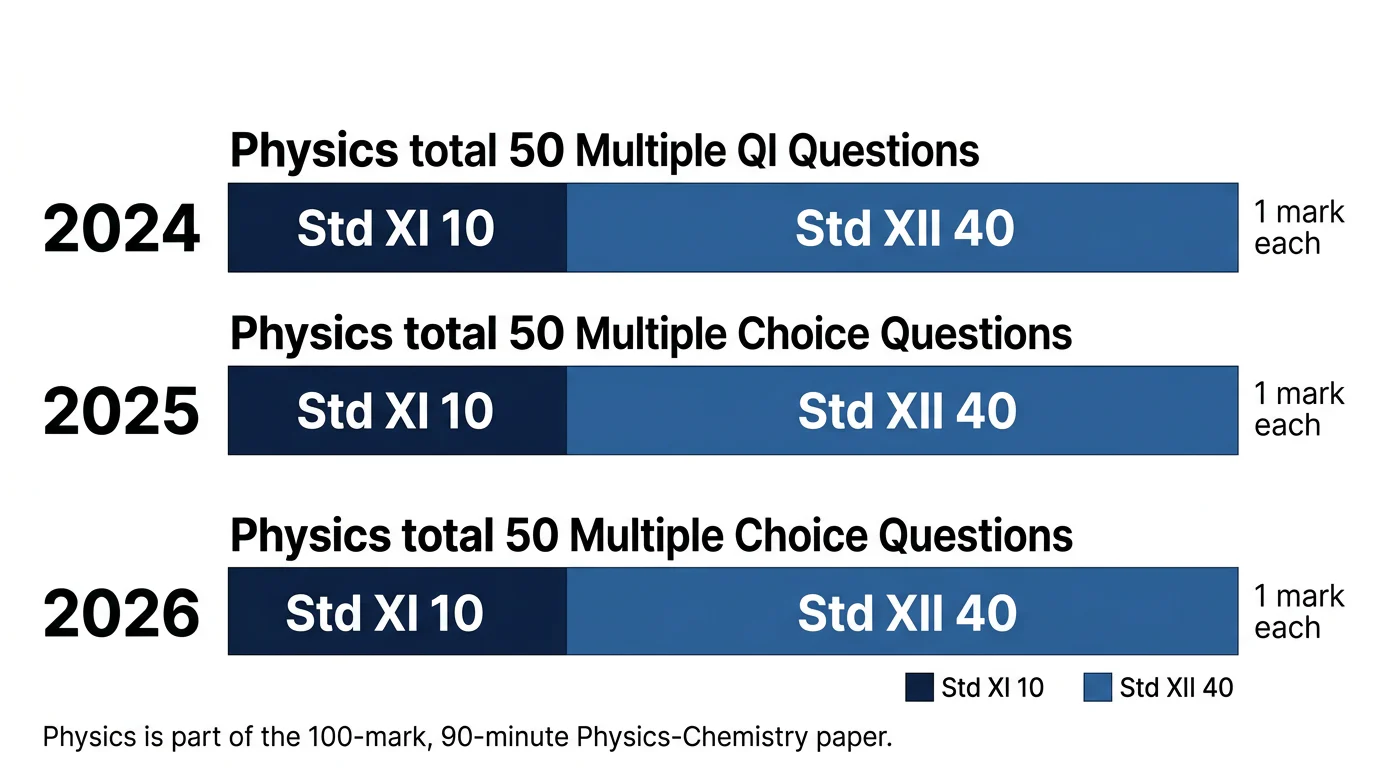
Use the recurring class split as a planning constraint. Use any chapter ranking only as a clearly dated layer on top of that constraint.
A historical table needs evidence a reader can inspect
A transparent MHT-CET Physics analysis starts with a paper ledger, not a polished percentage table. Record the year, attempt and shift for every paper included. Record where each paper was obtained and mark any paper that was unavailable, incomplete or excluded.
Next, assign every question to one primary syllabus chapter. The chapter names should follow the official syllabus rather than a convenient coaching label. When a question genuinely uses more than one chapter, state the rule used to assign it, or keep a separate mixed-question category. When the evidence does not support a chapter label, mark the question uncodable instead of forcing it into a total.
Finally, publish annual counts and the denominator behind each percentage. This lets readers see whether a result comes from a broad paper set or from a narrow sample, and it lets a future update correct the table without rewriting the conclusion.
Frequency can set revision order, not syllabus coverage
The practical trade-off is simple. A frequency estimate can help decide which chapter to revise earlier, but it cannot tell a student that another official chapter is safe to abandon. The 2026 State CET Cell scheme includes the whole Std XII syllabus and a defined set of Std XI Physics topics.
Use an estimate in three limited ways: choose the first revision sequence, select additional question practice, and decide where to inspect errors in a mock. Do not use it as a promise of marks, a prediction of a future shift or a reason to leave a syllabus area untouched.
Students who need help deciding whether to study independently or add support can use MHT-CET Physics preparation support: practice more or get mentor support?. That decision should be based on coverage, accuracy and doubt patterns, not on an unsupported chapter forecast.
Turn the audit into a study decision
A useful study plan begins with the official syllabus, then adds historical analysis only where it changes a real decision. If a chapter appears frequently in an auditable paper set and your mock errors cluster there, schedule targeted revision and questions. If a chapter appears less often but remains incomplete, finish the core concepts before treating it as a lower priority.
Keep a simple record of mistakes by syllabus chapter and question type. This makes a future historical table personal: it shows where your own marks are being lost rather than where an unsourced table says marks might appear. Structured teaching can support this process, but no batch can make an estimated chapter share official or replace question practice.
For a focused next step after reviewing errors, see MHT-CET Physics accuracy improvement plan: self-fix errors or ask a mentor?.
Go deeper
Frequently asked
No official MHT-CET document in the 2024, 2025 and 2026 source set assigns marks or question counts to individual Physics chapters. State CET Cell documents set the Std XI and Std XII question mix, syllabus and paper rules, so chapter percentages should be labelled as historical estimates.
The State CET Cell's 2026 syllabus and marking scheme lists 10 Std XI Physics MCQs and 40 Std XII Physics MCQs. Each Physics question carries one mark, and Physics sits with Chemistry in a 100-mark Paper II with a 90-minute duration.
A low historical frequency is not permission to skip an officially prescribed chapter. The official scheme covers the whole Std XII syllabus, so use frequency estimates only to order revision and practice after making sure every syllabus area has been studied.
A trustworthy historical analysis should name every year, attempt and shift included, identify the paper source, explain how each question was assigned to a chapter, flag mixed or uncodable questions, and publish the count and denominator behind every percentage.
Explore MHT-CET Physics study options
Review the available MHT-CET courses and choose support that fits your syllabus coverage and practice needs.
View MHT-CET courses