MHT CET Physics Preparation Support: Practice More or Get Mentor Support?
MHT CET Physics Preparation Support for 25 to 30 marks: diagnose errors, improve speed, and decide when mentor support is worth it.

The latest detailed official blueprint gave Physics a 50-question structure, with 10 questions from Std XI and 40 from Std XII. That makes a 25 to 30 score a diagnostic problem first, not proof that you must restart every chapter.
For MHT CET Physics Preparation Support, students at 25 to 30 out of 50 should first correct repeated errors instead of restarting the syllabus. Tag each miss as a concept, calculation, formula-recall, time, or selection problem, then practise the largest category in short timed sets. Pay for structured help only when errors or consistency failures keep surviving retests.
We will show you how to identify the actual source of lost marks, recover speed without doing marathon revision, and decide whether independent practice, occasional doubts, or ongoing mentoring fits your situation.
What Is Holding a 25 to 30 Physics Mock Score Back?
A mock score does not tell you what to fix. Your error pattern does. Two students can both score 28, while one loses marks through formula recall and the other spends too long on questions that should have been skipped.
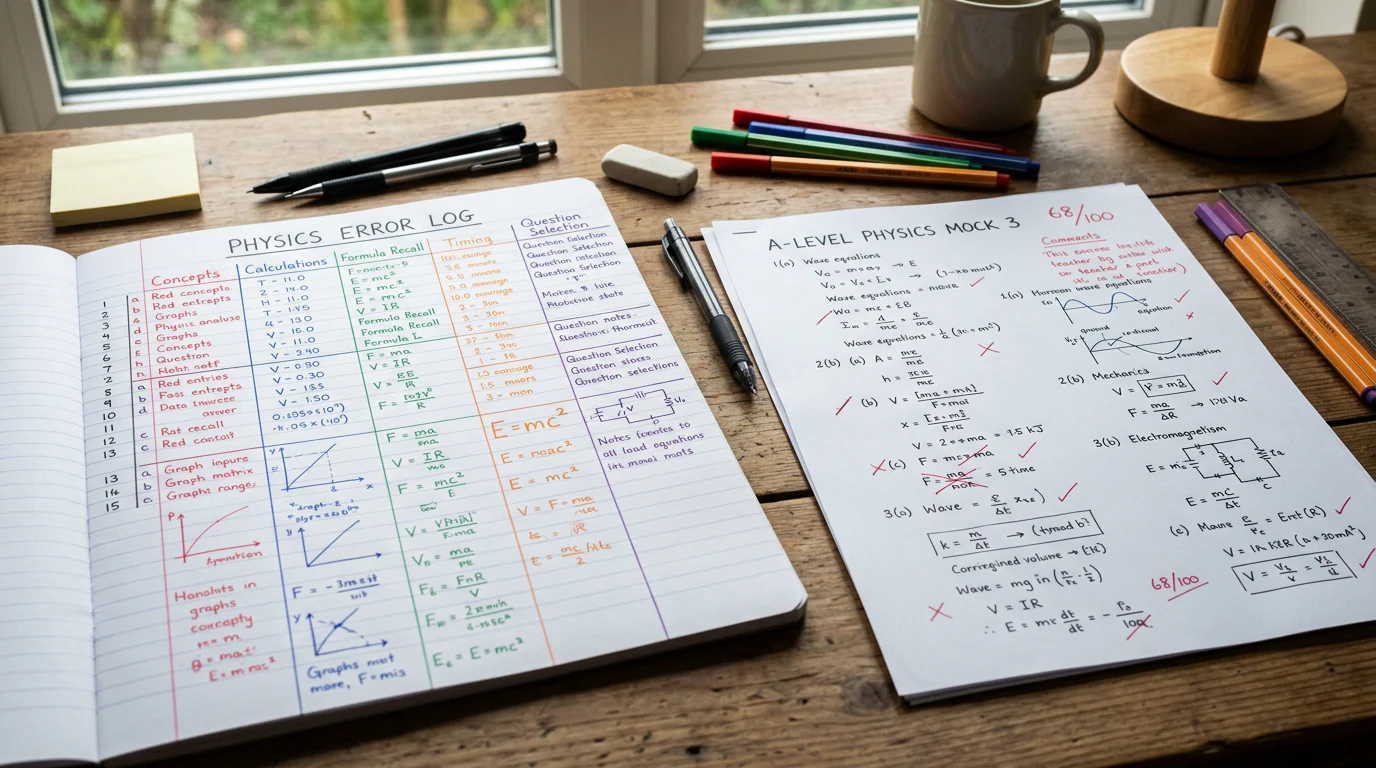
Use the table after every mock. We recommend logging wrong answers, slow correct answers, and guesses separately, because a lucky correct answer can still be an exam-day risk.
| Error Category | What It Looks Like | First Fix | Sign You Need More Help |
|---|---|---|---|
| Concept Gap | You cannot set up the relevant equation | Relearn one micro-concept, then solve three fresh variations | The same setup fails in two retests |
| Calculation Error | Signs, units, powers, or algebra go wrong | Write full working in a short accuracy drill | The same slip repeats after checking |
| Formula-Recall Failure | You know the method after seeing the formula | Use closed-book formula recall before practice | Recall still breaks in timed work |
| Time Loss | You get stuck on otherwise familiar questions | Use six-question timed sets and a skip rule | Time per question does not improve across three sets |
| Poor Question Selection | You guess early or tackle low-confidence questions first | Use a two-pass attempt order | The same choice pattern appears in two mocks |
This system turns a vague “I am weak in Physics” conclusion into one correctable target. If you need a fuller mock routine, use our eight-week mock plan alongside your own test series.
How Can You Improve Accuracy and Numerical Speed Without Restarting the Syllabus?
The fastest route is usually a smaller loop: test, classify, correct, retest. Repeating a whole chapter may feel productive, but it often hides whether the actual problem is recall, setup, arithmetic, or pace.
Tag Every Miss Before Looking at the Solution
Give each missed question one primary tag. Do not give it three excuses. If the formula was known but you used the wrong sign, classify it as a calculation error. If you spent too long deciding how to begin, classify it as a concept or selection issue.
Retrieval practice is useful here because it makes you reconstruct the method before seeing the answer. A 2011 learning study found retrieval practice supported meaningful science learning better than elaborative concept mapping in its experiments.
Build Short Timed Sets Around One Error Type
Use six questions from one chapter or one error category. Set a time limit, solve without notes, check each step, and write one correction rule such as “convert all values before substitution.”
Do not use a timed drill to prove that you are fast. Use it to find the exact point at which your method slows down. Our accuracy improvement plan can help you turn that evidence into weekly targets.
Retest After Two Days and in the Next Mock
A correction only counts when it survives a fresh question. Retest the same skill after roughly two days, then look for it again in your next mock.
If a mistake disappears, move to the next error category. If it returns, reduce the task further: one formula family, one calculation step, or one question type. That is more useful than switching immediately to broad revision or another random worksheet.
Which Chapters Should Get Priority in Eight Weeks?
Start with coverage, then personalise the order using your error log. The official split makes Std XII the larger recovery opportunity, but that does not mean every Std XI weakness should be ignored.
For a final-month choice between broad revision and targeted work, see revision versus past papers. The important distinction is between official syllabus weighting and unofficial chapter predictions, so we would not treat fixed chapter percentages as a promise for your shift.
| Priority | Coverage | Why It Comes First | Weekly Action |
|---|---|---|---|
| First | Entire Std XII Physics syllabus | The detailed official scheme allocated 40 of 50 Physics questions to Std XII | Put unfinished XII chapters into the calendar first |
| Second | Vectors, Error Analysis, Motion in a Plane, Laws of Motion, Gravitation | These are listed Std XI units within the remaining 10 questions | Recover only the units causing repeated errors |
| Second | Thermal Properties, Sound, Optics, Electrostatics, Semiconductors | These are also named Std XI units | Use short recall and numerical drills |
| Personal Override | Any chapter with the most wrong, slow, or guessed questions | Your recent mocks show your current loss points | Move it above a generic priority list |
The official scheme also states that Physics and Chemistry share the first 90-minute test block, so speed work should reflect the combined pressure rather than an imaginary Physics-only window. Review our crash-course guide if your chapter backlog is making you consider a condensed route.
For an eight-week recovery, make Week 8 your baseline mock, Weeks 7 to 5 your largest-error repair period, Weeks 4 to 3 your timed comparison phase, and Weeks 2 to 1 your exam-window rehearsal. Keep the calendar tied to your actual allotted date, not an outdated public timetable.
When Does MHT CET Physics Preparation Support Beat Independent Practice?
Independent practice is enough when you can identify errors, follow a written plan, and see those errors disappear in fresh timed questions. Support becomes valuable when the feedback loop itself has broken, not merely because a mock score feels disappointing.
Use this decision matrix honestly. It is not a diagnosis of ability. It is a way to decide whether more questions, a quick doubt session, or structured accountability is the next useful investment.
| Signal | Independent Practice | Occasional Doubt Solving | Structured Mentoring |
|---|---|---|---|
| Error Recurrence | Fixed in the next retest | One or two topics remain unclear | Same category survives two reviewed retests |
| Syllabus Completion | Priority coverage is mostly complete | A few blocked chapters remain | Important chapters remain unfinished |
| Numerical Speed | Improving across three timed sets | One bottleneck needs explanation | Slow work persists across multiple mocks |
| Study Consistency | Weekly targets are completed | A periodic checkpoint helps | Targets repeatedly slip without accountability |
Recoverable Through Self-Study
You are scoring 25 to 30, but most misses are formula recall or calculation slips. Your priority chapters are covered, and retests improve after you review your working.
Suitable for Occasional Doubt Solving
You can follow the calendar, but one or two concept clusters keep blocking you. A focused explanation and fresh practice set may be enough, without adding a full programme.
Suitable for Structured Mentoring
You have unfinished priority chapters, repeat the same errors after review, lose time in numericals, and regularly miss your own study targets. In that situation, our coaching decision guide can help you compare accountability needs with independent practice.
Good feedback needs to be specific enough to change the next attempt. Research on the power of feedback also cautions that feedback quality and timing matter, so no provider should promise a score outcome without showing how corrections are reviewed.
What Should You Ask Before Paying for Support?
Paying for help should buy a better correction system, not just more videos. Use these questions to separate a one-off explanation need from a real mentoring need before you choose a programme.
- Feedback: Who reviews the error log, and how quickly do they respond to a submitted doubt?
- Tests: Are there Physics-only timed tests, full mock reviews, and fresh retest questions?
- Scheduling: How will missed classes, school exams, and unfinished targets be handled?
- Mentor Access: Is support live, asynchronous, group-based, or individual, and what happens when you need help quickly?
- Accountability: Will someone check completed drills and recurring errors, rather than only attendance?
- Exit Test: What evidence would show that you can return to independent practice confidently?
A worthwhile provider should answer these questions clearly before asking you to commit. Compare those answers with our mentoring quality guide before you decide whether structured help is worth paying for.
Build Your Next Physics Recovery Plan with RG Lectures
At RG Lectures, we believe a student does not need a louder timetable, they need a feedback loop that identifies the next mark to recover. We help you turn a mock into a usable plan: tag the miss, choose the smallest corrective drill, retest it, and decide whether a doubt needs a quick answer or sustained mentoring. Our approach keeps preparation anchored to your actual Physics errors, available study hours, and upcoming tests instead of a one-size-fits-all promise. Bring your recent mocks, your unfinished chapters, and the pattern you cannot break. We will help you see whether disciplined independent practice is enough or whether guided accountability would save time. Start with our study resources and preparation guidance, so your next study block has a clear purpose, a measurable target, and a review point you can actually keep, at RG Lectures Home.
FAQs on MHT CET Physics Preparation Support
Use your mock evidence. Let it guide your next step.
How Do I Improve from 25 to 30 Marks?
Begin with two recent mocks. Count concept, calculation, recall, time, and selection mistakes, then spend the next study sessions retesting the category that loses most marks first.
How Can I Improve Physics Numerical Speed?
Use six-question timed sets from one error type rather than marathon worksheets. Check every solution, write one correction rule, and repeat fresh variations two days later.
When Is Paid Support Worth It?
Paid help makes sense when the same error survives two reviewed retests, priority chapters remain unfinished, or your written weekly plan repeatedly fails without outside accountability.
Which Chapters Should I Prioritise First?
Prioritise the complete Std XII syllabus first, then use your error log to select relevant Std XI units. Avoid treating predicted chapter percentages as guarantees for any shift.
Does Physics Have Its Own 90 Minutes?
No. Physics and Chemistry share the first 90-minute block, so speed drills should reflect the combined exam window rather than a separate Physics-only clock on test day.