MHT CET Physics Accuracy Improvement Plan: Self-Fix Errors or Ask a Mentor?
Improve a 25 to 30 out of 50 MHT CET Physics mock score with an eight-week error-recovery plan, and know when recurring doubts need a mentor.

MHT CET Physics has 50 one-mark questions, so a few repeated errors can keep a mock score stuck even when much of the syllabus feels familiar. Physics also shares its first exam block with Chemistry, making clear decisions as important as knowing formulas.
Students scoring 25 to 30 out of 50 should use an MHT CET Physics accuracy improvement plan that fixes repeated error patterns instead of restarting every chapter. Self-correct isolated formula, calculation, and timing mistakes. Ask a mentor when a misconception repeats, numerical speed stays poor, or retests do not move your score.
This page shows how to diagnose lost marks, convert mock mistakes into targeted corrections, prioritise revision, and decide when structured doubt support is useful.
How Does an MHT CET Physics Accuracy Improvement Plan Start?
It starts with evidence from your last mock, not a fresh timetable for every chapter. Label every wrong, skipped, guessed-correct, and unusually slow question before deciding what to revise. The current exam instructions confirm that questions appear one at a time and there is no negative marking, so the goal is to recognise solvable questions faster without turning every attempt into a guess.
A score of 25 to 30 usually contains more recoverable marks than it first appears. An isolated sign error needs a different fix from a missed condition in the question stem. Treating both as “weak Physics” wastes revision time.
| Error Category | Symptom | Evidence To Log | Self-Fix | Mentor Trigger | Retest Method |
|---|---|---|---|---|---|
| Concept Gap | You cannot explain why a principle applies | Same micro-topic is wrong twice | Revise one micro-topic, then solve five untimed MCQs | The misconception survives two correction cycles | Ten mixed MCQs after 48 hours |
| Formula Recall Failure | You know the method only after seeing the solution | Missing, swapped, or misapplied formula | Closed-book formula recall | Recall fails again under time pressure | Ten-question formula drill |
| Calculation Error | Setup is right but arithmetic, unit, or sign is wrong | First incorrect line in rough work | Written calculation drill | The same slip repeats despite clean work | Five numericals with checked workings |
| Misread Question | You miss a condition, unit, or negative word | Exact missed word or condition | Stem-and-data reading checklist | It repeats across unrelated chapters | Timed stem-first set |
| Time Loss | You skip or rush known questions | Time spent and final skips | Timed chapter MCQs and a first-pass rule | Delays repeat in two timed mocks | Fifty-question simulation |
Use the table to build an error log with only five columns: question number, chapter, error category, corrective action, and retest result. For broader support choices after that first diagnosis, see our coaching choices.
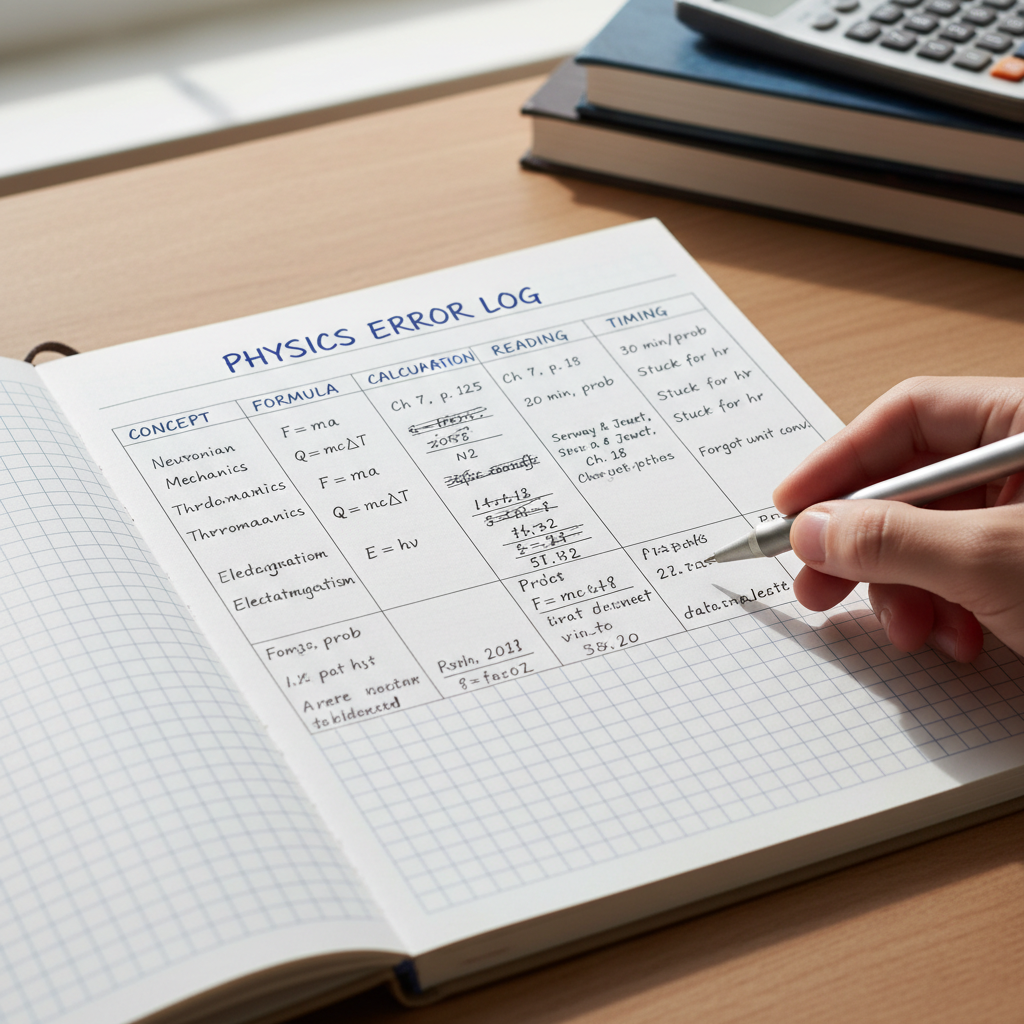
How Do You Turn Mock Mistakes into Useful Fixes?
A mock only becomes valuable after it changes what you do next. We recommend reviewing it while the questions and decision points are still fresh, then giving each lost mark one clear action. Research on practice testing found that testing can improve later performance compared with no-test control, which is why correction and retesting should sit at the centre of revision.
Separate Wrong, Guessed-Correct, Skipped, and Slow-Correct Answers
A correct answer reached by guessing is not secure knowledge. Mark it for review alongside incorrect and skipped questions. Slow-correct answers matter too, because they can create avoidable time pressure later in the section.
Find the First Broken Step
Ask where the attempt actually failed: reading the stem, selecting the principle, recalling a formula, setting up the calculation, calculating, or deciding when to move on. “Silly mistake” is not a diagnosis because it does not tell you what to practise.
Give Each Error One Corrective Action
- Concept gap: Revise one narrow idea, then solve a short set without looking at notes.
- Formula recall: Write the needed relationship from memory before opening a formula sheet.
- Calculation: Redo the question with every unit and sign visible in rough work.
- Misread stem: Underline the condition before looking at answer options.
- Time loss: Repeat similar questions with a timer and a clear stop rule.
Retest Before You Call It Fixed
Return to the micro-topic after 48 hours with ten mixed questions. Then look for it again in the next mock. If the error disappears in both places, move it from “repeat” to “fixed.” Our video lessons can support a focused micro-topic review when the exact gap is clear.
Which Physics Chapters Need Attention First?
Start with chapters that your error log identifies, while respecting the official syllabus split. The MHT CET blueprint places 40 of the 50 Physics questions in Std. XII and 10 in Std. XI, so a complete restart of one familiar chapter is rarely the best response to a small number of lost marks.
The official syllabus also names Std. XI areas such as vectors, error analysis, motion in a plane, laws of motion, gravitation, thermal properties, sound, optics, electrostatics, and semiconductors. Keep those in rotation instead of ignoring them, but do not confuse a syllabus list with a prediction that every chapter will produce the same number of questions.
To decide whether a repeated weak area needs more revision or more paper practice, use our revision versus papers guide before changing your study plan.
| Revision Priority | Topic Or Module | Evidence-Based Reason | Best Next Move |
|---|---|---|---|
| First | Full Std. XII syllabus | It accounts for 40 of the 50 Physics questions | Repair repeated errors before adding new material |
| High diagnostic focus | Electricity and magnetism | Recent paper analysis reported a strong combined presence | Use mixed, timed numerical practice after concept review |
| High diagnostic focus | Semiconductors and communication | Recent analysis identified this as a distinct recurring area | Build rapid recall through direct MCQs |
| Review by error log | Rotation, oscillations, waves, optics, thermal physics | These areas often expose formula, setup, and timing issues | Prioritise only when mock evidence supports it |
| Do not omit | Listed Std. XI units | They account for 10 Physics questions | Maintain short recall and MCQ coverage weekly |
Treat recent-paper patterns as revision clues, not promises. If one area is often discussed as important but your mocks show clean, fast accuracy there, maintain it and redirect effort to repeated losses. For a time-limited chapter decision, use our crash course comparison.
What Does an Eight-Week Recovery Plan Look Like?
This plan is built for a student currently scoring 25 to 30 out of 50, with roughly two months remaining. It uses one Physics mock or fifty-question simulation each week, but the review and retest are more important than collecting a large number of unanalysed scores.
| Week | Main Focus | Mock And Review Checkpoint | Retest Checkpoint |
|---|---|---|---|
| 1 | Build the baseline error log | One timed fifty-question Physics set | Categorise every lost mark |
| 2 | Repair the most common error type | One mixed chapter set | Ten-question retest after 48 hours |
| 3 | Improve formula recall and calculation discipline | One timed Physics set | Revisit Week 1 repeated errors |
| 4 | Repair numerical speed | Physics simulation within a shared subject block | Escalate persistent slow topics |
| 5 | Correct priority-module weaknesses | Full Physics mock | Compare score, time, and error mix |
| 6 | Build mixed-topic accuracy | Full Physics mock | Retest every repeated label |
| 7 | Build consistency | Full Physics mock | Seek support only for unresolved patterns |
| 8 | Consolidate rather than rebuild | Two final simulations with full review | Formula and error-log sweep |
The common traps are passive revision, mocks with no post-test analysis, shortcuts used before the method is understood, and rebuilding chapters that already produce correct answers. A research review identifies practice testing and distributed practice as high-utility study techniques, which fits the weekly mock, correction, and retest cycle here.
When you reach Week 6, use your records to choose between more revision and more paper practice. Our small-batch guide can help you make that decision without abandoning accuracy work.

When Does a Slow Numerical Need a Mentor?
Slow numericals usually come from one of four places: delayed principle selection, formula searching, inefficient setup, or reluctance to leave a difficult question. The fix depends on which one appears in your log. Rewatching a whole chapter may feel productive, but it will not necessarily repair a recurring first-step problem.
Self-study is enough when you can explain the method after reviewing it, solve a similar question correctly, and improve in the 48-hour retest. Structured help becomes useful when you repeatedly cannot choose between methods, keep accepting the wrong solution path, or still lose time after focused drills.
| Signal | Self-Fix First | Ask A Mentor |
|---|---|---|
| Recurrence | One isolated occurrence | The same micro-topic fails twice |
| Time Lost | One slow question | Slow numericals repeat across two timed mocks |
| Score Movement | Error count falls in the next retest | No reduction after correction and retest |
| Solution Choice | You can explain the first step after review | You still cannot choose a valid method |
| Exam Proximity | Time remains and retests improve | Two months or less with the same unresolved pattern |
Bring evidence to a doubt session: the question, your attempted method, the exact point where you stopped, and the results of two reattempts. That creates a useful conversation instead of a vague request for “better Physics.” If you are comparing the amount of support you need, our coaching decision guide can help you assess it.

Build Your Recovery Plan with RG Lectures
At RG Lectures, we work best with students who can show us what is happening, not just a score. Bring your latest Physics mock, your marked questions, timings, and the short error log from this page. We use that evidence to separate a missed formula from a weak concept, a reading slip, or a slow numerical routine. Then we help you choose a practical next action: a micro-topic repair, a timed drill, a reattempt, or a structured doubt session. If self-study is already producing cleaner retests, we will not ask you to rebuild your plan. If the same pattern survives, our support can make the next two months more deliberate. We keep the focus on evidence, clear explanations, and repeatable decisions, so each study hour tackles a current error rather than vague worry. Explore our current resources and study support at RG Lectures Home
FAQs on MHT CET Physics Accuracy Improvement Plan
How Can I Improve an MHT CET Physics Mock Score from 25 to 30 Out of 50 in Two Months?
Classify each lost mark, correct one repeatable cause, retest after 48 hours, then use weekly timed Physics sets to verify that accuracy and speed are improving.
What Is an MHT CET Physics Accuracy Improvement Plan?
It is a focused system for logging mock errors, assigning one correction to each error, retesting weak micro-topics, and escalating only recurring problems for help.
Why Am I Slow at MHT CET Physics Numericals?
You may be delaying principle selection, searching for formulas, using inefficient calculations, or staying too long on difficult questions. Log the first bottleneck before practising speed.
How Should I Analyse MHT CET Physics Mock Mistakes?
Review wrong, skipped, guessed-correct, and slow-correct answers. Identify the first broken step, assign one correction, then retest the same micro-topic after 48 hours.
When Should I Ask a Mentor for MHT CET Physics Doubts?
Ask when the same misconception survives two correction cycles, numerical speed remains poor in timed mocks, or you cannot explain why a solution method applies.
Is It Worth Paying for Structured MHT CET Physics Support?
It can be worthwhile when independent review and retests do not reduce repeated errors. Choose support that addresses your logged evidence, not generic syllabus coverage.