
TL;DR
Our MHT-CET PYQ library helps Physics-focused students practise questions by chapter, subject, year and shift while checking source status and worked solutions. Use chapter-wise sets to diagnose concepts, shift-wise papers to rehearse timing, and our error log to turn repeated mistakes into revision and retests.
During the 2026 PCM first attempt, 4,54,069 candidates appeared for MHT-CET. That scale makes a random folder of PDFs less useful than a system that tells you exactly what you are practising.
Our MHT-CET PYQ library lets you practise questions by subject, chapter, year and shift, while showing source status and a checked solution. Use chapter-wise sets to find weak Physics concepts, use shift-wise papers for timed practice, then save every repeat mistake in an error log and retest it.
This guide explains how we organise papers, what a detailed solution should include, and how to turn PYQs into a practical Physics revision routine.
Which MHT-CET Papers Can You Practise in Our Library?
We treat paper availability as a recordkeeping problem, not a marketing claim. Every question card needs a subject, chapter, stream, exam date, shift and source label before it is useful for serious revision. That matters because MHT-CET has separate PCM and PCB streams, and recent examinations have included more than one attempt.
The official 2026 record confirms four distinct groups. Our index keeps those groups separate, then lets you move into the specific date and Morning or Evening shift card without mixing questions from different papers.
| Year | Attempt | Stream | Official Date Range | Sessions | How We Label Questions |
|---|---|---|---|---|---|
| 2026 | First Attempt | PCM | 11 April to 20 April | 16 | Date, shift, subject, chapter, source status |
| 2026 | Second Attempt | PCM | 12 May to 20 May | 11 | Date, shift, subject, chapter, source status |
| 2026 | First Attempt | PCB | 21 April to 26 April | 11 | Date, shift, subject, chapter, source status |
| 2026 | Second Attempt | PCB | 10 May to 11 May | 4 | Date, shift, subject, chapter, source status |
We use three clear provenance labels: official paper, memory-based question and reconstructed question. An official paper has a traceable official origin. A memory-based question reflects candidate recall. A reconstructed question is edited into a usable form from available evidence. Those categories should never be silently merged.
A paper is only marked complete when its question set, subject mapping and solution review are complete. If a session is partial or unavailable, we show that status rather than implying coverage that does not exist. Before choosing a paper, use our syllabus checklist to identify the Physics chapters that need attention.
How Does This MHT-CET PYQ Library Find the Right Physics Questions?
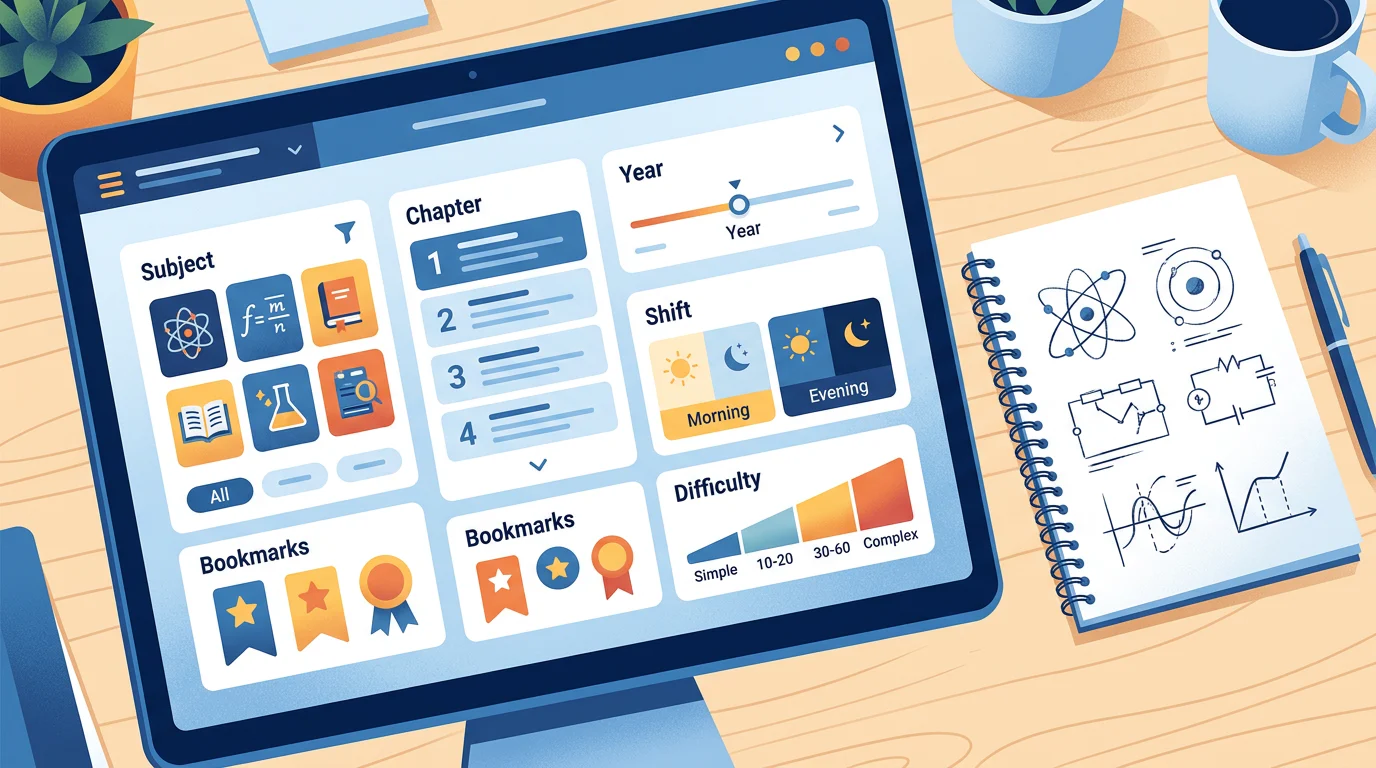
The best filter is the one that prevents you from practising a chapter you already understand. Our search starts with subject and chapter, then narrows by year, shift, difficulty, attempted status and bookmarked status. For Physics students, that makes it possible to return to a specific weak area instead of beginning every session with a mixed list.
Browse by Current Syllabus Chapters
We map chapter filters to the current syllabus rather than vague labels such as “important topics.” The 2026 syllabus assigns approximately 20% of the paper to Std. XI and 80% to Std. XII, so both parts belong in a useful revision index.
Physics filters include units such as Vectors, Error Analysis, Motion in a Plane, Laws of Motion, Gravitation, Thermal Properties, Sound, Optics, Electrostatics and Semiconductors. Chemistry, Mathematics and Biology use the same chapter-first structure for their respective streams.
Save Questions That Deserve a Second Look
Attempted and bookmarked filters create a working revision queue. Bookmark a question when its method is worth revisiting, not merely because you got it wrong. Marking a correct but slow question is often just as valuable as marking an incorrect one.
Read a Solution That Teaches the Method
For Physics, our solution cards should do more than reveal an option. We explain the formula choice, substitutions, units, rejected options and the common trap behind the question. That approach helps students who need the concept rebuilt before they can use a shortcut confidently.
After you identify a weak unit, make the next set deliberately small and focused. Our chapter-wise plan helps you turn a chapter filter into a repeatable practice session rather than another long, unfocused question list.
When Should You Use Chapter-Wise or Shift-Wise PYQs?
Chapter-wise and shift-wise practice solve different problems. A chapter set tells you whether your concept, formula selection or calculation is weak. A timed shift tells you whether you can make decisions under the real paper structure.
| Practice Mode | Best For | What You Learn | Best Next Step |
|---|---|---|---|
| Chapter-Wise Practice | Fixing a Physics concept | Accuracy by chapter and error type | Review the method, then retest |
| Shift-Wise Timed Paper | Rehearsing exam conditions | Pace, stamina and question selection | Analyse missed and slow questions |
| Bookmarked Retest | Checking revision quality | Whether the mistake has actually gone | Return it to practice if needed |
For PCM, the official format gives Physics and Chemistry the first 90 minutes, followed by Mathematics for another 90 minutes. PCB uses Biology in the second block, as explained in the official brochure. A realistic timed mode should preserve that sequence instead of treating all subjects as one interchangeable question feed.
Start with a chapter set if you keep making the same conceptual mistake. Move to a shift-wise paper when your chapter accuracy is stable and you need to practise selecting, skipping and returning under time pressure. Our free Physics mock is a useful bridge between those two modes.
Use Difficulty as a Review Tool
Difficulty is not a verdict on your ability. Use it to separate direct formula questions from questions that require a longer setup, unit conversion or careful reading. If easier questions are causing errors, review the concept. If only difficult questions are slow, practise the method under a timer.
Keep Timing Separate from Understanding
A wrong answer caused by rushing is different from a wrong answer caused by a missing concept. Our error log keeps those categories separate so a timing problem does not send you into unnecessary theory revision.
Retest Before You Move On
After revising a missed question, retest it without seeing the solution. Then attempt a fresh question from the same chapter. This checks whether you learned the method rather than memorised one answer.
How Do We Keep Answers, Errors and Coverage Accurate?
A reliable archive shows its uncertainty. We retain source labels, review dates and correction history because official answer decisions can change after objections. The 2026 correction notice shows why a solution should have an answer-key status rather than a permanent, unexplained answer.
When you miss a PYQ, record the question ID, chapter, error type, your chosen option, correct method and retest date. A useful error log should answer one question quickly: what must you do differently next time? Use our error-log guide after a timed paper to make that review specific.
- Concept Error: Revisit the underlying principle before attempting another set.
- Formula Error: Write the condition for using the formula, not just the formula itself.
- Unit Error: Rework the substitution with units shown at every step.
- Reading Error: Identify the word or condition that changed the answer.
- Timing Error: Repeat the question with a short time limit after learning the method.
A correction should not erase your original attempt. Keep the first selected option, the answer status that existed when you attempted it, and the date of any later update. This makes it possible to separate an avoidable concept error from a question whose answer decision changed later.
When an official decision changes an answer, we preserve the earlier solution status and date the correction. Our answer-key guide explains why this distinction matters when you are checking a previous paper after the objection process.
Do not reopen every Physics chapter after one difficult paper. Review the error category first, revise the linked concept, then try a fresh question from the same chapter. Record whether the second attempt was correct, slow or still uncertain, because that result decides whether the topic needs more practice.
After several attempts, look for patterns rather than individual bad questions. Repeated unit mistakes, for example, need a different fix from repeated formula-selection mistakes. A focused accuracy plan keeps revision connected to evidence from your own attempts.
Practice with RG Lectures
At RG Lectures, we teach MHT-CET Physics for students who want to understand each MCQ instead of memorising an answer pattern. Our PYQ workflow lets you identify a chapter gap, work through the method, record the error, and return for a clean retest. That is especially useful when Physics marks fluctuate because of unit slips, formula selection, or rushed reading. Start with the library filters, then pair a weak chapter with your revision plan and a timed attempt when you are ready. If you need structured lessons alongside practice, our MHT-CET 2027 Batch is built for regular preparation, not last-minute scrolling. Use the library as evidence of what needs work, and use teaching only where it removes that obstacle. Build a calmer, repeatable Physics routine with explanations that stay connected to the exact questions you missed most often, with RG Lectures Home.
FAQs on MHT-CET PYQ Library
Where Can I Practise MHT-CET Previous-Year Questions with Solutions?
Practise in a library that shows the subject, chapter, year, shift, source status and checked method, then lets you bookmark questions and retest missed concepts.
Are All MHT-CET PYQs Official Papers?
No. A reliable archive separates official material from memory-based and reconstructed questions, retains source details, and flags answer changes after a formal review by experts.
Is Chapter-Wise Practice Better Than Shift-Wise Practice?
Chapter-wise sets reveal a specific concept gap, while shift-wise papers reveal pacing and stamina. Use the first for diagnosis, then the second to rehearse the exam.
What Makes a Physics Solution Detailed?
Detailed Physics solutions show the method, substitutions, units, correct option, rejected options and common trap. They preserve the chapter, shift and answer-key status for retesting.