CBSE Class 11 Physics: 14 Chapters, 70 Marks, Where to Start
CBSE Class 11 physics has 14 chapters and 70 theory marks. The first seven chapters carry 40 of them, so begin with units, vectors and motion before the other seven.

By Rahul Jeewani, Founder · Updated 9 Oct 2026

Key takeaways
- 01CBSE Class 11 physics has 14 chapters, 70 theory marks and 30 practical marks. Chapters 1 to 7 carry 40 of the 70 theory marks, so they get your first and best weeks.
- 02Run the four-question readiness check before chapter 2. Vectors, differentiation, dimensions and rearranging equations decide whether chapters 2 to 7 feel easy or impossible.
- 03If you can read a chapter but cannot solve its numericals, the problem is method, not memory. Solve in symbols, substitute numbers last and check units.
- 04
Study the National Council of Educational Research and Training (NCERT) books first and HC Verma (H. C. Verma's Concepts of Physics) second. In Maharashtra, MHT-CET tests only ten named Std XI units, so plan from that list, not an NCERT chapter list.
In this article
- 1What is in Class 11 physics, and how many marks does each chapter carry?
- 2Which Class 11 physics chapters should you study first?
- 3Are you ready for chapter 2? A six-minute readiness check
- 4Why can you read a chapter and still not solve the numericals?
- 5Should you use NCERT or HC Verma?
- 6How are the 30 practical marks split?
- 7Does Maharashtra's Std XI physics follow NCERT, and what does MHT-CET take from it?
- 8In what order should you study the ten Std XI units for MHT-CET?
- 9How is the MHT-CET physics paper set?
- 10How does our MHTCET 2028 Class 11th Physics Batch work?
- 11Frequently asked questions
Four chapters, units to laws of motion, carry 23 of the 70 theory marks in the Central Board of Secondary Education (CBSE) 2026-27 physics syllabus, more than any other group of chapters, so they deserve more time than the rest.
Those four chapters are where we see students stall most often, in our experience as teachers. Vectors and a little calculus arrive before physics has started to feel familiar. Skip past them and the gap follows you into rotation, gravitation and oscillations, which lean on the same ideas.
Below you get every chapter with its marks, the order we would study them in, a six-minute readiness check to run before chapter 2, and a fix for a common problem: reading a chapter and still being unable to solve its numericals (calculation-based problems). If you study in Maharashtra, in Standard XI (Std XI, the Maharashtra name for Class 11), there is a separate section on your syllabus and the Maharashtra Common Entrance Test (MHT-CET). Padhna aasaan hai, once the order is right.
What is in Class 11 physics, and how many marks does each chapter carry?
CBSE Class 11 physics has 14 chapters, taught from the two NCERT physics books. The theory paper is 3 hours and 70 marks, plus 30 marks of practical. CBSE publishes marks for groups of chapters, not for single chapters.
| No. | Chapter | CBSE marks for its group | Common sticking points (our teaching experience) |
|---|---|---|---|
| 1 | Units and Measurements | 23 (chapters 1 to 4) | Significant figures and error rules |
| 2 | Motion in a Straight Line | 23 (chapters 1 to 4) | Signs of velocity and acceleration; reading graphs |
| 3 | Motion in a Plane | 23 (chapters 1 to 4) | Resolving vectors; projectile motion |
| 4 | Laws of Motion | 23 (chapters 1 to 4) | Free-body diagrams; direction of friction |
| 5 | Work, Energy and Power | 17 (chapters 5 to 7) | Variable forces; collisions |
| 6 | System of Particles and Rotational Motion | 17 (chapters 5 to 7) | Torque versus angular momentum; moment of inertia |
| 7 | Gravitation | 17 (chapters 5 to 7) | Mixing up orbital speed and escape speed |
| 8 | Mechanical Properties of Solids | 20 (chapters 8 to 12) | Stress-strain graphs |
| 9 | Mechanical Properties of Fluids | 20 (chapters 8 to 12) | Bernoulli's theorem; surface tension |
| 10 | Thermal Properties of Matter | 20 (chapters 8 to 12) | Calorimetry sums |
| 11 | Thermodynamics | 20 (chapters 8 to 12) | Sign conventions; P-V diagrams |
| 12 | Kinetic Theory | 20 (chapters 8 to 12) | Degrees of freedom |
| 13 | Oscillations | 10 (chapters 13 and 14) | Phase; spring and pendulum formulas |
| 14 | Waves | 10 (chapters 13 and 14) | Standing waves in pipes; beats |
The chapter list and the 23, 17, 20 and 10 mark groups come from the CBSE Class XI physics curriculum. They add up to 70. The last column is our judgement, not an official list. Older lists with 15 chapters and a separate "Physical World" chapter are out of date: the current structure begins with Units and Measurements.
Which Class 11 physics chapters should you study first?
Study chapters 1 to 4 first, then 5 to 7. Together they carry 40 of the 70 theory marks (23 + 17 = 40, or 57%) in 7 of the 14 chapters. The other seven chapters carry 30.
Our working: group marks divided by the chapters in the group gives an average of 5.75 for chapters 1 to 4, 5.67 for chapters 5 to 7, 4 for chapters 8 to 12 and 5 for chapters 13 and 14. These are averages. CBSE does not split a group's marks by chapter, and your school's own paper may weigh chapters differently, so check your school's blueprint (its marks plan).
The order we recommend for a six-week first pass:
Weeks 1 and 2
Chapters 1, 2 and 3. Vectors and graphs are used in everything after.Week 3
Chapters 4 and 5. Force first, then energy.Week 4
Chapters 6 and 7. Both reuse circular motion and energy.Week 5
Chapters 10, 11 and 12. Heat, thermodynamics and gases build on each other, so take them together and in that order.Week 6
Chapters 8, 9, 13 and 14.
If your exam is close, protect chapters 1 to 7. Among chapters 8 to 14, the group of chapters 8 to 12 averages the fewest marks per chapter (4), so give those the least time. Which of them to trim is our judgement, because CBSE does not split a group's marks. We would trim chapters 8 and 9 first, since they rest on the fewest earlier chapters.
Are you ready for chapter 2? A six-minute readiness check
You are ready for the motion chapters if you pass all four questions below without a calculator. Each takes about a minute and a half. Do them on paper.
Vectors
Resolve a 10 N force acting at 30° to the horizontal into components. Pass: 8.66 N horizontal and 5 N vertical (cos 30° = 0.866, sin 30° = 0.5).Differentiation
A particle moves so that x = 3t² + 2t (x in metres, t in seconds). Find its velocity at t = 2 s. Pass: 14 m/s, from v = dx/dt = 6t + 2. Dividing x by t gives 8, which is a fail.Dimensions
Check s = ut + ½at² for dimensional consistency. Pass: you show that ut and at² both reduce to length (L).Rearranging
A body speeds up from 4 m/s to 10 m/s over 7 m. Find a from v² = u² + 2as. Pass: 6 m/s², since a = (100 − 16) ÷ 14.
Score 4 out of 4: go to chapter 2. Score 2 or 3: spend two days on the weak skill first. Score 0 or 1: revise basic trigonometry and earlier motion work before starting. The CBSE syllabus lists "elementary concepts of differentiation and integration" inside chapter 2, which is why question 2 is here.
Why can you read a chapter and still not solve the numericals?
Reading teaches you the formulas, but numericals need a separate skill: choosing the right principle and carrying it through cleanly. Many students read NCERT and HC Verma and still cannot solve problems, because they have no step-by-step method.
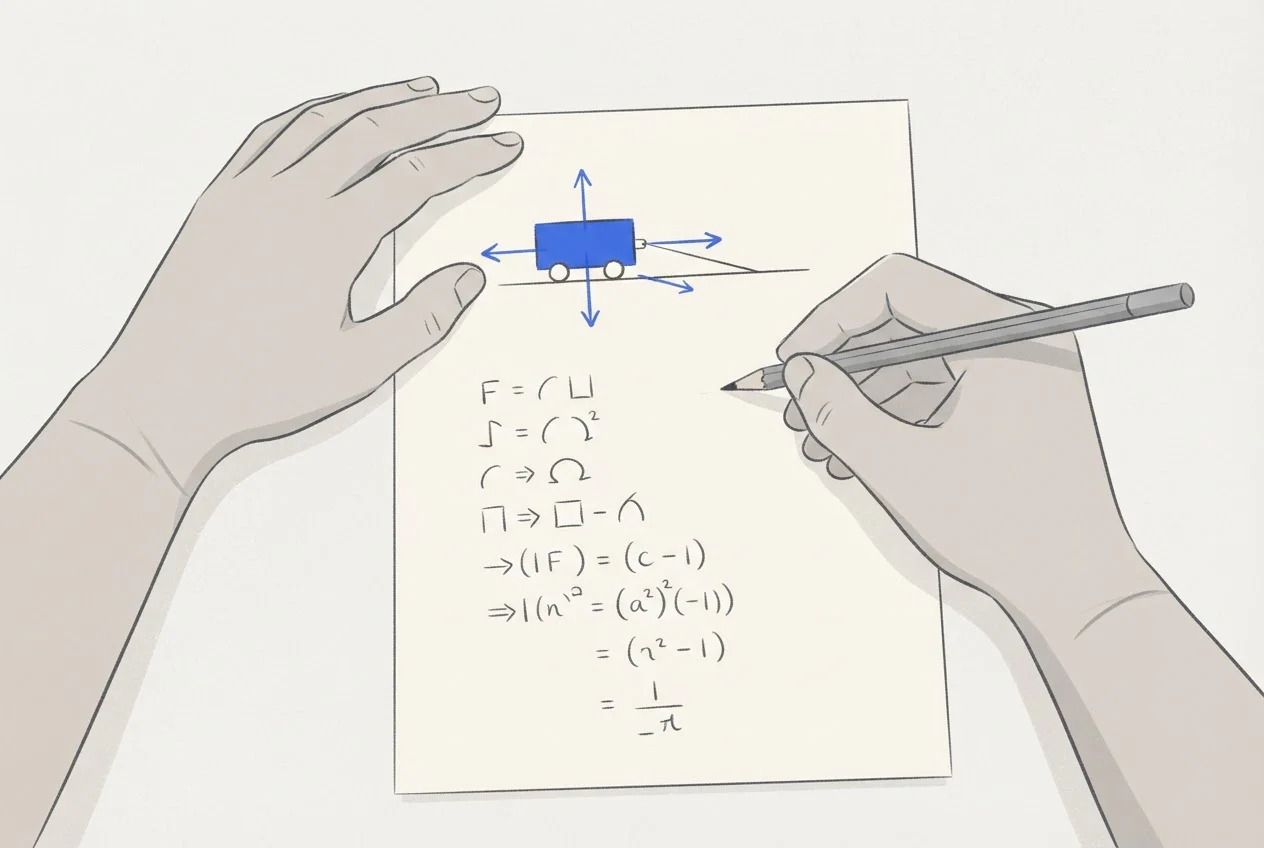
Use this one:
Draw and list
Sketch the situation. Write every given quantity with its unit and mark what you need to find.Name the principle
Write it in symbols before any numbers, for example F = ma for one body or conservation of momentum for a collision.Solve in symbols, substitute last
Get a final expression for the unknown, then put numbers in.Check units
Pass: the final expression has the dimensions of the quantity you were asked for. Fail: it does not, so look for an algebra slip.
Then test yourself. Cover the solution of a solved example, solve it, and compare. Pass: you reach the same symbolic expression before substituting numbers. Do not leave a chapter until you can do this on a fresh question. We suggest at least ten end-of-chapter questions per chapter, done without looking at the solution first.
Should you use NCERT or HC Verma?
Use NCERT first, then HC Verma. NCERT defines the CBSE syllabus, and both physics books are free on the NCERT textbook page. Work through every in-text example and end-of-chapter exercise before opening anything else.
HC Verma's Volume 1 covers Class 11. Its worked problems build the numerical depth that entrance exams such as the Joint Entrance Examination (JEE) and MHT-CET reward. Start HC Verma for a chapter only after you can do that chapter's NCERT exercises, otherwise it becomes one more thing you have read but cannot solve.
How are the 30 practical marks split?
The 30 practical marks in CBSE Class 11 physics split into 7 + 7 for two experiments, 5 for the record, 3 for one activity, 3 for the investigatory project and 5 for the viva (an oral test on your work). They add up to 30.
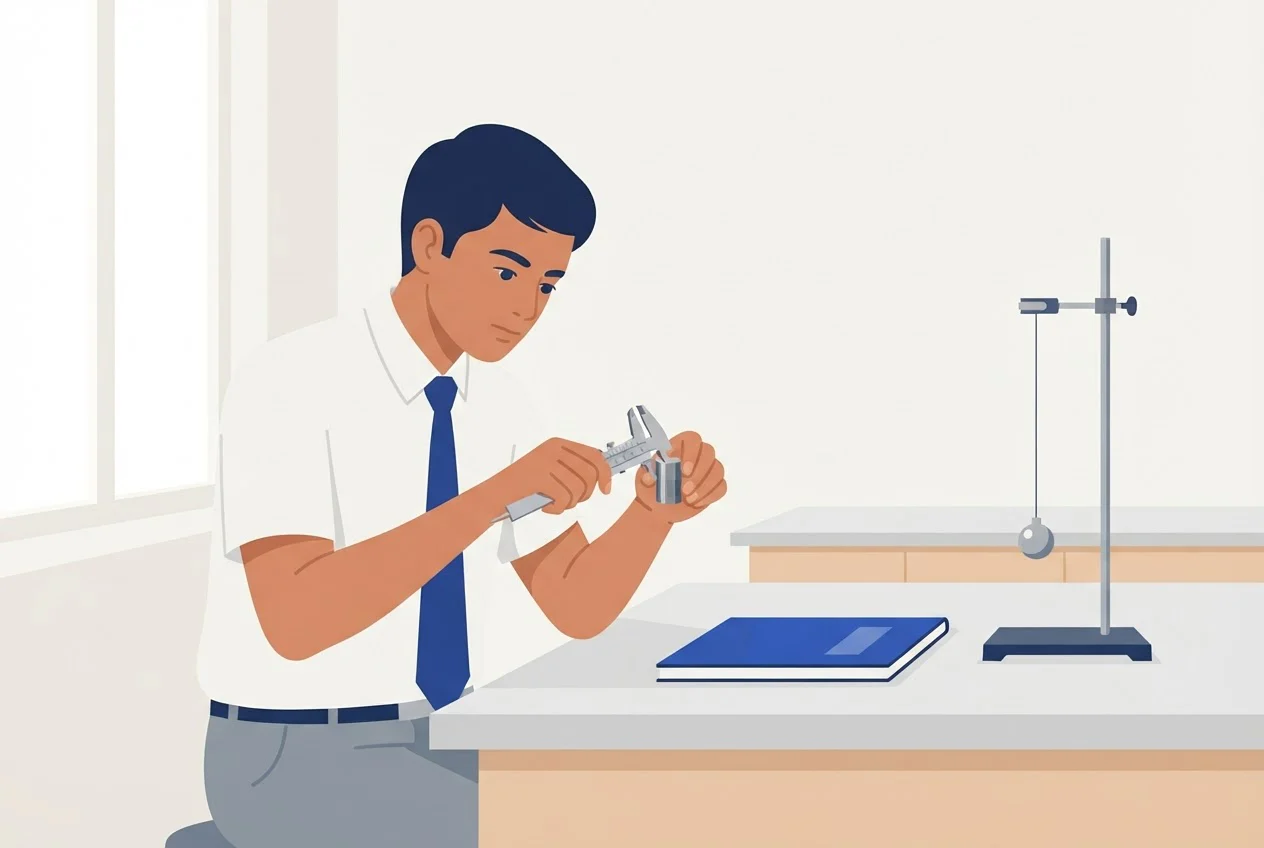
Your record must hold at least 8 experiments and 6 activities, per the CBSE curriculum. The Vernier callipers and screw gauge experiments link straight back to chapter 1.
Does Maharashtra's Std XI physics follow NCERT, and what does MHT-CET take from it?
No. MHT-CET questions are based on the curriculum of the State Council of Educational Research and Training (SCERT), Maharashtra, not NCERT. About 20% of the weightage goes to Std XI and 80% to Std XII. In Physics that is 10 questions from Std XI and 40 from Std XII.
That is from the State Common Entrance Test Cell's MHT-CET 2026 syllabus, the latest published as of October 2026. Check the State CET Cell site for each new year's version. The Std XI part is the Maharashtra Std XI syllabus of 2024-25, and only ten units are named: Vectors, Error Analysis, Motion in a Plane, Laws of Motion, Gravitation, Thermal Properties of Matter, Sound, Optics, Electrostatics and Semiconductors.
The CET Cell does not split the 10 questions by unit, so one question per unit (10 ÷ 10) is only an average, not a rule. Our recommendation: give Std XI roughly a fifth of your Physics time, and do not use the CBSE chapter table above as your plan.
In what order should you study the ten Std XI units for MHT-CET?
Study them in four blocks, then a mixed review. This order is our recommendation, because later units reuse earlier ideas.
- Week 1: Vectors, Error Analysis, Motion in a Plane, Laws of Motion.
- Week 2: Gravitation, Thermal Properties of Matter.
- Week 3: Sound, Optics.
- Week 4: Electrostatics, Semiconductors.
- Week 5: mixed questions and error review.
A student short of time can run this as a catch-up. We lay out the units in more detail in our guide to the ten Class XI units and in our MHT-CET physics syllabus checklist.
How is the MHT-CET physics paper set?
As of October 2026, the latest published pattern is MHT-CET 2026: Physics and Chemistry share one 90-minute paper at 1 mark per question, and Mathematics gets a separate 90-minute paper at 2 marks per question, with no negative marking. The PCM (Physics, Chemistry, Mathematics) test runs 180 minutes on computer.
Physics is 50 questions. The MHT-CET 2026 information brochure confirms the 180-minute structure and that Physics and Chemistry come first. Because wrong answers cost nothing, how to guess when there is no negative marking is worth reading before your first mock. Expect later years to be published on the same site.
How does our MHTCET 2028 Class 11th Physics Batch work?
The batch combines live classes, notes, previous year questions (PYQs) and mock tests for Class 11 physics, taught by Rahul Jewaani (RG Sir). It covers the complete Class 11 syllabus in depth, with a bridge from Class 10 to Class 11 ideas.
It is built around MHT-CET 2028, not the CBSE school-exam paper, so if you are in Maharashtra, check it against the Std XI list above. As of 9 October 2026 the batch costs ₹1,212 and access runs to 30 June 2028. Digital products are not refunded once the order is confirmed and the course is accessible. For details, see our page on the Class 11 physics batch for MHT-CET 2028.
See the full batch details and enrol in the MHTCET 2028 Class 11th Physics Batch.
Prepare for MHT-CET with the Class 11 Physics Batch
Frequently asked questions
Sources
- 1.CBSE Physics curriculum, Class XI-XII 2026-27: chapters, theory marks and practical marks
- 2.NCERT textbook page for Classes IX to XI
- 3.State CET Cell Maharashtra: CET syllabus and marking scheme, MHT-CET 2026
- 4.State CET Cell Maharashtra: MHT-CET 2026 Information Brochure
- 5.RG Lectures course page: MHTCET 2028 Class 11th Physics Batch (price, access, what it includes)