Build a Chapter-Wise MHT-CET Physics PYQ Plan for 50 Questions
A chapter-wise practice and review system based on the official 2026 Physics paper structure.
5 chapters · Updated Sep 17, 2026 · By Rahul Jeewani
- 10/40
- Class XI and Class XII Physics MCQ split
In brief
For MHT-CET 2026, Physics contributes 50 MCQs, split as 10 from Class XI and 40 from Class XII, inside a shared 90-minute Physics-Chemistry block. Use chapter-wise PYQs to diagnose errors, then repair and reattempt them instead of treating historical chapter rankings as official predictions.
Start with the official structure, not a chapter ranking
MHT-CET 2026 Paper II contains 50 Physics MCQs and 50 Chemistry MCQs, for 100 marks in 90 minutes. Physics contributes 10 Class XI questions and 40 Class XII questions, with 1 mark per question. The State CET Cell also specifies a computer-based MCQ format with four options, one correct answer and no negative marking. The 2026 Information Brochure is the source for these paper-level rules.
That pattern is useful because it defines the job of a PYQ session. A session is not only a search for familiar questions. It is a way to check whether you can identify the chapter, select an answer and move on while Physics competes for time with Chemistry. Keep your paper-pattern table limited to what is documented: question count, class split, marks, options, language and section timing. Do not add per-chapter marks to that table unless you label them as your own dated analysis of a disclosed question set.
Use the official structure as the fixed frame. Let your own attempt history supply the chapter-level diagnosis.
Make the chapter index show class level and source status
The 20/80 split is a split by class level, not by individual chapter. For 2026, the specified Class XI Physics units are Vectors, Error Analysis, Motion in a Plane, Laws of Motion, Gravitation, Thermal Properties of Matter, Sound, Optics, Electrostatics and Semiconductors. The State CET Cell lists these units in its 2026 syllabus and marking scheme.
Build your chapter index with columns for class level, chapter, question-set source, attempt date, result and error tags. This lets a student see which Class XI topics are being covered while keeping the much larger Class XII share visible. It also prevents a common mistake: treating a historical cluster of questions as a guaranteed marks allocation for the next paper.
If you later add a chapter-frequency table, state the exact years and shifts included, how questions were classified and when the table was updated. Readers should be able to distinguish an official syllabus rule from an editorial analysis. For the evidence boundary behind that distinction, see Why MHT-CET Physics Chapter Weightage Is Historical, Not Official.
Practise Physics inside its shared 90-minute block
For PCM and PCB candidates, Physics and Chemistry appear in the first 90 minutes of the examination. The State CET Cell says this group is auto-submitted when those 90 minutes end, before the next 90-minute Mathematics or Biology group begins. The official 2026 brochure defines that sequencing.
A chapter-wise set can begin untimed while you are learning the method. Once you have worked through a chapter, repeat a selected set with a time target that you set from your own results. Record the target and actual finish time beside the score. The aim is not to copy an unofficial claim that Physics deserves a fixed number of minutes. The aim is to learn whether a slow question is caused by a missing formula, a calculation problem, a reading error or a decision to spend too long.
When you move to mixed practice, keep Physics and Chemistry together. That is the closest match to the official section constraint and makes the hand-off between subjects visible in your review.
Turn every wrong, guessed and skipped PYQ into a review record
Use one row for every incorrect, guessed or skipped question. Record the date, chapter, question source, result, error tag, correct idea or formula, repair action, reattempt date and reattempt result. Keep the tags limited to causes you can act on: concept, formula, reading, calculation and time.
The review process has six stages. Choose an authorised set, attempt it with a recorded time target, create the error log, tag the cause, repair the tagged weakness and reattempt the set. The reattempt is important because it separates a recognised explanation from a question you can now answer under practice conditions. Treat a correct guess as a review item as well, because the log is for decision quality, not only scorekeeping.
A Six-Stage Review Path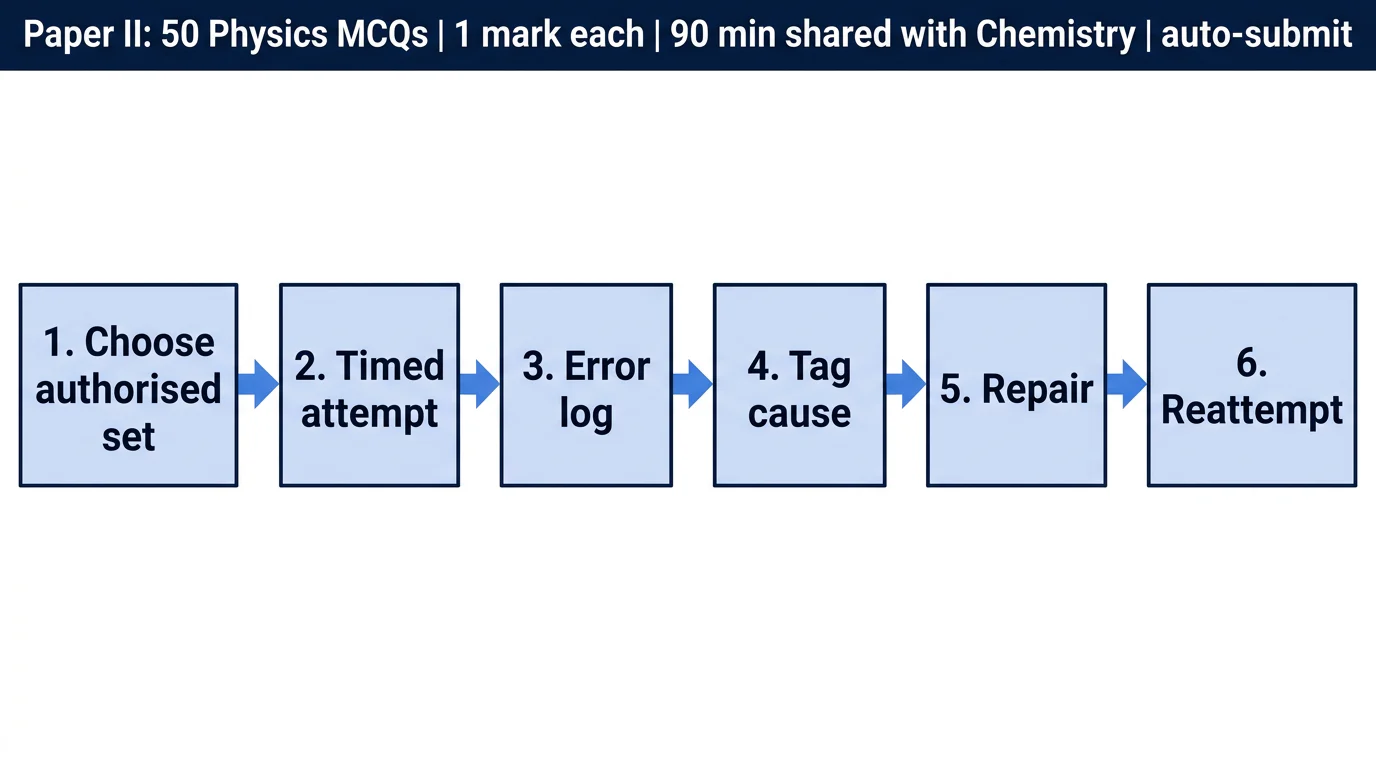
Keep the log chapter-wise at first. Later, sort it by tag across chapters. A repeated calculation tag calls for calculation practice; a repeated formula tag calls for a concise formula revision pass; a repeated time tag calls for a revised attempt strategy. For a related accuracy-focused workflow, see MHT CET Physics Accuracy Improvement Plan.
Keep paper analysis transparent and question access authorised
Question material should be used only when you are authorised to access it. This guide should not host copied or unlicensed paper PDFs, and it should not describe a reconstruction as an official paper. A practical chapter-wise plan can still work without hosting files: identify the source in your error log, attempt the questions where they are legitimately available and record the result.
The same caution applies to paper-pattern analysis. The official 2026 documents establish the Class XI and Class XII split and Paper II timing. They do not provide an official individual-chapter frequency table. A transparent analysis can therefore say what was counted in a stated collection of questions, but it should not promise that the next MHT-CET paper will repeat the same distribution.
This boundary is a strength, not a missing section. It gives students a clear difference between documented exam rules, a source-labelled practice collection and personal performance data. Use the official syllabus as the stable checklist, then use the error log to decide what to revise next. The 80/20 MHT-CET Physics Syllabus Checklist and Revision Order can support that revision sequence.
Go deeper
Frequently asked
The State CET Cell's 2026 pattern gives Physics 50 MCQs in Paper II: 10 based on Class XI and 40 based on Class XII. Each Physics question carries 1 mark, while Physics and Chemistry together make up the 100-mark Paper II.
The official 2026 material gives a Class XI and Class XII split, not marks or frequency for individual Physics chapters. A chapter ranking can be a dated analysis of a disclosed PYQ collection, but it should not be presented as an official weightage list or a prediction.
Physics shares the first 90-minute block with Chemistry, and that block auto-submits before the next subject group begins. Set a Physics time target from your own timed attempts, then revise the target after reviewing where wrong, guessed and skipped questions occurred.
This guide should use only question material that the reader is authorised to access and should not host copied or unlicensed PDFs. When a paper's source status is unclear, describe it cautiously and focus the page on the attempt-and-review method instead.
Choose the next step after your PYQ review
See RG Lectures' current MHT-CET batches and course details.
View MHT-CET batches