MHT CET Physics: Solo Practice or Mentor Help?
MHT CET Physics solo practice or mentor help: use an eight-week error-repair plan to improve accuracy from 25–30/50.

MHT CET Physics: Solo Practice or Mentor Help?
Two months is enough to make a meaningful accuracy improvement when we stop treating every wrong answer as proof that the whole syllabus is weak. In the latest official pattern, Physics has 50 questions, with 10 from Std XI and 40 from Std XII.
For MHT CET Physics solo practice or mentor help, start with solo diagnosis: classify every lost mark by chapter and cause, repair the most common failure, complete a short timed set, and retest it. Bring in mentor support when the same conceptual or method error survives two repair cycles or you cannot identify the reason without help.
We will map the exam constraints, a chapter-priority method, a seven-part error log, and an eight-week repair calendar. We will also show how to tell slow calculation from slow method selection before paying for more support.
What Should a 25 to 30 Out of 50 Scorer Do First?
A 25 to 30 score usually means there are marks to recover before there is any need to restart every chapter. We begin with one recent mock, then record not only what was wrong but why it was wrong and how long it took.
The official paper structure matters because Physics and Chemistry share the first 90-minute window. That means a student is working across 100 questions in 90 minutes, or an average of 54 seconds per question across the combined paper, rather than receiving a separate official Physics-only timer.
| Verified Physics Context | Current Rule |
|---|---|
| Physics questions | 50 total |
| Std XI Physics questions | 10 |
| Std XII Physics questions | 40 |
| Physics marks | 1 mark per correct answer |
| Physics and Chemistry window | 100 questions in 90 minutes |
| Negative marking | None |
| Question format | Four options, one correct answer |
The official syllabus also says questions are mainly application-based. We therefore track whether a loss came from choosing the wrong principle, failing to recall a formula, making a rushed calculation, or spending too long on one question.
Start with these three numbers in every review:
- Physics score: Correct answers out of 50.
- Accuracy rate: Correct answers divided by attempted questions.
- Repeat-error count: How many times the same cause appears across two analysed mocks.
A student whose score rises from 26 to 30 because arithmetic slips fall is making different progress from one who stays at 26 while attempting more questions. For a fuller calendar once the diagnosis is complete, use our eight-week score plan.
Which Physics Chapters Should You Prioritise First?
We do not recommend chasing internet chapter-weightage claims that cannot be checked against official evidence. Instead, we rank chapters by the marks they are actually leaking in your mocks, while respecting the official Std XII and Std XI split.
The first priority is not necessarily the chapter that sounds hardest. It is the chapter where a repair is likely to recover repeated marks quickly, especially if the same error has appeared in more than one paper.
| Priority | What To Review | Evidence Rule | Source And Date |
|---|---|---|---|
| First | Any chapter with the most repeated wrong answers | Same chapter and cause appear in two analysed mocks | Your dated error log |
| Second | Std XII chapters with recurring losses | Std XII supplies 40 of the 50 Physics questions | Official MHT-CET syllabus, 2026 |
| Third | Std XI listed units with recurring losses | Std XI supplies 10 of the 50 Physics questions | Official MHT-CET syllabus, 2026 |
| Last | Untested or merely feared chapters | Diagnose before calling a chapter low priority | Your first diagnostic |
The named Std XI Physics coverage includes vectors and error analysis, motion in a plane, laws of motion, gravitation, thermal properties, sound, optics, electrostatics, and semiconductors. The 2026 marking scheme confirms that the whole applicable Std XII syllabus remains in scope, so no one should promise that a short list will replace proper diagnosis.
Use a simple ranking calculation: repeated errors first, then marks lost, then the time needed to repair the pattern. Students deciding between fast revision and wider teaching can also compare our Physics crash course guide.
Why Is Your Numerical Solving Speed Slow?
Slow numericals are not one problem. Some students know the formula but cannot select the right principle. Others set up correctly, then lose time to units or arithmetic. Treating both students with the same 50-question worksheet wastes valuable revision time.
We use an error log because it turns “Physics is slow” into a precise next action. That is the difference between repeating questions and repairing the reason they fail.
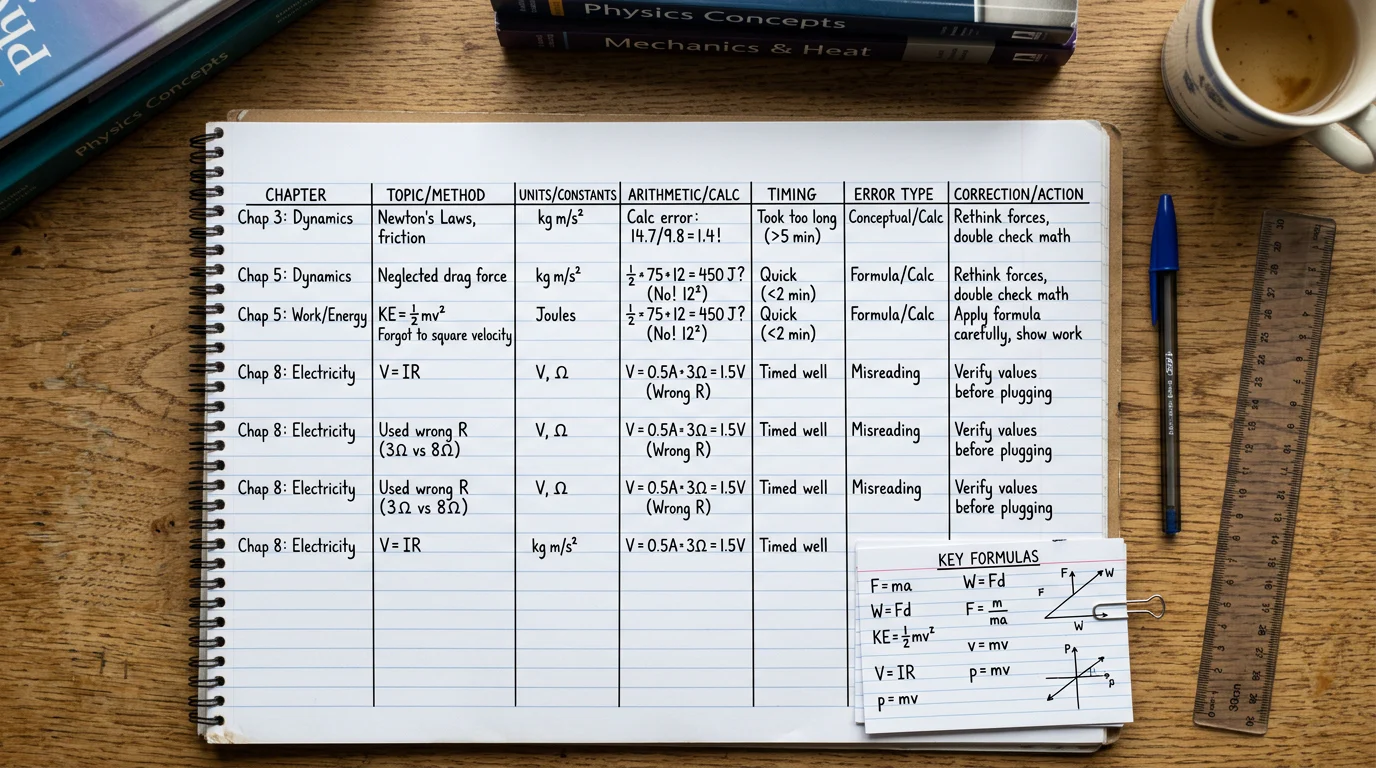
Build a Seven-Category Error Log
| Error Category | What It Looks Like | First Repair |
|---|---|---|
| Conceptual gap | The governing principle is misunderstood | Relearn the minimum concept, then explain it aloud |
| Formula retrieval | The method is known but the formula is missing | Use formula-to-condition recall drills |
| Setup or method selection | The wrong equation, variable, or diagram is chosen | Write given, principle, equation before calculation |
| Units or dimensions | A conversion or dimensional check fails | Write units before substituting values |
| Arithmetic | Setup is correct but calculation changes the answer | Practise short calculations with visible steps |
| Guessing | An option is selected without a reason | Record why the chosen option seemed plausible |
| Time allocation | One question consumes too much of the paper | Mark, move, and return during a second pass |
Separate Method Time from Calculation Time
Give each numerical two timers. In the first, do not calculate: identify the known values, required quantity, and governing principle. In the second, carry out the calculation only after the route is clear.
If the first timer repeatedly stalls, the issue is method selection. If the route is immediate but the second timer drags, the issue is calculation, units, or arithmetic. This distinction lets us choose the right drill instead of assigning more of the same work.
Turn Each Loss into a Fresh Test
A repair is incomplete when the student merely understands the solution after seeing it. We ask for a new, structurally similar question with changed values or context, completed under a recorded timer.
For chapter-specific practice formats and worked explanations, students can use our numerical practice resources. The goal is not to collect more solutions, but to make the next unseen question less dependent on them.
How Do You Repair an Accuracy Error Instead of Restarting the Syllabus?
We use a four-stage loop: classify, repair, drill, and retest. It is deliberately narrower than broad revision because it creates evidence that a problem has actually improved.
A correct answer on the same question does not prove mastery. A correct answer on a fresh question, reached by the right method in less time, is much stronger evidence that the repair worked.
Classify the Loss
Record the chapter, selected option, correct option, category of error, time used, and confidence level. A confident wrong answer usually needs a different repair from a rushed guess.
Repair the Smallest Broken Step
Repair only what failed. A conceptual gap may need a first-principles explanation, while a formula retrieval problem may need a short recall drill. At RG Lectures, we can unpack each MCQ from the basics when that is the missing step, rather than assuming every student already has the foundation.
Drill the Exact Method
Use a small timed set that repeats the method, not the original question. For example, a setup issue in current electricity needs several fresh circuit setups, not a general reread of every electricity note.
Retest with Unseen Questions
Retest after the drill and update the error log. When the same conceptual or setup error remains after two complete repair cycles, stop trying to solve it through volume alone and move it into mentor review.
Our accuracy improvement plan can help students keep this loop consistent across the full eight-week period.
When Is MHT CET Physics Solo Practice or Mentor Help Worth It?
Solo work is enough when students can accurately diagnose a mistake, choose a repair, and show improvement on a fresh retest. Structured help becomes valuable when the feedback loop is broken, not simply because a mock score feels disappointing.
The decision should be based on recurrence, diagnosis ability, available time, and trend across analysed mocks. A mentor cannot replace practice, but timely feedback can prevent repeated practice from hardening the wrong method.
| Decision Factor | Continue Solo When | Consider Mentor Help When |
|---|---|---|
| Error recurrence | The cause disappears on a fresh retest | The same concept or setup error survives two repair cycles |
| Diagnosis ability | You can name the cause and choose a repair | You cannot tell whether the issue is concept, formula, setup, or timing |
| Available time | You can complete repair and retest before simulations | Trial and error is taking time away from full-paper practice |
| Score trend | The last two analysed results are improving | Results remain flat or decline despite completed practice |
| Doubt pattern | You need an occasional specific clarification | You repeatedly need a first-principles explanation of the method |
Use Mentor Time for Diagnosis, Not Passive Watching
Bring a mentor the exact question, your attempted method, your error category, and the result of your retest. That makes the session a diagnosis and repair conversation, not a vague request for “more Physics.”
Students comparing what effective feedback should look like can read our mentoring quality standard. We recommend choosing support that can explain why the method failed and prescribe the next testable action.
Follow an Eight-Week Repair Calendar
| Weeks | Stage | Main Work | Evidence To Keep |
|---|---|---|---|
| 1 To 2 | Diagnosis | Analyse recent mocks and build the error log | Baseline score, accuracy rate, chapter heat-map |
| 3 To 4 | Targeted repair | Fix the two most frequent error categories | Two repair-cycle records |
| 5 To 6 | Mixed practice | Combine repaired and stable chapters in timed sets | Trend in method and calculation time |
| 7 To 8 | Simulation | Take combined Physics and Chemistry practice under the shared clock | Final score trend and prevention checklist |
Use your own median from the last three section results as the baseline, then write a realistic target score out of 50. Since percentile is not the same as raw marks, the official brochure is a better guide to the exam structure than universal score-to-percentile promises.
Check These Points Before the Next Mock
- Formula condition: Recall when the formula applies, not only its symbols.
- Units check: Convert quantities before substitution, then inspect the final dimension.
- Method choice: Identify the principle before starting calculations.
- Time control: Mark a time sink and return after the first pass.
- Final response check: Use the remaining shared window to ensure every Physics response is recorded.
For a deeper decision framework before choosing paid support, see our doubt-solving guide.
Build a Repair System with RG Lectures
At RG Lectures, we work with students who do not need another enormous syllabus list. They need someone to locate why a Physics answer went wrong, rebuild the missing step, and make the next timed attempt more reliable. Our approach is to unpack each MCQ from the basics when necessary, then move quickly to the exact numerical pattern that still costs marks. That makes support useful for students whose doubts are recurring, whose method choice freezes under time, or whose mock reviews never turn into a next action.
We encourage you to bring a recent error log, not just a score. Together, we can separate formula recall from conceptual gaps, weak setup from arithmetic slips, and a one-time mistake from a repeating pattern. If solo repair is working, we will say so. If a tighter feedback loop would save time, we will show you what to fix first. Explore RG Lectures Home.
FAQs on MHT CET Physics Solo Practice or Mentor Help
Can I Improve from 25 to 30 Out of 50 in Eight Weeks?
Yes. Focus on repeated errors instead of restarting every chapter. Track each loss, repair its cause, and confirm progress with new timed questions in practice.
Should I Restart the Entire Physics Syllabus?
No. Identify the chapters and error types leaking marks first. Rebuild the faulty method only, then retest it using unfamiliar questions under realistic timed conditions.
Why Do I Know Formulas but Still Lose Numericals?
Knowing a formula is only one step. Slow numericals often begin with slow method selection, unclear variables, weak unit control, or arithmetic after correct setup.
When Is Mentor Help Worth Paying For?
Consider mentor help when the same conceptual or setup mistake remains after two repair cycles, or when you cannot diagnose the cause from solutions independently yet.
How Should I Use the Physics and Chemistry Time Window?
Use a combined Physics and Chemistry simulation within the official 90-minute window, then tag Physics mistakes separately. This better mirrors the shared exam clock during testing.