How to Improve MHT CET Physics in 8 Weeks | MHT CET Physics Mock Accuracy Improvement Plan
MHT CET Physics mock accuracy improvement plan for students scoring 25 to 30: diagnose errors, build speed, and decide when mentor support helps.

MHT CET gives Physics and Chemistry a shared first block of 90 minutes, so a Physics score can fall when calculation, selection, or pace breaks down even if the chapter feels familiar. The current 2026 brochure also confirms four-option MCQs and no negative marking.
For students scoring 25 to 30 in mocks, our MHT CET Physics mock accuracy improvement plan starts with missed questions, not a syllabus restart. Label each miss as concept, calculation, formula recall, timing, or selection; repair one micro-topic, then prove the fix in a short timed set before your next mock.
We will show you how to diagnose errors, choose chapters without chasing generic weightage lists, run an eight-week cycle, analyse numericals, and decide when structured mentor support is worth using.
What Is Suppressing Your Score? The MHT CET Physics Mock Accuracy Improvement Plan
A score stuck in the 25 to 30 range rarely means every chapter is weak. It usually means the same small set of mistakes keeps returning under timed conditions. We begin by making those mistakes visible, because “revise Physics” is too broad to tell you what to do tomorrow.
Use Five Error Labels
Give every missed or slow question one primary label. If a formula was remembered but the exponent was copied wrongly, it is a calculation error, not a formula-recall error. This keeps the correction specific.
| Error Type | What It Looks Like | Immediate Fix | Timed Re-Test |
|---|---|---|---|
| Concept | Wrong law, model, or condition chosen | Review the exact sub-concept | Four similar questions |
| Calculation | Unit, sign, algebra, or exponent mistake | Rewrite the calculation check | Six short numericals |
| Formula Recall | Formula unavailable or incomplete | Build one formula cue | Ten recall prompts |
| Timing | Correct route found too slowly | Practise the shortest valid method | Five-question sprint |
| Question Selection | Easy question skipped or hard question held too long | Set a pass order | Mixed mini-mock |
Catch Avoidable MCQ Patterns
Some errors deserve their own line in the log because they are preventable. Before checking the solution, mark whether you changed units, wrote the sign convention, and read the condition at the end of the question.
- Unit conversion: Check prefixes before substituting values.
- Sign errors: Write the direction or sign rule before starting algebra.
- Premature approximation: Keep enough digits until the final comparison with options.
- Misread conditions: Circle words such as “maximum,” “least,” “not,” or “at equilibrium.”
- Formula misuse: Note the condition under which the formula applies, not only the formula itself.
When you want a second view of your log, use our accuracy plan as a comparison point. The goal is not a prettier notebook. It is fewer repeat mistakes in the next timed set.
Which Chapters Come First?
We rank chapters with three signals: whether they are in the current syllabus, their past-paper estimate, and how often they appear in your error log. The official material defines the syllabus and pattern, but it does not publish fixed chapter-level marks, so no chapter percentage should be treated as guaranteed.
Past-paper estimates can still help break a tie. One past-trend table groups Oscillations and Waves, and Modern Physics, at about 7% each, with Work, Energy and Power, Thermodynamics, Current Electricity, and Optics around 6% each. Use these as planning signals, not official allocations.
| Priority | Chapter Group | Past-Paper Signal | Your Error Trigger | This Week’s Action |
|---|---|---|---|---|
| First | Oscillations And Waves | About 7% | Three or more recurring misses | Repair the repeated micro-topic |
| First | Modern Physics | About 7% | Formula recall or option confusion | Formula recall plus mixed MCQs |
| Next | Thermodynamics Or Work, Energy And Power | About 6% | Slow numerical setup | Shorter solution route practice |
| Next | Current Electricity Or Optics | About 6% | Unit, sign, or condition errors | Targeted numerical sets |
| Later | Any Chapter With Few Errors | Varies | Errors already corrected | Cumulative review only |
A lower-estimate chapter can move to the top if it leaks marks in every mock. For a broader chapter sequence, compare your list with our crash-course guide, then keep your own error frequency as the deciding signal.
What Should Each Week Contain?
An eight-week recovery plan works only when each week produces evidence. We want a mock, a diagnosis, a narrow revision task, and a timed re-test. Reading a chapter again may be useful, but it is not proof that the error has gone away.
| Week | Main Job | Practice Output | Review Decision |
|---|---|---|---|
| 1 | Set a baseline | One mock and complete error log | Choose top three error patterns |
| 2 | Repair first patterns | Three timed chapter sets | Re-test Week 1 mistakes |
| 3 | Repair second patterns | One mixed set and one mock | Compare error categories |
| 4 | Calibrate speed | Timed mixed sets | Identify time sinks |
| 5 | Build cumulative control | One full mock and re-tests | Remove solved micro-topics |
| 6 | Eliminate repeat errors | Mixed numerical practice | Escalate persistent problems |
| 7 | Execute under exam conditions | Two full mocks | Stabilise question order |
| 8 | Consolidate | Error-log revision and selected mocks | Practise only unresolved issues |
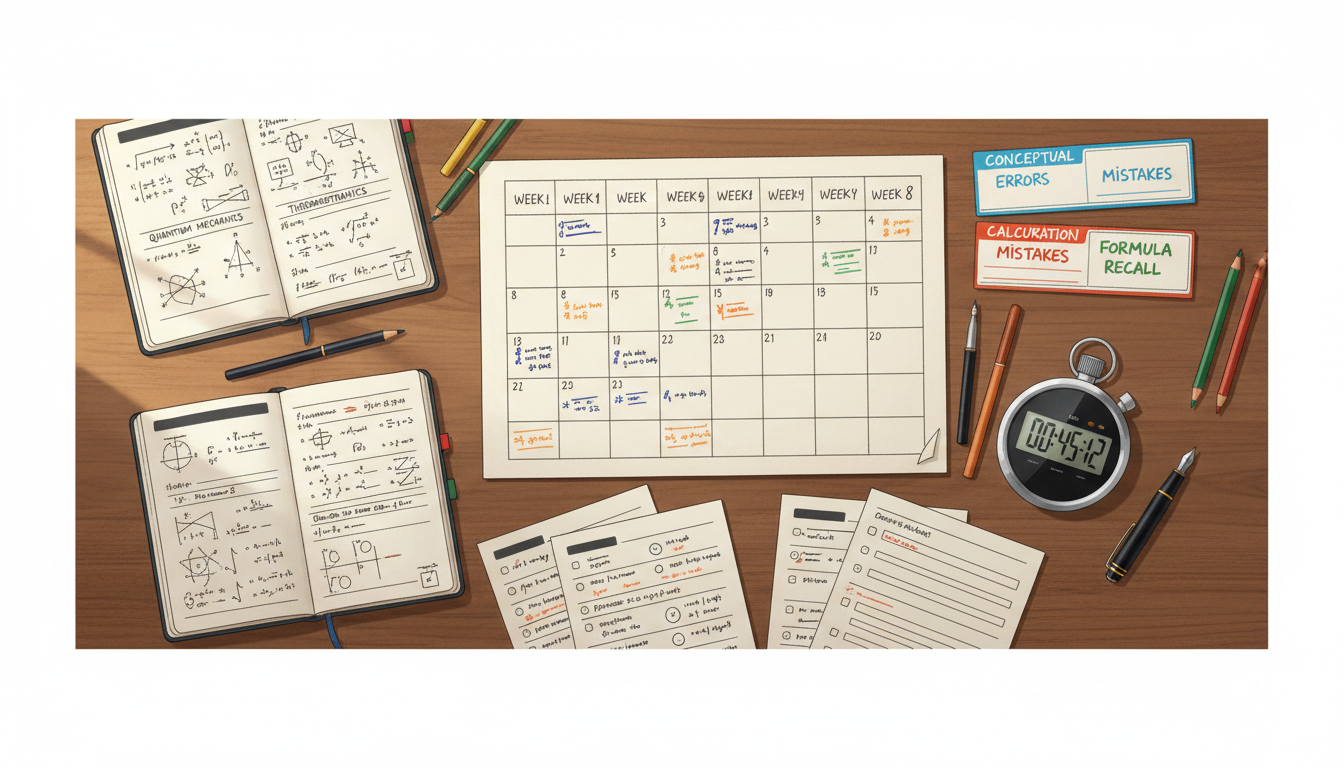
Keep the mock condition realistic: Physics and Chemistry share the first part of the exam, so train your pacing alongside the subject rather than inventing an isolated time limit. Our revision comparison can help when you are deciding whether the next session should be revision or past-paper practice.
How Should You Analyse a Mock?
A mock is not finished when you see the score. We use it as a diagnostic test: Which questions were correct but too slow? Which were wrong but recoverable? Which were not attempted because the first step was unclear? Those answers determine the next week.
Timed quizzing is worth protecting in this plan. A review of 222 studies involving 48,478 students found a medium overall achievement benefit from testing and quizzing, especially when practice is designed with useful conditions such as feedback and repeated testing. See the quizzing evidence for the research context.
Run a Short Post-Mock Triage
Set aside the first 20 minutes after a mock to sort questions into four groups: correct and quick, correct but slow, wrong but fixable, and wrong because the concept was missing. Do not begin a full chapter revision before completing this sort.
Students who need scheduled check-ins alongside self-study can use our small-batch comparison to assess whether the review structure matches their error pattern and available study time.
Turn a Wrong Numerical into a Micro-Task
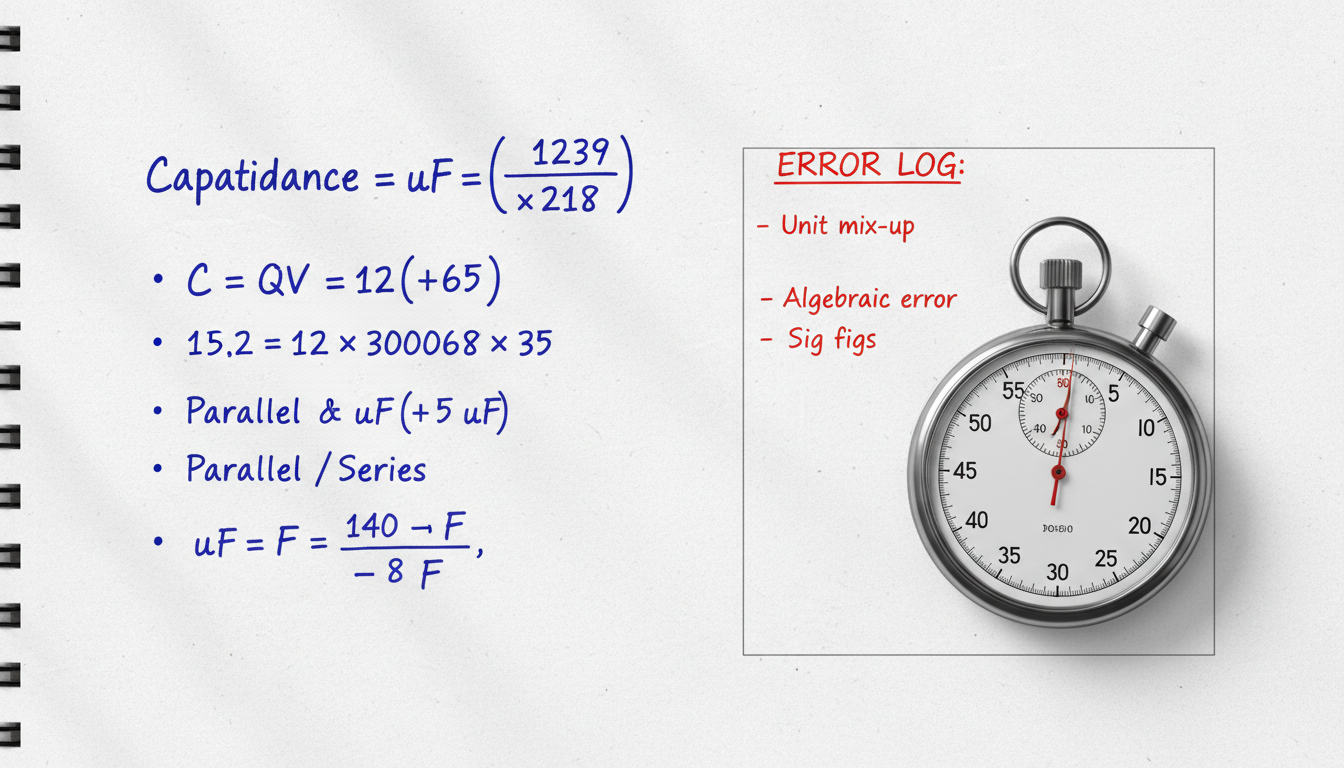
Suppose an illustrative capacitance question gives (Q = 6,\mu C) and (V = 12,V). You use (C = Q/V), then select 0.5 F instead of 0.5 μF.
The diagnosis is calculation, specifically a missed micro-prefix. Your correction is not “revise electrostatics.” It is: review SI-prefix conversion, solve four conversion checks, solve four electrostatics substitutions, then complete four mixed questions on a timer. If the same issue returns, log it as a repeat error.
Use a Three-Pass Attempt Order
Start with direct-recognition questions, move to familiar numericals, then return to uncertain questions. Since there is no negative marking, the final pass can include informed attempts, but only after you protect the questions you can solve accurately.
When Is Mentor Support Useful?
Structured help becomes useful when the same problem survives self-correction. A student who corrects a unit mistake once and gets the re-test right may only need a good error log. A student who repeatedly chooses the wrong law, stalls on numerical setup, or mismanages timing across two analysed mocks needs more diagnostic feedback.
| Pattern In Your Log | Best Support Level | What Good Feedback Produces |
|---|---|---|
| One-off recall lapse that disappears in a re-test | Self-correction | Formula cue and verified re-test |
| One defined method stays unclear | Occasional doubt solving | Explanation, alternate method, short check set |
| Same error returns in two analysed mocks | Regular mentor review | Root-cause diagnosis and weekly reset |
| Speed remains poor despite correct concepts | Regular mentor review | Question selection and method feedback |
Feedback quality matters more than access to answer keys. A meta-analysis covering 435 studies and more than 61,000 learners found a medium average effect for feedback, while also showing that its information content changes its impact. That is why we look for precise corrective feedback, not a generic “practise more” response. Read the feedback research for that distinction.
Use our mentoring quality standard to assess how feedback should work. Before paying, ask about mock analysis, doubt-response time, individual follow-through, and whether corrections are tested again.
How Do You Measure Improvement?
A better score is the outcome, but it is not the only measure we track. If accuracy rises while speed holds, the plan is working. If you attempt more questions but accuracy falls sharply, the problem is likely selection or rushed calculation, not lack of effort.
Track these numbers after every mock:
- Attempted questions: The number you seriously answered.
- Correct answers: Your raw accuracy base.
- Avoidable errors: Calculation, recall, timing, or selection mistakes you could have prevented.
- Repeat-error count: Errors that returned after a correction task.
- Time per attempted question: Physics minutes divided by attempted Physics questions.
Review the trend after each full mock, not after every single practice set. If a category repeats twice, change the support level or the correction method. If a category disappears, stop spending revision time on it and shift the effort to the next leak. Our coaching decision guide can help you judge whether a more regular review structure fits your pattern.
Get an Error-First Review from RG Lectures
At RG Lectures, we built our MHT CET Physics support around the work a late-stage student actually needs: seeing why a question was lost, choosing the next micro-topic, and checking whether that correction holds under time. We do not treat a mock score as a verdict. We use it to focus the next week. Bring your recent Physics mocks, attempted-question counts, and error log. We can help you separate a one-time formula lapse from a repeat concept, calculation, timing, or selection problem, then decide whether a doubt session or regular review makes sense. Before paying for any program, ask how quickly doubts are answered, whether somebody reads your mock analysis, and who follows up after correction. Our goal is a usable feedback loop, not more unfinished material, so your next practice session has a clear, testable purpose. Start by exploring RG Lectures Home.
FAQs on MHT CET Physics Mock Accuracy Improvement Plan
These answers apply the same error-first approach to the most common decisions students face during an eight-week Physics recovery period.
Can I Improve from 25 to 30 Marks in Eight Weeks?
Yes, if missed marks mainly come from repeatable errors rather than untouched syllabus. Set a baseline, repair recurring errors, then test every correction under timed conditions.
What Should I Track After Each Mock?
Track attempted questions, correct answers, avoidable errors, repeat-error count, and minutes per attempted question. Together, these reveal whether accuracy, speed, or question selection is limiting progress.
When Should I Get Regular Mentor Review?
Choose occasional doubt solving when one method remains unclear after targeted revision. Choose regular review when the same mistake returns across two fully analysed mocks consecutively.
Should I Always Start with Higher-Weightage Chapters?
Prioritise chapters by three signals: syllabus inclusion, past-paper estimates, and recurring errors. A lower-estimate chapter can come first when it repeatedly leaks marks in mocks.
How Should I Attempt Physics Questions Faster?
Use three passes: direct questions first, familiar numericals next, and uncertain items last. Recheck units, signs, and conditions before changing an answer under pressure.