Electric Dipole: Torque, Work and Energy in 3 Steps
An electric dipole is two equal and opposite charges held apart, with moment p = qd pointing from negative to positive. Torque, work and energy questions all hinge on one angle.

By Rahul Jeewani, Founder · Updated 12 Nov 2026

Key takeaways
- In a uniform field, a dipole's torque is pE sinθ (largest at 90°) and its potential energy is −pE cosθ (lowest at 0°, zero at 90°, highest at 180°). Here p is the dipole moment, E the field, and θ the angle between them.
- Work to turn a dipole slowly from θ₁ to θ₂ is pE(cosθ₁ − cosθ₂). Starting parallel to the field, turning through 60° costs pE/2 and turning through 180° costs 2pE, which is 4 times as much.
- The axial field is twice the equatorial field only when the point is far from the dipole. In our calculation the ratio is about 2.96 at a distance of 3a, where 2a is the separation of the charges.
- MHT-CET gives 1 mark per Physics question and has no negative marking. Physics shares a 90-minute block with Chemistry, about 54 seconds per question, and a three-step check fits inside that.
In this article
- 1What is an electric dipole and which way does its dipole moment point?
- 2How do I solve an electric dipole numerical in three steps?
- 3Why does a dipole at 180° have zero torque but the highest potential energy?
- 4Is the field on the axis of an electric dipole always twice the field on the equator?
- 5What should I practise for MHT-CET dipole questions?
- 6Where can I practise electric dipole numericals with a teacher?
- 7Frequently asked questions
A dipole feels the most torque, the turning effect of a force, at 90°, but its potential energy is highest at 180°. Confusing the two is the easiest way to lose a mark on this topic. Both numbers come from the angle between the dipole moment and the electric field.
The formulas are short. What trips people up is the angle: which one goes into which formula, why a dipole with zero torque can still sit at maximum energy, and when the rule that the field along the dipole's axis is twice the field on its equator stops being true.
Below you get a three-step routine that fixes the angle before any formula comes out, three tables to check answers against, and a calculation showing how far the 2:1 rule can be trusted. It is written for Class 12 students preparing for MHT-CET, the Maharashtra Health and Technical Common Entrance Test, though the physics is the same on any board.
What is an electric dipole and which way does its dipole moment point?
An electric dipole is a pair of equal and opposite point charges, +q and −q, held a fixed distance d apart. Its dipole moment is p = qd, a vector pointing from the negative charge to the positive charge, measured in coulomb-metres (C·m) (Wikipedia, Electric dipole moment).
Textbooks often write the separation as 2a, so p = q × 2a. Two slips happen here before any physics starts:
- The length. If a question says "a dipole of length 2 cm", that is the full separation d between the charges. Do not halve it, and do not double it again.
- The direction. p points from −q to +q. The field lines inside a dipole also run from +q to −q, so the two directions are opposite and easy to swap.
How do I solve an electric dipole numerical in three steps?
Name the quantity asked for, fix θ as the angle between p and the electric field E, then check the answer against the shape of the energy curve. The formulas hold in a uniform field, where E has the same value and direction across the whole dipole (LibreTexts, The Electric Dipole).
- Name what is asked.
- Torque: τ = pE sinθ.
- Potential energy: U = −pE cosθ.
- Work to rotate the dipole slowly (so it gains no kinetic energy): W = U₂ − U₁ = pE(cosθ₁ − cosθ₂).
- Fix the angle and the units.
- θ is always the angle between p and E. "Placed parallel to the field" means θ = 0°, and "opposite to the field" means θ = 180°.
- Convert centimetres to metres, and use d, the full separation, in p = qd.
- Check the answer against the curve.
- Torque is zero at 0° and 180° and largest at 90°.
- Energy is lowest at 0°, zero at 90° and highest at 180°.
- Turning a dipole away from the field (θ increasing) costs positive work. A negative W is correct only when the dipole turns towards the field (θ decreasing); otherwise you have swapped cosθ₁ and cosθ₂.
The table below gives τ and U in units of pE, from τ = pE sinθ and U = −pE cosθ, so you can check any answer by eye.
| θ | Torque τ (units of pE) | Energy U (units of pE) | What it means |
|---|---|---|---|
| 0° | 0 | −1 | Lowest energy, stable |
| 30° | 0.5 | −0.866 | Swings back to 0° |
| 60° | 0.866 | −0.5 | Swings back to 0° |
| 90° | 1 | 0 | Largest torque, energy zero |
| 120° | 0.866 | +0.5 | Swings towards 0° |
| 180° | 0 | +1 | Highest energy, unstable |
Worked example 1: find the charge from the torque. Practice problem: a dipole of length 2 cm sits at 30° to a uniform field of 5 × 10⁴ N/C and feels a torque of 0.05 N·m. Find q.
- τ = qdE sinθ, so q = τ / (dE sinθ).
- d = 0.02 m, so q = 0.05 / (0.02 × 5 × 10⁴ × 0.5) = 0.05 / 500 = 1 × 10⁻⁴ C.
Worked example 2: scale the work. A dipole starts parallel to the field. The work to turn it through 60° is W. What is the work to turn it through 180°?
- W = pE(cos 0° − cos 60°) = pE(1 − 0.5) = 0.5 pE.
- For 180°: pE(cos 0° − cos 180°) = pE(1 + 1) = 2 pE.
- So the 180° work is 2 pE ÷ 0.5 pE = 4W.
| Turned from parallel through | Work (units of pE) | Multiple of the 60° work |
|---|---|---|
| 60° | 0.5 | 1 |
| 90° | 1 | 2 |
| 120° | 1.5 | 3 |
| 180° | 2 | 4 |
The work is not proportional to the angle. It follows (1 − cosθ), which is why 180° costs 4 times as much as 60° rather than 3 times.
Why does a dipole at 180° have zero torque but the highest potential energy?
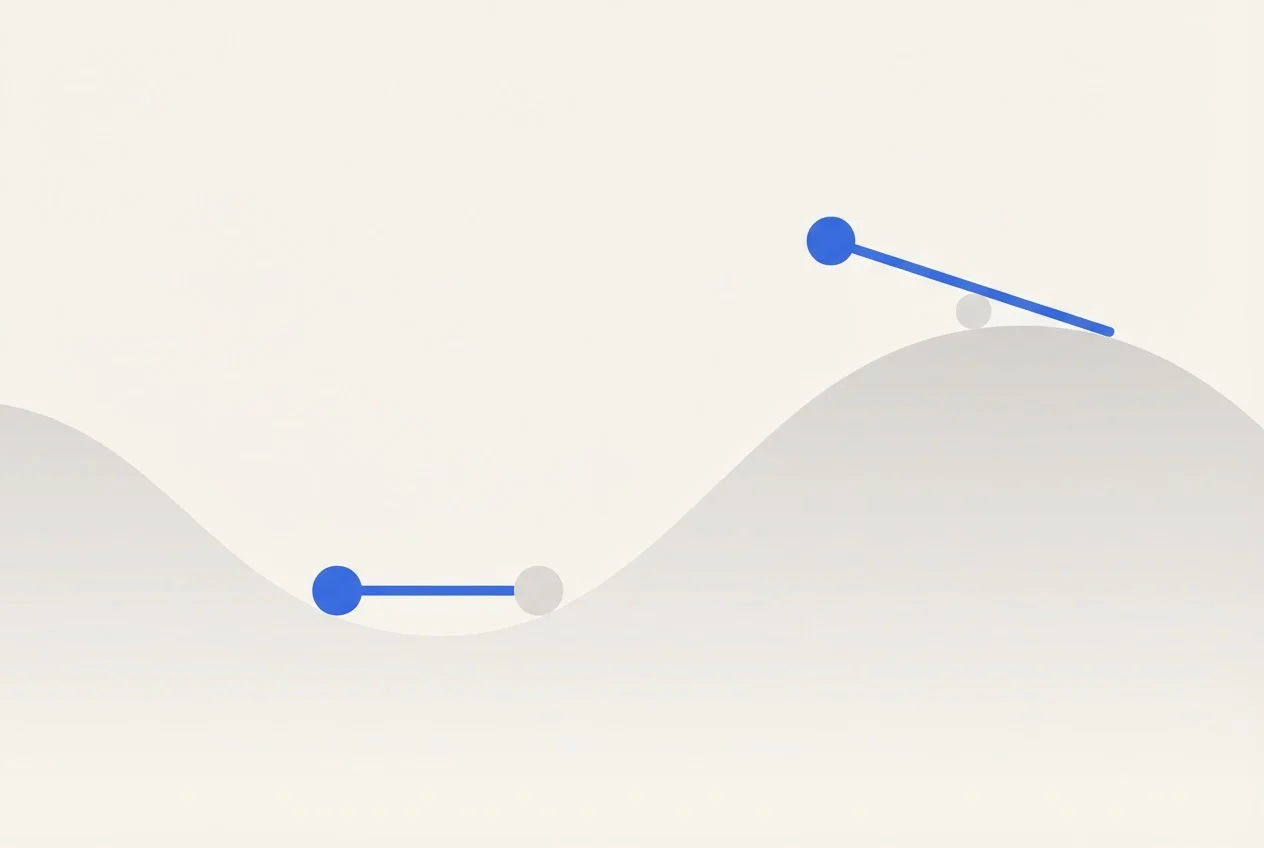
Torque is the slope of the energy curve, and the slope is zero at both the bottom and the top of the curve. Differentiating U = −pE cosθ gives dU/dθ = pE sinθ, which is exactly the size of the torque.
At 0° the dipole sits at the bottom of the curve. Nudge it and it swings back, which is stable equilibrium. At 180° it sits at the top. The smallest nudge sends it rotating away and the stored energy is released, which is unstable equilibrium (LibreTexts). Think of a pendulum hanging straight down against one balanced upright: both have zero torque, only one has high energy.
The zero of potential energy at 90° is a choice, not a law. (LibreTexts). That is why work questions subtract two energies instead of quoting one.
Is the field on the axis of an electric dipole always twice the field on the equator?
No. The axial field (on the line through both charges) is twice the equatorial field (on the perpendicular bisector) only when the point is far from the dipole, meaning r is much greater than a. Close in, the ratio is bigger than 2.
The exact fields follow from Coulomb's law for two point charges at ±a, with k = 1/(4πε₀) and p = 2aq. For help with direction and medium slips in that law, see our Coulomb's Law page.
- Axial point, distance r from the centre: E = kq[1/(r − a)² − 1/(r + a)²] = 2kpr / (r² − a²)², along p.
- Equatorial point, distance r from the centre: the components along the axis add and the sideways ones cancel, so E = kp / (r² + a²)^(3/2), opposite to p.
- Far away (r ≫ a): these reduce to 2kp/r³ and kp/r³.
The ratio is axial ÷ equatorial = 2r(r² + a²)^(3/2) / (r² − a²)². It works out as follows at four distances.
| Distance r | Ratio axial ÷ equatorial |
|---|---|
| 3a | 2.96 |
| 5a | 2.30 |
| 10a | 2.07 |
| 100a | 2.001 |
If a question gives r and a of similar size, use the exact formulas. Use 2kp/r³ and kp/r³ only when r is much larger than the separation.
A dipole has zero net charge, so the net flux through any closed surface enclosing both charges is zero. Zero flux does not mean zero field, and our Gauss Law page works through why.
What should I practise for MHT-CET dipole questions?
Practise torque, rotation work and energy first, and do them fast. As of November 2026, the 2026 brochure from the CET Cell Maharashtra sets the PCM (Physics, Chemistry, Mathematics) pattern as 150 multiple-choice questions in 180 minutes, with no negative marking (CET Cell Maharashtra, Information Brochure MHT-CET 2026, updated 11 April 2026).
The 2026 MHT-CET PCM paper has two 90-minute blocks. Physics and Chemistry share the first block (100 questions, 1 mark each), which works out to about 54 seconds per question (90 × 60 ÷ 100). Mathematics has the second block (50 questions, 2 marks each). Candidates cannot return to Physics or Chemistry once block 1 ends (RG Lectures, MHT-CET exam pattern).
We recommend practising torque, rotation work and energy first, because they need only three formulas and one angle.
- Time the routine. Run the three steps on ten numericals and aim for under a minute each. Our guide on how to solve physics numericals covers the general four-step method behind it.
- Never leave one blank. With no negative marking, a guess costs nothing. The curve check often removes options: for "angle of maximum potential energy", 0° and 90° are out immediately.
- Write the angle down first. Write "θ = angle between p and E = ..." before any formula.

Where can I practise electric dipole numericals with a teacher?
We teach the complete MHT-CET Physics and Chemistry syllabus in our MHTCET 2027 Long Term Batch, taught by Rahul Jewaani (RG Sir). It includes live classes, recordings, notes, previous year questions (PYQs) and mock tests. As of November 2026 it is listed at ₹1,632, discounted from ₹1,999.
Our PCM Test Series in the store lets you practise the 54-second pace under paper conditions. Physics Aasaan hai once the angle is fixed, and that is the habit we teach. See the MHT-CET 2027 batches in our store.