Glossary
MHT-CET exam pattern
Also called: MHT CET paper pattern · MHT-CET question and marking scheme

By Rahul Jeewani, Founder · Reviewed 16 Sept 2026
Definition
MHT-CET exam pattern is the State CET Cell’s 2026 blueprint for the computer-based PCM and PCB routes: four-option multiple-choice questions, 180 minutes split into two locked 90-minute blocks, and 200 possible marks. PCM has 150 questions, while PCB has 200, with no negative marking.
In practice
- Physics and Chemistry always occupy the first 90-minute block, which is automatically submitted before the second block opens.
- PCM and PCB both carry 200 marks, but PCB requires 50 more questions than PCM.
- A wrong answer does not deduct marks under the 2026 marking scheme.
- Raw marks and percentile are different measures, so a score total is not an official percentile.
Two routes, one fixed 180-minute sequence
The State CET Cell’s 2026 marking scheme sets three 100-mark papers. PCM uses the Physics and Chemistry paper plus Mathematics. PCB uses the Physics and Chemistry paper plus Biology.
| Route | Minutes 1–90 | Minutes 91–180 | Total |
|---|---|---|---|
| PCM | Physics 50 questions + Chemistry 50 questions, 100 marks | Mathematics 50 questions, 100 marks | 150 questions, 200 marks |
| PCB | Physics 50 questions + Chemistry 50 questions, 100 marks | Biology 100 questions, 100 marks | 200 questions, 200 marks |
The same official scheme assigns roughly 20% of questions to Std XI and 80% to Std XII. Mathematics has 10 Std XI and 40 Std XII questions. Physics and Chemistry each have 10 Std XI and 40 Std XII questions, while Biology has 20 Std XI and 80 Std XII questions.
The time boundary is part of the pattern
The 2026 State CET Cell brochure says that Physics and Chemistry are enabled first, then auto-submitted after 90 minutes. Mathematics or Biology is enabled only after that hand-off.
That makes the two blocks separate practical tasks. A candidate cannot save an unfinished Physics or Chemistry question for the Mathematics or Biology period. The official pattern gives one shared 90-minute block for Physics and Chemistry, not separate subject-level time limits.
A raw-mark example that changes mock review
Suppose a PCM candidate gets 42 Mathematics answers correct, 37 Physics answers correct and 38 Chemistry answers correct. The raw score is 159 marks: 42 × 2 for Mathematics, plus 37 × 1 for Physics, plus 38 × 1 for Chemistry.
The decision is not simply whether 159 is a good result. The candidate should check whether the 37 Physics and 38 Chemistry answers were completed inside the first 90 minutes, then review Mathematics separately as the second block. The official 2026 rules also confirm that wrong answers carry no negative marking. Raw marks still do not yield an official percentile.
What the recent brochures show, and what they do not
The official 2024 brochure, 2025 brochure and 2026 materials retain the core 150-question PCM, 200-question PCB and 180-minute structure. The 2026 cycle additionally included provisions for two attempts.
Use that history as context, not as a forecast. A future MHT-CET notice can change an operational rule, so candidates should check the brochure issued for their own examination year.
The operational detail worth remembering is the forced hand-off between blocks. The State CET Cell’s 2026 information brochure says the first Physics and Chemistry block is automatically submitted before the second block opens.
Where the first 90 minutes end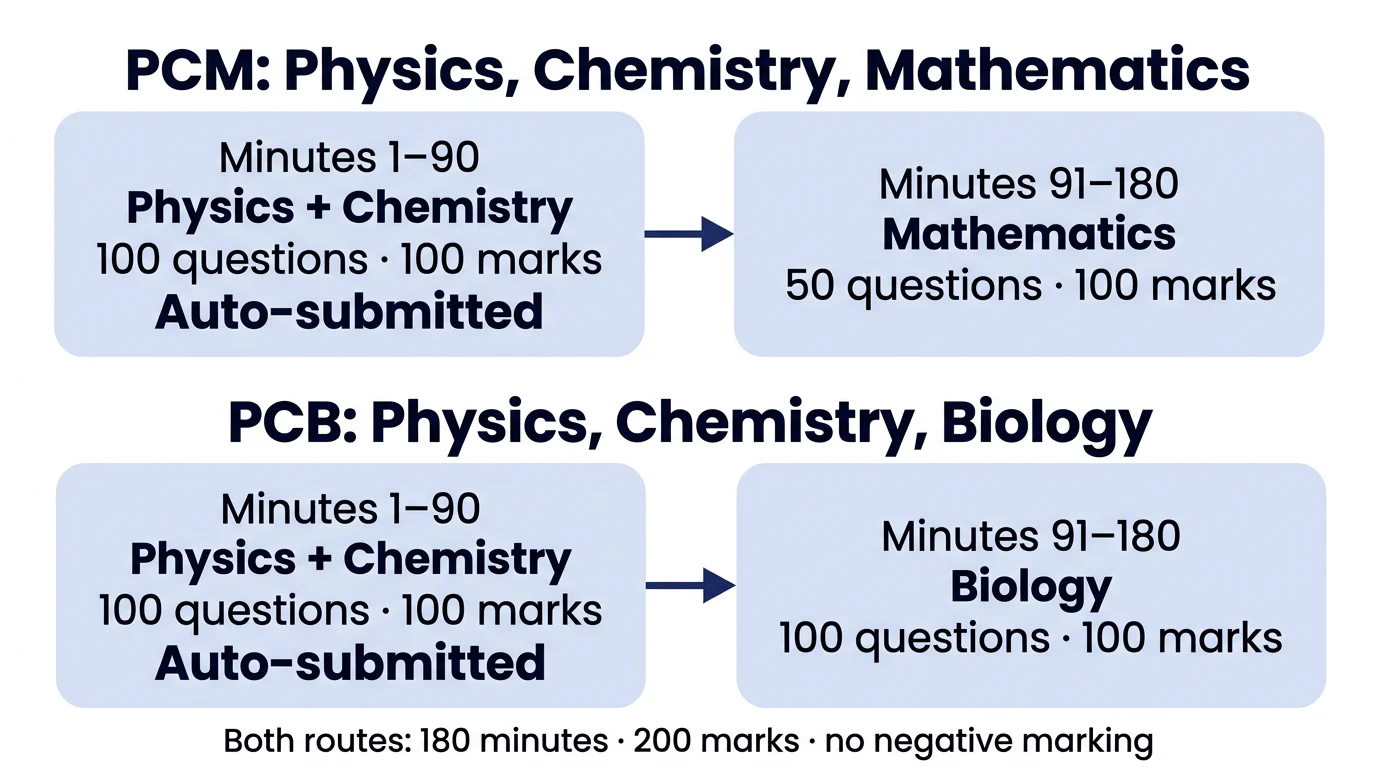
Related terms
Keep reading



Frequently asked
No. MHT-CET 2026 lasts 180 minutes, but the exam is split into two fixed 90-minute blocks. Physics and Chemistry come first. That block auto-submits after 90 minutes, then Mathematics opens for PCM candidates or Biology opens for PCB candidates.
No. The 2026 State CET Cell instructions say the first Physics and Chemistry block is automatically submitted at the end of its 90 minutes. Candidates should therefore treat the first block as final before the second subject group becomes available.
PCM has 150 multiple-choice questions for 200 marks: 50 Physics questions and 50 Chemistry questions worth one mark each, plus 50 Mathematics questions worth two marks each. PCB has 200 multiple-choice questions for 200 marks: 50 Physics, 50 Chemistry and 100 Biology questions, each worth one mark.
No. A raw score is the marks earned from correct answers under the official marking scheme. The State CET Cell states that percentile is not the same as the percentage of marks obtained, so a raw score alone cannot produce an official percentile.
The 2024, 2025 and 2026 official brochures use the same core question, mark and 180-minute structure. However, candidates should use the brochure for their own examination year because the 2026 cycle also included provisions for two attempts.
Turn the official timing rules into a Physics practice plan
Choose a course that matches the part of MHT-CET preparation you want to strengthen.
Explore Physics courses