Turn an MHT-CET Test Series Into a 180-Minute Review Plan
Use the test series to expose a preparation gap, correct it and test it again, rather than treating each mock as a score prediction.
5 chapters · Updated Sep 17, 2026 · By Rahul Jeewani
- 20% / 80%
- Std XI and Std XII syllabus weight in the 2026 scheme
In brief
A useful MHT-CET PCM test series gives you exam-pattern practice, corrective solutions and a way to act on recurring errors. Build your calendar around the official 180-minute PCM structure, then reserve a correction and re-attempt step after every test.
Choose the series by the work it lets you do
Start with the question, “What must change after I see my result?” A test series is useful when it supplies enough evidence to answer that question. Check whether full tests match the applicable official structure, whether smaller tests help you isolate a chapter or portion, whether every question has a corrective explanation, and whether results reveal the topic and timing pattern behind lost marks.
For PCM, the official 2026 baseline is not simply a three-hour paper. The State CET Cell specifies 150 questions in 180 minutes, with one mark for Physics and Chemistry questions and two marks for Mathematics questions. The official 2026 information brochure is the reference for that year, not a provider’s similarity claim. Recheck the notice for your own examination year before buying or scheduling around a pattern.
Use a short checklist before enrolling: exam-pattern timing, syllabus coverage, quality of corrective solutions, usable result breakdown, and a practical re-attempt option. A series that only displays a score can still provide exposure, but it is weaker for diagnosing why marks were lost.
Takeaway: Choose a test series for its correction loop, not for its headline number of tests.
Put review work on the calendar before adding another test
Build a calendar that connects each attempt to the next study decision. Give every row a date, test type, syllabus covered, result, missed-question topic, likely cause, correction task and re-attempt date. This format works whether you use chapter tests early, cumulative tests after several topics, or full-syllabus mocks later.
For a full PCM simulation, protect the complete official test window rather than fitting questions into scattered spare minutes. In the 2026 scheme, Mathematics is a 90-minute, 50-question, 100-mark paper, while Physics and Chemistry are jointly 90 minutes, with 50 questions in each subject and 100 marks together. The State CET Cell’s syllabus and marking scheme also assigns approximately 20% question weight to Std XI and 80% to Std XII. Those figures help you audit whether a full mock covers the intended structure.
Do not use a fixed universal number of mocks as a target. A calendar with fewer attempts and completed correction cycles can be more informative than a longer list of unreviewed scores.
Takeaway: A calendar is complete only when every test has a named correction task and a re-attempt date.
Practise the two-part PCM timing, not only the total duration
A full mock should train the sequence you will actually face, not only add up to the right total time. For the 2026 PCM format, Physics and Chemistry are enabled for the first 90 minutes. That group is automatically submitted before Mathematics becomes available for the next 90 minutes. The official information brochure also states that there is no negative marking for that examination year.
Record what happened in each half separately. Did a Physics or Chemistry question consume too much time? Did Mathematics begin with sufficient focus and a clear approach? Did a topic loss come from not knowing the method, an avoidable calculation error, or a rushed choice? These notes are more actionable than one combined score.
This approach is not ideal for every practice session. Untimed learning, worked examples and short topic practice still have a place when a concept is new. Use a full simulation once you have enough material to test, and use smaller tests when one chapter needs diagnosis.
Takeaway: A full PCM mock should reproduce the two 90-minute groups and produce separate review notes for each.
Make the solution review change the next attempt
Review in a fixed order. First, identify the questions you could not start. Next, separate questions where the method was known but execution failed. Then identify questions where time pressure changed a choice or prevented an attempt. Give each loss a topic and a cause, then choose one correction action: revisit the concept, solve a focused set, redo the worked method, or re-attempt the question without seeing the answer.
Correct answers matter more than a simple right-or-wrong indicator. In a primary study published in Memory, participants who received answer feedback after errors had higher final-test accuracy than participants who received right-or-wrong feedback or no feedback. Fazio, Huelser and Marsh’s study does not prescribe an MHT-CET calendar, but it supports treating solutions as corrective material rather than a score-checking formality.
From score to next attempt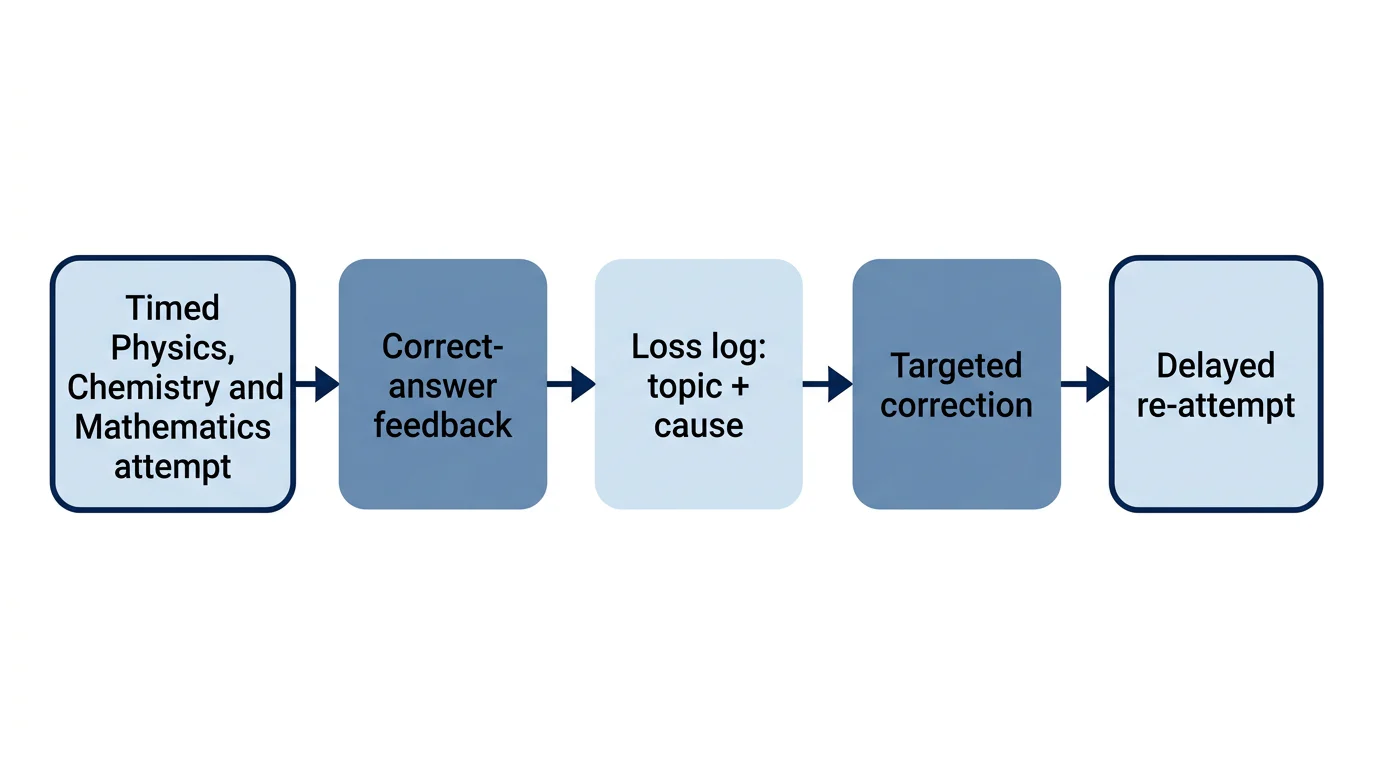
A loss log is not a replacement for learning the chapter. It is a way to choose the next learning task with evidence. Keep the labels simple enough that you will use them after every attempt.
Takeaway: Review is complete when each repeated loss has one correction action and one later re-attempt.
Decide whether tests, teaching or support are the actual gap
A standalone series fits students who already have coverage and need disciplined timed practice, feedback and a review structure. It is less suitable when the recurring loss is that you cannot explain a chapter, lack basic examples, or leave doubts unresolved. In those cases, add concept work or support before treating more full mocks as the answer.
An included series can be useful when it is connected to the lessons and materials you are using. RG Lectures describes its MHT-CET 2027 Physics Complete Batch as including an integrated test series, chapter-wise tests, PYQs, modules and Class 11 content. That makes it relevant for a student who needs Physics learning and testing in one study path. It does not remove the need to use the checklist in this guide and reserve review time yourself.
If you are unsure whether payment solves a real bottleneck, begin with a diagnostic and identify whether the missing input is content, practice, feedback or accountability. The supporting guide, When Is Online Test Preparation Worth Paying For?, helps frame that decision without treating a dashboard as proof of improvement.
Takeaway: Pay for a test series only when it fixes a named practice or feedback gap in your existing preparation.
Go deeper
Frequently asked
An MHT-CET PCM test series should let you practise the applicable official pattern under time pressure, check correct answers with explanations, and identify which topics or error types need another study cycle. More test titles alone do not create a useful review system.
Schedule a full-length test only when you can protect the complete test window and a separate review block afterwards. Use the State CET Cell’s 2026 PCM timing as a planning baseline, then confirm the official pattern for your own examination year before treating it as final.
A separate test series is useful when your current practice does not provide enough timed exposure, corrective solutions or a way to revisit recurring losses. Keep an included series when it already supports those jobs and fits the rest of your study schedule.
A score identifies the outcome, while corrective feedback helps turn an error into a study task. A primary learning experiment found higher later accuracy after answer feedback than after right-or-wrong feedback or no feedback, which is why explanation quality belongs in the checklist.
Start with a chapter-level Physics baseline
Take a free mock, then use the report to decide what your next test and review cycle should target.
Take the free Physics mock