Gauss Law: Cube Flux Values and Why Zero Flux Isn't Zero Field
Gauss law says net electric flux through a closed surface equals enclosed charge divided by ε0. For a cube, a central charge gives q/ε0, and zero flux never means zero field.

By Rahul Jeewani, Founder · Updated 25 Oct 2026

Key takeaways
- Gauss law always holds: the net electric flux through any closed surface equals the net enclosed charge divided by ε0, whatever the surface's shape or the arrangement of charges.
- Zero net flux does not mean zero field. Charges outside a surface still create a field at every point on it; their flux simply goes in on one side and out on the other.
- For a cube of charge q: centre gives q/ε0 in total (q/6ε0 per face), a corner gives q/8ε0, a face centre gives q/2ε0, and a charge outside gives 0.
- You can pull E out of the Gauss law integral only for spherical, cylindrical or planar symmetry. For any other arrangement the law gives flux, not field.
In this article
- 1What does Gauss law say, and what do flux and a Gaussian surface mean?
- 2Why does zero flux through a Gaussian surface not mean zero electric field?
- 3How much electric flux passes through a cube for each charge position?
- 4When can Gauss law be used to find an electric field?
- 5Does Gauss law also work for magnetism and gravity?
- 6How should you prepare Gauss law for HSC and MHT-CET?
- 7Frequently asked questions
Gauss law fits on one line, yet treating flux and field as the same thing is a common mistake. Zero flux through a surface gets read as zero field on that surface.
That reading is wrong. A charge placed outside a cube gives the cube zero net flux, yet the field at the cube's centre is still about 3,994 newtons per coulomb in the example below. The popular shortcut "each face gets q/6ε0" is also true only when the charge sits at the exact centre.
Here you get the flux through a cube for five charge positions, worked out by direct integration, and then a three-question test that tells you whether Gauss law can give you a field at all.
The page is written for Class 12 (Higher Secondary Certificate, HSC) and MHT-CET (Maharashtra Common Entrance Test) Physics, but the physics is the same for any board. Padhna Aasaan Hai: once the rule is clear, the numericals follow.
What does Gauss law say, and what do flux and a Gaussian surface mean?
Gauss law says the net electric flux through any closed surface equals the net charge inside that surface divided by ε0: ∮E·dA = Q_enc/ε0. Flux counts how much electric field passes through a surface, with field leaving the surface counted positive and field entering counted negative.
Three terms do the work:
- Gaussian surface: an imaginary closed surface that you choose, such as a sphere, a cylinder or a cube.
- Q_enc: the enclosed charge, meaning the signed sum of all charges inside the Gaussian surface. A +3 µC and a −1 µC inside give +2 µC.
- ε0: the permittivity of free space, 8.854 187 8188 × 10⁻¹² F/m (NIST, CODATA 2022). Flux is measured in N·m²/C.
If no charge is enclosed, the flux through the surface is zero (OpenStax University Physics Vol. 2, section 6.2). The E inside the integral is the total field at that point from every charge, whether it is inside the surface or outside it. A common source of confusion is forgetting that last sentence.
Why does zero flux through a Gaussian surface not mean zero electric field?
Flux adds up the field over the whole surface, so field that enters on one side and leaves on the other cancels in the total without vanishing anywhere. A charge outside the surface contributes no net flux, but it still makes a field at every point on the surface.
Here is a case you can check. Take a cube of side 1 m spanning x = 0 to 1 m, and place q = 1 µC outside it at x = 2 m, on the line through the cube's centre. The net flux through the cube is zero. The field at the cube's centre, 1.5 m from the charge, is E = kq/r² with k = 1/(4πε0) = 8.98755 × 10⁹ N·m²/C², so E = (8.98755 × 10⁹ × 10⁻⁶)/1.5² ≈ 3,994 N/C. Zero flux, nonzero field.
Where does the cancellation come from? We found, face by face (method in the next section): the near face carries −7.24 × 10³ N·m²/C (field entering), the far face +2.12 × 10³, and each of the four side faces +1.28 × 10³. The sum is −7.24 + 2.12 + 4 × 1.28 ≈ 0 (× 10³).
Students do trip on this. In a 25-question multiple-choice test given to 541 introductory physics students at the University of Pittsburgh (Singh, American Journal of Physics 74(10), 2006; arXiv:1602.07376), the hollow-cube question, where a non-conducting hollow cube carries charge on its surface, was answered correctly by only 21% of the introductory students, and 55% said the field inside is zero everywhere. Another 30% thought Gauss law gives both flux and field. Over all 25 questions, the average was 49% for the introductory students and about 75% for 33 graduate students. This is one US sample, published in 2006, so read it as a sign of where the traps are, not as an Indian benchmark.
Two habits fix most of this:
- When a question says "zero flux", write "net flux = 0" and stop. Do not write "E = 0".
- Every charge contributes to E at every point. Gauss law sorts out the flux; it does not make faraway charges disappear from the field.
How much electric flux passes through a cube for each charge position?
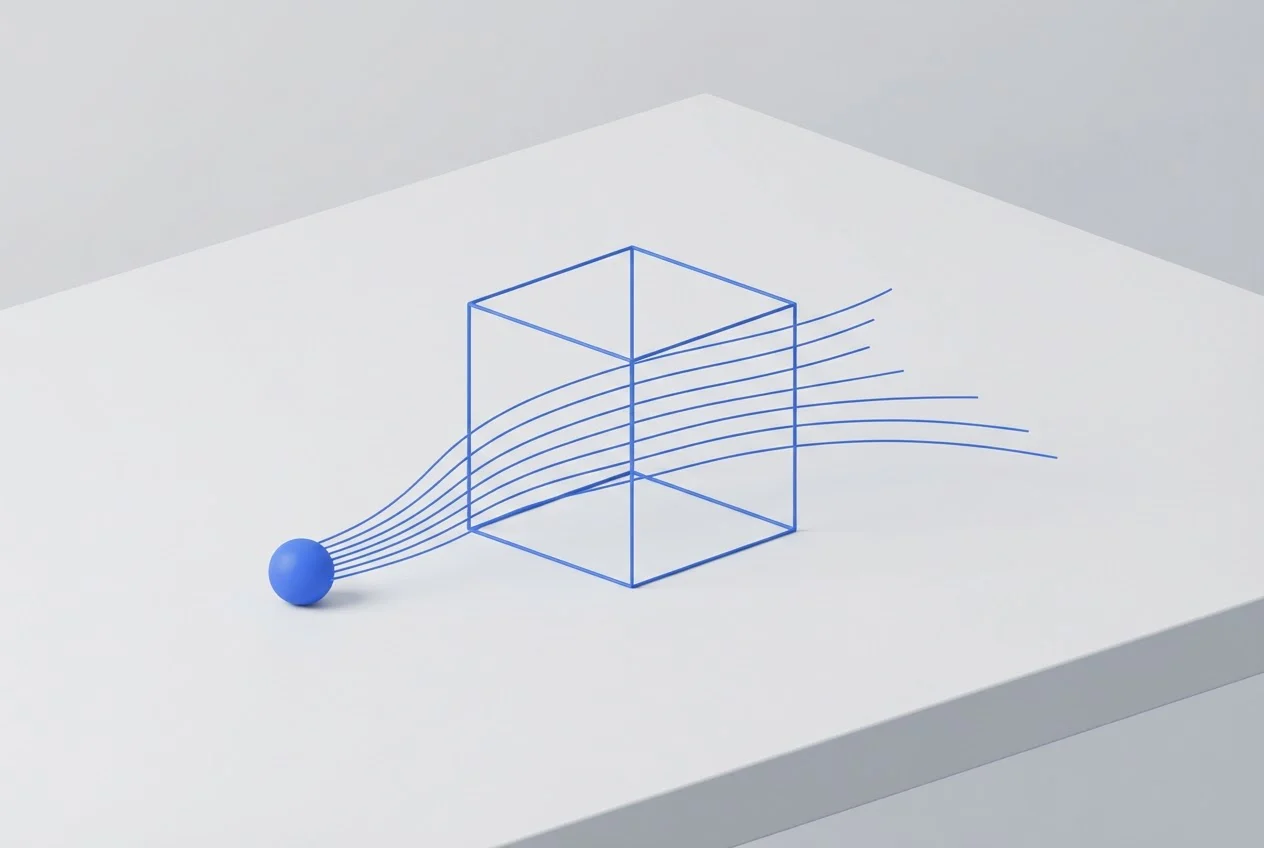
A charge q at the cube's centre gives q/ε0 in total, which is q/6ε0 through each face. The same total holds for a charge anywhere inside. A corner charge gives q/8ε0, a face-centre charge gives q/2ε0, and a charge outside gives zero net flux.
| Charge position | Flux through the cube | In units of q/ε0 | For q = 1 µC (N·m²/C) |
|---|---|---|---|
| Centre | q/ε0 in total, q/6ε0 on each face | 1 | 1.13 × 10⁵ total; 1.88 × 10⁴ per face |
| Anywhere inside (we tested a point 0.2, 0.7, 0.4 m from the corner) | q/ε0 in total; the six faces now get unequal shares | 1 | 1.13 × 10⁵ |
| At a corner | q/8ε0 in total: 0 through the 3 faces touching the charge, q/24ε0 through each of the 3 far faces | 1/8 | 1.41 × 10⁴ total; 4.71 × 10³ per far face |
| At the centre of a face | q/2ε0 through the cube's other 5 faces | 1/2 | 5.65 × 10⁴ |
| Outside (1.5 m from the cube's centre) | 0 net; entering and leaving cancel | 0 | 0 |
How we got these numbers (our calculation, not an official figure; 25 October 2026). Cube from (0,0,0) to (1,1,1) m, q = 1 µC, ε0 = 8.8541878188 × 10⁻¹² F/m (the NIST value above). Each row came from a midpoint grid: we split each face into N × N equal small squares with N = 3,000, and added E·dA over them using Coulomb's field E = q/(4πε0r²).
When the charge sits straight in front of the middle of a square face, you can check the result in closed form. The flux through the face is (q/ε0) × Ω/4π, where Ω is the solid angle (the share of the full sphere of directions that the face covers). For a square of side a seen head-on from distance h to its centre, Ω = 4·arcsin[(a/2)² / (h² + (a/2)²)]. For a charge at the centre, h = 0.5 m and a = 1 m give Ω = 4π/6, so q/6ε0 per face. For the outside charge in the previous section, h = 1 m gives 7.24 × 10³ N·m²/C on the near face and h = 2 m gives 2.12 × 10³ on the far face. The four equal side faces then carry (7.24 − 2.12)/4 × 10³ = 1.28 × 10³ each, which the grid also gave.
A quick sanity check: eight identical cubes meet at a corner, so 8 × q/8ε0 = q/ε0, the full flux of the charge. Two cubes share a face, so 2 × q/2ε0 = q/ε0.
One caution. Gauss law as written assumes each charge is clearly inside or clearly outside the surface; a charge lying exactly on the surface is a limiting case that the plain statement does not cover (Physics Stack Exchange discussion). The 1/8 and 1/2 fractions come from integrating the field, as above. If you are free to choose the surface, our advice is to move it slightly so the charge is plainly inside or outside.
When can Gauss law be used to find an electric field?
Gauss law can give you the field only when the charges have spherical, cylindrical or planar symmetry; OpenStax states there are only three such types. For anything else, such as a cube of charge, the law is still true but yields flux only.
Run these three tests in order. Each has a clear pass or fail.
- Symmetry test.Pass: the charge looks identical when you rotate it about a point (sphere), rotate or slide it along an axis (long cylinder or line), or slide it along a plane (infinite sheet). Fail: a cube, a short rod, a dipole. On a fail, stop: you can find flux, not E.
- Surface test.Pass: you can draw a Gaussian surface where, on every piece, E is either constant and perpendicular to the surface, or parallel to it (so it adds nothing to the flux). Fail: E varies along a piece of surface, and E cannot leave the integral.
- Charge-count test.
Pass: Q_enc counts only charges inside the surface, while the E you solve for is the total field at the surface. Fail: you dropped an outside charge from the field or put an outside charge into Q_enc.
| Symmetry | Gaussian surface to pick | What makes E leave the integral |
|---|---|---|
| Spherical | Concentric sphere | E has the same size everywhere on the sphere and points along the radius |
| Cylindrical | Coaxial closed cylinder with flat caps | E is constant on the curved side and parallel to the caps |
| Planar | "Pillbox" (a short flat cylinder) straddling the sheet | E is constant and perpendicular on both flat faces, parallel on the side |
Two planar results are worth memorising, where σ (sigma) is surface charge per unit area: an infinite thin non-conducting sheet gives E = σ/2ε0 on each side, and the surface of a conductor gives E = σ/ε0 just outside. The FAQ below shows why they differ.
If you are rusty on setting up such problems, our guide to solving Physics numericals covers the habit of writing the given data and the formula before you calculate.
Does Gauss law also work for magnetism and gravity?
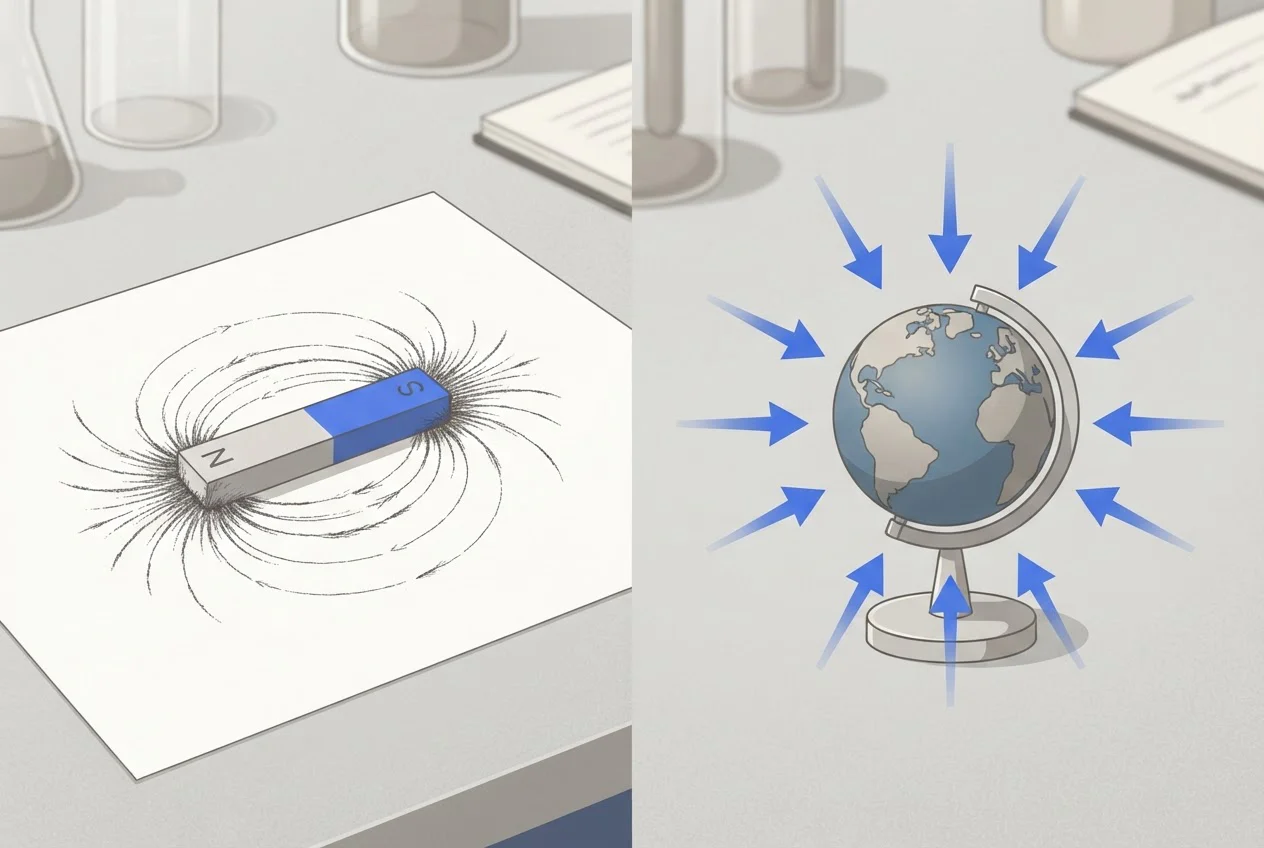
Yes, in both, with a different right-hand side. For magnetism, ∮B·dS = 0 through any closed surface (Gauss's law for magnetism). For gravity, ∮g·dA = −4πGM (Gauss's law for gravity).
The magnetic version is zero because magnetic field lines form closed loops and no isolated magnetic pole exists to act as an enclosed "charge". In the gravity version, M is the enclosed mass, G is the gravitational constant, and the minus sign appears because gravity pulls inward, so the flux of g points inward. The same symmetry rule applies as for the electric law: spherical, cylindrical or planar symmetry before you can solve for g.
How should you prepare Gauss law for HSC and MHT-CET?
To prepare Gauss law for HSC and MHT-CET, learn the cube flux values, the three-test check for when Gauss law gives a field, and the two planar results (σ/2ε0 and σ/ε0), then practise numericals. (CET Cell syllabus notice; how MHT-CET marking works). The whole Std XII syllabus is examined. Std means Standard (class). Since wrong answers cost nothing, attempt every question.
Here is how we help with it at RG Lectures, starting with what costs nothing:
- Free video: Gauss Theorem EASIEST EXPLANATION (Electrostatics Class 12) In Hindi on our YouTube channel. We also have short free videos on the field of an infinite sheet, outside a charged conducting cylinder, and outside a charged conducting sphere.
- Free notes: our "MHTCET NOTES" course in the store costs ₹0 and includes Electrostatics PDFs.
- Paid, as of 25 October 2026: "The OG & HISTORICAL Crash Course COMBO" costs ₹1,699. Its OG course has four Electrostatics lecture recordings and an Electrostatics question bank. "MHTCET 2027 - LONG TERM BATCH" costs ₹1,632 and has an Electrostatics chapter test plus two Electrostatics PDF sets (SET 1 and SET 2).
Put the formulas on one page with the HSC Physics formula sheet, then test yourself on the MHT-CET previous year question (PYQ) practice library.
Start with the free video, then see the MHT-CET 2027 batch.
Start with the free Gauss law video
Frequently asked questions
Lagrange first formulated it in 1773, and Gauss followed in 1835, which is why it carries Gauss's name (Wikipedia, Gauss's law).
Sources
- 1.Gauss's law, Wikipedia
- 2.Gauss's law for magnetism, Wikipedia
- 3.Gauss's law for gravity, Wikipedia
- 4.OpenStax University Physics Volume 2, 6.2 Explaining Gauss's Law
- 5.OpenStax University Physics Volume 2, 6.3 Applying Gauss's Law
- 6.NIST CODATA 2022, vacuum electric permittivity ε0
- 7.Singh, "Student understanding of symmetry and Gauss's law of electricity", American Journal of Physics 74(10), 2006; arXiv:1602.07376
- 8.CET Cell, Maharashtra: MHT-CET 2026 syllabus notice
- 9.Physics Stack Exchange: point charges lying exactly on the Gaussian surface