Glossary
Hall effect
Numericals depend on using the thickness along the field correctly.

By Rahul Jeewani, Founder · Updated 31 Oct 2026
On this page
- 01Definition
- 02Quick facts
- 03Introduction
- 04What is the Hall effect, in plain words?
- 05Which side of the sample is t in the Hall voltage formula?
- 06Why do some Hall effect formula sheets fail a unit check?
- 07What do worked Hall voltage numbers look like?
- 08How do you tell n-type from p-type using Hall voltage?
- 09What is the Hall effect confused with?
- 10Where does the Hall effect appear in SPPU Engineering Physics?
- 11How RG Lectures handles it
- 12Example
- 13Related terms
- 14Frequently asked
What is the Hall effect?
The Hall effect is the voltage that appears across a conductor or semiconductor when current flows through it and a magnetic field acts at right angles to that current.
Key takeaways
- In V_H = IB/(n e t), t is the sample side along the magnetic field, not the side the voltmeter spans. The sign of the Hall voltage shows whether the carriers are electrons (n-type, negative) or holes (p-type, positive).
- The Hall voltage holds steady once the sideways electric force balances the magnetic force, and it reveals carrier density.
- Electrons and holes are pushed to the same face but carry opposite charge, so the polarity flips between n-type and p-type.
- Semiconductors give a far larger Hall voltage than metals because carrier density n is far smaller, a gap of several orders of magnitude.
Quick facts
- Discovered by
- Edwin Hall
- Year discovered
- 1879
- Unit of Hall coefficient
- m³/C
- Sign for n-type
- Negative Hall coefficient
- Sign for p-type
- Positive Hall coefficient
Introduction
Every Hall effect formula looks alike, and every one hangs on a single choice: which side of the sample you call the thickness. Pick the wrong side and the answer is wrong, even when every substitution is clean. Use the wide side instead of the thin one and the answer shrinks by the ratio of the two sides, so a ribbon five times wider than it is thick comes out five times too small.
That choice matters to first-year engineers in Pune. The 2024 pattern Engineering Physics syllabus of Savitribai Phule Pune University (SPPU) asks for the derivation of Hall voltage and Hall coefficient, plus numericals. Its lab asks you to find a semiconductor's Hall coefficient and charge carrier density.
Below you get the meaning in plain words, a four-step card for numericals, worked numbers you can redo, and the sign rule that separates n-type from p-type. Padhna aasaan hai once you sketch the sample properly.
What is the Hall effect, in plain words?
That voltage is the Hall voltage. NIST explains the cause as the Lorentz force, the magnetic push on moving charges.
Carriers are shoved to one face, charge piles up, and a sideways electric field grows until it cancels the magnetic push. After that the voltage stays constant. Edwin Hall discovered the effect in 1879.
Which side of the sample is t in the Hall voltage formula?
The thickness t is the dimension of the sample along the magnetic field. The Hall voltage is read across the width w, at right angles to both current and field. Here n is carrier density (electrons per m³), p is hole density (per m³), e is the electron charge and R_H is the Hall coefficient:
Which side is the thickness t?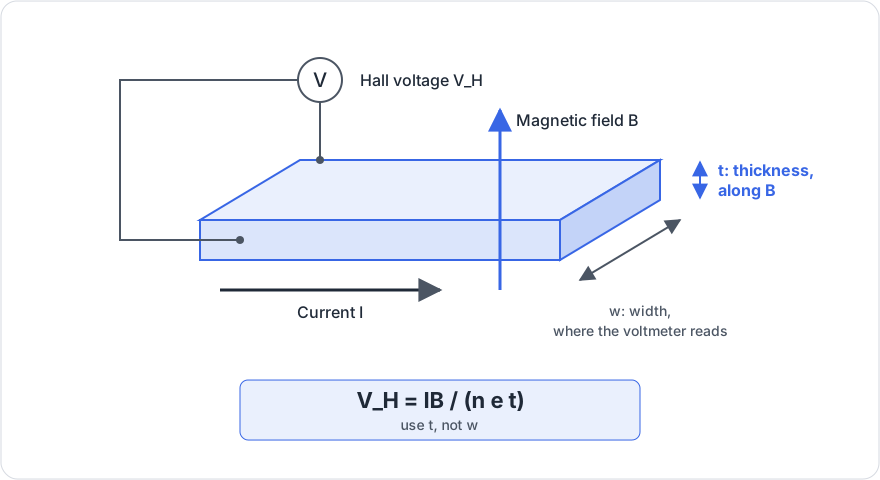
- V_H = IB / (n e t)
- R_H = V_H t / (IB), which equals −1/(ne) for electrons and +1/(pe) for holes
- n = 1/(e |R_H|)
- If drift speed v is given instead of current: V_H = B w v
The four-step Hall numerical card
- Sketch. Draw I, B and the voltage direction, then mark the side B passes through as t. Pass: the voltmeter spans w, never t.
- Convert. Change mm and cm to m, and cm⁻³ to m⁻³ (multiply by 10⁶). Pass: every length is in metres.
- Pick the formula. Use the table below. Pass: the quantity you are asked for appears alone on the left of the formula you chose, and every other symbol is given in the question.
- Check units. R_H must come out in m³/C. Fail: m²/C means t was dropped.
- The question gives
- I, B, n, t
- You find
- V_H
- Use
- V_H = IB/(n e t)
- The question gives
- V_H, I, B, t
- You find
- R_H
- Use
- R_H = V_H t/(IB)
- The question gives
- R_H
- You find
- n or p
- Use
- 1/(e|R_H|)
- The question gives
- v, w, B
- You find
- V_H
- Use
- V_H = B w v
Why do some Hall effect formula sheets fail a unit check?
The thickness sits in the denominator of V_H and in the numerator of R_H, and any sheet that flips either one fails a unit check. Run it yourself. A tesla is V·s/m², so I·B has units A·V·s/m². Then V_H/(IB) comes to m²/C, while V_H·t/(IB) gives the m³/C a Hall coefficient needs.
A t in the numerator of V_H is also wrong physically. A thicker sample spreads the same current over more carriers, so the Hall voltage drops. Test any formula sheet you copy with the same unit check before you trust it.
What do worked Hall voltage numbers look like?
A silver ribbon 1.0 cm by 0.20 cm carrying 100 A in a 1.5 T field gives about 7.9 µV, as in OpenStax University Physics Volume 2, section 11.6 (6 October 2016). Rerunning it with t = 0.20 cm and n = 5.9×10²⁸ m⁻³ gives 100 × 1.5 / (5.9×10²⁸ × 1.602×10⁻¹⁹ × 0.0020) = 7.93 µV.
Metal against semiconductor. Keep I = 10 mA, B = 0.5 T and t = 1 mm. Silver gives 0.53 nV. A silicon sample with an assumed n = 1×10²¹ m⁻³ gives 31 mV, about 5.9×10⁷ times more, because V_H falls as n rises. That is why a semiconductor gives a readable signal and a metal strip barely does.
How do you tell n-type from p-type using Hall voltage?
Read the polarity. A negative Hall coefficient means electrons carry the current (n-type), and a positive one means holes do (p-type), as NIST sets out for semiconductors.
The reason trips people up. For the same current direction, electrons and holes drift in opposite directions and carry opposite charge, so the magnetic force pushes both to the same face. That face collects negative charge in n-type and positive charge in p-type, so the voltage flips. OpenStax College Physics 2e, section 22.6 (13 July 2022) states the same opposite-sign result.
Which terminal counts as positive depends on your sketch, so follow your lab manual's convention. When a material has sizeable numbers of both carriers, the single-carrier formulas no longer hold.
What is the Hall effect confused with?
Four neighbours cause most mix-ups:
- Hall voltage and Hall coefficient. The voltage changes with current, field and sample size. The coefficient, 1/(nq) for one carrier type, belongs to the material.
- Mobility. Hall measurements, combined with resistivity, give how freely carriers move, as NIST notes.
- Hall-effect sensors. These use the effect to sense magnetic fields and position, and Hall-effect thrusters use it for spacecraft propulsion, per Wikipedia.
- Quantum Hall effect. This is a separate high-field, low-temperature phenomenon.
Where does the Hall effect appear in SPPU Engineering Physics?
It sits in Unit IV, Semiconductor Physics and Ultrasonics (8 hours), of course BSC-102-BES. The unit lists "Hall effect: derivation for Hall voltage and Hall coefficient and related numerical problems" in the SPPU First Year Engineering 2024 Pattern curriculum. Theory is split into 40 marks of continuous assessment and 60 end-semester, with 25 term-work marks. Lab options include finding the Hall coefficient and carrier density, or an Arduino Hall sensor experiment.
How RG Lectures handles it
Our Engineering Physics course for Pune University (2026-27) is taught by Rahul Jewaani (RG Sir) in Hindi, with pre-recorded digital-board lectures and notes. As of October 2026 it costs ₹1,299 (list price ₹1,599). Browse the Pune University courses in our store.
Example
Take V_H = 2.0 mV, I = 5 mA, B = 0.4 T and t = 0.5 mm. Then R_H = (2.0×10⁻³ × 0.5×10⁻³)/(5×10⁻³ × 0.4) = 5.0×10⁻⁴ m³/C, so n = 1/(e |R_H|) = 1.25×10²² m⁻³.
Frequently asked
No. It holds steady once the sideways electric force on a carrier equals the magnetic force, giving V_H = B w v. Reverse the magnetic field and the polarity reverses, but the size stays the same.
V_H = IB/(n e t) falls as carrier density n rises, and a semiconductor has far fewer carriers per cubic metre than a metal. With I = 10 mA, B = 0.5 T and t = 1 mm, silver (n = 5.9×10²⁸ m⁻³) gives 0.53 nV and an assumed silicon sample (n = 1×10²¹ m⁻³) gives 31 mV, about 5.9×10⁷ times more.
The unit of the Hall coefficient is cubic metres per coulomb (m³/C). Both R_H = V_H t/(IB) and R_H = 1/(nq) reduce to it, so it works as a quick check on any numerical. If your answer comes out in m²/C, the thickness t was left out of the calculation, and you should go back and check the formula you used.
Sources
- 1.OpenStax University Physics Volume 2, section 11.6, The Hall Effect, OpenStax, 6 October 2016
- 2.OpenStax College Physics 2e, section 22.6, The Hall Effect, OpenStax, 13 July 2022
- 3.The Hall Effect, NIST, updated 1 March 2023
- 4.First Year Engineering (2024 Pattern) curriculum, Savitribai Phule Pune University
- 5.Hall effect, Wikipedia