Units and Dimensions in Class 11 Physics: A 3-Step Check and Common Mistakes
Units and dimensions in Class 11 Physics are not the same: a unit is the standard you measure with, a dimension is the kind of quantity, and replace, simplify, compare checks equations.

By Rahul Jeewani, Founder · Updated 21 Oct 2026

Key takeaways
Run the check as replace, simplify, compare. Swap every symbol for its dimension, reduce each side to powers of [M], [L] and [T], then compare. Any mismatch in an exponent, or in an added term, means the equation is wrong.
- A passed check proves only that an equation is not wrong yet. A missing ½ or 2π, or torque written in place of work, still passes.
- Memorise a few definitions (F = ma, W = F × s, p = F/A) and build the other dimensional formulae from them, instead of memorising a long list.
In this article
- 1What is the difference between units and dimensions in Class 11 Physics?
- 2What are fundamental and derived quantities, and the 7 SI base units?
- 3Which dimensional formulae should you know, and how do you build one?
- 4How do you check an equation using dimensions in three steps?
- 5What can a dimensional check not prove?
- 6Which common mistakes make a dimensional check go wrong?
- 7How do you convert CGS units to SI using dimensions?
- 8Which five practice questions test units and dimensions?
- 9Where does this chapter lead next?
- 10Frequently asked questions
Half-remembered formulas are where Class 11 Physics students go wrong. Is the period of a spring 2π√(m/k) or 2π√(k/m)? A dimensional check settles it in 20 seconds, with no calculator and no unit conversion.
The check works because every quantity in this chapter is built from a few base quantities: mass, length, and time in mechanics. Write both sides of an equation in those terms and, if the equation is right, they must match. This is the first chapter of the Class 11 Physics book from the National Council of Educational Research and Training (NCERT), and the habit pays off in every later chapter.
Below you get a three-step routine, a table of eight wrong equations showing what the routine catches and what slips through, and five practice questions with full working.
What is the difference between units and dimensions in Class 11 Physics?
A unit is the agreed standard you compare a quantity with, such as the metre, the second or the newton. A dimension is the kind of quantity, written as the powers of the base quantities that build it. Force has the dimension [M L T⁻²] whichever unit you pick.
Take speed. 72 km h⁻¹ and 20 m s⁻¹ are the same speed in two units, and both have the dimension [L T⁻¹]. The newton and the dyne (the dyne is the unit of force in the centimetre-gram-second system) are two units of force, and both have the dimension [M L T⁻²]. NCERT points out that dimensions ignore magnitude: speed, average velocity and a change in velocity all share [L T⁻¹].
This is why a dimensional check is easier than a unit check. You never choose a unit system and never convert centimetres to metres first.
Students usually search for “units and dimensions”, but the textbook chapter is titled Units and Measurement in NCERT’s 2026-27 reprint and Units and Measurements in the Maharashtra Standard (Std) XI Physics book. That book is published by the Maharashtra State Bureau of Textbook Production and Curriculum Research (Balbharati) and is free to download on the Balbharati e-book portal. Both chapters cover dimensional analysis, so if you searched either name, you are in the right place. Check your own book’s contents page for the exact title and the order of topics.
What are fundamental and derived quantities, and the 7 SI base units?
Fundamental (base) quantities are the seven quantities from which all others are built. Derived quantities are combinations of them, such as speed, force or pressure. SI, the Système International or international system of units, gives each base quantity one base unit. The seven are in the table below.
| Base quantity | SI unit (symbol) | Dimension symbol (NCERT) |
|---|---|---|
| Length | metre (m) | [L] |
| Mass | kilogram (kg) | [M] |
| Time | second (s) | [T] |
| Electric current | ampere (A) | [A] |
| Thermodynamic temperature | kelvin (K) | [K] |
| Amount of substance | mole (mol) | [mol] |
| Luminous intensity | candela (cd) | [cd] |
The seven base units are listed on the SI base units page of the International Bureau of Weights and Measures (BIPM). All other SI units come from multiplying powers of them. NCERT writes the last four dimensions as [A], [K], [mol] and [cd]. Other books write I, Θ, N and J. This page uses NCERT's symbols.
Older systems still appear in questions: CGS (centimetre, gram, second), MKS (metre, kilogram, second) and FPS (foot, pound, second).
Which dimensional formulae should you know, and how do you build one?
Know ten dimensional formulae, and build each from a definition rather than from memory. Write the formula, replace each quantity with its dimension, then add exponents when you multiply and subtract them when you divide.
| Quantity | Dimensional formula | SI unit |
|---|---|---|
| Velocity | [L T⁻¹] | m s⁻¹ |
| Acceleration | [L T⁻²] | m s⁻² |
| Force | [M L T⁻²] | N (kg m s⁻²) |
| Energy | [M L² T⁻²] | J |
| Power | [M L² T⁻³] | W |
| Pressure | [M L⁻¹ T⁻²] | Pa (N m⁻²) |
| Density | [M L⁻³] | kg m⁻³ |
| Spring constant k | [M T⁻²] | N m⁻¹ |
| Gravitational constant G | [M⁻¹ L³ T⁻²] | N m² kg⁻² |
| Planck's constant h | [M L² T⁻¹] | J s |
Build force from F = ma. Mass is [M] and acceleration is [L T⁻²], so [F] = [M][L T⁻²] = [M L T⁻²].
The same move gives the rest. Work is force times distance, so energy is [M L T⁻²][L] = [M L² T⁻²]. Pressure is F/A, so [M L T⁻²]/[L²] = [M L⁻¹ T⁻²]. The spring constant comes from F = kx, so [k] = [M L T⁻²]/[L] = [M T⁻²]. Planck's constant comes from E = hf, so [h] = [M L² T⁻²][T] = [M L² T⁻¹]. G comes from F = Gm₁m₂/r², so [G] = [M L T⁻²][L²]/[M²] = [M⁻¹ L³ T⁻²].
How do you check an equation using dimensions in three steps?
Run replace, simplify, compare. Replace every symbol with its dimension, simplify each side to powers of [M], [L] and [T], then compare both sides and every added term. It takes about 20 seconds once the dimensions in the table feel familiar. This is the principle of homogeneity of dimensions: only quantities with the same dimensions can be added, subtracted or equated, so both sides of a correct equation must have the same dimensions.
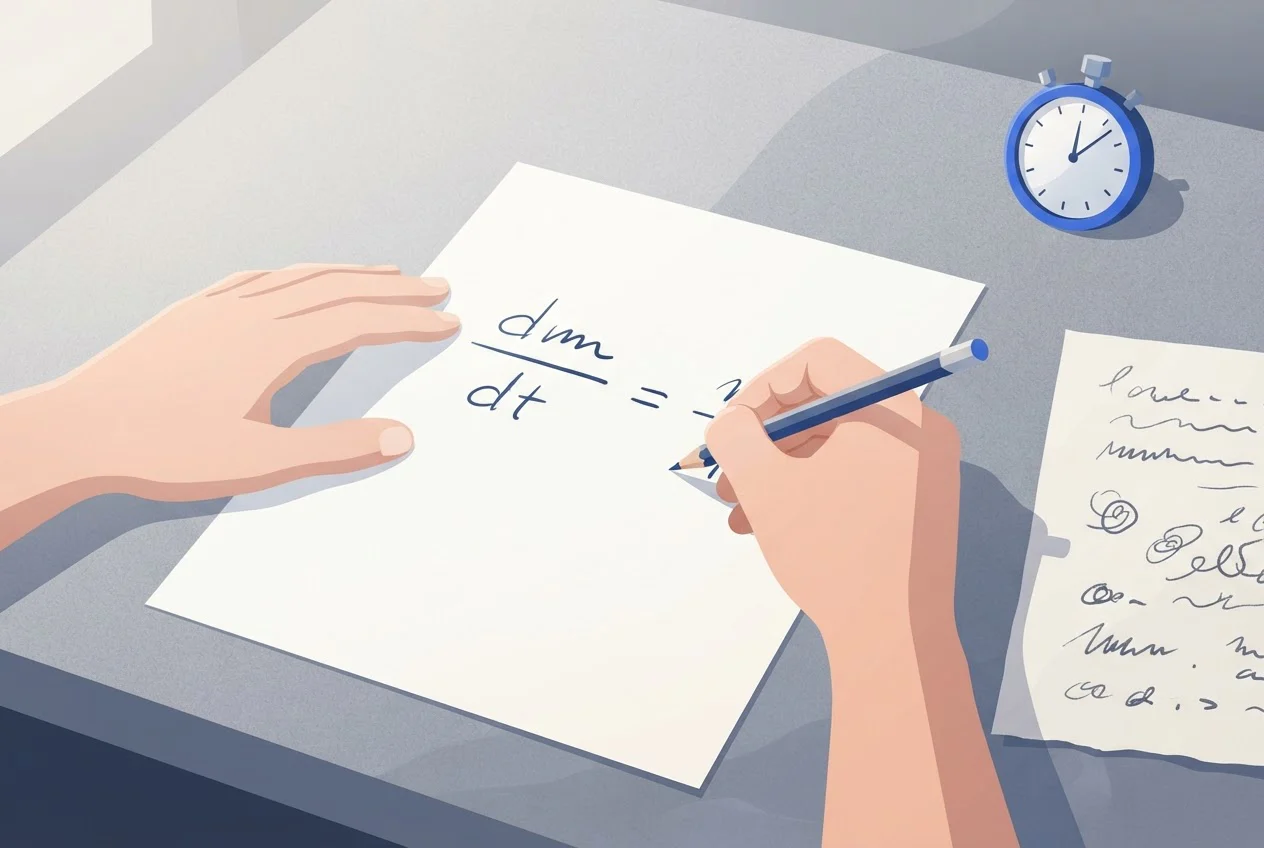
- ReplaceWrite the dimension of every symbol. Pass: no symbol is left without a bracket, and pure numbers such as ½ and 2π are treated as 1. A pure number has no unit and no dimension.
- Simplify
For each side, add and subtract the exponents of [M], [L] and [T] separately. Pass: each side is one expression of the form [Mᵃ Lᵇ Tᶜ].
- CompareThe two sides must match, and every term joined by + or − must match too. Fail: any single exponent differs. The equation is wrong, and you stop.
Worked example. The time period of a mass m on a spring of spring constant k, first the correct form, then the wrong one. We found [k] = [M T⁻²] from F = kx above.
Correct: T = 2π√(m/k).
- Replace: left side [T]. Right side 2π → 1, [m] = [M], [k] = [M T⁻²].
- Simplify: m/k = [M]/[M T⁻²] = [T²], and the square root is [T].
- Compare: [T] = [T]. It passes.
Wrong: T = 2π√(k/m).
- Replace: the same symbols, swapped.
- Simplify: k/m = [M T⁻²]/[M] = [T⁻²], and the square root is [T⁻¹].
- Compare: [T] ≠ [T⁻¹]. It fails, so the equation is wrong.
The wrong version also gives a clue. [T⁻¹] is the dimension of frequency, and √(k/m) is the angular frequency of the spring. The student has mixed up the angular frequency and the period. Oscillations, a later chapter, sorts out which formula goes with which quantity.
How do you find a relation using dimensions?
Dimensions can also suggest the form of a formula. This is the third use of dimensional analysis, after checking an equation and converting units. Take the time period T of a simple pendulum. Assume it depends only on the mass m of the bob, the length l of the string and g, the acceleration due to gravity, and write T = k mᵃ lᵇ gᶜ, where k is a pure number.
- Replace: [T] = [M]ᵃ [L]ᵇ [L T⁻²]ᶜ.
- Simplify: [T] = [Mᵃ L^(b + c) T^(−2c)].
- Compare: the powers of M give a = 0, the powers of L give b + c = 0, and the powers of T give −2c = 1. So c = −½ and b = ½.
So T = k√(l/g). The mass drops out. Dimensions cannot give the constant k; experiment or full theory gives 2π.
What can a dimensional check not prove?
A dimensional check can prove an equation wrong, but it can never prove one right. NCERT states that if an equation passes the check, it "is not proved right". These are the limitations of dimensional analysis.
- Dimensionless constants are invisible. ½, 2π and 3/16 all count as 1. NCERT’s own example is K = (3/16)mv², which passes the same check as the correct K = ½mv².
- sin, log and exp need a pure-number argument. Look inside the bracket separately, as in x = A sin(ωt), where ωt must be dimensionless.
- Only three unknown powers can be found with M, L and T. The pendulum derivation above had three unknown exponents and three equations, one per base quantity. A fourth unknown would leave the equations unsolvable, and the constant k stays unknown.
- Same dimensions, different quantities. Torque and work both have [M L² T⁻²], so the check cannot separate them.
The table lists eight wrong equations and whether the dimensional check catches each one. The reason column shows the dimensions of the right-hand side.
| Wrong equation | Does the check catch it? | Reason |
|---|---|---|
| p = F × A | Catches it | Right side is [M L³ T⁻²]; pressure is [M L⁻¹ T⁻²] |
| T = 2π√(k/m) | Catches it | Right side is [T⁻¹]; the period is [T] |
| Disc: I = ½MR | Catches it | Right side is [M L]; moment of inertia is [M L²] |
| x = A sin t (t in seconds) | Catches it | The argument t has dimension [T], not a pure number |
| K = mv² (½ missing) | Misses it | Right side is [M L² T⁻²], the same as energy |
| T = √(m/k) (2π missing) | Misses it | Right side is [T]; the constant is invisible |
| K = (3/16)mv² | Misses it | Only a number differs from ½ |
| Torque = ½mv² | Misses it | Both sides are [M L² T⁻²]; the check cannot tell torque from energy |
Row three is a typical rescue. If you half remember a formula from our moment of inertia page, the check tells you straight away that the disc formula needs R².
Which common mistakes make a dimensional check go wrong?
Most failed checks come from four habits. Each has a quick test you can run on your own working.
- Calling a unit a dimension. Test: a dimension is written in square brackets with M, L and T (for example [M L T⁻²]); a unit has a symbol such as N, J or m s⁻¹. "The dimension of force is N" fails this test.
- Adding unlike terms. In E = ½mv² + mg, the first term is [M L² T⁻²] and the second is [M L T⁻²]. Test: before you simplify, check that every + or − joins terms with the same bracket. Here the student forgot the height h.
- Giving angles and ratios a dimension. An angle is arc divided by radius, [L]/[L], so it has no dimension. Refractive index, relative density and strain are also ratios of like quantities. Test: dividing two quantities of the same kind gives [M⁰ L⁰ T⁰].
- Putting dimensions into exponents or functions. In e⁻ᵗ, t has the dimension [T], so the exponent is not a pure number. In e^(−t/τ), t/τ is a ratio of two times, so it is a pure number. Test: the power of e, and the argument of sin or log, must reduce to [M⁰ L⁰ T⁰].
The chapter also covers measurement errors, least count and significant figures. They are a separate skill from dimensions, so this page leaves them out to keep the three-step check in focus.
How do you convert CGS units to SI using dimensions?
Convert by dimensions using n₂ = n₁ (M₁/M₂)ᵃ (L₁/L₂)ᵇ (T₁/T₂)ᶜ, where the quantity has dimension [Mᵃ Lᵇ Tᶜ] and n₁ and n₂ are its numerical values in the two systems. The ratios compare the size of each base unit.
Example: 1 Pa in dyne/cm². Pressure is [M L⁻¹ T⁻²], so a = 1, b = −1, c = −2. Going from SI (kg, m, s) to CGS (g, cm, s): M₁/M₂ = 1 kg / 1 g = 1000, L₁/L₂ = 1 m / 1 cm = 100, T₁/T₂ = 1.
n₂ = 1 × 1000¹ × 100⁻¹ × 1 = 10
So 1 Pa = 1 N/m² = 10 dyne/cm². As a cross-check, 1 N = 10⁵ dyne and 1 m² = 10⁴ cm², so 10⁵ ÷ 10⁴ = 10.
The US National Institute of Standards and Technology (NIST) gives the standard atmosphere as exactly 1.01325 × 10⁵ Pa in its guide to SI conversion factors, so 1 atm ≈ 1.013 × 10⁵ Pa ≈ 1.013 × 10⁶ dyne/cm².
The erg is the CGS unit of energy, and 1 erg = 10⁻⁷ J. You need it in the practice questions next.
Which five practice questions test units and dimensions?
These five questions cover a conversion, the dimensions of a constant, a check, a slip and an angle trap. Try each before reading the answer.
Q1 (conversion). A pump delivers 60 W. Express this in erg s⁻¹. Answer: Power is [M L² T⁻³], so a = 1, b = 2, c = −3. n₂ = 60 × 1000¹ × 100² × 1 = 60 × 10⁷ = 6 × 10⁸. The power is 6 × 10⁸ erg s⁻¹. Check: 1 W = 1 J s⁻¹ = 10⁷ erg s⁻¹.
Q2 (dimensions of a constant). A ball moving slowly through oil feels a drag F = bv. Find the dimensions and SI unit of b. Answer: [b] = [F]/[v] = [M L T⁻²]/[L T⁻¹] = [M T⁻¹]. The SI unit is kg s⁻¹. Check: N s m⁻¹ = kg m s⁻² × s × m⁻¹ = kg s⁻¹.
Q3 (check an equation). The speed of a wave on a stretched string is claimed to be v = √(F/μ), where F is the tension and μ is the mass per unit length. Is it dimensionally consistent? Answer: [μ] = [M L⁻¹]. F/μ = [M L T⁻²]/[M L⁻¹] = [L² T⁻²], and the square root is [L T⁻¹], which is the dimension of speed. It is consistent. The check alone cannot tell you it is also the correct formula.
Q4 (spot the slip). A student writes the time to fall from rest through a height h as t = √(2g/h). Find the slip. Answer: g/h = [L T⁻²]/[L] = [T⁻²], so the right side is [T⁻¹], not [T]. g and h are swapped. The correct form t = √(2h/g) gives [L]/[L T⁻²] = [T²], so [T]. The 2 cannot be checked by dimensions.
Q5 (angle trap). Angular velocity is ω = θ/t. A student writes [ω] = [rad T⁻¹] and says x = A sin(ωt) fails the check because rad is not in M, L, T. Is the student right? Answer: No. θ = arc/radius = [L]/[L], so θ has no dimension. [ω] = [T⁻¹], and rad is a unit. Then ωt = [T⁻¹][T], which is dimensionless, so the argument of sin is fine.
Where does this chapter lead next?
Dimensional checks pay off in later chapters whenever you half remember a formula, as in the spring and disc examples above. Our Class 11 Physics overview covers the rest of the syllabus.
For the Maharashtra Common Entrance Test (MHT-CET), our syllabus checklist lists the ten Std XI units named in the 2026 syllabus of the State Common Entrance Test Cell (State CET Cell). As of October 2026, that list names Error Analysis and does not name dimensional analysis, so treat this chapter as the base for later chapters and check the official document for the current list. If you have already fallen behind, the catch-up plan for the ten Class XI units shows how to rebuild.
If you are starting Class 11 and want the whole syllabus taught from the basics, join the MHTCET 2028 foundation batch. It is the MHTCET 2028 Class 11th Physics Batch, covering the full Class 11 syllabus from the basics, taught by RG Sir (Rahul Jewaani), founder of RG Lectures.
Learn Class 11 Physics from the basics with RG Sir
Frequently asked questions
A unit gives the size of a quantity in one system, while a dimension gives its kind in every system. The same force can be 1 N or 10⁵ dyne. The units differ, but the dimension [M L T⁻²] stays the same.