Glossary
Escape velocity
Escape velocity is the minimum speed an object needs to leave a planet's gravity without further push, about 11.2 km/s for Earth, and it is √2 times the circular orbital speed.

By Rahul Jeewani, Founder · Updated 30 Oct 2026
Also called Escape speed
On this page
- 01Definition
- 02Quick facts
- 03Introduction
- 04What is escape velocity, and what does the formula say?
- 05Why does the escape speed equal √2 times the circular orbital speed?
- 06How do you solve an escape speed numerical step by step?
- 07Which mistakes cost marks in escape velocity questions?
- 08Where escape velocity fits in MHT-CET
- 09How RG Lectures handles it
- 10Example
- 11Related terms
- 12Frequently asked
What is escape velocity?
Escape velocity is the minimum speed that lets an object leave a body's gravity and never return, when nothing else pushes it. It is really a speed, so it is also called escape speed.
Key takeaways
- Earth's escape velocity is about 11.2 km/s, which is the 7.9 km/s circular orbital speed multiplied by √2.
- The escape speed equals √2 (about 1.414) times the circular orbital speed at the same distance, so knowing one gives you the other.
- The object's mass does not change it, and neither does launch direction.
- In MHT-CET the topic sits inside Gravitation, a Class 11 chapter.
Quick facts
- Formula
- v = √(2GM/R), or √(2gR) when g and R are known
- Earth
- About 11.2 km/s
- Moon
- About 2.4 km/s
- Mars
- About 5.0 km/s
- Exam topic
- Gravitation, Class 11 (MHT-CET)
Introduction
Escape velocity looks like a formula to memorise. It is tempting to learn 11.2 km/s for Earth and √(2GM/R) and hope the question matches. The trouble starts when the question changes the planet, gives g instead of the mass, or mentions a satellite.
One relationship between two speeds does most of the work, and it saves you from learning a second formula. Once you see where it comes from, you can cross-check the values for Earth, the Moon and Mars instead of memorising each one.
In a numerical, the final number is the easy part. The marks go on picking the right form, converting kilometres to metres, and not letting the launch angle or the object's mass throw you off.
Below you get the meaning, a five-step routine with a pass or fail test at each step, a worked example, and the confusions that cost marks in HSC (Higher Secondary Certificate) Physics and MHT-CET (Maharashtra Health and Technical Common Entrance Test).
What is escape velocity, and what does the formula say?
It is really a speed, because direction does not matter, so it is also called escape speed. The formula is v = √(2GM/R), which becomes √(2gR) when you know g and R.
Here G is the gravitational constant, M is the mass of the planet and R is the distance from its centre. Gravity is conservative, so only the start and end points matter, not the path. That is why the angle drops out. The object's mass m cancels from ½mv² = GMm/R.
Why does the escape speed equal √2 times the circular orbital speed?
Escape speed is √2 times the circular orbital speed, the speed that keeps an object circling just above the surface, because escaping needs twice the kinetic energy of circling. A circular orbit comes from mv²/R = GMm/R², giving v_orb = √(GM/R). Escape comes from ½mv² = GMm/R, giving v_esc = √(2GM/R). Divide one by the other and √2 is left.
Circling versus escaping: a √2 speed ratio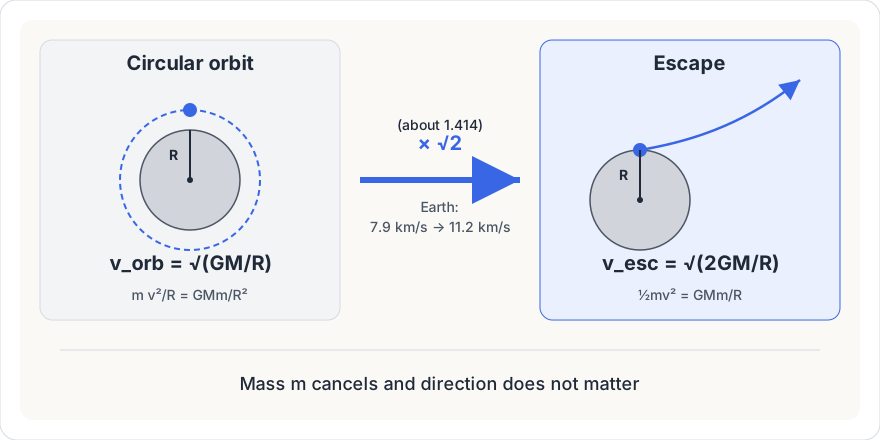
The table is calculated from NASA fact sheet values, using v_esc = √(2GM/R), v_orb = √(GM/R) and G = 6.674×10⁻¹¹ N m² kg⁻², with R taken as half of NASA's listed diameter.
The ratio is √2 in every row because of the algebra above, not because of the data. NASA's own table lists escape velocities of 11.2, 2.4, 5.0 and 59.5 km/s for the same four bodies.
- Body
- Earth
- M (kg)
- 5.97×10²⁴
- R (km)
- 6,378
- Escape speed (km/s)
- 11.18
- Circular orbital speed (km/s)
- 7.90
- Body
- Moon
- M (kg)
- 7.3×10²²
- R (km)
- 1,737.5
- Escape speed (km/s)
- 2.37
- Circular orbital speed (km/s)
- 1.67
- Body
- Mars
- M (kg)
- 6.42×10²³
- R (km)
- 3,396
- Escape speed (km/s)
- 5.02
- Circular orbital speed (km/s)
- 3.55
- Body
- Jupiter
- M (kg)
- 1.898×10²⁷
- R (km)
- 71,492
- Escape speed (km/s)
- 59.53
- Circular orbital speed (km/s)
- 42.09
How do you solve an escape speed numerical step by step?
Pick the form from what the question gives you, then run five steps built on the formulas above.
- Name what is asked. "Just escapes" or "never returns" means escape speed; "circular orbit" means circular orbital speed. Pass: you can point to the phrase that tells you.
- Choose the form from the table. Pass: the quantities you were given are exactly the ones in the formula you picked. Fail: you need a value the question does not give.
- Convert units. R in metres, g in m/s². Pass: Earth lands near 11,000 m/s. Fail: 11 or 11 million.
- Size-check. Pass: the answer is within about 10% of the nearest of 11.2 (Earth), 2.4 (Moon) or 5.0 km/s (Mars) for a body of similar size. Fail: it is off by a factor of about 1,000 or by √2.
- Cross-check with √2. Pass: escape speed divided by circular orbital speed is about 1.414.
- Question gives
- Mass and radius of the planet
- Use
- √(2GM/R)
- Question gives
- g and R
- Use
- √(2gR)
- Question gives
- Circular orbital speed just above the surface
- Use
- circular orbital speed × √2
- Question gives
- A height h above the surface
- Use
- √(2GM/(R+h))
Which mistakes cost marks in escape velocity questions?
Three confusions cost marks: mixing up escape speed with circular orbital speed, with the speed a rocket actually flies, and with the effect of the object's mass or launch angle. Escape speed is for a non-propelled object. A rocket with engines running keeps adding energy, so it can leave Earth without ever touching 11.2 km/s. Circular orbital speed is the speed to circle, which is lower.
A bigger object does not need a bigger speed (m cancels), and a slanted launch does not need more speed (energy does not care about direction). Related terms to know are gravitational potential energy and the binding energy of a satellite.
Where escape velocity fits in MHT-CET
Escape velocity belongs to Gravitation, a Class 11 topic in the MHT-CET syllabus. As of 30 October 2026, check the State CET Cell syllabus and marking scheme page for the syllabus that applies to MHT-CET 2027; the one released on 21 November 2025 was for academic year 2026-27. Gravitation is a single Class 11 chapter, so escape velocity is likely a small but scoring topic.
How RG Lectures handles it
Our MHT-CET 2027 Long Term Batch, taught by Rahul Jewaani (RG Sir), covers the full MHT-CET syllabus plus Class 11 Physics basics, with live classes, recordings, notes, PYQs (previous year questions) and mock tests. As of 30 October 2026 it costs ₹1,632. If Class 11 feels shaky, start with our Class 11 catch-up units and keep the HSC formula sheet open. Padhna Aasaan Hai: the rest of our courses are in the store.
Example
With g = 9.8 m/s² and R = 6.4×10⁶ m, √(2 × 9.8 × 6.4×10⁶) = 11,200 m/s, or 11.2 km/s. Rounding g to 10 gives 11.3 km/s, a small drift. Writing 2√(gR) by mistake gives 15.8 km/s, which the size-check catches. For a satellite orbiting just above Earth at 7.9 km/s, the escape speed is 7.9 × 1.414 ≈ 11.2 km/s.
Frequently asked
Sources
- 1.Escape velocity, Wikipedia, Wikipedia
- 2.Planetary Fact Sheet, NASA, NASA
- 3.MHT CET syllabus, Careers360, Careers360
- 4.Syllabus and marking scheme, State CET Cell Maharashtra, State CET Cell Maharashtra
- 5.MHTCET 2027 Long Term Batch, RG Lectures, RG Lectures