Moment of Inertia: Formulas, Axis Rules and the Ring-Disc Race
Moment of inertia measures how hard it is to change a body's spin about a chosen axis, and it equals the sum of mass times distance squared from that axis.

By Rahul Jeewani, Founder · Updated 10 Oct 2026
Key takeaways
- 01Moment of inertia (I) is the sum of mass times distance squared from the axis, I = Σmr², measured in kg m². It depends on the axis and on how the mass is spread out, not on mass alone.
- 02Name the axis before you pick a formula. If the axis is off-centre but parallel to a central one, add Md². The perpendicular axis theorem works only for flat bodies.
- 03In rolling problems only the shape factor c = I/(MR²) matters: ring 1, thin hollow sphere 2/3, solid disc 1/2, solid sphere 2/5. The smaller c is, the faster the body rolls down.
- 04Our recommendation: learn the table as ratios (ring : disc = 2 : 1 about the central axis), because the listed MHT-CET questions include ratio forms such as ring against disc and rod centre against rod end.
In this article
- 1What is moment of inertia, and why is the distance squared?
- 2Which moment of inertia formula applies to each shape?
- 3Do you use the parallel axis or the perpendicular axis theorem?
- 4Why does a ring lose to a disc when both roll down a slope?
- 5How does rotational inertia show up in MHT-CET and board questions?
- 6Is the moment of inertia of a rectangle the same thing?
- 7How do we help you learn rotational motion at RG Lectures?
- 8Frequently asked questions
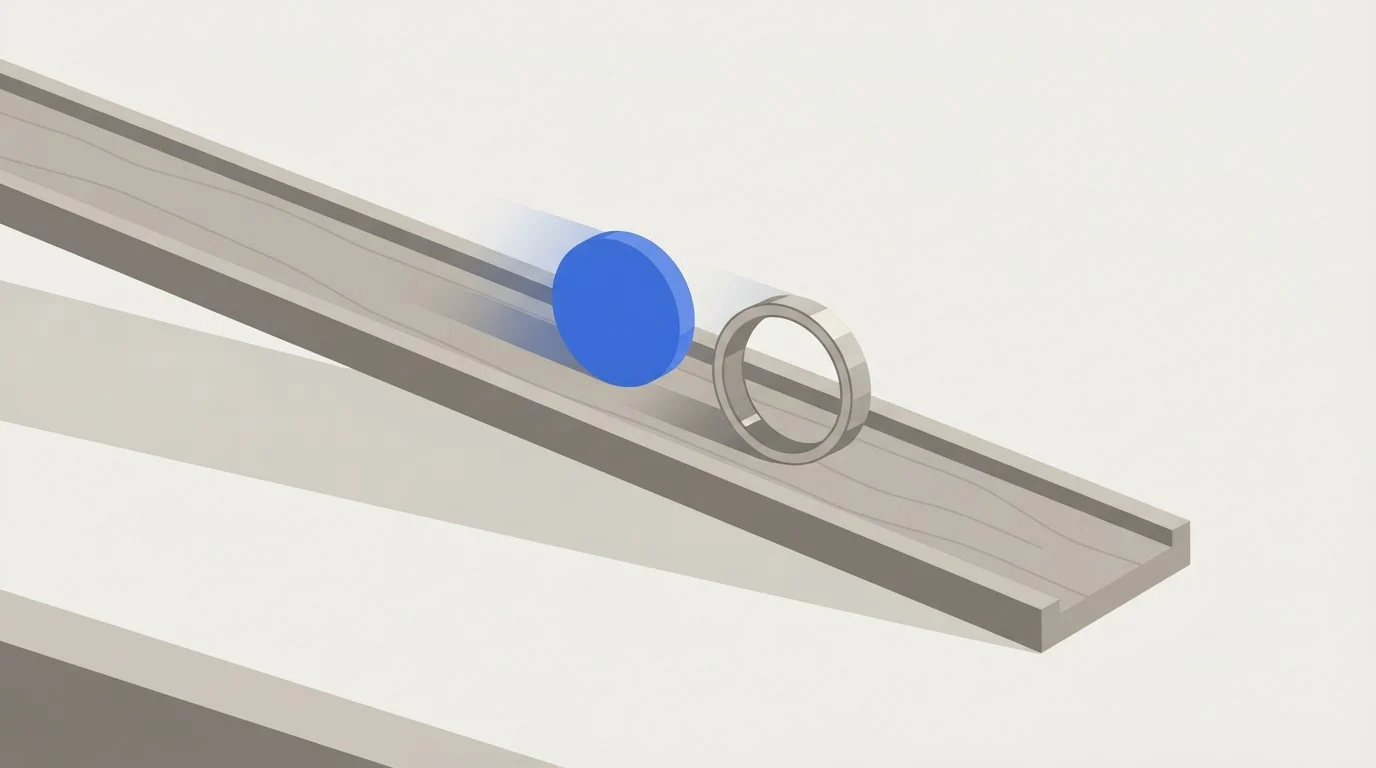
A solid disc and a thin ring with the same mass and radius never tie when they roll down a slope without slipping. The ring always loses, and the reason is the whole chapter in one result: moment of inertia is not a fixed number stamped on an object.
It changes with the axis you spin the object about and with where its mass sits. The usual slip is applying the right formula to the wrong axis, or reaching for a theorem that does not fit the shape.
Examiners test exactly this. ExamSIDE's collection of MHT-CET previous year questions (PYQs) tags 197 questions to rotational motion from papers between 2020 and 2026, and the set includes moment of inertia, parallel axis, radius of gyration and rolling problems. MHT-CET is the Maharashtra Common Entrance Test.
Padhna Aasaan Hai: choose the axis first, then the theorem, then the number. Below are a formula table with the axes stated, a five-step test for choosing the theorem, and the rolling race worked out in numbers.
What is moment of inertia, and why is the distance squared?
The distance is squared because one factor of r comes from the lever arm of the torque and the other from converting angular acceleration to linear acceleration, so τ = mr²α and I = mr². Moment of inertia (also called rotational inertia) is the rotational counterpart of mass: it tells you how much torque you need to give a body a certain angular acceleration about a given axis.
Here is the working. Torque (τ, the turning effect of a force) is force times lever arm. Push a point mass m, sitting at distance r from the axis, with a tangential force F:
- The linear acceleration is a = rα, where α (alpha) is the angular acceleration. So F = m·r·α.
- The torque is τ = F·r = (m·r·α)·r = mr²α.
Compare that with τ = Iα and you get I = mr². For a body made of many pieces, I = Σmᵢrᵢ², where r is the perpendicular distance from the axis.
The practical meaning: double the distance and I becomes four times larger. A 2 kg mass at 3 m from the axis gives 2 × 3² = 18 kg m². Bring the same mass to 1.5 m and you get 2 × 1.5² = 4.5 kg m², exactly one quarter. That is also why a skater spins faster when she pulls her arms in. With no outside torque, angular momentum L = Iω is conserved, so when I falls, ω must rise.
Which moment of inertia formula applies to each shape?
Each shape has one standard formula for one standard axis, and the formula is wrong for any other axis. The table below gives the common ones for uniform bodies of mass M. R is the radius, L is the length of a rod, and the radius of gyration K is the distance at which the whole mass could sit and still give the same I, so I = MK² and K = √(I/M). The values follow the standard list of moments of inertia on Wikipedia and OpenStax University Physics Volume 1, section 10.5.
| Body | Axis | I | K |
|---|---|---|---|
| Point mass at distance r | Through the axis | mr² | r |
| Thin ring (or thin hollow cylinder) | Central, perpendicular to the plane | MR² | R |
| Solid disc (or solid cylinder) | Central axis | ½MR² | R/√2 ≈ 0.71R |
| Solid sphere | Any diameter | (2/5)MR² | R√(2/5) ≈ 0.63R |
| Thin spherical shell | Any diameter | (2/3)MR² | R√(2/3) ≈ 0.82R |
| Thin rod | Perpendicular, through centre | ML²/12 | L/√12 ≈ 0.29L |
| Thin rod | Perpendicular, through one end | ML²/3 | L/√3 ≈ 0.58L |
| Rectangular plate (sides w and h) | Through centre, perpendicular to the plate | M(h² + w²)/12 | √[(h² + w²)/12] |
Two patterns save you from memorising everything. First, the more mass sits at the rim, the larger I is: ring > thin shell > solid disc > solid sphere, which is the order of 1, 2/3, 1/2 and 2/5 times MR². Second, the rod's end value is four times its centre value, because more of the rod lies far from the end.
Do you use the parallel axis or the perpendicular axis theorem?
Use the parallel axis theorem when the axis does not pass through the centre of mass but is parallel to one that does. Use the perpendicular axis theorem only when the body is flat and the axis stands at right angles to it. The centre of mass is the balance point of the body. Run these five checks in order.

Write the axis first.
Pass: you can finish the sentence "through the ___, perpendicular to / in the plane of ___". Fail: you have written a formula before naming the axis.
Is the axis through the centre of mass?
If yes, read the value from the table. If it is parallel to a central axis at distance d, use I = I_cm + Md². This holds for any body. Pass: your answer is larger than I_cm. Fail: it is smaller, because the centre-of-mass axis always gives the minimum.
Is the body flat, with the axis perpendicular to its plane?
Then I_z = I_x + I_y, where x and y are two perpendicular axes in the plane through the same point. Pass: the body is flat and the axis is perpendicular to its plane. Fail: the body is a sphere or a solid cylinder, or the axis lies in the plane, where the theorem does not hold.
Is it a rolling question?
Work out c = I/(MR²) and put it into the energy equation. Pass: you got c as a pure fraction with no M or R left in it. Fail: M or R still appears, so recheck the energy equation.Test with a limit.
Pass: setting d = 0 removes the extra term and returns I_cm. Fail: a non-zero extra term remains.
Worked examples, all from the table:
- Disc about a diameter: by symmetry I_x = I_y, so 2I_x = ½MR², giving I_x = ¼MR².
- Disc about a tangent, perpendicular to its plane: ½MR² + MR² = (3/2)MR².
- Disc about a tangent in its plane: ¼MR² + MR² = (5/4)MR².
- Rod about its end: ML²/12 + M(L/2)² = ML²/12 + 3ML²/12 = ML²/3. This matches the table, so you can rebuild the end formula in one line instead of memorising it.
Why does a ring lose to a disc when both roll down a slope?
A ring takes about 15% longer than a solid disc on any slope gentle enough for both to roll without slipping, because it puts a larger share of the same energy into spinning. Rolling without slipping means the contact point is momentarily at rest, so v = ωR. It needs friction coefficient μ ≥ c·tanθ/(1 + c), which is tanθ/2 for a ring and tanθ/3 for a disc.

For rolling without slipping, the acceleration is a = g sinθ/(1 + c), where θ is the slope angle, g is the acceleration due to gravity and c = I/(MR²). Here is the derivation. Starting from rest, a body that drops through height h has energy Mgh to share between moving and spinning: Mgh = ½Mv² + ½Iω². With ω = v/R, Mgh = ½Mv²(1 + c). Then v = √(2gh/(1 + c)). The mass M and the radius R vanish, and only c is left.
This resolves a common confusion, "the ring has more rotational energy, so why is it slower?" The ring does carry more energy as spin (half of Mgh, against a third for the disc), but that leaves it less translational energy and a lower speed. At the bottom the ring moves at √(gh) and the disc at √(4gh/3).
Our calculation (g = 9.8 m/s², a 30° slope, 2 m travelled along it, rolling without slipping, starting from rest; at 30° the ring needs μ ≥ 0.29):
| Body (same M and R) | c | a as a fraction of g sinθ | Share of energy in spin, c/(1 + c) | Time for 2 m |
|---|---|---|---|---|
| Thin ring | 1 | 1/2 | 1/2 | 1.28 s |
| Thin hollow sphere | 2/3 | 3/5 | 2/5 | 1.17 s |
| Solid disc | 1/2 | 2/3 | 1/3 | 1.11 s |
| Solid sphere | 2/5 | 5/7 | 2/7 | 1.07 s |
Time scales as 1/√a, so the ring-to-disc time ratio is √[(2/3)/(1/2)] = √(4/3) ≈ 1.155. That is the 15%, and it does not depend on the angle as long as both bodies roll without slipping. If the slope were frictionless and nothing rolled, all four bodies would arrive together.
How does rotational inertia show up in MHT-CET and board questions?
Moment of inertia sits in Chapter 1, Rotational Dynamics, of Maharashtra State Board Class 12 Physics, and the MHT-CET questions on it come in a few repeating types. As of October 2026, the Class 12 chapter covers circular motion and its applications, vertical circular motion, moment of inertia as the analogue of mass, radius of gyration, and the perpendicular and parallel axes theorems. In the Maharashtra Board Class 11 book, you meet only the groundwork: torque, couple, centre of mass and equilibrium.
The ExamSIDE question set linked above shows these types, and the chapter content points to the same ones:
- The ratio of I (or of K) for two bodies about the same axis, such as ring against disc.
- The value about an edge or tangent axis, which is a parallel axis question.
- A disc about a diameter or an edge, or a rod about its centre against its end.
- Rolling: acceleration, or how the kinetic energy splits between moving and spinning.
- Angular momentum when frequency or energy changes.
Our recommendation: practise these as ratios and fractions, not decimals. Knowing that c is 1, 2/3, 1/2 and 2/5 answers most rolling questions in a line. Chapter-wise question counts are historical estimates, not official CET Cell figures; our page on MHT-CET Physics chapter weightage explains why. Then build the habit with a chapter-wise plan for MHT-CET Physics PYQs.
Is the moment of inertia of a rectangle the same thing?
No. When engineering students search for the moment of inertia of a rectangle, they usually mean the second moment of area, a geometric property of a shape with units of m⁴. Mass moment of inertia, the topic of this page, has units of kg m².
For a rectangle of base b and height h, the standard results are given on Wikipedia's second moment of area page:
- About the centroidal axis (the axis through the centroid, the geometric centre) parallel to the base: I_x = bh³/12.
- About the base itself: bh³/3, from the parallel axis theorem I = I_c + Ad² (the same idea, with area A in place of mass).
- Polar moment: J = I_x + I_y = bh(b² + h²)/12, where "polar" means about an axis perpendicular to the section.
Product of inertia (∫xy dA, which measures how the area is distributed across two axes at once) is a different quantity again, and it is zero when either axis is an axis of symmetry. First-year engineers meet all of this in Engineering Mechanics, and our Savitribai Phule Pune University (SPPU) unit-by-unit plan for Engineering Mechanics shows where it fits.
How do we help you learn rotational motion at RG Lectures?
We teach Physics concept-first, in simple Hinglish, from the basics up to numericals, and this page follows the same method: meaning first, then the axis, then the theorem, then the number. Our question bank has MCQs (multiple-choice questions), previous year questions and numerical problems with solutions, and our one-shot revision videos are built for the last stretch before an exam.
RG Sir (Rahul Jewaani) leads the teaching, and you can try his style first in the free lessons on our RG Lectures YouTube channel. When you are ready to study the full Class 12 Physics chapters with him, join our MHT-CET 2027 Long Term Batch.
Learn rotational motion concept-first with RG Sir
Frequently asked questions
Sources
- 1.List of moments of inertia, Wikipedia
- 2.Calculating Moments of Inertia, OpenStax University Physics Volume 1, section 10.5
- 3.Second moment of area, Wikipedia
- 4.Balbharati Physics Class 12, Chapter 1 Rotational Dynamics (Maharashtra State Board)
- 5.Rotational Motion, MHT CET previous year questions, ExamSIDE