Centroid: Formulas, Composite-Shape Method and Common Mistakes
A centroid is the average position of all points in a shape. For a triangle, average the corner coordinates; for composite shapes, use an area-weighted table and subtract holes.

By Rahul Jeewani, Founder · Updated 10 Oct 2026
Key takeaways
- 01The centroid of a triangle is the mean of its three corners, (x₁+x₂+x₃)/3 and (y₁+y₂+y₃)/3. Every other shape needs an area-weighted average: x̄ = ΣA·x̄ ÷ ΣA.
- 02For a composite shape, measure every part from one origin, enter holes as negative areas, and divide the summed area-times-distance products by the total area.
- 03In our worked example, forgetting the 60 mm base under a semicircle moves the answer by 25.56 mm, about half its value, while adding a hole instead of subtracting it moves it by 2.90 mm.
- 04Centroid and centre of mass are the same point only when the density is uniform.
In this article
- 1How do you find the centroid of a triangle?
- 2What are the centroid formulas for standard shapes?
- 3What is the composite-shape method for finding a centroid, with a worksheet?
- 4Which slips move the centroid of the 100 × 60 mm worked example the most?
- 5How can you test a centroid answer before submitting?
- 6Is the centroid the same as the centre of mass or centre of gravity?
- 7Where does centroid appear in first-year engineering, and how do we help?
- 8Frequently asked questions
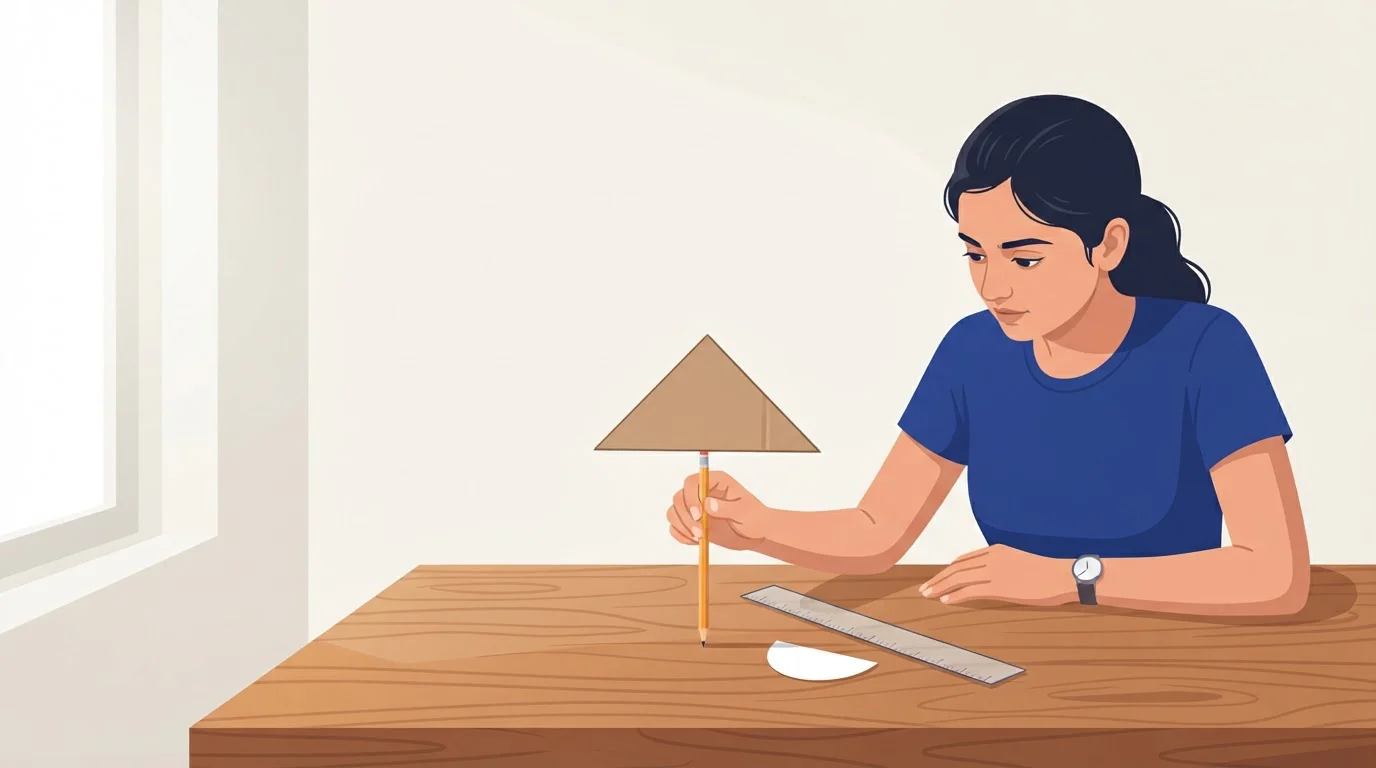
In our experience, the slips that cost marks on centroid questions are usually the origin, a sign, or a formula meant for a different shape. The idea itself is short: the centroid is the point where a flat shape cut from uniform card would balance on a pencil tip.
The Savitribai Phule Pune University (SPPU) 2024-pattern syllabus puts the centroid of basic and composite figures in Unit I of Engineering Mechanics, a six-hour unit it shares with force systems and moment of inertia (how strongly a shape resists being rotated). The course carries a 70-mark end-semester theory paper, so six hours is not much time to build a reliable habit.
A triangle takes one line. A composite shape fails far more often, because it chains five steps and any one of them can slip. The method below, with a worksheet and a worked example, closes those gaps. A short checklist at the end lets you test an answer before you submit it.
How do you find the centroid of a triangle?
Average the corner coordinates. For corners (x₁, y₁), (x₂, y₂), (x₃, y₃), the centroid is ((x₁+x₂+x₃)/3, (y₁+y₂+y₃)/3). It is also where the three medians meet. A median joins a corner to the midpoint of the opposite side. The centroid sits two-thirds of the way along each median, measured from the corner (Math Is Fun).
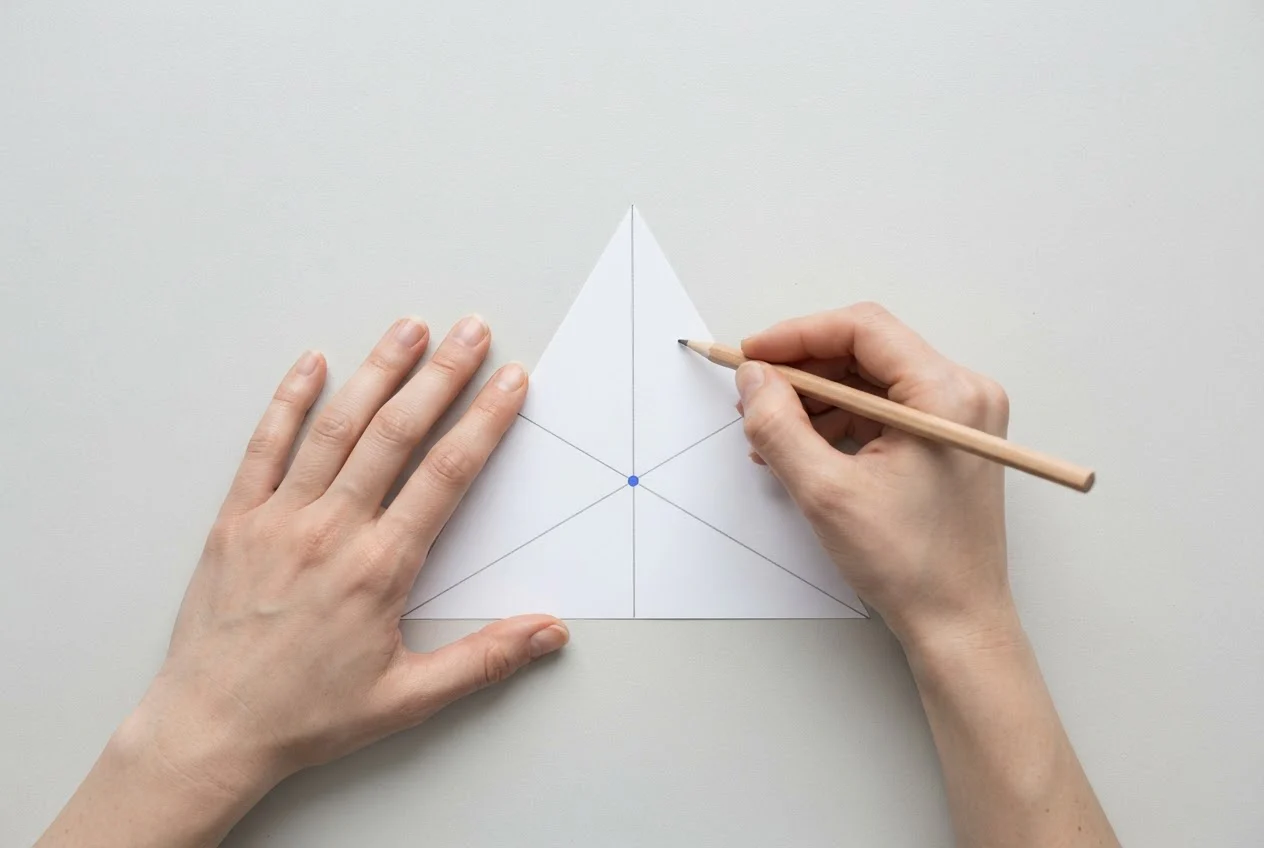
Example: corners (0, 0), (6, 0) and (3, 9). The centroid is ((0+6+3)/3, (0+0+9)/3) = (3, 3).
The orthocentre (where the altitudes meet; an altitude drops perpendicular from a corner to the opposite side), incentre (angle bisectors) and circumcentre (perpendicular lines through the midpoints of the sides) are different points. All four coincide only in an equilateral triangle.
Do not stretch the average-of-corners rule to four-sided shapes. Take the quadrilateral (0,0), (4,0), (4,1), (0,10). Averaging the corners gives (2.00, 2.75). The true area centroid is (1.45, 3.36). We got this by splitting the shape into a 4 × 1 rectangle (area 4, centroid (2, 0.5)) and a triangle (area 18, centroid (1.33, 4)), then weighting by area: x̄ = (4×2 + 18×1.333)/22 = 1.45 and ȳ = (4×0.5 + 18×4)/22 = 3.36. A shape with unequal parts needs weights, which is what the next sections build.
What are the centroid formulas for standard shapes?
Learn five shapes, each measured from a stated reference. These values are the standard ones in the Engineering LibreTexts shape table.
| Shape | Area | Centroid location |
|---|---|---|
| Rectangle (b wide, h high) | b·h | b/2 from the left edge, h/2 from the bottom edge |
| Right triangle | ½·b·h | b/3 and h/3, measured from the right-angle corner |
| Circle | π·r² | At the centre |
| Semicircle (radius r) | ½·π·r² | 4r/(3π) ≈ 0.424r from the flat diameter, on the axis of symmetry |
| Quarter circle | ¼·π·r² | 4r/(3π) ≈ 0.424r from each straight edge |
Two traps sit in this table. First, 4r/(3π) is the distance from the straight edge, not from the top of the curve. Second, it applies to the area. A thin curved wire shaped like a semicircle has its centroid at 2r/π ≈ 0.637r instead. Both come from integration. For the area, the strip method gives 4r/(3π). For the arc, ∫ r·sinθ · r dθ from 0 to π equals 2r², and dividing by the arc length πr gives 2r/π. The wire value is 1.5 times the area value (2/π ÷ 4/(3π) = 1.5), so using the wrong one puts that part's offset 50% out.
What is the composite-shape method for finding a centroid, with a worksheet?
Split the shape into parts whose centroids you know, then take an area-weighted average from one common origin. A composite shape is one built from simple parts, such as a rectangle with a semicircle on top and a hole cut out. The formula is x̄ = (A₁x̄₁ + A₂x̄₂ + …) ÷ (A₁ + A₂ + …), and the same for ȳ. A hole counts as a negative area (engineeringstatics.org). The products A·x̄ and A·ȳ are the first moments of area about the origin: each area multiplied by its distance from the origin.
The worksheet. Copy this into your answer sheet:
| Part | A (mm²) | x̄ (mm) | ȳ (mm) | A·x̄ | A·ȳ |
|---|---|---|---|---|---|
| 1 | |||||
| 2 | |||||
| 3 (hole: A is negative) | |||||
| Total | ΣA | ΣA·x̄ | ΣA·ȳ |
Then x̄ = ΣA·x̄ ÷ ΣA and ȳ = ΣA·ȳ ÷ ΣA.
The steps:
- Sketch the shape and put the origin at one corner. We use the bottom-left.
- Split it into rectangles, triangles, circles, semicircles or quarter circles.
- For each part, write its area and the centroid distances from the origin, not from the part's own corner.
- Give holes a negative area.
- Fill the two moment columns, add the columns, and divide.
Worked example (our own calculation). A 100 mm wide, 60 mm high rectangle has a semicircle of radius 50 mm on top. A hole of radius 15 mm is centred at (50, 30).
| Part | A (mm²) | x̄ | ȳ | A·x̄ | A·ȳ |
|---|---|---|---|---|---|
| Rectangle | 6,000.00 | 50 | 30 | 300,000 | 180,000 |
| Semicircle | 3,926.99 | 50 | 81.22 | 196,350 | 318,953 |
| Hole | −706.86 | 50 | 30 | −35,343 | −21,206 |
| Total | 9,220.13 | 461,007 | 477,747 |
The semicircle's ȳ is 60 + 4×50/(3π) = 60 + 21.22 = 81.22. The result is x̄ = 461,007 ÷ 9,220.13 = 50.00 mm and ȳ = 477,747 ÷ 9,220.13 = 51.82 mm. The x̄ of 50 follows from symmetry, which is a free check.
Which slips move the centroid of the 100 × 60 mm worked example the most?
In this example, forgetting the 60 mm base under the semicircle does the most damage (25.56 mm), followed by using the arc formula (4.52 mm) and adding the hole (2.90 mm). We re-ran the worked example with each mistake in turn (our calculation):
| Mistake | ȳ you get | Error against 51.82 mm |
|---|---|---|
| Correct method | 51.82 mm | none |
| Semicircle ȳ taken as 21.22 (4r/3π) without adding the 60 mm base | 26.26 mm | 25.56 mm too low, about half the right answer |
| Arc formula 2r/π used for the semicircle's area (that part's offset becomes 31.83 mm instead of 21.22 mm) | 56.33 mm | 4.52 mm too high |
| Hole added instead of subtracted | 48.92 mm | 2.90 mm too low |
The ranking holds for this shape. The size of each error depends on how large the affected part is, so on another shape the order can change, and any of the three can cost you the mark. Two further slips are using the wrong origin and adding centroids without weighting by area.
How can you test a centroid answer before submitting?
Run these five tests. Each has a clear pass or fail.
- Same origin: every x̄ and ȳ in your table is measured from the one origin you drew. Pass if you can point to that origin on the sketch for every row. Fail if any row was measured from a part's own corner.
- Hole sign: every hole has a negative area. Pass if the total area is smaller than the outline's area. Fail if it is equal or larger.
- Symmetry: if the shape is symmetric about a line, the centroid lies on it. In the example x̄ = 50 came out exactly as symmetry predicts. Fail if your x̄ is off the line.
- Bounding box: the answer lies inside the smallest rectangle around the shape. Here ȳ = 51.82 mm sits between 0 and 110 mm (60 + 50). Fail if either coordinate falls outside.
- Dimension reading: for every hole, check that its centre plus its radius stays inside the outline. Pass if every hole sits wholly inside the plate. Fail if a hole crosses the edge, which means you read a dimension to the hole's edge instead of its centre.
Is the centroid the same as the centre of mass or centre of gravity?
Only for a body of uniform density. A centroid is a weighted average where the weight is area (flat shapes) or volume (solids). Centre of mass weights by mass, and centre of gravity by weight. In a uniform gravitational field and a uniform material, all three land on the same point (engineeringstatics.org, Engineering LibreTexts)).
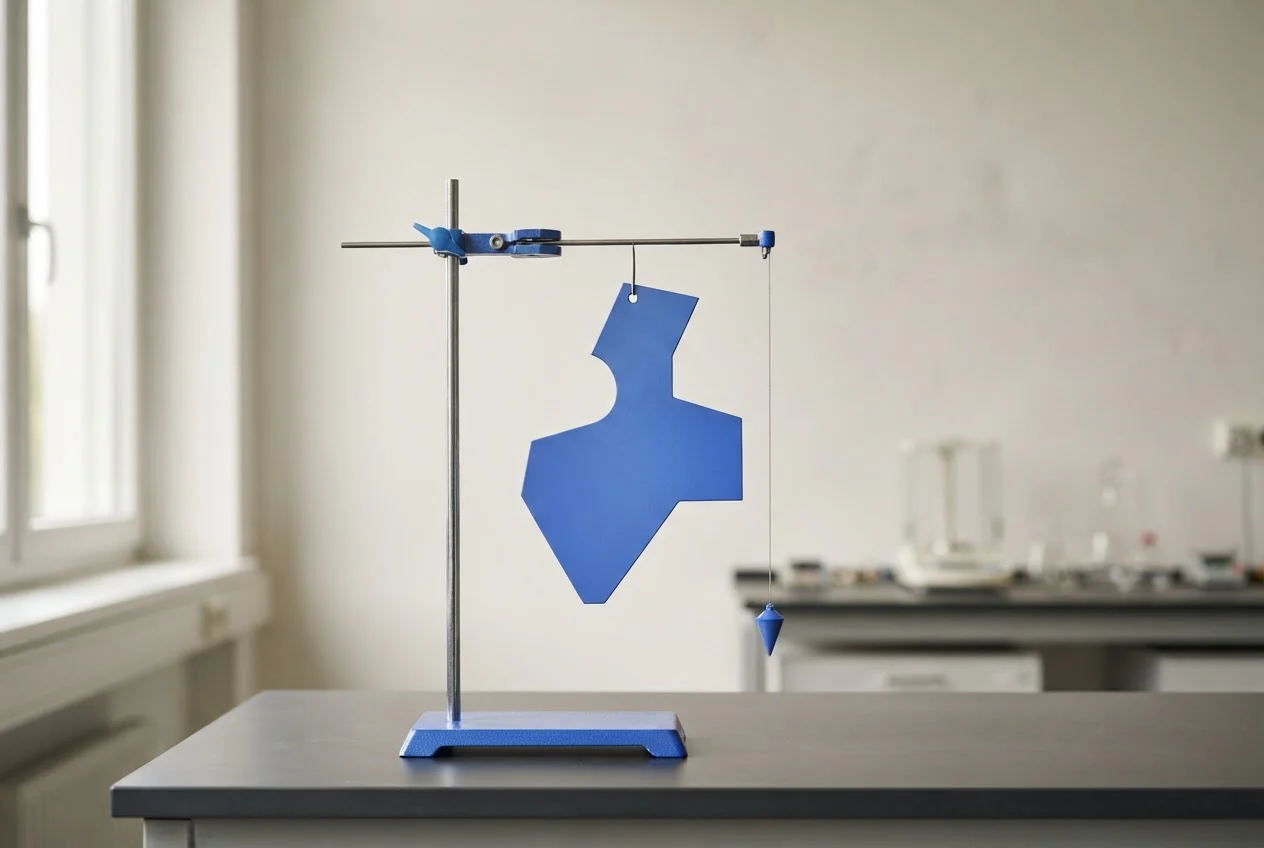
The same table method works in physics and in statics, as long as you weight by the right quantity. If one half of a plate is steel and the other is aluminium, the centroid stays at the geometric middle but the centre of mass shifts toward the steel. In your composite table, you would weight by mass instead of area.
Where does centroid appear in first-year engineering, and how do we help?
In SPPU's first-year Engineering Mechanics (course code CVL107, 2024 pattern), Unit I lists "centroid of basic figures, centroid of composite figure", followed by moment of inertia and the parallel and perpendicular axis theorems. The course carries 70 marks in the end-semester theory exam, 30 in internal assessment and 25 in term work (SPPU syllabus). Other universities arrange it differently, so check your own syllabus.
Centroid is one unit among several, so it helps to see where it sits in the whole course. Our unit-by-unit plan for studying Engineering Mechanics at SPPU shows how to order the units, and our guide to the Engineering Mechanics SPPU online course shows what the course covers. If you are still deciding what to take in first year, our roadmap of first-year engineering classes in Maharashtra compares the options.
RG Lectures, started in May 2018 by Rahul Jewaani (RG Sir) in Ulhasnagar, Maharashtra, runs an FE Engineering course for SPPU that covers Physics, Mechanics and Drawing, with one year of validity. As of October 2026 you can take Engineering Mechanics on its own, or as a combo with the other first-year subjects. Our approach is Padhna Aasaan Hai: explain the idea in plain words, then drill it on questions, which is exactly what the worksheet above asks of you. See the FE Engineering SPPU course.
We also teach Physics for the Maharashtra Common Entrance Test (MHT-CET) and Higher Secondary Certificate (HSC) Board Physics.
Learn Engineering Mechanics the Padhna Aasaan Hai way
Frequently asked questions
Sources
- 1.Savitribai Phule Pune University, First Year Engineering 2024 Pattern syllabus (CVL107 Engineering Mechanics)
- 2.Engineering LibreTexts, Centroids and Area Moments of Inertia for 2D Shapes
- 3.Engineering LibreTexts, 7.4 Centroids
- 4.engineeringstatics.org, Centroids using composite parts
- 5.engineeringstatics.org, Statics: Centroids
- 6.Math Is Fun, Centroid and Center of Gravity