How to Study Engineering Mechanics: SPPU Unit-by-Unit Plan
To study engineering mechanics in first year, learn the five syllabus units in dependency order, draw the free body diagram first in every problem, and practise each problem type with solutions closed.

By Rahul Jeewani, Founder · Updated 9 Oct 2026

Key takeaways
- 01To study engineering mechanics, build one skill, the free body diagram (FBD), and apply it through all five units. Spend most of your extra time on Unit II (Equilibrium), because Units III and V both start from it.
- 02Solve every numerical in four steps: draw the FBD, choose axes and resolve the forces, write the equations, then check direction, units and size of the answer.
- 03Plan each session by time and problem type: new type first, then older types, solutions closed. Aim for three problems per type each week, and log which of the four steps failed in every wrong answer.
- 04Check your own university's marking scheme. SPPU's revised syllabus puts 60 of its 100 theory marks in the end-semester paper, so solved problems on paper decide most of the result.
In this article
- 1How do you study engineering mechanics when every numerical looks different?
- 2What does the SPPU Engineering Mechanics syllabus actually cover?
- 3In what order should you study the five Engineering Mechanics units?
- 4What is the four-step method for solving an Engineering Mechanics numerical?
- 5What does a unit-by-unit study sheet for Engineering Mechanics look like?
- 6How long should one Engineering Mechanics study session be?
- 7How do you catch up in Engineering Mechanics if you started late?
- 8How do we teach Engineering Mechanics at RG Lectures?
- 9Frequently asked questions
Many students follow every lecture and still struggle in the paper, because Engineering Mechanics, the first-year subject on forces, equilibrium, friction and motion, is examined on solved problems, not recalled theory. In the revised first-year syllabus of Savitribai Phule Pune University (SPPU), the end-semester paper carries 60 theory marks, and the course outcomes ask you to apply and analyse, not only to understand.
That is why the advice to practise daily does not help a student who cannot begin a problem. A numerical, meaning a worked problem with numbers, almost always starts from the same drawing, and a wrong drawing spoils every line after it. Fix that one habit and the syllabus becomes five variations on it.
Below you get a study order based on how the five units depend on each other, a four-step method with one fully worked example, and a unit-by-unit sheet to copy into your notebook.
How do you study engineering mechanics when every numerical looks different?
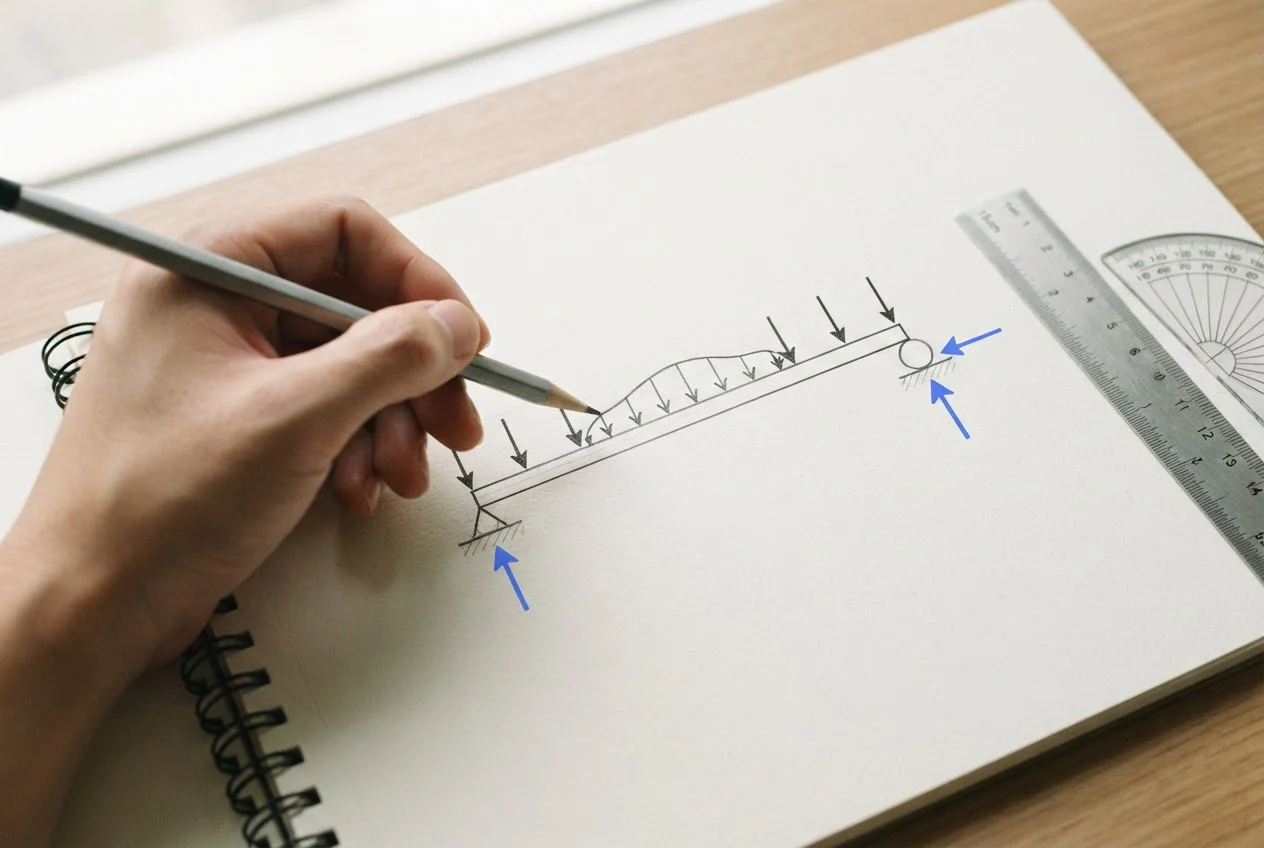
Learn one skill and apply it five times: draw the free body diagram, then write equations from it. An FBD is a sketch of one body, cut free from everything around it, showing every force and moment acting on it, with each support replaced by the reaction it provides.
Numericals look different on the surface (a ladder, a truss, a block on a slope, a falling ball), but the first move is the same. The syllabus says as much: its second course outcome is to "apply concept of free body diagram for static equilibrium", and Unit II is where it is taught. Friction and truss problems in Unit III need the FBD, and so does Newton's second law in Unit V, where the sum of forces on the FBD equals mass times acceleration.
In our experience, once you can draw the FBD correctly in about a minute, the rest of most statics problems is algebra.
What does the SPPU Engineering Mechanics syllabus actually cover?
The SPPU syllabus covers five units of 6 hours each, 30 hours in total, plus a laboratory. As of October 2026, the revised SPPU 2024-pattern syllabus, effective from academic year 2025-26, sets 40 marks for Comprehensive Continuous Evaluation (CCE, the internal tests), 60 for the end-semester paper and 25 for term work. The course code is ESC-104-CVL, where ESC stands for Engineering Science Course. Theory runs 2 hours a week and practical 2 hours a week, for 2 theory credits and 1 practical credit, according to the revised SPPU first-year syllabus.
If a senior's notes say 30 and 70, those figures come from the original 2024-25 scheme. The unit contents stayed the same.
| Unit | Topic | What you must be able to do |
|---|---|---|
| I | Force systems and resultants, plus centroid and moment of inertia | Resolve forces, find the resultant (the single force with the same effect as the whole system), take moments, and find the centroid (geometric centre of an area) and moment of inertia (how an area is spread about an axis) of composite shapes |
| II | Equilibrium | Draw FBDs, identify load and support types, find beam support reactions |
| III | Friction and trusses | Solve sliding, ladder and belt friction; analyse pin-jointed trusses by the method of joints and method of sections |
| IV | Kinematics of particle | Describe straight-line and curved motion, including projectiles, without reference to forces |
| V | Kinetics of particle | Apply Newton's second law, work-energy, impulse-momentum and impact |
The laboratory needs four compulsory experiments, four graphical solutions and at least four examples on each unit, which is 20 examples across the five units. Those 20 are the minimum your journal needs, so treat them as a floor for practice, not a target.
If your university is not SPPU, the unit names will differ a little, but the method below still applies.
In what order should you study the five Engineering Mechanics units?
Study them in the order I, II, III, IV, V, and give Unit II more of your own time than any other. Each unit needs something from an earlier one, and Unit II is the one that Units III and V both depend on.
| Unit | Needs first | Why |
|---|---|---|
| I Force systems | Trigonometry | Splitting a force into components uses sine and cosine |
| II Equilibrium | Unit I | Equilibrium equations use force components and moments |
| III Friction and trusses | Unit II | Both start from a correct FBD |
| IV Kinematics | Calculus | Motion described by displacement, velocity and acceleration; it does not need statics |
| V Kinetics | Units II and IV | Needs the FBD for the forces and kinematics for the acceleration |
The syllabus gives each unit 6 hours. Our recommendation, which is our own reasoning from this dependency chain and not an official weighting, is to put your extra revision time into Unit II. If you are strong at calculus, you can study Unit IV earlier, since it stands apart from the statics units.
What is the four-step method for solving an Engineering Mechanics numerical?
Use four steps every time: draw the FBD, choose axes and resolve every force, write the equations, then check the answer. Do not skip to step three; most wrong answers start in step one or two.
FBD
Isolate the body. Draw every force, including weight, supports' reactions and friction, and mark which way friction would act.Axes and components
Choose axes that make the most forces lie along an axis (along and perpendicular to a slope, for example) and resolve the rest.Equations
Write the sum of forces along each axis and the sum of moments. For friction, add the limit condition F = μN, where μ (the coefficient of friction) is the ratio of limiting friction to the normal reaction.Check
Is the sign sensible, are the units right, and does the size make physical sense?
Worked example. A 20 kg block rests on a rough plane inclined at 30°, with μ = 0.3. What is the minimum force P, pushed up the slope and parallel to it, needed to stop the block sliding down? (Our own calculation, taking g = 9.81 m/s².)
- Step 1: weight W = 20 × 9.81 = 196.2 N. The block tends to slide down, so friction acts up the slope, along with P.
- Step 2: along the slope, W sin 30° = 98.1 N. Perpendicular to the slope, W cos 30° = 196.2 × 0.866 = 169.9 N.
- Step 3: perpendicular to the slope, N = 169.9 N, so the maximum friction is 0.3 × 169.9 = 51.0 N. Along the slope, with the block on the point of sliding down, P + 51.0 = 98.1, so minimum P = 47.1 N.
- Step 4: with no push at all, the slope would need 98.1 N of friction but only 51.0 N is available, so the block slides, and P must be positive. The block stays at rest for any P from 47.1 N to 149.1 N, where 149.1 = 98.1 + 51.0 is the point at which it would start sliding up the slope.
The trap here is using F = μN as if friction always has that value. Friction takes whatever value keeps the block still, up to μN, and the check in step 4 is how you catch it.
What does a unit-by-unit study sheet for Engineering Mechanics look like?
Use one row per unit: the skill to master, the drawing to make first, a weekly drill with solutions closed, and the slip to watch for. Copy this into your notebook and tick off the drills.
| Unit | Master this | Draw or write first | Weekly drill target (solutions closed) | Slip to watch |
|---|---|---|---|---|
| I | Resultants, moments, Varignon's theorem (the moment of a resultant equals the sum of the moments of its components), centroid and moment of inertia of composite shapes | Axes, plus one moment sign convention (anticlockwise positive) | 3 concurrent-force resultants, 3 parallel-force resultants, 3 composite centroids, 3 composite moments of inertia | Mixed moment signs; forgetting the A·d² term in the parallel-axis theorem; not subtracting a cut-out |
| II | Equilibrium and beam reactions | Replace each support by its reactions: a roller gives one force perpendicular to the surface, a hinge two components, a fixed support two components and a moment; replace a uniformly distributed load by its total at its centre | 3 beams with point loads, 3 with distributed loads, 3 with a couple | A horizontal reaction drawn at a roller; the distributed load placed at the wrong point |
| III | Friction (incline, ladder, belt) and trusses | Friction opposing the motion that would happen; for a truss, first the whole-truss FBD for support reactions | 3 incline, 3 ladder, 3 belt; 3 trusses by joints, 3 by sections | Using F = μN when the body is not about to slip; mixing tension and compression in a truss |
| IV | Straight-line and curved motion | One chosen positive direction; projectile split into horizontal and vertical | 3 uniform-acceleration, 3 variable-acceleration, 3 projectile | Using constant-acceleration formulas when acceleration changes with time |
| V | Newton's second law, work-energy, impulse-momentum, impact | FBD at the instant you study, then choose the method | 3 problems per method | Using the wrong method for the question |
For Unit V, our rule for choosing a method: a force and an acceleration point to Newton's second law, speed against distance points to work-energy, and time with a change in velocity points to impulse-momentum.
How long should one Engineering Mechanics study session be?
Plan a session around one unit and a time budget, not a count of problems. A 90-minute session works as 15 minutes of recall, 20 minutes on one new type, 45 minutes of problems and 10 minutes on the error log.
- 15 minutes recall: redraw yesterday's FBDs and write the key formulas from memory.
- 20 minutes new type: read one solved example with the solution covered, then check against it.
- 45 minutes of problems: start with the new type, then older types, solutions closed. Do as many as fit. If you are stuck, look at the next step only, not the whole solution.
- 10 minutes error log: for each wrong answer, write which of the four steps failed (FBD, axes, equations or check).

A resultant takes a few minutes, but a truss or a ladder-friction problem can take far longer, so the problem block is set by time, and the three-per-type targets in the study sheet are weekly. After two weeks, count the log. The step that appears most is the one to drill before you do anything else.
How do you catch up in Engineering Mechanics if you started late?
Start with Units I and II, then III, then take IV and V together. This covers the statics core first and leaves the motion units, which need Newton's second law plus kinematics, for the end. Our recommendation is to attempt one full paper's worth of problems from the unit you are weakest in, with solutions closed, before moving on.
Do not try to read the whole syllabus once. A single pass through five units leaves the FBD untested, and a wrong FBD spoils every later line of the answer. If trigonometry or calculus is the obstacle, spend your first two sessions on those rather than on mechanics.
If other first-year subjects are also slipping, read our guide to Engineering Graphics and our roadmap of first year engineering classes. Our Pune University courses also include Engineering Physics and Engineering Graphics.
How do we teach Engineering Mechanics at RG Lectures?
Our Engineering Mechanics Pune University 2026-27 course covers the complete SPPU syllabus in Hindi, with video lectures and practice sets, and access runs until 30 June 2027. It includes foundational content for students with gaps in earlier-class maths, and you can rewatch any unit and repeat the drills at your own pace.
As of October 2026, the course is ₹1,699, reduced from ₹1,999. For two or three subjects together, our store lists an Engineering Two Subject Combo at ₹2,429 and an Engineering Combo (3 Subjects) at ₹3,546.
Study Engineering Mechanics in Hindi with RG Lectures
Frequently asked questions
Sources
- 1.Savitribai Phule Pune University, First Year Engineering (2024 Pattern) Revised syllabus, effective academic year 2025-26, Engineering Mechanics course
- 2.Savitribai Phule Pune University, First Year Engineering (2024 Pattern) original syllabus, Engineering Mechanics course (copy hosted by DPCOE Pune)
- 3.RG Lectures, Engineering Mechanics Pune University 2026-27 course page
- 4.RG Lectures, Pune University course listing