Coulomb's Law Made Aasaan: Direction and Medium Slips in MHT-CET Numericals
Coulomb’s law gives the force between point charges at rest as F = (1/4πε₀)(q₁q₂/r²). The blog teaches two exam slips: adding pair forces as numbers instead of arrows, and mishandling the medium factor εr. Worked numericals and a checklist help.

By Rahul Jeewani, Founder · Updated 6 Nov 2026

Key takeaways
- Coulomb's law gives F = (1/4πε₀)(q₁q₂/r²) for point charges at rest. Put only the magnitudes of the charges into the formula, then decide attraction or repulsion from the signs.
- With three or more charges, draw one arrow per pair, resolve into components, add the components, and use Pythagoras last. Never add the magnitudes of arrows that are not in a straight line.
- In a medium that fills the space around the charges, divide the force by εr once. If the distance changes too, write (r/r′)² as a separate step. For the same force in air and in a medium, r′ = r/√εr, which is smaller than r.
- Convert µC to C and cm to m before you substitute, then run the seven-point checklist before you lock an answer.
In this article
- 1Coulomb's law in one minute: statement and formula
- 2What k = 9×10⁹ really is, and when to use ε₀
- 3Direction first: vector form and the sign trick
- 4Slip 1: direction with three or more charges
- 5Resolve, then add vectors: the principle of superposition
- 6Pre-submit check
- 7The medium trap: F divided by εr
- 8Slip 2: εr, ε and ε₀ mix-up
- 9Which symbol is which: εr, ε and ε₀
- 10Pre-submit check
- 11Worked MHT-CET-style numericals
- 12Numerical 1: same force in air and in oil, find the new distance
- 13Numerical 2: three charges, find the resultant force
- 14Numerical 3: two touched spheres
- 15Quick checklist before you lock the answer
- 16Where to go next
- 17Frequently asked questions
You know F = (1/4πε₀)(q₁q₂/r²) by heart, yet marks still slip away. The formula is rarely the problem. Trouble starts when a question adds a third charge or a medium, and the working quietly goes wrong.
Exam pressure makes it worse. According to the State CET Cell’s MHT-CET 2024 marking scheme, Physics and Chemistry share one 90-minute paper of 100 questions, which is about 54 seconds each by our arithmetic. One JEE Main 2024 question (31 January, Shift 2) put a medium (K = 5, called εr in some books) and one-fifth of the distance into a single problem. The answer was 5F, and in our reading each wrong option (F/5, 25F, F/25) is what one slip produces.
This page fixes both slips for Class 12 and MHT-CET (Maharashtra Health and Technical Common Entrance Test) students. You get a pre-submit check for each slip, three worked numericals and a seven-point checklist. First, the law itself, in one minute.
Coulomb's law in one minute: statement and formula
Coulomb's law says the force between two point charges at rest is proportional to the product of the charges and inversely proportional to the square of the distance between them. It acts along the line joining the charges. Like charges repel and unlike charges attract.
In symbols, F = k q₁q₂ / r², where k = 1/(4πε₀) is the constant covered in the next section, with F in newton (N), q in coulomb (C) and r in metre (m).
The law holds for point charges at rest. Charged spheres count as point charges when their separation is much larger than their radii, as NCERT Class 12 Physics, Chapter 1 puts it.
Two quick feel-checks:
- Double one charge and the force doubles.
- Double the distance and the force becomes one-quarter.
What k = 9×10⁹ really is, and when to use ε₀
k is shorthand for 1/(4πε₀) and its value is about 9 × 10⁹ N m² C⁻². Use k when the question gives charges and a distance in vacuum or air. Switch to ε₀ when the question gives you ε₀ itself or a medium's permittivity ε.
NCERT gives ε₀ = 8.854 × 10⁻¹² C² N⁻¹ m⁻². The 2022 value from the Committee on Data of the International Science Council (CODATA), published by the National Institute of Standards and Technology (NIST), is 8.854 187 8188 × 10⁻¹² F m⁻¹, and farad per metre is the same unit as C² N⁻¹ m⁻².
Here is our own working from that value:
- 1/(4π × 8.8541878188 × 10⁻¹²) = 8.98755 × 10⁹ N m² C⁻².
- 9 × 10⁹ is therefore (9 − 8.98755)/8.98755 ≈ 0.14% above the CODATA 2022 value.
- That gap is small enough to use 9 × 10⁹ in numericals, unless the question gives a different k.
Remember the scale too. Two 1 C charges 1 m apart in vacuum push each other with 9 × 10⁹ N (NCERT), which is why questions use µC and mC. For a unit check of k and ε₀, see our guide on units and dimensions in Class 11.
Direction first: vector form and the sign trick
The vector form F₁₂ = (1/4πε₀)(q₁q₂/r²) r̂ gives the force on q₁ due to q₂. Here r̂ is the unit vector (length 1) pointing from q₂ to q₁. If q₁q₂ is positive, the force points along r̂, away from q₂, which is repulsion. If q₁q₂ is negative, it points toward q₂, which is attraction. NCERT writes the same form.
The sign trick for numericals: put only the magnitudes |q₁| and |q₂| into the formula, then decide direction from like or unlike. Mixing the two methods is how a minus sign gets lost halfway.
Like charges (q1 x q2 positive): repel
  <-- F on q1    (q1) ------------ (q2)    F on q2 -->

Unlike charges (q1 x q2 negative): attract
                 (q1) --> F on q1    F on q2 <-- (q2)

r-hat for the force on q1 points from q2 to q1.
Slip 1: direction with three or more charges
The direction slip with three or more charges is adding the pair forces as plain numbers. Forces are vectors, so they have to be added as arrows. A third charge does not change the force between the other two. It only adds one more arrow to the sum.
Resolve, then add vectors: the principle of superposition
By the principle of superposition, the force on one charge is the vector sum of the forces from each other charge, taken one at a time (NCERT, Section 1.7). Each pair force is worked out as if the other charges were absent.
The routine:
- Pick the charge you want the force on.
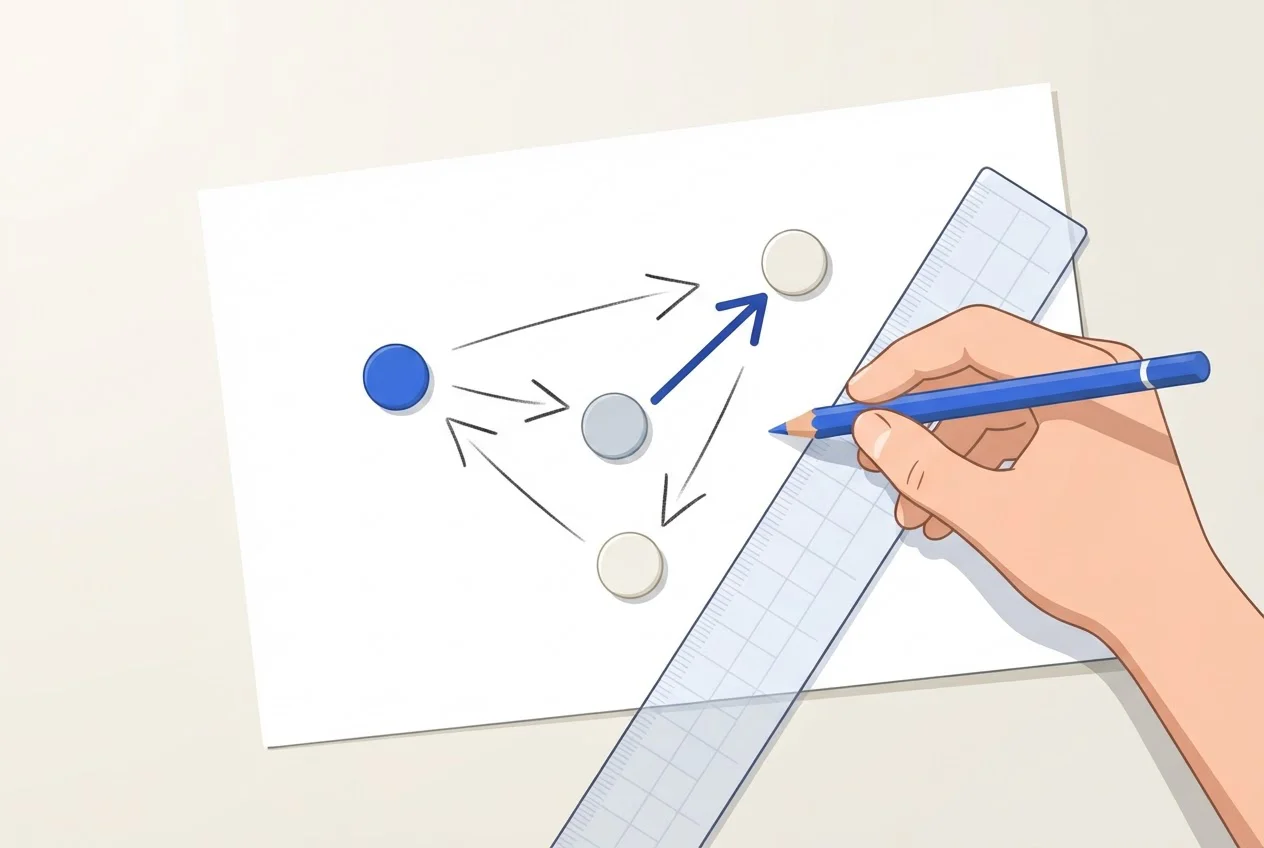
- Draw one arrow per other charge, along the line joining the pair. Like charges point away from the source charge and unlike charges point toward it.
- Find each magnitude from the formula, using |q| values.
- Split every arrow into x and y components.
- Add the x components together and the y components together.
- Use Pythagoras last, then give the angle from a named axis.
Pre-submit check
Run these three tests before you move on:
- Arrow count. Pass: the number of arrows equals the number of other charges. Fail: you drew one arrow for the whole group.
- Like or unlike. Pass: every arrow matches its pair (away for like, toward for unlike). Fail: any arrow you cannot justify from the charge signs.
- Resultant size. Pass: the resultant is smaller than the sum of the magnitudes whenever the arrows are not in a straight line. Fail: the resultant equals that sum with the arrows at an angle. You added numbers, not arrows.
The medium trap: F divided by εr
In a medium that fills the space around and between the charges, the force is the vacuum force divided by εr: F_medium = F_vacuum / εr, at the same charges and the same distance. The charges and the distance stay as given. Only the force changes.
This rule assumes the medium fills the space between the charges. A slab placed between the charges, with air elsewhere, is a different case, so dividing by εr does not apply to it.
When the distance changes as well, two factors act at once:
F′/F = (1/εr) × (r/r′)²
Take the JEE Main 2024 question (31 January, Shift 2) from the introduction. Charges in vacuum at r cm have force F. In a medium with εr = 5 (K = 5 in the question) at r/5 cm, the force is F′ = (1/5) × (5)² × F = 5F.

| Option | What it equals | Slip it matches (our reading) |
|---|---|---|
| 5F | (1/5) × 25 | Correct: medium factor and distance factor both applied |
| F/5 | 1/5 | Medium factor applied, distance change ignored |
| 25F | 25 | Distance change applied, medium factor ignored |
| F/25 | 1/25 | Distance factor turned upside down, medium factor ignored |
The habit the table teaches is to treat the medium factor and the distance factor as two separate steps, and write both.
Slip 2: εr, ε and ε₀ mix-up
The mix-up is dividing by the wrong symbol. ε₀ is a fixed constant, ε is a permittivity with units, and εr is a pure number that is at least 1.
Which symbol is which: εr, ε and ε₀
| Symbol | Name | Unit | Value or range |
|---|---|---|---|
| ε₀ | Permittivity of free space | C² N⁻¹ m⁻² | 8.854 × 10⁻¹² |
| ε | Absolute permittivity of the medium | C² N⁻¹ m⁻² | ε = ε₀εr |
| εr | Relative permittivity of the medium | none | 1 for vacuum; more than 1 for a dielectric (insulating) material |
Books and papers use both names for the same quantity. NCERT writes K: ε = ε₀K and K = ε/ε₀ (NCERT Class 12 Physics, Chapter 2). MHT-CET questions often write K or k, as the JEE Main 2024 question above did, so be ready for either.
The force in a medium can be written either way:
- F = q₁q₂ / (4πε r²), or
- F = q₁q₂ / (4πε₀ εr r²).
Pre-submit check
- Size of the divisor. Pass: the number you divided by is a pure number of at least 1. Fail: you divided by a value near 10⁻¹¹. That is ε, not εr. Divide it by ε₀ first to get εr.
- Direction of change. Pass: at the same distance, the force in the medium is smaller than in vacuum. Fail: the force went up with no change in distance.
- ε₀ appears once. Pass: exactly one ε₀ in your final expression. Fail: ε₀ and ε both sit in the denominator, which counts it twice.
- Same-force questions. Pass: setting F_medium(r′) = F_vacuum(r) gives r′ = r/√εr, a smaller distance than r. Fail: r′ comes out larger than r.
Worked MHT-CET-style numericals
Three worked numericals follow, on the same-force-in-oil, three-charge and touched-sphere cases, each ending with a check line. Our four-step method for physics numericals covers the general method, and for more chapter-wise practice questions you can use our MHT-CET PYQ practice library. In all three, use k = 9 × 10⁹ N m² C⁻².
Numerical 1: same force in air and in oil, find the new distance
Two charges exert a force F on each other at 24 cm in air. They are placed in oil with εr = 2.25. At what distance in the oil is the force again F?
- Same force: (1/εr)(1/r′²) = 1/r², so r′ = r/√εr.
- r′ = 24/√2.25 = 24/1.5 = 16 cm.
- Test it: F′ = (F/2.25) × (24/16)² = (F/2.25) × 2.25 = F.
Check before you submit: the oil weakens the force, so the charges must come closer to get the same force. If your r′ is more than 24 cm, the root went the wrong way.
Numerical 2: three charges, find the resultant force
A = +4 µC sits at the origin. B = +5 µC is 10 cm from A along +x. C = −5 µC is 10 cm from A along +y. Find the resultant force on A.
- Convert: 4 µC = 4 × 10⁻⁶ C, 5 µC = 5 × 10⁻⁶ C, 10 cm = 0.10 m.
- Each pair: F = 9 × 10⁹ × (4 × 10⁻⁶)(5 × 10⁻⁶) / (0.10)² = 0.18/0.01 = 18 N.
- Directions: B and A are both positive, so B repels A and the force on A points along −x. C is negative and A is positive, so C attracts A and the force points along +y.
- Components: Fx = −18 N, Fy = +18 N.
- Resultant: √(18² + 18²) = 18√2 ≈ 25.5 N, at 45° above the −x axis.
Check before you submit: 25.5 N is less than 18 + 18 = 36 N because the arrows are at right angles. If you wrote 36 N, you added numbers instead of arrows.
Numerical 3: two touched spheres
The spheres are identical and conducting, carry opposite charges (+12 µC and −4 µC), and are at the same 20 cm separation before and after touching, so the charge shares equally. Find the force before and after touching.
NCERT Chapter 1 describes the same idea: touching a charged sphere to an identical uncharged one shares the charge equally, which is how Coulomb halved a charge.
- Before: F = 9 × 10⁹ × (12 × 10⁻⁶)(4 × 10⁻⁶) / (0.20)² = 0.432/0.04 = 10.8 N, attraction.
- After touching: total charge = +12 − 4 = +8 µC, so each sphere has +4 µC.
- After: F = 9 × 10⁹ × (4 × 10⁻⁶)(4 × 10⁻⁶) / (0.20)² = 0.144/0.04 = 3.6 N, repulsion.
- The force falls to 3.6/10.8 = 1/3 of its earlier value, and changes from attraction to repulsion.
Check before you submit: add the charges with their signs before you split them, and note that the force changed from attraction to repulsion. If your "after" force is still attractive, the sign was lost.
Quick checklist before you lock the answer
Run these seven tests. Each has a pass and a fail. According to the State CET Cell’s MHT-CET 2024 marking scheme, Physics and Chemistry share one 90-minute paper of 100 questions, each worth one mark, with no negative marking. Our arithmetic: 5,400 seconds over 100 questions is about 54 seconds a question, so each check below is built to take a few seconds. Our guide to the MHT-CET exam pattern covers the current format.
- Units. Convert µC to C and cm to m before substituting. Pass: every quantity in C and m. Fail: a "µ" or "cm" survives in the line. A refresher on unit checks is in units and dimensions in Class 11.
- Arrows. Pass: one arrow per other charge, each along the line to its source. Fail: any pair without an arrow.
- Components. Pass: you added components and used Pythagoras last. Fail: you added magnitudes of non-parallel arrows.
- Medium. Pass: you divided by εr once and the force dropped at the same distance. Fail: you divided by ε, or divided twice.
- Distance. Pass: (r/r′)² written as its own factor. Fail: the ratio is not squared or is the wrong way up.
- Symbols. Pass: εr is a pure number of at least 1, and ε₀ appears once. Fail: you divided by a number of order 10⁻¹¹.
- Final word. Pass: the answer says attraction, repulsion or an angle from a named axis. Fail: a bare number with no direction.
For the full formula list, use our HSC Physics formula sheet.
Where to go next
Before you move on, keep two habits from this page. With more than two charges, draw one arrow per pair before you touch a formula. When a question mentions a medium, write the medium factor and the distance factor as two separate steps, then check that the force fell at the same distance.
If a question will not finish in about a minute, mark your best option and move on, because MHT-CET has no negative marking. Tonight, redo Numerical 2 and Numerical 3 without looking at the working, then run the seven-point checklist on each.
The next electrostatics topic is Gauss’s law, which covers field and flux. For a whole-year plan, use our Class 12 physics study plan.
If you would rather prepare MHT-CET Physics with RG Sir, compare the options in our MHT-CET courses before you choose. Padhna aasaan hai, once the routine is clear.
Prepare MHT-CET Physics with RG Sir
Frequently asked questions
Sources
- 1.NCERT, Class 12 Physics Part 1, Chapter 1, Electric Charges and Fields (Coulomb's law, vector form, superposition, Example 1.5)
- 2.NCERT, Class 12 Physics Part 1, Chapter 2, Electrostatic Potential and Capacitance (ε = ε₀K, dielectric constant)
- 3.NIST, CODATA 2022 value of the vacuum electric permittivity ε₀
- 4.State CET Cell, Syllabus and Marking Scheme for MHT-CET 2024 (paper pattern, 90-minute Physics and Chemistry paper, no negative marking, JEE (Main) level)