Maxwell's Equations for Mumbai University FE: What Gets Asked
Maxwell's equations are four laws linking charge, magnetic fields and changing fields. In Mumbai University's first-year Applied Physics exam they have been a five-mark state, explain or derive question plus vector calculus.

By Rahul Jeewani, Founder · Updated 17 Nov 2026

Key takeaways
- Maxwell's equations are Gauss's law for electricity, Gauss's law for magnetism, Faraday's law and the Ampère–Maxwell law. In the three Mumbai University FE papers we reviewed, the Maxwell question was a five-mark "state, explain or derive" on the fourth or second equation, never a plug-in numerical.
- Gradient, divergence and curl carried more marks than the Maxwell question itself: 8 of the up to 13 marks. Practise these first.
- The fourth equation needs its extra term, the displacement current, because Ampère's law alone gives two answers for one loop around a charging capacitor.
- For a five-mark answer, write the law's name and number, the integral form, the point form, the theorem linking them, and a one-line meaning. For the fourth equation, add why the extra term exists.
In this article
- 1What are Maxwell's equations, in plain words?
- 2What does the Mumbai University FE exam actually ask about Maxwell's equations?
- 3Why does the fourth Maxwell equation need an extra term?
- 4How do you solve divergence, curl and gradient questions?
- 5Do Maxwell's equations give the speed of light?
- 6How should you write a five-mark Maxwell answer?
- 7How do we teach the Electrodynamics module at RG Lectures?
- 8Frequently asked questions
Many first-year students get stuck in the same way. You can work out a curl at a point, pass the numerical, and still have no feel for what the equations mean. That gap makes the fourth equation, with its odd extra term, feel like something to memorise instead of understand.
Maxwell's equations take four of the 26 teaching hours in Mumbai University's first-semester Applied Physics course, but in the three Semester I papers we reviewed they could carry up to 13 of the 45 marks. Most of those marks are not for reciting the four laws. They are for vector calculus and for one five-mark state, explain or derive question.
This page gives you the four equations in plain words and the question pattern from those three papers. It also has worked vector calculus problems, a charging-capacitor calculation that shows why the fourth equation needs its extra term, and a five-mark answer plan you can reuse. It is written for first-year engineering (FE) students at Mumbai University, and the syllabus details apply to that university only.
What are Maxwell's equations, in plain words?
Maxwell's equations are four laws that describe where electric and magnetic fields come from. Charges make electric fields. Magnetic field lines never start or end. A changing magnetic field makes a circulating electric field. Current and a changing electric field both make a circulating magnetic field.
Each law has two forms. The integral form works over a closed surface or loop. The point (differential) form works at a single point and uses divergence (∇·, how much field spreads out from a point) and curl (∇×, how much it swirls around one). The Mumbai University syllabus asks for both. The integral forms below follow OpenStax University Physics, Volume 2, section 16.1.
| Usual number | Law | Integral form | Point form | In words |
|---|---|---|---|---|
| 1 | Gauss's law, electric | ∮E·dA = Q/ε₀ | ∇·E = ρ/ε₀ | Enclosed charge is where electric field lines start and end |
| 2 | Gauss's law, magnetism | ∮B·dA = 0 | ∇·B = 0 | There are no isolated magnetic poles, so B lines close on themselves |
| 3 | Faraday's law | ∮E·dl = −dΦ_B/dt | ∇×E = −∂B/∂t | A changing magnetic field makes a circulating electric field |
| 4 | Ampère–Maxwell law | ∮B·dl = μ₀I + μ₀ε₀ dΦ_E/dt | ∇×B = μ₀J + μ₀ε₀ ∂E/∂t | Current and a changing electric field both make a circulating magnetic field |
Here Q is the enclosed charge, ρ is charge density, J is current density, and Φ_B and Φ_E are magnetic and electric flux. The numbering above is the order most Indian textbooks use. Check your own textbook's order, and in the exam name the law as well as the number. The separate laws are covered on our pages for Gauss's law, Faraday's law and Ampère's circuital law.
What does the Mumbai University FE exam actually ask about Maxwell's equations?
The three Semester I Applied Physics papers we reviewed each asked the same three things on this module: a short divergence or curl question, a vector calculus numerical, and a five-mark Maxwell question. (NEP is the National Education Policy 2020.) Module IV lists gradient, divergence, curl, the four laws, the divergence and Stokes theorems, and Maxwell's equations in point and integral form. Stokes' theorem turns a loop integral into a surface integral of the curl, and the divergence theorem turns a closed-surface integral into a volume integral of the divergence.
Each is 45 marks over 1.5 hours. We counted them in November 2026.
| Paper | Short question (3 marks) | Numerical (5 marks) | Maxwell question (5 marks) |
|---|---|---|---|
| December 2024 | Divergence of a curl is zero | Gradient of a scalar function at a point | State and explain the fourth equation |
| May 2025 | Divergence of a curl is zero | Curl of two given vector fields | State Ampère's law, then derive the fourth equation in point form |
| December 2025 | Meaning and significance of curl | Curl of a given vector at a point | Deduce the second equation in point and integral form |
Two things follow from this table, and both come from our count of these three papers:
- Marks versus hours. The module is 4 of the course's 26 teaching hours (4+4+4+4+6+4), about 15%. If you attempt all three parts above, they are worth 3 + 5 + 5 = 13 of 45 marks, about 29%. Of those 13 marks, 8 are vector calculus.
- What the Maxwell question looked like. It was the fourth equation twice and the second once, and it was always state, explain or derive. None of the three papers asked a numerical that puts numbers into Maxwell's equations.
Three papers show a pattern, not a rule. Question 1 is "attempt any five of seven", and you answer any two of Questions 2 to 5, so you can skip any of these parts. We would still treat the module as scoring material, because it is a short, learnable block.
Why does the fourth Maxwell equation need an extra term?
The Ampère–Maxwell law needs the term μ₀ε₀ ∂E/∂t because Ampère's law alone gives two different answers for the same loop around a charging capacitor. It is called displacement current, but no charge crosses the gap. It is a changing electric field doing the job a current does.
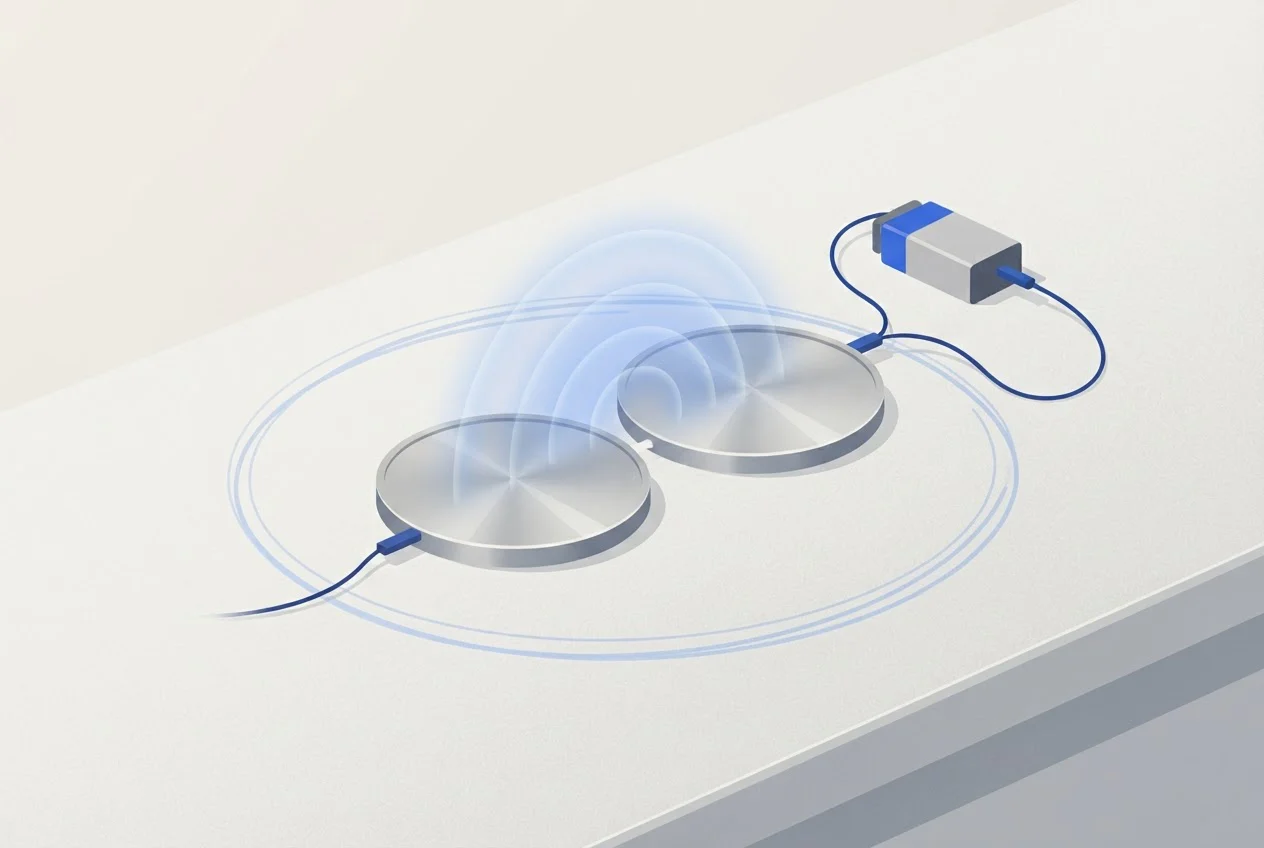
Take circular plates of radius R = 5 cm charged by a steady current I = 2 A. Draw a circular loop of radius r in the gap. A flat surface across the gap catches no conduction current, so Ampère's law alone says B = 0. A bulging surface through the same loop that passes through the wire catches 2 A and says B ≠ 0. One loop cannot have two answers.
The electric flux through the loop supplies the missing term. Inside the gap, dE/dt = I/(ε₀πR²), so Ampère–Maxwell gives B · 2πr = μ₀ε₀ · (dE/dt) · πr². This simplifies to B = μ₀Ir/(2πR²). Outside the plates only the conduction current remains, so B = μ₀I/(2πr).
| Position | Formula | B (our calculation, μ₀ = 4π×10⁻⁷) |
|---|---|---|
| r = 3 cm, in the gap | μ₀Ir/(2πR²) | 4.8 µT |
| r = 5 cm, at the plate edge | either formula | 8.0 µT |
| r = 8 cm, outside | μ₀I/(2πr) | 5.0 µT |
At r = R the inside and outside formulas both give 8.0 µT, so the field is continuous across the plate edge. That only works with the extra term. In this setup the field is changing at dE/dt = I/(ε₀πR²), about 2.9×10¹³ V m⁻¹ s⁻¹ (using ε₀ = 8.854×10⁻¹² F m⁻¹).
There is also a one-line reason. The divergence of any curl is zero, so ∇·(∇×B) = 0. If ∇×B = μ₀J alone, that forces ∇·J = 0, which is false while charge piles up on a plate. Adding μ₀ε₀∂E/∂t fixes it. Take the divergence and use ∇·E = ρ/ε₀, and you get μ₀(∇·J + ∂ρ/∂t), which is zero by charge conservation. This is why "show that the divergence of a curl is zero" keeps turning up beside the fourth equation.
How do you solve divergence, curl and gradient questions?
Differentiate each component with respect to the right variable, then substitute the point. The formulas are mechanical. Where marks go missing is in the intuition and in sign slips.
- Gradient of a scalar φ is (∂φ/∂x, ∂φ/∂y, ∂φ/∂z). For φ = 2x²y + yz at (1, 2, 3): ∂φ/∂x = 4xy = 8, ∂φ/∂y = 2x² + z = 5, ∂φ/∂z = y = 2. So ∇φ = (8, 5, 2).
- Curl of A = (Ax, Ay, Az) is (∂Az/∂y − ∂Ay/∂z, ∂Ax/∂z − ∂Az/∂x, ∂Ay/∂x − ∂Ax/∂y). For A = (xy, yz, zx): the components are (0 − y, 0 − z, 0 − x), so ∇×A = (−y, −z, −x).
- Divergence of that curl is ∂(−y)/∂x + ∂(−z)/∂y + ∂(−x)/∂z = 0. In general, expanding ∇·(∇×A) gives six second-derivative terms that cancel in pairs because the order of differentiation does not matter. That holds for any field whose second derivatives are continuous, which covers every field you will meet in this course.
The picture that makes divergence and curl stick: divergence measures how much field starts or ends at a point, like a fountain or a drain. Curl measures how much a tiny paddle wheel would spin there. A curl-free field has no spin anywhere. This matters because calculation alone does not give understanding. In a pretest of 30 second-year physics students at KU Leuven (Table I of a 2015 paper), none gave a correct concept of divergence and 10% gave one for curl; the same students were skilled at the calculations. It is a small sample from one university, so read it as a warning and not a statistic.
Do Maxwell's equations give the speed of light?
Yes. In free space Maxwell's equations produce waves travelling at c = 1/√(μ₀ε₀). The National Institute of Standards and Technology (NIST) lists the 2022 recommended values as μ₀ = 1.256 637 061 27 × 10⁻⁶ N A⁻² and ε₀ = 8.854 187 8188 × 10⁻¹² F m⁻¹.
Putting both into 1/√(μ₀ε₀) gives 299 792 458 m/s, the defined value of c. That agreement is by construction, because ε₀ is itself derived from μ₀ and the defined c, so treat it as a consistency check and not an independent measurement. The practical point for numericals: with the textbook shortcuts μ₀ = 4π×10⁻⁷ and ε₀ = 8.85×10⁻¹², you get 2.9986×10⁸ m/s, about 0.02% high. Use ε₀ = 8.854×10⁻¹² unless the question says otherwise.
How should you write a five-mark Maxwell answer?
Write the law's name and number first, then the integral form, the point form, the theorem that connects them, and a one-line meaning. With 45 marks in 90 minutes, each mark gets about 2 minutes by our division, so a five-mark answer deserves about 10. This plan is our recommendation, and the table maps the question wording to what to write.

| If the question says | It is | Write |
|---|---|---|
| State and explain the fourth equation | Ampère–Maxwell | Both forms, meaning of each term, why the displacement term was added |
| Derive the fourth equation in point form | Ampère–Maxwell | Start from ∮B·dl = μ₀I, apply Stokes' theorem to get ∇×B = μ₀J, then add the displacement term using charge conservation |
| Deduce the second equation | Gauss's law for magnetism | ∮B·dA = 0, apply the divergence theorem, get ∇·B = 0 |
| Show that the divergence of a curl is zero | Vector identity | Expand ∇·(∇×A) and show it cancels to zero |
| What is curl, and what is its significance | Vector calculus | The rotation of a field, with zero curl for conservative fields |
Before you move on, run these checks on your own answer:
- Name and numberPass if the law's name and its number both appear in your first line.
- Integral formPass if every symbol is defined.
- Point formPass if you name the theorem that gets you there: Stokes for the curl equations, the divergence theorem for the divergence equations.
- MeaningPass if one sentence says what the equation tells you physically, without repeating the symbols.
- Fourth equation onlyPass if you say why the extra term exists, either the capacitor gap or ∇·J ≠ 0.
How do we teach the Electrodynamics module at RG Lectures?
We teach it in our Engineering Physics course for Mumbai University (2026-27), taught by Rahul Jewaani, known as RG Sir. As of November 2026 it costs ₹1,299, with lectures, study notes and validity through your exam period. It is in Hindi and pre-recorded, so you can watch at your own pace and rewind the parts that did not click. Padhna Aasaan Hai. If you are still choosing how to study the subject, our guide to choosing an Engineering Physics course weighs a degree, NPTEL and a paid batch.
The Electrodynamics section builds up in the order this page does. As of November 2026, Lectures 1 to 5 cover scalar and vector fields, the del operator, gradient, divergence and curl. Lectures 12 to 18 cover Gauss's law for electric and magnetic fields, Ampère's law, Faraday's law, the meaning of Maxwell's equations, sample numericals and the derivations, each with notes. If anything is unclear, email ask@rglectures.com.
Learn Electrodynamics with RG Sir in Hindi
Frequently asked questions
Sources
- 1.University of Mumbai, First Year Engineering (Semester I and II), revised course, NEP-2020 scheme, from academic year 2024-25 (Item No. 28/6/2024), Applied Physics BSC102, Module IV: syllabus document
- 2.University of Mumbai, FE Semester I Applied Physics (NEP-2020) question papers, paper code N10412: December 2024, May 2025 and December 2025 (counted by us in November 2026 for the table above)
- 3.University Physics Volume 2, section 16.1: Maxwell's Equations and Electromagnetic Waves, OpenStax (Rice University)
- 4.CODATA 2022 recommended values: magnetic constant μ₀, National Institute of Standards and Technology (NIST)
- 5.CODATA 2022 recommended values: electric constant ε₀, National Institute of Standards and Technology (NIST)
- 6.Students' difficulties with vector calculus in electrodynamics, Table I, Bollen, van Kampen and De Cock (KU Leuven and Dublin City University), 2015
- 7.Engineering Physics – Mumbai University (2026-27), course page, RG Lectures, November 2026