Faraday's Law Numericals: Magnitude First, Then Direction
Faraday's law says the induced voltage equals the number of turns times the rate of change of magnetic flux. Find its size first using the angle from the normal, then its direction.

By Rahul Jeewani, Founder · Updated 24 Oct 2026

Key takeaways
- Faraday's law gives the size of the induced emf (electromotive force), and Lenz's law gives its direction, so treat them as two separate jobs.
- Measure θ from the normal to the loop, never from its plane.
- The induced field opposes the change in flux, not the field itself.
- Multiply by N once, and expect zero emf when the flux is steady.
In this article
- 1What does Faraday's law say, and what do you calculate with it?
- 2How do you solve a Faraday's law numerical? Run this card
- 3How much does the wrong angle cost in a Faraday's law numerical?
- 4How do you find the direction of the induced current with Lenz's law?
- 5What does the minus sign in Faraday's law mean?
- 6Which worked examples should you check your method against?
- 7How should you prepare Faraday's law for HSC and MHT-CET?
- 8Which RG Lectures batch is for MHT-CET 2027?
- 9Frequently asked questions
A Faraday's law numerical can go wrong in one line and still look perfect. Write cos 30° where cos 60° belongs, and every later step is clean, the units are right, and the answer is 1.73 times as large as it should be. The slip is in the angle, not in the law.
The formula is one line. The marks in an HSC (Maharashtra Higher Secondary Certificate, the Class 12 board exam) or MHT-CET (Maharashtra Common Entrance Test for engineering) question are decided by the routine around it: which angle to use, whether to multiply by the number of turns, and which way the current flows.
Below is a short card to run on every numerical, worked examples with the arithmetic shown, and a plain way to settle the question students keep asking: "how do I actually work out the direction of this current?" (Physics Forums). Padhna Aasaan Hai, once the routine is fixed.
What does Faraday's law say, and what do you calculate with it?
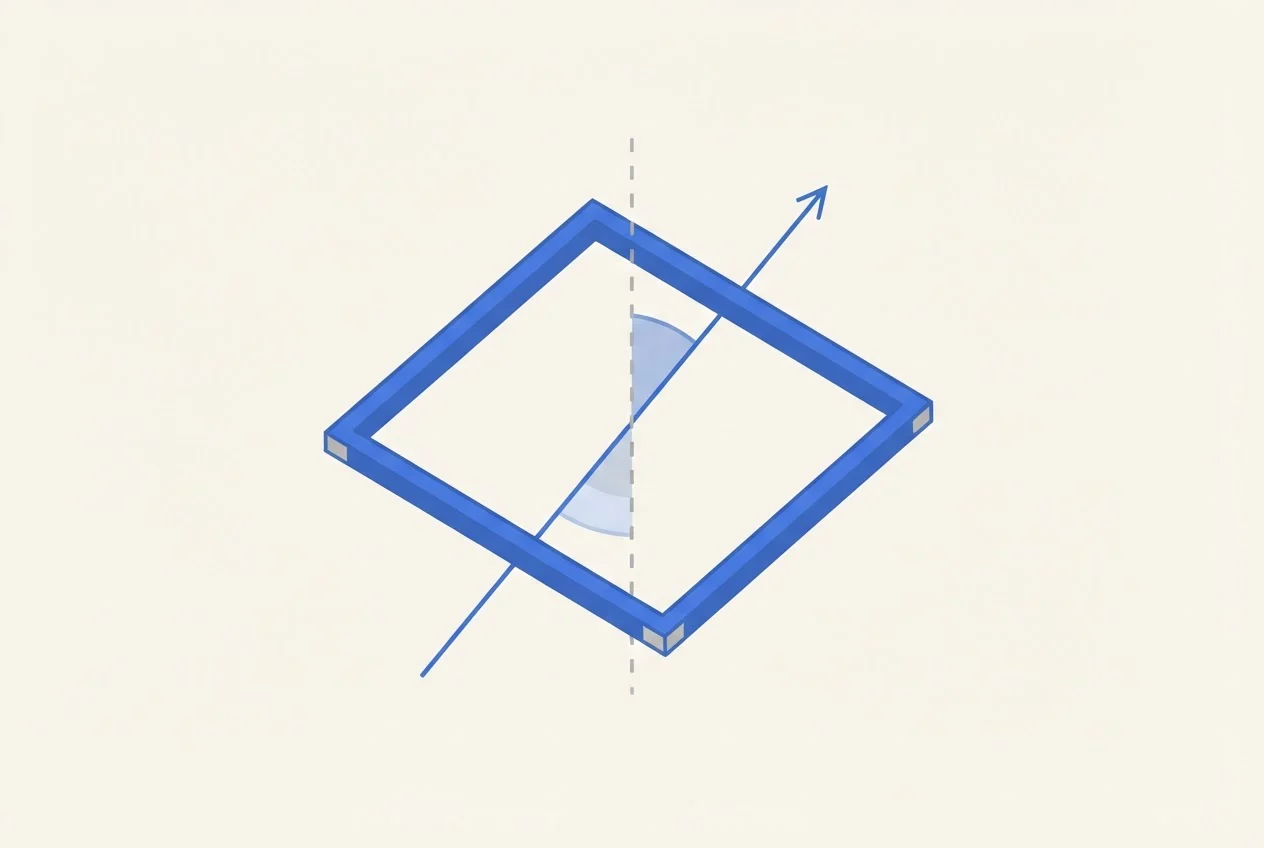
Faraday's law says the emf (electromotive force, the induced voltage) in a coil is emf = −N ΔΦ/Δt. Here N is the number of turns and ΔΦ/Δt is the rate at which magnetic flux changes. Flux is Φ = BA cos θ, where θ is the angle between the field and the normal to the loop (OpenStax, College Physics for AP Courses 2e, section 23.2).
In plain terms:
- Magnetic flux is how much field passes through the loop. It is measured in weber (Wb), with B in tesla (T) and A in square metres.
- The normal is the line at 90° to the flat face of the loop.
- Flux changes when B changes, when A changes, or when θ changes.
- If none of the three changes, ΔΦ is zero and there is no emf, even when the flux is large.
Every Faraday's law question asks for one or both of two things: how big the emf is, and which way it pushes the current. Do them in that order, as separate jobs.
How do you solve a Faraday's law numerical? Run this card
Run eight checks in order: five for size, then three for direction. Each one has a pass test you can apply to your own working. This is our routine, built on the standard steps in OpenStax.
Size
- Name what changes: B, A or θ. Pass: you can write the flux before and after as two separate numbers. Fail: you have only one flux value.
- Fix the angle. Pass: θ is measured from the normal. If the question gives the angle with the plane of the loop, θ = 90° minus that angle. Fail: you plugged the given angle in without asking which line it is measured from.
- Find ΔΦ for one turn: final flux minus initial flux. Pass: your ΔΦ equals the final flux minus the initial flux, with the sign kept, and a recomputed cos θ gives the same value.
- Multiply by N once. Pass: N appears once in your last line, because ΔΦ is already per turn.
- Divide by Δt. Pass: Δt is converted to seconds before dividing.
Direction 6. Is the flux through the loop rising or falling? Pass: you wrote one of those two words. 7. Say what the induced field must do: oppose a rise, or support a fall. Pass: you wrote "opposite to B" or "same as B" for the induced field. 8. Use the right-hand rule to get the current that makes that induced field. Pass: you wrote clockwise or anticlockwise, with the viewing side.
Our numericals guide has the general four-step habit that sits around this card.
How much does the wrong angle cost in a Faraday's law numerical?
The wrong angle makes the answer about 73% too high in this example (0.0866 V against 0.05 V), because cos 30° is 1.73 times cos 60°. The error changes with the angle. Here is the worked case. These are our own numbers and the arithmetic is shown.
A single loop of area 0.02 m² sits in a 0.5 T field. The field makes 30° with the plane of the loop and is switched off in 0.1 s.
- Correct: θ from the normal = 90° − 30° = 60°. Φ = 0.5 × 0.02 × cos 60° = 0.005 Wb. emf = 0.005 / 0.1 = 0.05 V.
- Wrong (30° used as θ): Φ = 0.5 × 0.02 × cos 30° = 0.00866 Wb. emf = 0.0866 V.
- The ratio is cos 30° / cos 60° = 0.866 / 0.5 = 1.73, which is √3. That is (0.0866 − 0.05) / 0.05, about 73% too high.
The shortcut is that when the angle is with the plane, flux uses the sine of that angle: cos(90° − 30°) = sin 30°. This applies only when the angle is given with the plane. If a question says the field makes an angle with the normal, use that angle as it is. If it says the field is perpendicular to the plane, θ = 0° and the flux is simply BA.
How do you find the direction of the induced current with Lenz's law?
Decide whether flux through the loop is rising or falling, then let the induced current make a field that fights that change. The induced field opposes a rising flux and reinforces a falling one (OpenStax, University Physics Volume 2, section 13.2). The right-hand rule then gives the current.
The usual stumbling block is the word "oppose". A common slip is to think the induced field always opposes the magnetic field. It opposes the change in flux. When a loop leaves a field region, the flux is falling, so the induced field points the same way as the original field.
Energy conservation is the reason. If the induced field helped the change instead of resisting it, the magnet would be pulled in and drive a current without anyone doing work (OpenStax, University Physics Volume 2, section 13.2).

What does the minus sign in Faraday's law mean?
The minus sign is Lenz's law written in algebra: it says the induced effect opposes the change in flux (OpenStax, College Physics for AP Courses 2e, section 23.2). In a "find the emf" question, calculate the size and settle the direction with the three direction checks.
A negative emf in a worked solution does not mean a "negative voltage". It means the emf points opposite to the direction you chose as positive. That is why we keep the size and the direction as separate steps. It stops the sign from tangling the arithmetic.
Which worked examples should you check your method against?
Check your method against two examples: a coil in a rising field (20 V) and a moving rod (0.6 V). These are our worked examples, with the arithmetic shown.
Example 1: a coil in a rising field. A coil has N = 200 turns and area 0.05 m². Its field is normal to the coil and rises from 0.2 T to 0.8 T in 0.3 s.
- ΔΦ per turn = 0.05 × (0.8 − 0.2) = 0.03 Wb.
- emf = 200 × 0.03 / 0.3 = 20 V.
- Direction: if the field points into the page and is rising, the induced field must point out of the page. The right-hand rule gives an anticlockwise current.
Example 2: a moving rod. A rod of length 0.4 m moves at 5 m/s, perpendicular to a 0.3 T field. The field points into the page, and the rod moves right on rails that form a closed circuit.
- For a rod moving perpendicular to the field, the motional emf is ε = Blv (OpenStax, University Physics Volume 2, section 13.3).
- ε = 0.3 × 0.4 × 5 = 0.6 V.
- Direction: the loop area and the inward flux are increasing, so the induced field points out of the page, and the current in the rod is anticlockwise.
How should you prepare Faraday's law for HSC and MHT-CET?
Practise one question of each type (changing B, changing A or θ, moving rod) with the eight-check card, and review every error. As of October 2026, the State CET Cell split is 10 Class 11 and 40 Class 12 Physics questions, and it publishes no official chapter percentages (our weightage guide explains this). Treat any per-chapter count as a historical estimate.
Electromagnetic induction is part of the Class 12 Maharashtra syllabus (Shaalaa, Balbharati Physics Std 12, Chapter 12). As our recommendation:
- Keep the formulas on the HSC Physics formula sheet in front of you.
- Practise from previous-year questions (PYQs) using our chapter-wise PYQ plan, and run the card on every question, including the ones you get right.
Which RG Lectures batch is for MHT-CET 2027?
As of October 2026, we list the MHTCET 2027 Long Term Batch, taught by Rahul Jewaani, at ₹1,632 (listed at ₹1,999).
Join the MHTCET 2027 Long Term Batch
Frequently asked questions
Sources
- 1.OpenStax, College Physics for AP Courses 2e, section 23.2: Faraday's Law of Induction and Lenz's Law
- 2.OpenStax, University Physics Volume 2, section 13.2: Lenz's Law
- 3.OpenStax, University Physics Volume 2, section 13.3: Motional emf
- 4.Physics Forums: Understanding and Applying Lenz's Law
- 5.Shaalaa: Balbharati Physics Std 12, Chapter 12, Electromagnetic Induction
- 6.State CET Cell Maharashtra
- 7.RG Lectures: MHTCET 2027 Long Term Batch course page, October 2026