Maharashtra HSC Physics Syllabus and Revision Tracker 2026-27
Track all 16 Maharashtra HSC Physics chapters, outcomes, revision status, and next actions for the 2026-27 board year.

Maharashtra HSC Physics Syllabus and Revision Tracker 2026-27
For 2026-27, the official Maharashtra Class 12 Physics textbook contains 16 chapters arranged across six units.
The Maharashtra HSC Physics syllabus for 2026-27 is best revised from the official 16-chapter list, not scattered notes. We turn each chapter into checks for concepts, formulas, derivations, diagrams, numericals, and Board-paper questions, then review red chapters first while retaining coverage of every unit.
Below, we map the syllabus, explain how to verify it, and provide a usable revision tracker for Maharashtra HSC students.
What Is Included in the Maharashtra HSC Physics Syllabus?
The syllabus has six connected units, from rotational motion and fluids to modern physics. Keeping the units visible matters because a chapter that feels complete in isolation can still leave a gap in derivations, diagrams, or written numerical steps.
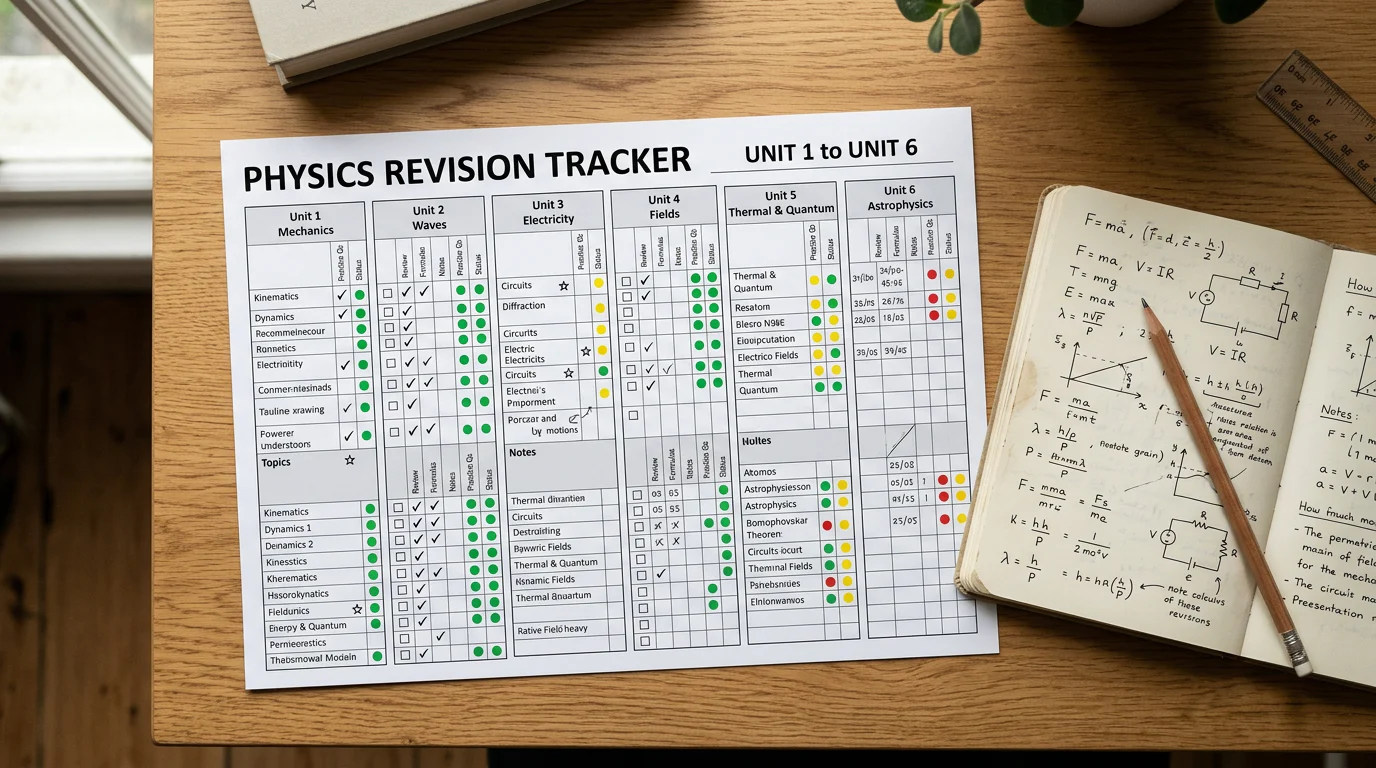
Our tracker uses the official chapter structure, then adds revision fields that students can update after every study session. The outcomes below are the learning targets to check, not a list of optional extra topics.
The Complete Unit and Chapter Map
| Unit | Chapter | Prescribed Outcomes To Track | Confidence | Last Revised | Next Action |
|---|---|---|---|---|---|
| I | Rotational Dynamics | Distinguish centrifugal and centripetal forces; visualise moment of inertia; relate moment of inertia to angular momentum; differentiate translational and rotational motion of rolling objects. | Red, Yellow, Or Green | Record Date | Use Rubric Below |
| I | Mechanical Properties Of Fluids | Relate pressure to depth; explain atmospheric-pressure measurement with a barometer; apply Pascal’s law to hydraulic lift and brakes; relate surface energy to surface tension; distinguish capillary rise and fall; identify daily-life uses of surface tension; explain viscosity; differentiate streamline and turbulent flow. | Red, Yellow, Or Green | Record Date | Use Rubric Below |
| II | Kinetic Theory Of Gases And Radiation | Relate gas laws to the ideal-gas equation; distinguish ideal and real gases; visualise mean free path; obtain degrees of freedom of a diatomic molecule; apply equipartition to monoatomic and diatomic molecules; compare thermal and blackbody radiation; apply Stefan’s law. | Red, Yellow, Or Green | Record Date | Use Rubric Below |
| II | Thermodynamics | Identify daily-life thermodynamic processes; relate mechanical and thermodynamic work; differentiate thermodynamic processes; explain heat engines, refrigerators, and air conditioners. | Red, Yellow, Or Green | Record Date | Use Rubric Below |
| III | Oscillations | Identify periodic motion and simple harmonic motion; obtain laws of motion for a simple pendulum; visualise damped oscillations. | Red, Yellow, Or Green | Record Date | Use Rubric Below |
| III | Superposition Of Waves | Distinguish stationary waves in open and closed pipes; verify vibrating-string laws with a sonometer; explain physics in musical instruments. | Red, Yellow, Or Green | Record Date | Use Rubric Below |
| III | Wave Optics | Apply wave theory to reflection, refraction, interference, and diffraction; visualise polarised and unpolarised light; apply diffraction to resolving power. | Red, Yellow, Or Green | Record Date | Use Rubric Below |
| IV | Electrostatics | Use Gauss’s law for a charge distribution; relate potential energy to work done; determine electrostatic potential; distinguish conductors and insulators; visualise dielectric polarisation; categorise dielectrics; explain a dielectric’s effect on capacitance. | Red, Yellow, Or Green | Record Date | Use Rubric Below |
| IV | Current Electricity | Apply Kirchhoff’s laws; find unknown resistance using a meter bridge; find cell emf and internal resistance with a potentiometer; convert a galvanometer into a voltmeter and ammeter. | Red, Yellow, Or Green | Record Date | Use Rubric Below |
| V | Magnetic Fields Due To Electric Current | Relate Lorentz force to the unit of magnetic field; visualise cyclotron motion; calculate force on current-carrying wires; apply Biot-Savart law; use Ampere’s law. | Red, Yellow, Or Green | Record Date | Use Rubric Below |
| V | Magnetic Materials | Compare gravitational, magnetic, and electrostatic potentials; distinguish paramagnetic, diamagnetic, and ferromagnetic materials. | Red, Yellow, Or Green | Record Date | Use Rubric Below |
| V | Electromagnetic Induction | Relate flux to Faraday and Henry experiments; relate Lenz’s law to conservation of energy; visualise eddy currents; determine mutual inductance; explain a generator using induction laws. | Red, Yellow, Or Green | Record Date | Use Rubric Below |
| V | AC Circuits | Relate power in a resistor to rms current; visualise phase in AC; explain AC through resistor, capacitor, and inductor circuits; explain resonance in LCR circuits. | Red, Yellow, Or Green | Record Date | Use Rubric Below |
| VI | Dual Nature Of Radiation And Matter | Establish particle nature of light from experiments; determine wavelength range for photocurrent; visualise dual nature of matter and light; apply electron waves to microscope resolution. | Red, Yellow, Or Green | Record Date | Use Rubric Below |
| VI | Structure Of Atoms And Nuclei | Check atomic models against experiments; identify nuclear constituents; differentiate electromagnetic and atomic forces; obtain radioactive-sample age from activity; judge nuclear power’s importance. | Red, Yellow, Or Green | Record Date | Use Rubric Below |
| VI | Semiconductor Devices | Explain a p-n junction diode as a rectifier; find applications of special-purpose diodes; explain solar cells, LEDs, and photodiodes; relate p-n and special-purpose diodes; analyse transistor use in circuits. | Red, Yellow, Or Green | Record Date | Use Rubric Below |
For a focused resource stack after this map, use our board-only resources rather than adding material intended for a different examination.
How Do You Download and Verify the Official PDF?
Start with the Board’s current HSC subject page, select Physics, subject code 54, and save the document shown there. Then compare its Class 12 scope with the official eBalbharati Physics textbook before changing your tracker.
This second check is important. A document can remain online long after a textbook update, while an unofficial chapter list can combine Board work with entrance-exam topics. Our method is to retain every chapter above until a dated Board notice says otherwise.
Use Six Completion Checks per Chapter
Use each chapter name as the row label in your personal tracker. The six columns below prevent a watched lecture or highlighted paragraph from being mistaken for a completed chapter.
| Concepts | Formulas | Derivations | Diagrams | Numericals | Board-Paper Questions |
|---|---|---|---|---|---|
| Explain Without Notes | Recall Conditions And Units | Write Start To Finish | Label From Memory | Solve And Check Units | Log Paper, Error, And Fix |
Record Only Verifiable Paper Evidence
The Board’s sample-paper hub includes HSC Physics under subject code 54. Record the medium, paper date, question type, and error beside each attempt. This makes “past-paper practice” a checkable activity instead of a vague plan.
For a worked-example routine that stays close to this syllabus, our HSC worked examples can support the numerical and derivation columns without replacing the official textbook.
Apply the Red, Yellow, and Green Rubric
| Status | Evidence | Next Action |
|---|---|---|
| Red | You cannot explain an outcome or complete a representative question without notes. | Relearn one outcome, write one worked example, and attempt retrieval questions within 24 hours. |
| Yellow | You can follow a solution but need prompts, omit a step, or make repeatable errors. | Repair the named error, redraw the diagram or derivation, and re-test after two or three days. |
| Green | You explain the outcome and solve a mixed question independently. | Schedule a short retrieval check after seven days and retain it in mixed practice. |
Research on practice testing identifies self-testing and distributed practice as high-utility study techniques. That is why our green status still requires a later check.
How Can You Finish the Syllabus When Time Is Short?
Finishing faster does not mean reading chapters in a random order. It means identifying the smallest next action that changes a red cell to yellow, then returning to it after a delay. A student with several green chapters should still keep them alive through short mixed retrieval, not restart them from page one.
Rank the Next Study Block
Give each chapter a live priority score:
- Confidence Score: Red is 3, yellow is 2, and green is 1.
- Incomplete Checks: Add one point for every unfinished tracker column.
- Verified Paper Evidence: Add one point when an official sample-paper question exposes an unresolved error.
- Time Since Review: Break ties by choosing the chapter revised least recently.
This is a decision tool, not an official chapter-weightage claim. It combines what you cannot yet do, what you have not checked, and what Board-style practice has actually revealed. When choosing between lectures and questions, use our revision versus papers guide to protect time for both repair and retrieval.
Use a Seven-Day Revision Cycle
| Day | Main Block | Retrieval Block | Paper Task |
|---|---|---|---|
| Day 1 | Repair the highest-priority red chapter. | Recall one green chapter without notes. | Log one official-paper error. |
| Day 2 | Complete a second red chapter’s weakest outcome. | Re-test Day 1’s outcome. | Attempt one numerical or derivation. |
| Day 3 | Finish an unfinished yellow checklist column. | Mix two earlier chapters. | Check diagrams and units. |
| Day 4 | Repair the next red chapter. | Re-test Day 2’s outcome. | Attempt a Board-style written answer. |
| Day 5 | Complete one unit-level formula review. | Recall a green chapter. | Correct accumulated errors. |
| Day 6 | Work through the weakest two outcomes. | Mixed oral recall across units. | Attempt a timed set. |
| Day 7 | Diagnose gaps, not just scores. | Re-test red and yellow items. | Set next revision dates. |
If the tracker repeatedly stays red because your plan breaks down, compare your routine with our guide to paid Physics support. The useful question is whether structured feedback fixes a tracked problem, not whether more material exists.
Which Maharashtra-Specific Resources and Exam Checks Matter?
For this page, Board alignment comes first. Use the official textbook for scope, the Board’s current subject page for notices, official sample papers for question evidence, and one concise notebook for errors. Keep unfamiliar advanced topics out of the tracker unless they appear in the verified Class 12 material.
The Board can update notices or sample papers, so check its latest publication before relying on an old pattern chart. We recommend writing the date of your last Board check at the top of the tracker. That simple habit stops last year’s advice from silently becoming this year’s plan.
When Structured Help Becomes Useful
Structured help is worth considering when the same issue remains red after two repair cycles, when derivations and diagrams need feedback, or when your weekly plan never survives beyond a few days. It is not automatically necessary because the syllabus has 16 chapters.
Students who want support should first compare whether a service is genuinely Board-specific. Our board-only comparison explains what to check before choosing help, including syllabus fit, written-answer feedback, and whether the routine creates a usable revision record. Our self-study support guide helps students decide whether their tracker needs a change in method or added guidance.
Study with RG Lectures
At RG Lectures, we built this tracker for Maharashtra HSC students who need one reliable place to see what is prescribed, what is unfinished, and what should happen next. Our approach begins with the Board textbook and official paper evidence, then turns each chapter into practical checks for concepts, formulas, derivations, diagrams, numericals, and written responses. We do not ask students to rebuild bulky notebooks when a concise error record and scheduled retrieval can show the real gap. If your tracker reveals repeated red chapters, unclear derivations, or a revision plan that keeps collapsing, we can help you identify the support that matches that evidence. Start by keeping the syllabus map current, record the next action after every study block, and let the tracker guide the decision. Visit RG Lectures Home
FAQs on Maharashtra HSC Physics Syllabus
Has the Maharashtra HSC Physics Syllabus Changed for 2026-27?
Check the Board directory and dated notices before removing anything. We keep every official textbook chapter active until a current Board notice or replacement document states otherwise.
Where Can I Download the HSC Physics Syllabus PDF?
Start with the Board’s HSC subject directory, select Physics code 54, then cross-check the Class 12 chapter list against the official eBalbharati textbook PDF before revising.
How Do I Finish the Physics Syllabus Without Rewriting Notes?
Keep one short record per chapter: trigger ideas, formula conditions, derivation outline, diagram labels, one error, and a scheduled retrieval date. Prioritise red cells first.
What Exam Pattern Should I Follow for Physics?
Use the latest Board-issued Physics sample paper for your medium. We recommend checking it alongside current notices instead of relying on older pattern summaries alone.
When Is Paid HSC Physics Support Worth It?
Consider structured support when repeated red items persist after two repair cycles, written-answer feedback is unavailable, or your weekly tracker fails. Compare methods before paying for a programme.