Can Online Resources Replace HSC Physics Coaching?
Can online resources replace HSC Physics coaching? Compare board fit, flexible study, derivations, papers, and when a teacher is useful.

Can Online Resources Replace HSC Physics Coaching?
Maharashtra HSC Physics is assessed through a 70-mark Board paper, so the useful question is not whether an online library looks large. It is whether it helps a student produce marks-ready answers under board conditions.
Online resources can replace HSC Physics coaching when they follow the full Maharashtra syllabus, teach board-standard derivations and numericals, include paper practice, and fit the student’s school timetable. They are a weaker substitute when misconceptions go unchecked, board-essential depth is unclear, or the student cannot maintain a reliable weekly review routine.
We compare the evidence a board-focused resource should show, the work a student must supply independently, and the moments when structured support is the wiser choice.
Can Online Resources Replace HSC Physics Coaching?
They can, but only when self-paced learning becomes a system instead of a collection of videos. A useful stack has four parts: the official textbook as the syllabus anchor, explanations that match it, written numerical and derivation practice, and a weekly review that exposes gaps before they become backlog.
Scheduled classes solve some practical problems automatically. They create deadlines, force attendance, and offer a place to ask when a step in a derivation makes no sense. Replacing HSC Physics coaching means deliberately rebuilding those functions, not merely finding recordings that can be watched after school.
The strongest signal is independent output. After learning a topic, a student should be able to reproduce a derivation in sequence, solve a standard numerical with units, and write a complete theory answer without replaying the lesson. Our self-study guide helps students test that distinction before they commit to either route.
A self-paced option is especially suitable for students whose school, travel, or practical schedule conflicts with fixed batches. It is less suitable when the same doubt returns after revision, written answers remain incomplete, or missed sessions keep accumulating. Flexibility only works when the student uses it to protect study time rather than postpone it.
What Counts as Complete Maharashtra HSC Physics Coverage?
Complete coverage means more than finding a lesson with a familiar title. The Maharashtra Board Physics XII sequence contains 20 chapters, from Circular Motion through Communication Systems, as shown in the official chapter map. A course should make it possible to trace every one of those chapters to teaching, textbook work, and board-style practice.
Audit Every Chapter Before Calling a Course Complete
Use this as a practical coverage sheet. A resource passes only when the chapter has visible teaching and the student can point to appropriate written practice.
| Chapter | Board-Essential Evidence To Look For |
|---|---|
| Circular Motion | Radial acceleration, banking, and vertical circular motion |
| Gravitation | Kepler’s laws, satellites, escape velocity, and variation of g |
| Rotational Motion | Moment of inertia, rolling motion, torque, and axis theorems |
| Oscillations | SHM, energy, phase, pendulum, and damping |
| Elasticity | Stress, strain, elastic constants, and applications |
| Surface Tension | Molecular theory, capillarity, and temperature effects |
| Wave Motion | Progressive waves, reflection, beats, and Doppler effect |
| Stationary Waves | Strings, air columns, resonance, and forced vibrations |
| Kinetic Theory Of Gases And Radiation | Gas-pressure derivation, thermodynamics, and radiation laws |
| Wave Theory Of Light | Huygens principle, reflection, refraction, and polarisation |
| Interference And Diffraction | Young’s experiment, diffraction, and resolving power |
| Electrostatics | Gauss’s law, capacitors, dielectric effects, and energy |
| Current Electricity | Kirchhoff’s laws, bridges, meter bridge, and potentiometer |
| Magnetic Effects Of Electric Current | Ampere’s law, galvanometer, ammeter, and voltmeter |
| Magnetism | Magnetic materials, domain theory, and Curie temperature |
| Electromagnetic Inductions | Induction, transformer, alternating current, and resonance |
| Electrons And Photons | Photoelectric effect and Einstein’s equation |
| Atoms, Molecules And Nuclei | Bohr model, radioactivity, nuclei, and matter waves |
| Semiconductors | Diodes, transistors, logic gates, and device characteristics |
| Communication Systems | Modulation, bandwidth, and wave propagation |
Test the Lesson, Not the Marketing Claim
Pick one derivation-heavy chapter and one numerical-heavy chapter. Watch enough of each sample lesson to see whether the explanation follows the textbook heading, whether the working is reproducible on paper, and whether the questions resemble the board task rather than a general entrance problem.
Then complete a short closed-book test. Write one derivation, solve one numerical, and answer one theory question. If the lesson only feels clear while it is playing, it may be helpful teaching, but it has not yet proved it can replace support.
Use the Textbook as the Final Checklist
The official textbook remains the safest reference when a lesson sequence is unclear or a course merges chapters. Its headings show what needs to be covered, while a teaching resource should help students understand and practise those headings rather than quietly replace them with a different syllabus.
We recommend keeping the textbook open beside every resource audit. Students comparing options can also use our board-only comparison to separate visible evidence from broad promises.
Which HSC Physics Resource Stack Fits You?
The best stack depends on the gap a student actually has. A student who understands concepts but needs flexible revision has a different need from a beginner who cannot yet set up a circuit numerical or write a theory response in order.
The matrix below stays provider-neutral because a brand name does not prove board fit. Compare the exact course, lesson, or support plan in front of you, then sort your choices by the criterion that matters most.
| Resource Type | Board Alignment | Lecture Flexibility | Derivations | Numericals | Board Papers | Doubts | Progress Tracking |
|---|---|---|---|---|---|---|---|
| Official textbook and Board papers | Primary reference | No teaching schedule | Textbook source | Board practice | Official format | None | Student maintained |
| Public board topic map | Chapter reference | On-demand access | Topic list only | Not supplied | Not supplied | Not supplied | Not supplied |
| Generic entrance resource library | Often partial | Usually flexible | May exceed board need | May exceed board need | Often not HSC-specific | Varies | Varies |
| Recorded board-focused course | Audit chapter by chapter | Check access period | Request a sample | Request board examples | Request proof | Request policy | Request test plan |
| Scheduled class or mentor layer | Audit chapter by chapter | Fixed or limited slots | Request written-answer evidence | Request HSC examples | Request paper schedule | Request hours | Request review cadence |
Choose for Schedule Flexibility
Students with irregular school hours should begin with a resource they can pause and resume without losing the chapter order. The right choice still needs a fixed weekly appointment with the textbook and a written-practice block, otherwise recordings become an archive rather than a learning plan.
A student who needs flexibility should decide the weekly slots before selecting the resource. Our doubt-support guide can help clarify whether an occasional unanswered question is manageable alone or needs a reliable support route.
Choose for Beginner Explanations
A beginner should prioritise patient, sequential teaching over fast revision. The relevant question is whether the lesson explains why each equation or derivation step exists, then gives a board-level example before moving on.
Choose for Concise Revision or Doubt Access
Students close to exams usually need targeted revision, not a new large library. For concise revision, select chapter-specific derivations, numericals, and paper questions. For doubts, ask for published support hours, the channel used, a realistic response expectation, and an escalation route before paying.
A public national platform says it provides free lessons, practice, mocks, doubt tools, and study plans, according to IIT Kanpur notes. Those features can be useful, but HSC students should still verify the chapter fit and written-answer practice themselves. Our worked-example guide is useful when the missing piece is a clearer board-level solution rather than more theory.
Where Does Board-Essential Physics End?
Competitive depth is not automatically wasted effort. It becomes a problem when difficult, unrelated questions replace the derivations, standard numericals, and written theory answers that the Board paper actually rewards.
Use the official syllabus as the boundary. First master the listed concept, derivation, and typical board application. Only then should students add harder material for a separate entrance goal.
| Chapter Group | Board-Essential Focus | Optional Competitive Depth After Mastery |
|---|---|---|
| Circular Motion To Rotational Motion | Banking, gravitation, rolling, torque, and listed moment-of-inertia work | Multi-constraint systems and unusual geometry |
| Oscillations To Stationary Waves | SHM, pendulum, waves, beats, Doppler effect, strings, and air columns | Coupled oscillations and harder mixed-wave setups |
| Kinetic Theory To Diffraction | Prescribed gas and light topics, including interference and diffraction | Extended derivations beyond board-answer needs |
| Electrostatics To Current Electricity | Gauss’s law, capacitors, Kirchhoff’s laws, bridges, and potentiometer | Complex networks and non-standard charge distributions |
| Magnetism To Electromagnetic Inductions | Galvanometer, magnetic materials, induction, transformer, and AC concepts | Advanced field geometries and transient-circuit mathematics |
| Electrons To Communication Systems | Photoelectric effect, atoms, nuclei, devices, logic gates, and modulation | Quantum formalism, complex circuits, and signal analysis |
This distinction protects revision time. If a student cannot write the prescribed derivation or solve the standard numerical independently, advanced questions are not a next step yet. They are a distraction from the current score target.
The board-only resource stack can help students keep the official sequence visible while choosing explanations selectively. The aim is not to avoid difficult Physics forever. It is to learn the right depth in the right order.
Build a Flexible Week, Then Decide
A flexible plan should be small enough to survive school deadlines and specific enough to reveal whether self-paced study is working. Five focused hours are more useful than a vague promise to watch lessons whenever time appears.
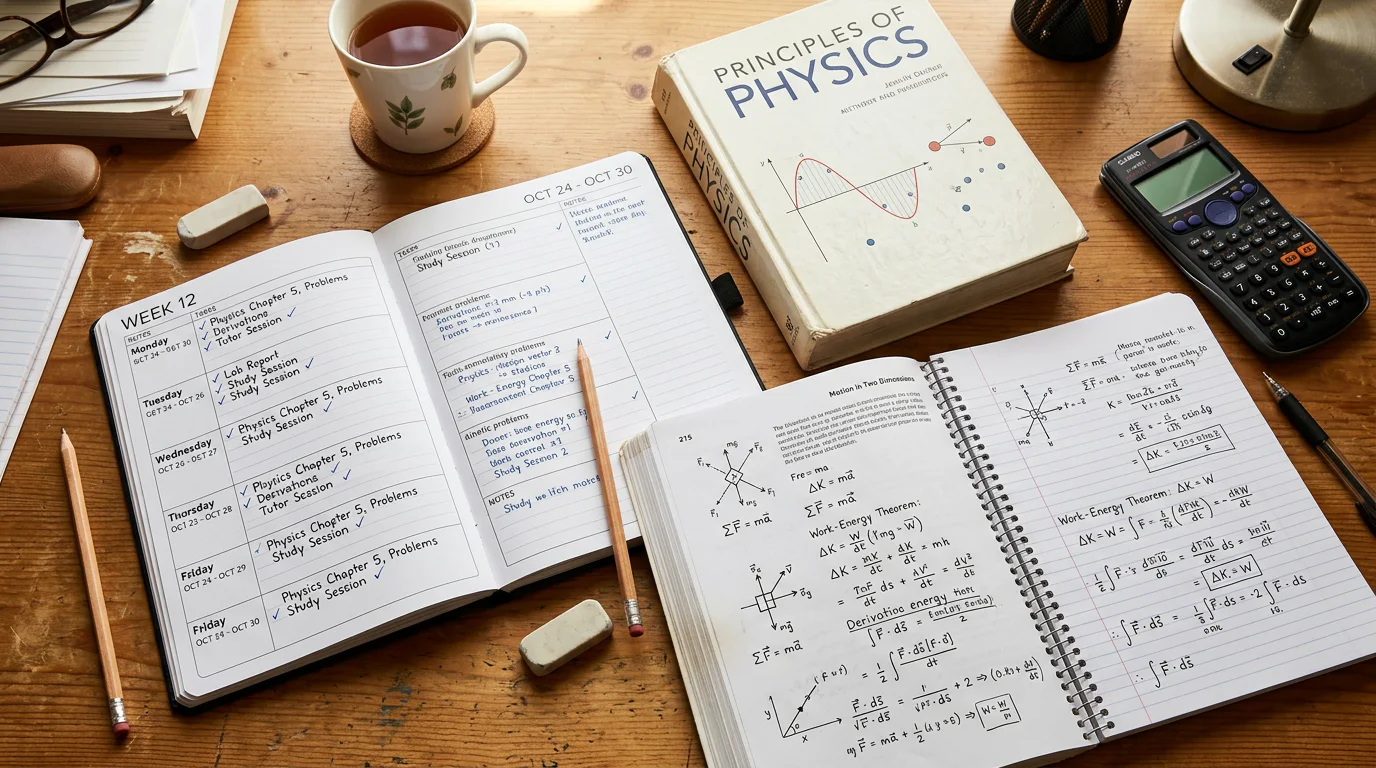
| Weekly Block | Suggested Time | Required Output |
|---|---|---|
| Self-Paced Teaching, Twice Weekly | 2 x 60 minutes | One syllabus-mapped concept each session |
| Textbook And Written Practice, Twice Weekly | 2 x 45 minutes | One derivation or theory answer, plus 4 to 6 numericals |
| Timed Paper And Review | 90 minutes | Timed questions, checked errors, and next-week priorities |
The paper block matters because it joins learning to output. A student should mark where time was lost, where a unit was omitted, where a diagram or step was missing, and which misconception caused the error. Our revision versus papers guide can help students choose the right balance when exams are closer.
Choose replacement only after this routine has held for two weeks and the audit shows complete coverage. Choose a supplement when one area, such as answer feedback or beginner explanation, remains weak. Choose structured coaching or mentoring when recurring doubts, missed blocks, or incomplete written work continue despite a clear plan.
Do not treat this as a permanent label. A student may need teacher feedback for a difficult chapter and still use online resources successfully for the rest of the syllabus. Revisit the decision after timed practice, using written errors rather than confidence as the evidence.
RG Lectures for Board-Focused Physics
At RG Lectures, we want students to make this decision from evidence, not from a larger library or a louder timetable. Start with your chapter audit and let its gaps decide what support, if any, you need next. Test one troublesome lesson against the textbook: can you reproduce the derivation, complete a board-style numerical, and write a full answer without replaying the video? If yes, self-paced study may be enough for that chapter. If not, use our material as a focused explanation and add support only where the evidence says you need it. Our public lessons can support revision beside official materials, while students can inspect access details before they commit. Return to the core question: what will make tomorrow’s written answer clearer? Keep that standard when your schedule has room for deliberate practice and honest review each week. Begin with RG Lectures for HSC Physics
FAQs on HSC Physics Coaching
Can Online Resources Replace HSC Physics Coaching?
Online resources can replace coaching when students cover every chapter, practise written answers, and maintain weekly review. Add support when those routines repeatedly break down.
What Does Complete HSC Physics Coverage Mean?
Complete coverage means every official chapter maps to a lesson, textbook work, appropriate board-level numericals or derivations, and written paper practice for each topic consistently.
How Can I Avoid Competitive-Exam Overload?
Use the textbook topic list as the boundary. Master prescribed answers and standard questions first, then add optional advanced practice only when it serves another goal.
How Do I Audit a Course Before Enrolling?
Ask for a chapter map, sample lesson, access period, board-paper evidence, doubt policy, and current fee. Missing evidence should not influence an enrolment decision alone.
When Should I Add Teacher or Mentor Support?
Choose support when you cannot identify required depth, repeat the same misconception, or miss planned study blocks. Mentoring works best for those specific gaps only.