Ampere's Circuital Law for MHT-CET: Count the Current First
Ampere's circuital law says the magnetic field integrated around a closed loop equals μ₀ times the net current through it. Count that enclosed current first, then choose the formula.

By Rahul Jeewani, Founder · Updated 11 Nov 2026

Key takeaways
- Ampere's circuital law is ∮B·dl = μ₀Ie. Work out the signed enclosed current Ie first, and only then choose a formula.
- A wire outside the loop still makes a field on the loop, but it adds nothing to the sum around the loop. In our two-wire check, only enclosed wires changed the result.
- Solenoid and toroid questions differ in how you count. A solenoid uses n, turns per metre. A toroid uses N, the total turns.
- Loop shape does not change the circulation. Symmetry only decides whether you can solve for B.
In this article
- 1What is Ampere's circuital law and what does each symbol mean?
- 2The 5-line enclosed-current counter
- 3Why don't currents outside the loop count in Ampere's law?
- 4Ampere's law formulas: which loop for a wire, a solenoid and a toroid
- 5Straight wire (outside and inside)
- 6Ideal solenoid
- 7Toroid (inside, outside, in the hole)
- 8Worked examples
- 9Which four slips should you watch for, and how does the counter catch them?
- 10What should you check about MHT-CET before practising Ampere's law?
- 11Practise with RG Lectures
- 12Frequently asked questions
The integral in Ampere's law is the easy part. The hard step comes before it: deciding which currents count. The wording of the law makes that look harder than it is.
Here is the apparent contradiction. Put a second wire near your loop but outside it. That wire still creates a magnetic field at every point of the loop, yet the equation ignores it. Either the law is incomplete or you have misread something.
Neither is true. The law fixes the circulation of B, which is a sum around the whole loop, not the value of B at each point. We ran a numerical check on two wires to show what changes that sum and what does not.
The result is a routine you can run on any loop, a table of standard cases and three worked calculation questions with fresh numbers. It is written for students preparing for MHT-CET (Maharashtra Health and Technical Common Entrance Test), but the method works on any board's numericals.
In short: Ampere's law is ∮B·dl = μ₀Ie, meaning the sum of B·dl around a closed loop equals μ₀ times the signed current through the loop. The rule is to count the enclosed current first, then pick the wire, solenoid or toroid formula that matches the loop's symmetry.
What is Ampere's circuital law and what does each symbol mean?
Ampere's circuital law states that the line integral of the magnetic field B around any closed loop equals μ₀ times the current through the surface that loop bounds: ∮B·dl = μ₀Ie, where Ie is the signed current through that surface (the enclosed current). Here μ₀ is the permeability of free space, 4π × 10⁻⁷ T m/A.
The integral ∮B·dl adds up B·dl, the component of the field along each tiny piece of the loop, all the way round. That total is called the circulation of B.
The sign of Ie comes from the right-hand rule. Curl the fingers of your right hand along the direction in which you travel round the loop. Your thumb then points in the direction in which current counts as positive.
When B is tangential and constant along the loop (or normal to it, or zero) on each part, the law simplifies to BL = μ₀Ie. L is the length of loop where B is tangential. This form needs steady currents that do not change with time.
The law relates a field on a boundary to a source inside it, in the same way that Gauss's law relates the electric field over a closed surface to the charge inside it. That is why it is so useful when the symmetry is right.
The 5-line enclosed-current counter
Run these five lines on every Ampere's law question before you write a formula. An Amperian loop is the imaginary closed path you choose to run the integral around. It is not a real wire.

- Draw the loop and a travel arrow.Pass: the loop is closed and the arrow is on it. Fail: you started a formula without a direction.
- Fix the sign with the right-hand rule.Curl your fingers along the arrow. A current along your thumb is positive, and one against it is negative. Pass: every current has a sign. Fail: a current has no sign.
- List the conductors that pierce the flat surface inside the loop.A wire running past the outside of the loop does not make the list. Pass: each listed wire crosses the surface. Fail: you listed a wire because it is close.
- Add the signed currents.For a thick wire where the loop sits inside the conductor, multiply the total current by the area ratio. For a solenoid, count turns times I through the loop. Pass: you have one number for Ie, in amperes. Fail: you still have separate currents, or your answer is not in amperes.
- Only now ask whether symmetry lets you pull B out of the integral.Pass: B is tangential and constant, normal, or zero on every part of the loop, so BL = μ₀Ie works. Fail: the law still holds, but it will not give you B directly.
Why don't currents outside the loop count in Ampere's law?
A current outside the loop adds exactly zero to the circulation of B, even though its field is present at every point of the loop. Students often ask how the right-hand side can list only the wires inside the loop when every nearby wire adds to the field on it.
The left side is not B. It is B·dl summed round a closed path. An outside wire's field points along the direction of travel on one side of the loop and against it on the other. Over the whole closed path those pieces cancel. A wire that the loop goes around does not cancel, because the loop sweeps a full turn (2π) around it, so the whole current counts whatever the loop's shape.
We checked this numerically in November 2026. Two long straight parallel wires, both perpendicular to the page, carry steady current: W1 carries 5 A and W2 carries 3 A, 10 cm apart. At every point we used the true field of both wires. For each loop we summed B·dl round it anticlockwise, using 20,000 short segments for each circle and 4 × 5,000 for each square. We then divided by μ₀. Currents out of the page are positive. That gives 6 loops under 2 settings, 12 results in all.
| Loop | Wires inside the loop | W2 = +3 A | W2 = −3 A |
|---|---|---|---|
| Circle, radius 4 cm, centred on W1 | W1 | 5.000 A | 5.000 A |
| Same circle shifted 2 cm off-centre | W1 | 5.000 A | 5.000 A |
| Square, half-side 3 cm, around W1 | W1 | 5.000 A | 5.000 A |
| Circle, radius 4 cm, centred on W2 | W2 | 3.000 A | −3.000 A |
| Circle, radius 20 cm, around both | W1 and W2 | 8.000 A | 2.000 A |
| Circle, radius 4 cm, 30 cm from W1 and away from W2 | none | 0.000 A | 0.000 A |
Three things stand out. Shape and position make no difference as long as the same wires are inside. The answer is the signed sum of enclosed currents, so 5 A and −3 A give 2 A. And W2's field was present in every row, yet the loops around W1 alone did not feel it.
Ampere's law formulas: which loop for a wire, a solenoid and a toroid
Each standard case uses one loop and one count. Use a circle for a wire or toroid and a rectangle for a solenoid. For the full list of Class 12 formulas in the Maharashtra Higher Secondary Certificate (HSC) syllabus, use the HSC Physics formula sheet for Maharashtra Class 12. Below are only the Ampere's law cases.
In the table, a is the wire's radius, n is turns per metre and N is the total number of turns.
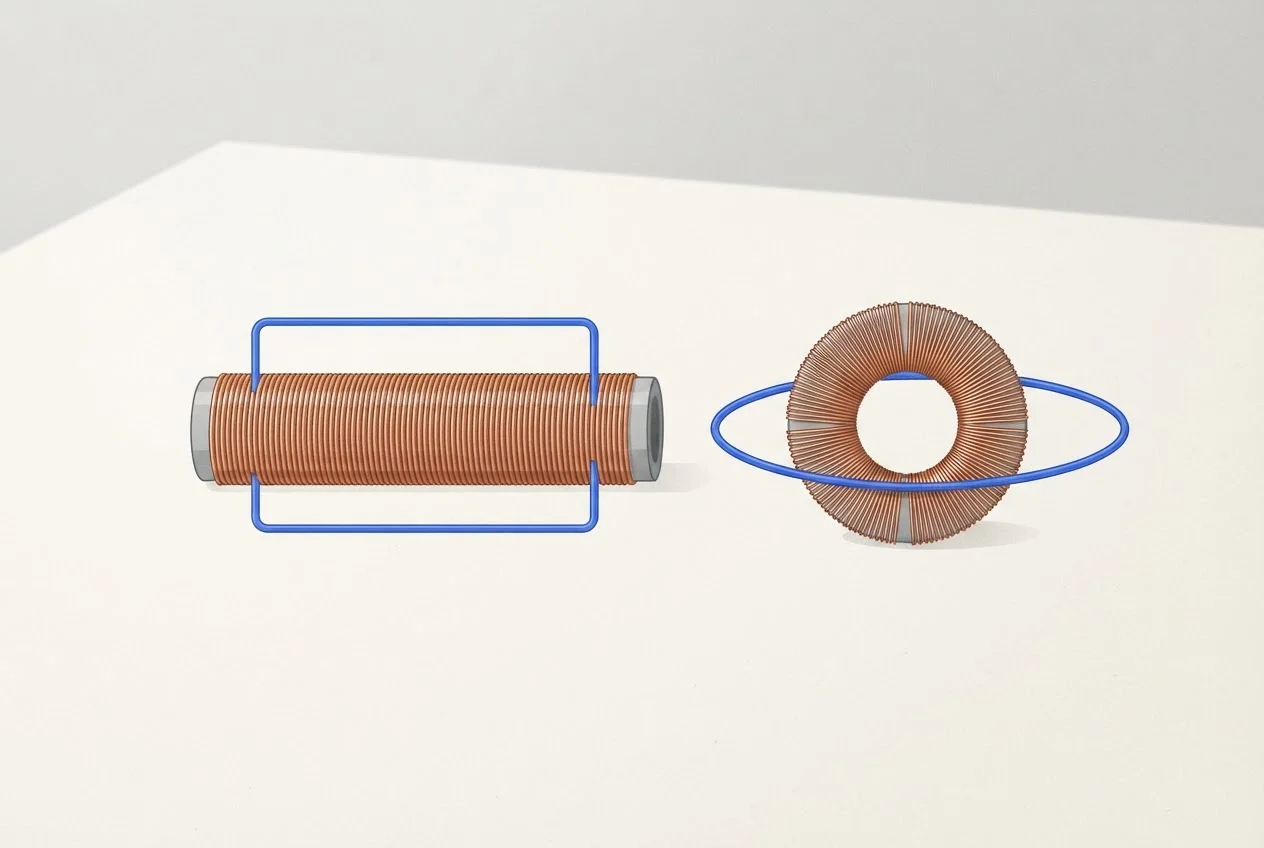
| Case | Loop | L | Ie | B |
|---|---|---|---|---|
| Long straight wire, outside | Circle of radius r | 2πr | I | μ₀I/(2πr) |
| Inside a solid wire (r < a) | Circle of radius r | 2πr | Ir²/a² | μ₀Ir/(2πa²) |
| Ideal solenoid, inside | Rectangle, one side h inside | h | nhI | μ₀nI |
| Toroid, inside the winding | Circle of radius r | 2πr | NI | μ₀NI/(2πr) |
| Toroid, in the hole or outside | Circle | 2πr | 0 | 0 |
Straight wire (outside and inside)
Outside a long straight wire, a circle of radius r around the wire gives B = μ₀I/(2πr). The field is tangential, and the thumb-along-current rule gives its direction.
Inside a solid wire whose current is spread evenly over its cross-section, the loop encloses only the fraction of current that passes through its own area. That fraction is r²/a², so Ie = Ir²/a² and B = μ₀Ir/(2πa²). The field rises in proportion to r up to the surface, then falls as 1/r. This works only for uniform current density.
Ideal solenoid
Inside an ideal solenoid, B = μ₀nI, where n is turns per metre (N divided by the length). Use a rectangle with one long side inside, parallel to the axis, and the opposite side outside. The short sides contribute nothing, so BL becomes Bh, and the enclosed current is nhI.
"Ideal" means very long compared with its radius, with closely wound turns. A real solenoid is a good match to this in the middle of its length. It has a weak field outside, and zero outside is the limit for a very long one.
Toroid (inside, outside, in the hole)
A toroid is a solenoid bent into a ring. Use a circle of radius r that shares the ring's axis.
- Inside the winding: the loop goes through the ring and every one of the N turns crosses the flat surface once. So Ie = NI and B = μ₀NI/(2πr). The field varies with r.
- In the hole (r smaller than the inner radius): no wire crosses the surface, so Ie = 0 and B = 0.
- Outside the ring: the loop encloses the whole toroid. Each turn crosses the surface twice, once in each direction, so Ie = 0 and B = 0.
Check your own textbook to see whether the toroid is in your syllabus before you spend time on it.
Worked examples
These use our own numbers. For the general routine on any physics calculation, see our four-step method for solving physics numericals.
Example 1: thick wire. A solid wire of radius 2 cm carries 12 A spread evenly over its cross-section. Find B at 1 cm and at 4 cm from the axis.
- At 1 cm, the loop is inside the wire. Ie = 12 × (1/2)² = 3 A. B = (4π × 10⁻⁷ × 3) / (2π × 0.01) = 6 × 10⁻⁵ T.
- At 4 cm, the loop is outside the wire. Ie = 12 A. B = (4π × 10⁻⁷ × 12) / (2π × 0.04) = 6 × 10⁻⁵ T.
The two values are equal, which is a useful warning. The field peaks at the surface, where r = 2 cm, at 1.2 × 10⁻⁴ T, and falls on both sides.
Example 2: solenoid. A solenoid has 800 turns over 40 cm and radius 1.5 cm, and carries 3 A. The length is much greater than the radius, so the long-solenoid formula applies. n = 800 / 0.40 = 2000 turns per metre. B = 4π × 10⁻⁷ × 2000 × 3 ≈ 7.5 × 10⁻³ T. Using N = 800 by mistake gives 3.0 × 10⁻³ T, about 2.5 times too small.
Example 3: toroid. A toroid has 1200 turns, wound between radii 7 cm and 11 cm, and carries 1.5 A. At the mean radius of 9 cm, B = (4π × 10⁻⁷ × 1200 × 1.5) / (2π × 0.09) = 4.0 × 10⁻³ T. At 7 cm it is about 5.1 × 10⁻³ T, and at 11 cm about 3.3 × 10⁻³ T. At 5 cm (in the hole) and at 15 cm (outside) it is zero.
Which four slips should you watch for, and how does the counter catch them?
Watch for four slips: using N instead of n in a solenoid, using the full current inside a thick wire, using the toroid formula in the hole or outside the ring, and treating a short solenoid as ideal. Counter lines 3, 4 and 5 catch them. This is our recommendation, based on where each calculation can go wrong.
- N instead of n in a solenoid.Line 4: convert N to n = N/length before you count.
- The full current I inside a thick wire.Line 3: a small loop inside the wire captures only part of the current.
- The toroid formula in the hole or outside the ring.Line 3: nothing crosses the surface in the hole, and outside the ring the currents cancel, so Ie = 0.
- A short solenoid treated as ideal.Line 5: B = μ₀nI and "zero outside" belong to a very long solenoid. If the question gives a length close to the radius, the formula is only an approximation.
What should you check about MHT-CET before practising Ampere's law?
In the State Common Entrance Test (CET) Cell's published marking scheme for MHT-CET, each Physics question carries 1 mark and there is no negative marking.
Check the toroid against your own textbook, and practise it only if your syllabus includes it. The wire and solenoid cases are the ones to have ready as a loop-and-count routine.
Once you have B, the next step in most chapters is its effect on moving charges. The Hall effect, the sideways voltage across a current-carrying strip placed in a magnetic field, is one example.
Practise with RG Lectures
Our MHT-CET 2027 Long Term Batch, taught by Rahul Jewaani (RG Sir), has live classes, notes, previous-year questions and mock tests, and covers the full MHT-CET syllabus. We do not list a separate lesson on Ampere's law, so use this page as the method and the batch for the wider syllabus. See the MHT-CET courses in our store.
Prepare with the MHT-CET 2027 Long Term Batch
Frequently asked questions
Sources
- 1.Class 12 Physics, Chapter 4 "Moving Charges and Magnetism", Reprint 2026-27. Used for the statement of the law, the right-hand sign rule, the simplified form BL = μ₀Ie, the steady-current condition and μ₀., National Council of Educational Research and Training (NCERT)
- 2.Syllabus and Marking Scheme 2024-25. Used for 1 mark per Physics question and no negative marking., State Common Entrance Test Cell, Maharashtra
- 3.Our own calculation, November 2026: the loop table, run as described in the section on outside currents. The worked examples use our own numbers.