Lorentz Force: Formula, Direction and Radius Rules for MHT-CET
The Lorentz force on a charge q is F = q(E + v × B). The magnetic part acts sideways to the motion, so it bends the path and does no work.

By Rahul Jeewani, Founder · Updated 14 Nov 2026

Key takeaways
- The Lorentz force is F = q(E + v × B). The magnetic part, qvB sin θ, is perpendicular to both the velocity and the field. It never changes a charge's speed or kinetic energy.
- For direction, always use the right hand on v × B. Flip the answer for a negative charge.
- Sort the numerical into one of eight types (speed or energy change, speed and field change, accelerating voltage, same momentum, same radius, period, velocity along B, work done), then use the one matching rule.
- The radius rules use the velocity component perpendicular to a uniform field, at speeds far below the speed of light.
In this article
- 1What is the Lorentz force, and what do the terms in F = q(E + v × B) mean?
- 2How do you find the direction of the magnetic force on an electron or a proton?
- 3Why does a magnetic field bend a charge's path but never change its speed?
- 4How do you sort a Lorentz force numerical before choosing a formula?
- 5What path does a charge take when its velocity is at an angle to the field?
- 6Which five checks catch most lost marks in magnetic force questions?
- 7Where does RG Lectures fit when you want this chapter taught and drilled?
- 8Frequently asked questions
Writing F = q(E + v × B) takes five seconds. Marks go missing afterwards. They go on the direction of the force on an electron, on radius questions where the speed, energy or voltage changes, and on the "work done" question that has a one-word answer.
This page gives the direction rule once. Then it gives a sorter that turns a Lorentz force numerical into one of eight types before you touch a formula. Physics, Aasaan.
It is written for Class 12 and MHT-CET students. MHT-CET (Maharashtra Health and Technical Common Entrance Test) is the state entrance test for engineering and pharmacy, run by the State CET Cell.
What is the Lorentz force, and what do the terms in F = q(E + v × B) mean?
The Lorentz force is the total force on a charge q moving with velocity v through an electric field E and a magnetic field B. It is written F = q[E + v × B] (NCERT Class 12 Physics, Ch. 4, Eq. 4.3). The first term is the electric force and the second is the magnetic force. The × is the vector (cross) product.
| Symbol | Meaning | SI unit (International System of Units) |
|---|---|---|
| F | Lorentz force | newton (N) |
| q | charge, with its sign | coulomb (C) |
| E | electric field | newton per coulomb (N/C) |
| v | velocity of the charge | metre per second (m/s) |
| B | magnetic field | tesla (T) |
The two parts behave very differently, which is the point of most conceptual questions (NCERT, Ch. 4):
| Property | Electric part, qE | Magnetic part, q(v × B) |
|---|---|---|
| Acts on a charge at rest? | Yes | No. It is zero if the charge is not moving |
| Direction | Along E for a positive charge, opposite for a negative one | Perpendicular to both v and B |
| Zero when | E is zero | v is parallel or antiparallel to B |
| Can it change kinetic energy? | Yes, it can transfer energy | No work is done |
The magnitude of the magnetic part is qvB sin θ, where θ is the angle between v and B.
How do you find the direction of the magnetic force on an electron or a proton?
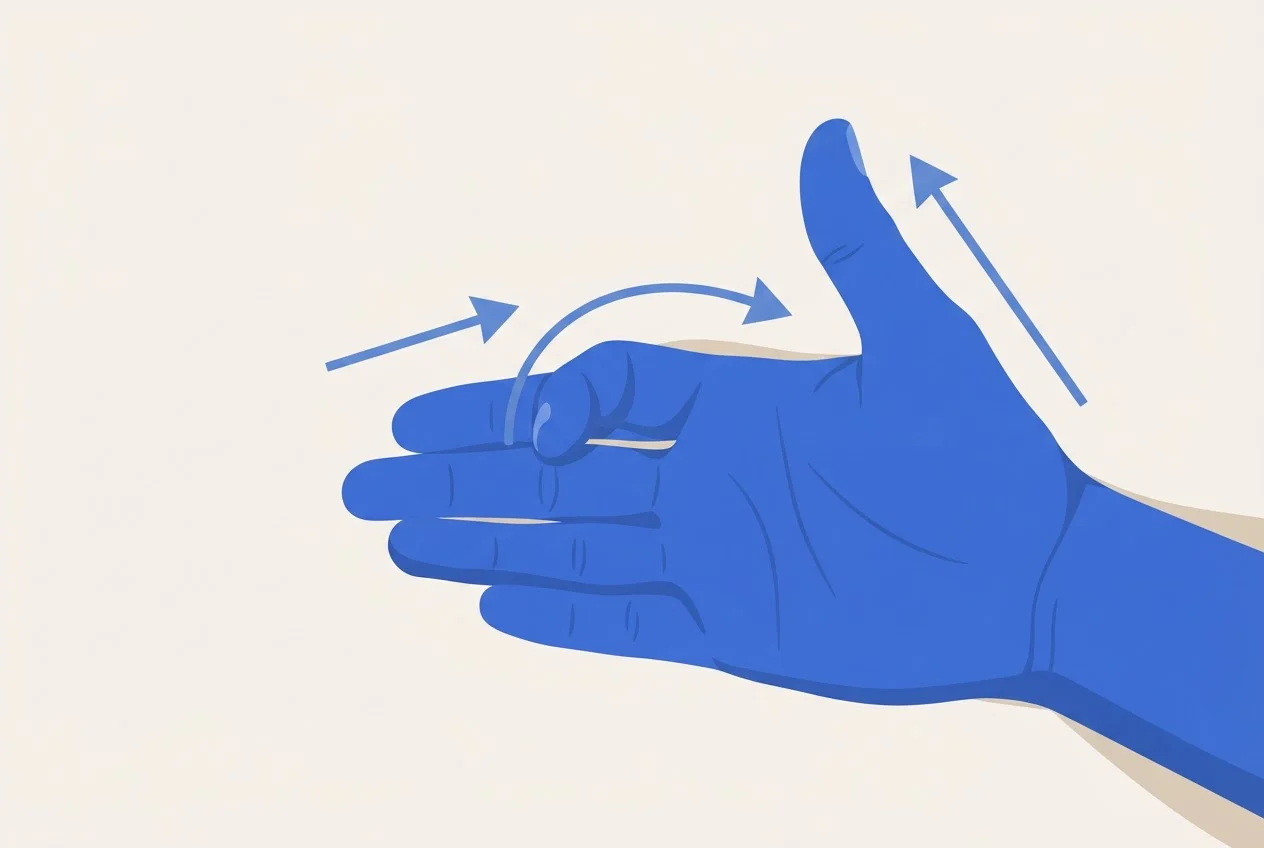
Use the right hand on v × B, then flip the result if the charge is negative. Point your fingers along v, curl them towards B, and your thumb gives the direction of v × B. That is the force direction for a positive charge. For a negative charge, the force is opposite (NCERT, Ch. 4).
NCERT's own example: v along +x and B along +y gives v × B along +z. The proton is pushed along +z and the electron along −z.
Students often ask whether the left hand should be used for electrons. That shortcut gives the same answer if you apply it consistently. Fleming's left-hand rule uses the conventional current direction, which is opposite to an electron's velocity, so mixing the two rules is how the arrow ends up wrong. We recommend one rule only: right hand, then flip for negative.
A self-test you can run: draw v, B and your final F for an electron. Pass: F is opposite to the thumb direction you got for v × B. Fail: F lines up with the thumb.
Why does a magnetic field bend a charge's path but never change its speed?
Because the magnetic force is always perpendicular to the velocity, it does no work. A force with no component along the motion cannot change the speed. It can only change direction, and NCERT states that "no work is done and no change in the magnitude of the velocity is produced" (NCERT, Ch. 4, Section 4.3).
When v is perpendicular to B, the magnetic force acts as the centripetal force. Setting mv²/r = qvB gives:
- Radius: r = mv/(qB) (Eq. 4.5)
- Angular frequency: ω = qB/m (Eq. 4.6a), which NCERT notes is independent of velocity or energy
So a faster particle makes a bigger circle in the same time. If you want the energy argument behind "no work, no change in kinetic energy", our work-energy theorem page covers it.
The same sideways push on charge carriers inside a conductor is behind the Hall voltage, which we cover on our Hall effect page.
How do you sort a Lorentz force numerical before choosing a formula?
Read the trigger words in the question, match one row in the sorter below, and use only that rule. Our recommendation is to do this before writing any numbers, because nearly every error comes from reaching for r = mv/(qB) when the question needed a ratio or a zero.
| If the question says… | Use | What it gives |
|---|---|---|
| Same particle and field, speed or kinetic energy (K) changes | r = mv/(qB), so r ∝ v and r ∝ √K | K ×3 gives r ×√3. K ×2 gives r ×√2 |
| Speed and field both change | r ∝ v/B | v halved and B doubled gives r/4. v doubled and B halved gives 4r |
| Accelerated through potential difference V, then enters the field | qV = ½mv² gives r = (1/B)√(2mV/q) | At the same V, r ∝ √(m/q) |
| Same momentum, same size of charge | r = p/(qB) | Same radius, opposite sense of turning if the charges differ in sign |
| Same radius and same field, different particles | K = q²B²r²/(2m) | K ∝ q²/m |
| Period or frequency asked | T = 2πm/(qB) | Independent of v and r |
| Velocity along B, or charge moving along the axis of a current loop | F = qvB sin θ with θ = 0 | F = 0, straight-line motion |
| Work done, or change in kinetic energy, by the magnetic force | Force ⟂ velocity | W = 0, speed unchanged |
These rows assume v perpendicular to B, a uniform field and speeds far below the speed of light. Rows 3 to 5 are our own algebra from NCERT's Eq. 4.5. Row 7 uses the fact that the field on the axis of a loop points along the axis.
Worked from NCERT's Example 4.3, an electron at 3 × 10⁷ m/s in 6 × 10⁻⁴ T perpendicular to its motion:
- r = mv/(qB) = (9 × 10⁻³¹ × 3 × 10⁷)/(1.6 × 10⁻¹⁹ × 6 × 10⁻⁴) = 0.281 m, which NCERT rounds to 28 cm.
- Frequency = v/(2πr) = 3 × 10⁷/(2π × 0.281) ≈ 17 megahertz (MHz).
- Kinetic energy = ½mv² = 0.5 × 9 × 10⁻³¹ × (3 × 10⁷)² = 4.05 × 10⁻¹⁶ J, about 2.5 keV.
What path does a charge take when its velocity is at an angle to the field?
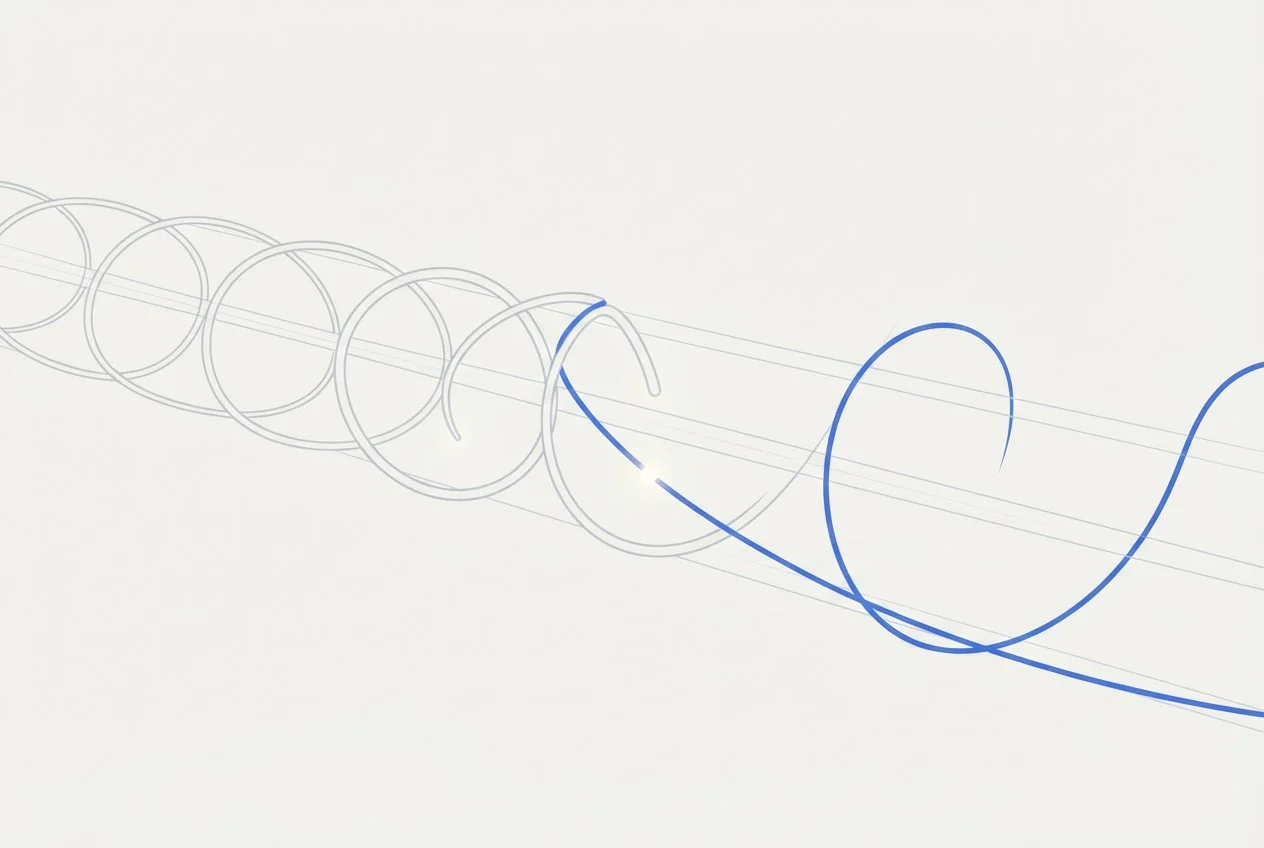
A helix. The component of velocity along B is unchanged because the field exerts no force along itself. The component perpendicular to B goes round in a circle. Together they make a spiral of constant radius (NCERT, Ch. 4).
- Radius: r = mv⊥/(qB), using only the perpendicular component.
- Pitch (distance advanced along B per turn): p = 2πm·v∥/(qB) (Eq. 4.6b).
Worked from NCERT's formulas: a proton (mass 1.67 × 10⁻²⁷ kg, charge 1.6 × 10⁻¹⁹ C) at 2 × 10⁶ m/s, 30° to a 0.1 T field, has v∥ ≈ 1.73 × 10⁶ m/s and v⊥ = 10⁶ m/s. The formulas give radius 0.1044 m and pitch 1.136 m.
Which five checks catch most lost marks in magnetic force questions?
These five tests catch the usual slips. Each has a pass and a fail you can run in under a minute.
- UnitsConvert gauss to tesla (1 gauss = 10⁻⁴ T) and everything else to SI before substituting. Pass: all inputs are in SI. Fail: using 5 gauss as 5 T, which makes the radius 10⁴ times too small.
- SignFind v × B first, then flip for a negative charge. Pass: the electron's arrow is opposite to the thumb. Fail: it matches.
- Ratio shortcutIf the question gives only changes ("doubled", "halved"), write the new radius over the old one before any constants. Pass: you reach a pure number. Fail: you are multiplying 10⁻³¹ and 10⁻¹⁹ for a question that never gave them.
- AngleIs v perpendicular to B? Pass: the radius uses v sin θ when it is not. Fail: the whole speed goes into r.
- WorkDoes your answer change the speed? Pass: speed and kinetic energy are the same after a magnetic force acts. Fail: any energy gain attributed to the magnetic part.
For a general routine on any numerical, see how to solve physics numericals.
Where does RG Lectures fit when you want this chapter taught and drilled?
We started RG Lectures in May 2018, and our founder Rahul Jewaani (RG Sir) teaches the MHT CET 2027 Long Term Batch. The batch covers the MHT-CET Physics and Chemistry syllabi, with live classes, notes, previous-year questions and mock tests. Recordings stay available, so you can rewatch a chapter before a test. We also include Class 11 Physics basics, which the CET Cell tests too.
As of November 2026, the MHT CET 2027 Long Term Batch costs ₹1,632.
Under that scheme, our recommendation is to finish every question and never leave one blank.
Learn this chapter with RG Sir's Long Term Batch
Frequently asked questions
One tesla is the field in which a 1 C charge moving at 1 m/s perpendicular to the field feels 1 N of force. A gauss is 10⁻⁴ tesla (NCERT, Ch. 4).
The Dutch physicist H. A. Lorentz, who worked at Leiden and won the Nobel Prize in 1902, gave the force law, building on the experiments of Ampère and others (NCERT, Ch. 4).