

TL;DR
We define real JEE course revision as a visible cycle of recall, mixed practice, PYQs, timed testing, error correction, targeted re-teaching, and retesting. We also show how to audit a course calendar, distinguish JEE Main from JEE Advanced revision, and ask for proof of test and doubt support before enrolling.
JEE Main Paper 1 currently has 75 questions carrying 300 marks, so remembering an early chapter only when a final mock arrives is a fragile plan. The official bulletin also confirms negative marking in both question sections.
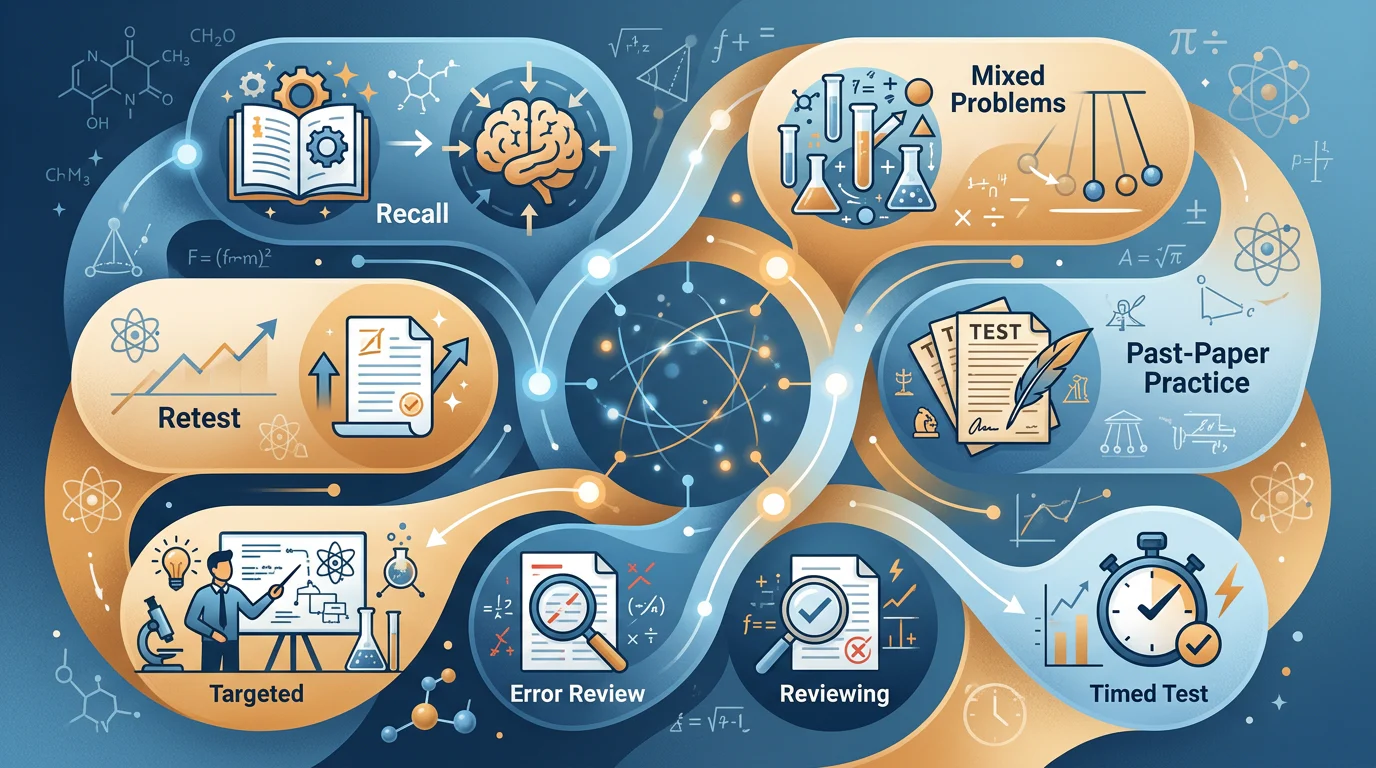
JEE course revision is real only when older chapters return on a dated calendar for recall, mixed questions, PYQs, timed cumulative testing, error analysis, correction, targeted re-teaching, and a retest. A recap lecture or a recording library alone does not prove that this cycle exists.
We will show you what to inspect, how Main and Advanced revision differ, and which evidence to request. If you later compare our course options, use this same standard.
What Counts as JEE Course Revision?
When students search for JEE online coaching with regular revision sessions, they are usually trying to avoid one specific problem: new chapters keep arriving while old chapters quietly disappear. We call it revision only when a course makes the return of old material visible, assessable, and responsive to a student’s errors.
- Visible Calendar: Completed chapters have dated return points, not a vague promise of revision near the exam.
- Retrieval Practice: Students solve or recall before reopening notes.
- Mixed Questions: Old and recent chapters appear together, requiring method selection.
- PYQs: Past questions are used to test application after concepts return.
- Timed Testing: Cumulative papers reveal pace, accuracy, and decision errors.
- Error Correction: Analytics lead to a defined correction task.
- Re-Teaching And Retesting: Persistent gaps trigger help, then fresh evidence of improvement.
Research supports this distinction. The Institute of Education Sciences recommends spaced learning, interleaving examples with problem solving, and active-retrieval quizzing in subjects including mathematics and science. Its learning guide rates spacing as moderate evidence.
| Signal | Real Revision | Recap Content |
|---|---|---|
| Calendar | Shows dated returns for completed chapters | Lists a broad revision phase |
| Student task | Requires recall and problem solving | Primarily asks students to watch |
| Question design | Mixes chapters and difficulty levels | Repeats one chapter at a time |
| Feedback | Connects errors to correction and retesting | Provides a solution or summary |
| Proof | Includes schedules, test syllabi, and reports | Relies on feature claims |
A recap can still be useful, especially before a test, but it is only one possible input to revision. For a broader decision on class size, feedback access, and schedule fit, read our small-batch Advanced guide.
What Should a Revision Cycle Include?
A reliable cycle starts before students feel ready. Looking at notes creates familiarity, but retrieval asks whether the idea can be produced under pressure. That difference matters when a question does not announce which formula or approach it needs.
How Should a Completed Chapter Return?
First, a short recall task should bring back definitions, formulas, common conditions, and standard moves without notes. Next, mixed questions should place that chapter beside other topics so students must identify the right method. Then PYQs test whether the work survives actual exam-style framing.
A 2021 review found that retrieval practice can slow forgetting across material types, learners, and test formats. That does not guarantee a rank, but it gives a sound reason to demand activities that require remembering rather than passive replay. See the retrieval review.
What Do Weekly, Cumulative, and Pre-Exam Revision Do?
Weekly revision checks whether newly taught material has settled before misconceptions harden. Cumulative revision checks whether older and newer chapters can coexist in one problem set. Pre-exam revision then shifts toward paper strategy, pacing, error control, and retaining the highest-value correction notes.
A course with weekly chapter tests but no cumulative tests may measure recent coverage well while missing long-term retention. A course with only full mocks may expose weaknesses too late. Students need both, plus an explicit bridge between them. Our mock-test formats guide can help you decide what conditions your practice should reproduce.
What Turns Test Analysis into Improvement?
A score report becomes useful only when it identifies the next action. Each wrong or skipped question should be classified as a concept gap, a method-selection gap, a calculation error, a time-management issue, or a reading mistake. The course should then prescribe correction work, offer a route to help, and schedule a retest.
This is where a fixed calendar and performance-triggered revision work best together. The calendar guarantees old topics return. Performance data determines which student needs extra practice or re-teaching before the next return point.
How Should JEE Main and JEE Advanced Revision Differ?
The same chapter can require different revision choices for the two exams. JEE Main revision needs broad recall, efficient execution, and care with negative marking. JEE Advanced revision must also test whether students can connect concepts, reason through unfamiliar framing, and sustain performance across both papers.
The official Advanced brochure states that both three-hour papers are compulsory and that questions are designed to test comprehension, reasoning, and analytical ability. It also notes that some questions may carry negative marks. Review the Advanced format before judging whether a test series truly fits your target.
| Revision Dimension | JEE Main Focus | JEE Advanced Focus |
|---|---|---|
| Question selection | Broad syllabus retrieval and efficient recognition | Multi-concept reasoning and unfamiliar applications |
| Timed practice | Full-paper pace and accuracy control | Two-paper stamina and strategic question choice |
| PYQ review | Identify recurring chapter patterns and common traps | Study reasoning paths, constraints, and alternate approaches |
| Solution review | Find fast, reliable methods | Compare methods and understand why a path fails |
| Error log | Track accuracy, pace, and negative-mark errors | Track assumptions, links between concepts, and decision errors |
| Mock environment | Rehearse computer-based timing | Rehearse both papers and changing question formats |
Doubt support should follow the same difference. A Main doubt may be about a recurring shortcut or calculation slip. An Advanced doubt may begin with a failed assumption, a missed condition, or uncertainty about choosing a path. When that happens, students need an instant doubt route connected to their error log, not an unrelated generic session.
How Can You Audit a Course Calendar Before Enrolling?
Ask for a batch-specific calendar before payment. A list that says “revision,” “tests,” or “doubt support” is not enough. You need to see when an already-completed chapter returns, what students do at that return point, and what happens if test evidence shows that the chapter still is not secure.
What Evidence Should You Request?
Request the teaching calendar, four consecutive test syllabi, a sample analytics report, and the policy for recordings and missed sessions. Check whether the dates line up. If a chapter is taught in one week, its first recall, mixed practice, and test appearance should be discoverable later in the schedule.
| Audit Check | Evidence That Passes | Warning Sign |
|---|---|---|
| Chapter Return | Dated recall or practice event for completed material | “Revision will happen later” |
| Mixed Practice | Test syllabus includes old and recent chapters | Every test follows only the latest chapter |
| PYQ Use | Dated PYQ session or tagged assignment | PYQs mentioned without timing |
| Analysis | Student-facing accuracy or error breakdown | Marks only |
| Re-Teaching | Clear route from repeated errors to faculty support | General doubt session with no trigger |
| Retest | Later check of corrected skill | No evidence after solution review |
| Missed Sessions | Recording, assignment, doubt route, and retest policy | Recording link alone |
Which Calendar Model Fits You?
A fixed revision calendar is particularly useful for students who need structure and who tend to postpone older chapters. Performance-triggered revision is useful when accurate analytics and teacher feedback can identify a repeated weakness quickly. The strongest option uses both: fixed revisits for all students and targeted work for the gaps that keep recurring.
If your scores have stalled, use our score diagnosis before assuming you simply need more lectures. The next revision action should match the actual failure pattern.
How Should Missed Revision Sessions Be Handled?
A replay is helpful, but it should not be the whole recovery plan. Ask whether a missed student receives the related question set, the test or quiz, solution discussion, a way to submit doubts from mistakes, and a later retest. Without those pieces, the student has access to content but not necessarily to the revision system.
What Should You Ask About Tests, Doubts, and Backlogs?
The enrollment conversation should produce evidence, not reassurance. Ask direct questions, then save the answers with the schedule or dashboard sample you were shown. If the answer changes from a written calendar to a verbal promise, treat the feature as unverified.
| Enrollment Question | Evidence To Request |
|---|---|
| When do completed chapters reappear? | Dated batch calendar |
| Are weekly tests cumulative or chapter-only? | Four consecutive test syllabi |
| How often are full-syllabus tests held? | Full test calendar |
| Are PYQs tagged by chapter and level? | Sample assignment or dashboard |
| What analytics appear after a test? | Student report screenshot |
| When do solutions and analysis arrive? | Written turnaround policy |
| Can doubts use a student’s test errors? | Booking or escalation workflow |
| Who decides re-teaching is needed? | Teacher-feedback policy |
| What happens after a missed session? | Recording and make-up policy |
| Is there a retest after correction? | Sample retest schedule |
The deciding question is simple: can the course show how a chapter moves from first teaching to later retrieval, testing, correction, and verification? If it cannot, the program may still provide useful classes, but it has not proved a revision architecture. For help deciding whether added support is worth paying for, use our support decision framework.
How RG Lectures Helps You Audit Revision Support
At RG Lectures, we want students to judge preparation support by what they can verify, not by a long feature list. We built this audit so you can compare a calendar, test design, feedback path, and missed-session policy before you commit. If you are deciding whether structured support will actually change your study routine, start by listing the chapters you have already completed and the mistakes that keep repeating. Then bring that list to any course conversation and ask for dated proof of the next revision loop. We will help you ask sharper questions, choose support that matches your schedule, and keep the decision tied to evidence rather than urgency. Explore our current study options, then return to this checklist whenever a course claim needs testing. Use our framework to spot old chapters that never return, then start with RG Lectures.
FAQs on JEE Course Revision
Are Weekly Chapter Tests Enough for JEE Revision?
Weekly tests check recent learning, but they are insufficient alone. Real revision returns older chapters through mixed questions, cumulative tests, feedback, correction tasks, and retesting.
Do Recorded Revision Lectures Count as Revision?
Only when it comes with a dated recall task, mixed practice, test feedback, correction guidance, a doubt route, and a scheduled retest for the same chapter afterward.
What Proof Should I Request Before Paying for a Course?
Request a dated batch calendar, four test syllabi, a sample analytics report, the doubt escalation process, and the written policy for missed revision sessions before enrolment.