Where to Get Instant JEE Physics Help: Instant JEE Physics Doubt Solving


TL;DR
We recommend instant JEE Physics doubt solving as a two-stage system: use AI to triage a clearly framed question, then take diagram-dependent or recurring gaps to a person. This guide compares four support models, tests explanation quality with rotational motion, covers privacy checks, and shows when a faster reply cannot fix a study-sequencing problem.
Rotational motion is not a side topic you can safely skip: the official syllabus includes torque, angular momentum, fixed-axis dynamics, and rolling without slipping, while SATHEE’s public programme includes 80,000+ questions across competitive-exam preparation.
For instant JEE Physics doubt solving at 2am, we recommend an AI tutor for immediate step-by-step triage, a moderated academic community for a second explanation, and a live human tutor when a diagram, hidden assumption, or disputed method changes the result. Choose support that explains why a principle applies, accepts equations or images, and permits follow-up questions.
We compare the available support models, show how to test an explanation using rotational motion, and explain when a recurring doubt needs a teacher or mentor instead of another quick answer.
How Does Instant JEE Physics Doubt Solving Work at 2am?
The best option depends on the kind of stuckness. If you cannot remember whether torque or energy for JEE Physics is relevant, immediate AI help can help you frame the problem. If you are unsure whether friction supplies torque or whether an axis has been chosen correctly, the more valuable next step is a human explanation that can inspect your diagram and challenge your assumptions.
| Support Model | Availability | Best Use | Follow-Up | Escalate When |
|---|---|---|---|---|
| AI Tutor | Available whenever the tool is live | First-pass setup, definitions, algebra checks | Usually conversational, without automatic human review | A diagram or constraint is unclear |
| Moderated Academic Community | Reply timing varies | A second method or peer explanation | Thread-based, moderation varies | Answers conflict or omit assumptions |
| Live Human Tutor | Depends on published session hours | Spoken clarification and whiteboard reasoning | Direct questions and correction | You need to discuss an unusual setup |
| Ongoing Mentor | Scheduled support | Repeated errors and study planning | Tracks patterns over time | The same doubt keeps returning |
We use this comparison because “instant” should mean useful next action, not merely a fast final number. A learner who gets a hint, identifies the correct principle, and solves a similar question independently has gained more than a learner who copied a polished solution. Our mentoring quality guide explains why this distinction matters when Physics questions become multi-step.
Which Support Options Should You Verify Before Asking a Doubt?
SATHEE is the public option we would check first for JEE-specific support. Its current JEE page describes free preparation, Physics, Chemistry, and Mathematics practice, plus one-to-one doubt clearing.
The government-backed programme also describes doubt-clearing sessions with IIT and AIIMS students, but we would treat human availability as session-based unless the current page publishes a specific time commitment.
| Option | Input Formats To Check | Price To Confirm | Human Review To Confirm |
|---|---|---|---|
| SATHEE | Typed doubt, chatbot, or uploaded image where available | Free JEE access is advertised | Whether the current session includes expert interaction |
| General AI Study Tool | Typed equations and clear images | Free and paid access can vary | None by default |
| Moderated Community | Text, LaTex, or diagram upload | Often varies by membership | Moderator credentials and thread policy |
| Live Tutor | Whiteboard, audio, video, image upload | Session or package terms vary | Direct human interaction |
SATHEE’s JEE course currently promotes free preparation and 8,000+ PCM problems, while its wider public materials describe chatbot, forum, and live doubt channels. We would still check the live page before relying on it for a late-night reply, because a platform feature is not the same as a guaranteed response time.
For a general AI tool, ask it to delay the final answer: “Help me choose the axis and write the equations, then stop so I can finish.” Current study-oriented AI features are designed to guide learners through questions rather than only return answers, but the learner must still verify the Physics.
How Can You Tell Whether a Reply Explains the Concept?
A good response makes its reasoning inspectable. It does not hide behind a formula, skip from a diagram to a value, or send you to a generic video that never addresses the detail that confused you. In mechanics, the first useful answer is often a question back to you: “About which point are you taking torque, and why?”
Use This Explanation-Quality Rubric
- Principle Selection: It names why torque, energy, angular momentum, or Newton’s laws apply.
- Assumptions: It states conditions such as no slip, fixed axis, negligible friction, or a massless string.
- Diagram And Axis: It identifies the point or axis about which torque is calculated.
- Units And Direction: It checks signs, directions, dimensions, and SI units.
- Alternative Method: It explains whether another approach works and why one method is clearer.
- Final Verification: It checks the result through substitution, a limiting case, or physical sense.
Watch for These Failure Modes
- Answer Dumping: A final value appears before the setup is explained.
- Hallucinated Steps: The reply introduces a force, condition, or theorem that the question never supplied.
- Irrelevant Video Links: A long lecture replaces an explanation of your exact uncertainty.
- Formula Substitution: An equation is used without showing why its assumptions are satisfied.
Audit the Same Question Side by Side
| Audit Field | Weak Reply | Strong Reply |
|---|---|---|
| First Move | Selects a remembered formula | Draws forces and names the axis |
| Constraint | Ignores rolling or string conditions | Tests whether the constraint applies |
| Torque | Uses magnitude without direction | States lever arm and sign convention |
| Check | Stops at a number | Tests units and a limiting case |
| Follow-Up | Offers none | Asks where the learner’s setup changed |
This is also how we would assess whether a response deserves trust. If you cannot explain the first line of the method in your own words, the doubt is not cleared. That pattern can later become test-day freezing, which is why we connect it to our JEE blanking diagnosis.
Can a Service Pass a Rotational-Motion Explanation Test?
Rotational motion is an effective test because several valid-looking equations can produce a wrong answer when the axis, constraint, or conservation condition is wrong. The JEE Advanced syllabus specifically includes rigid bodies, moment of inertia, torque, angular momentum, fixed-axis rotation, and rolling, so a response should distinguish these ideas instead of blending them together.
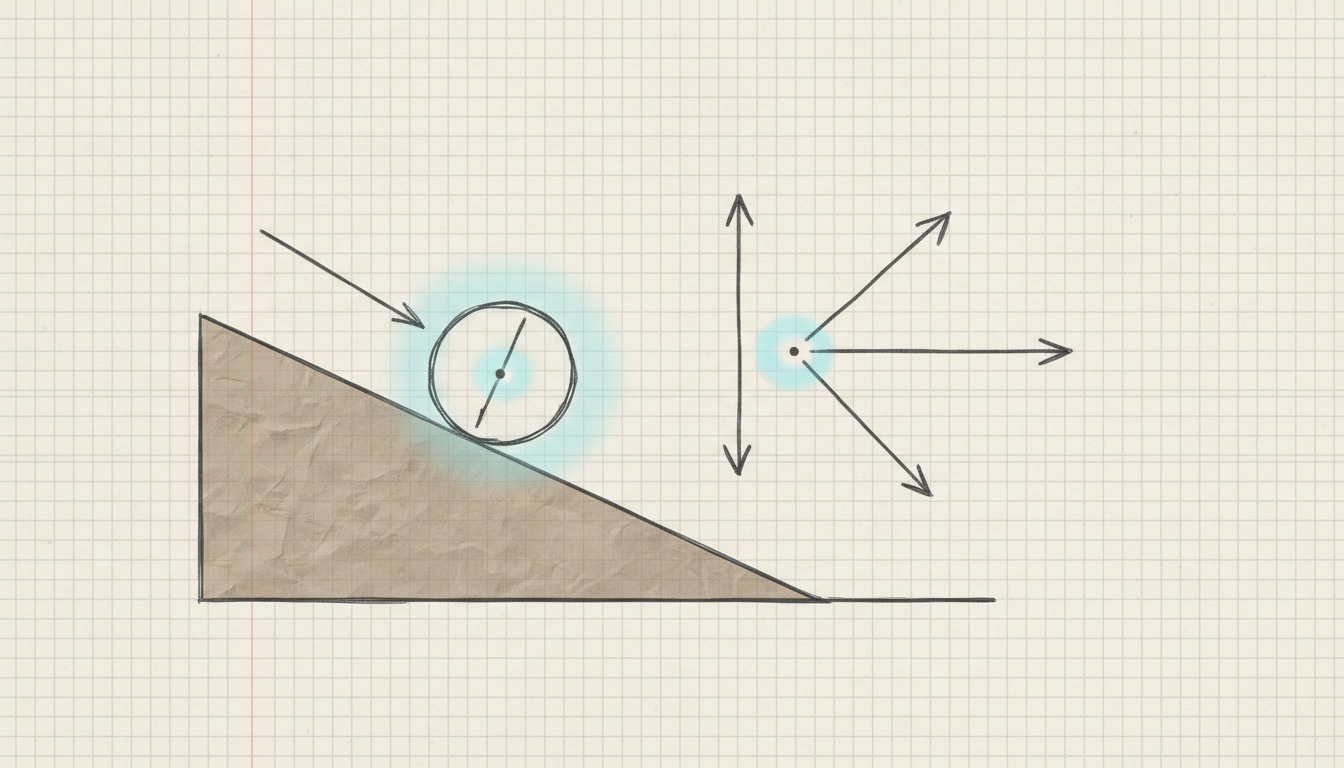
Use this prompt with any support option:
“Before calculating, identify the best axis for torque, state every constraint, decide whether torque, energy, or angular-momentum conservation applies, and explain why. Then give one check I can do myself.”
A reliable explanation will state whether the body is fixed-axis, translating and rotating, or rolling without slipping. It will explain whether (v = \omega R) is justified, identify the direction of angular acceleration, and say why a conservation law is permitted or not. It will not silently assume a pivot, friction condition, or ideal string.
When the diagram is cropped, rotated, colour-coded, or faint, treat an AI reading as provisional. Image systems can misinterpret spatial detail and visual styles, so a human review is safer when one missed arrow changes the whole setup. If your mock errors show the same mechanics gap repeatedly, use our mock-test diagnosis before collecting more isolated solutions.
How Should You Use Fast Doubt Support Safely?
We recommend a two-stage workflow. First, use the immediate channel to isolate the exact blockage: write the known quantities, attach a clean diagram, show your attempted first step, and ask for the smallest useful hint. Then, if the principle remains unclear, take your attempt and the response to a teacher or mentor who can inspect the reasoning.
Before uploading handwritten work, crop names, roll numbers, school identifiers, account details, faces, and identifiable classroom material. Privacy matters because education tools can collect and process personal data, a risk highlighted in UNESCO’s AI education guidance. Never upload passwords, payment details, identity documents, or another student’s work without permission.
A temporary or private mode can reduce what remains in visible history, but it does not remove the need to read the service’s privacy settings. We also recommend keeping a simple doubt log: topic, attempted method, exact misconception, correction, and one similar question solved alone. That makes each urgent interaction contribute to a stronger study system, alongside our mentor quality standard.
When Do Late-Night Doubts Signal a Study-Sequencing Problem?
Fast support is helpful, but it cannot repair a sequence problem if the same prerequisite has been skipped. Repeated rotational-motion confusion can begin much earlier with force diagrams, circular motion, work-energy reasoning, or vector direction. In that case, searching for another answer may feel productive while the missing link remains untouched.
Use the pattern, not your frustration level, to decide what to do next:
- Repeat Threshold: Escalate when the same conceptual doubt returns after two fresh practice questions.
- Conflict Threshold: Ask a teacher when two explanations disagree on the governing principle.
- Setup Threshold: Pause and rebuild basics when you cannot redraw the diagram or state the constraint unaided.
- Mock Threshold: Review your study order when the same chapter error appears in two mock tests.
Late-night questions also become less useful when fatigue turns every calculation into a new doubt. A planned review block, a short error log, and a follow-up with a human can be more efficient than extending a tired study session. For choosing a practice format that exposes those patterns, see our online versus offline mocks.
Get Ongoing Physics Support from RG Lectures
At RG Lectures, we help JEE aspirants turn a stuck question into a repeatable Physics habit, not a midnight answer collection. Our teaching support focuses on the point that fast tools cannot reliably see: whether you chose the right principle, used the diagram correctly, and can start the next problem alone. Bring us the photographed question, your own first attempt, and the exact step that stopped you. We will help you inspect the setup, uncover the missing prerequisite, and decide what to practise next. If rotating-body questions keep returning, we can connect the doubt to force diagrams, constraints, and the revision sequence around it. That makes urgent help useful without allowing it to replace deliberate study. Start with a focused question tonight, then build the independence that lets you handle the next version without waiting for a reply.
Explore our Courses today!
FAQs on Instant JEE Physics Doubt Solving
Can I Get JEE Physics Help at 2am?
Yes. Use an available AI tool for immediate triage, then save diagram-heavy, disputed, or recurring doubts for a teacher, tutor, or mentor review during the next session.
How Do I Check an AI Rotational-Motion Answer?
Ask it to identify the axis, forces, constraints, governing principle, units, and a self-check. If it cannot justify those choices, treat the result as unverified and escalate.
Is It Safe to Upload a Handwritten Physics Question?
Upload only a cropped question and diagram. Remove names, roll numbers, school details, faces, credentials, and other identifiable material before submitting work through any online service.
When Should I Stop Seeking Faster Replies?
Stop seeking faster replies when the same doubt returns after practice, explanations conflict, or you cannot state the setup independently. Rebuild prerequisites with guided support instead.