Why Do I Blank During JEE Mocks? A JEE Mock-Test Blanking Diagnosis


TL;DR
We treat JEE mock-test blanking as a problem to test, not a verdict on your ability. Our five-cause table, timed-to-untimed re-solve, reset protocol, pressure ladder, and event log show whether the next step is revision, retrieval practice, pacing work, or qualified mental-health support.
JEE Main Paper 1 gives students 75 questions in 180 minutes, so a single difficult question can disrupt both recall and pacing.
JEE mock-test blanking is not automatically a knowledge gap or test anxiety. If the method returns soon after the timer ends, retrieval pressure, pacing, or question choice is more likely; if you still cannot solve the item untimed, preparation is incomplete. Track the moment it happens, what returns afterward, and how the pattern changes in lower-pressure timed practice.
We will help you diagnose the blank, test the cause after the mock, reset during the paper, and choose one useful adjustment for the next attempt.
What Does JEE Mock-Test Blanking Actually Tell You?
A blank is an event to classify, not proof that you have forgotten an entire chapter. We use this same distinction when students compare online and offline mocks, because a change in test format can expose a performance problem that relaxed revision hides.
| Likely Cause | What Happens In The Mock | What Happens Afterward | First Response |
|---|---|---|---|
| Concept Gap | You cannot identify a principle or starting step | You still cannot solve untimed | Repair the concept and solve comparable items |
| Retrieval Failure | The question looks familiar but no cue arrives | A formula or path returns quickly | Practise closed-book recall |
| Cognitive Overload | Blanking rises late in the paper | Accuracy improves after rest | Adjust pacing and workload |
| Poor Question Selection | One hard question absorbs too much time | Easier missed questions are solvable | Use skip and return rules |
| Anxiety Response | Worry or physical symptoms interrupt solving | Knowledge may return as pressure falls | Use gradual pressure practice and track symptoms |
Test anxiety can affect concentration, but it is not always the direct cause of lower performance. A recent research review notes that knowledge and test-taking skills can explain much of the anxiety-score relationship. That is why we do not label every blank as anxiety.
A useful first move is to compare this mock with your own mock-score pattern. If blanks cluster in one chapter, begin with content. If they cluster after long calculations or difficult early questions, test pacing before restarting the entire syllabus.
How Can You Separate a Concept Gap from Retrieval Pressure?
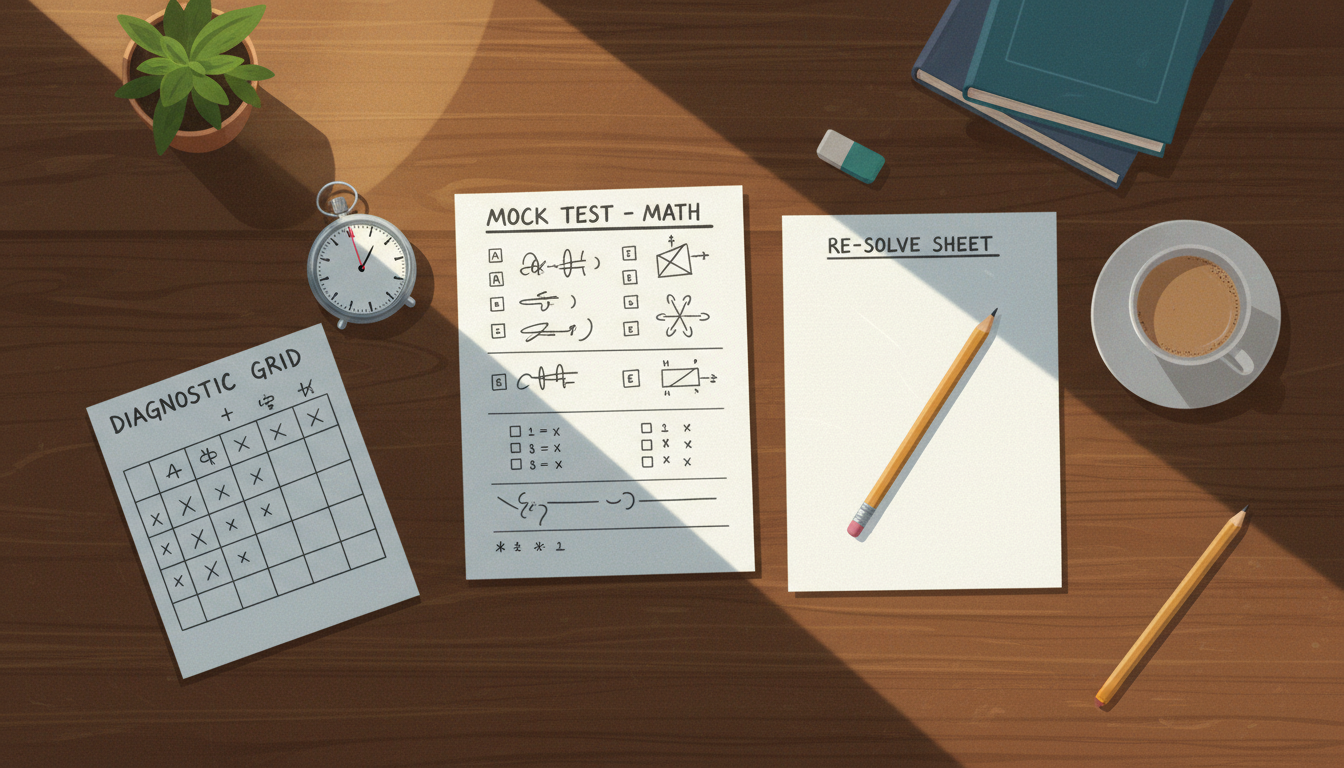
The most useful JEE mock-test blanking diagnosis happens after submission, before you read solutions. We use a three-stage re-solve test because the same wrong answer can come from very different failures.
Stage One: What Happened Under the Timer?
For every blanked question, record when you first saw it, how long you stayed, whether you could write a starting cue, and whether you skipped, guessed, or froze. Do not use a universal seconds-per-question rule. Compare the time with your own normal pace for similar questions.
Stage Two: What Returns Immediately After the Mock?
Without notes or solutions, write the formula family, diagram, first principle, or first two steps that come back after the paper ends. A path that returns quickly is evidence that the question may not need full chapter revision.
Stage Three: Can You Re-Solve It Untimed?
Now solve the same problem from a blank page. Untimed failure after a genuine attempt points to an incomplete concept or application skill. Untimed success after timed failure points instead to retrieval, pacing, overload, or question-selection pressure.
| Timed Attempt | Immediate Recall | Untimed Re-Solve | Best Next Test |
|---|---|---|---|
| Fails | Nothing Returns | Fails | Relearn and practise the concept |
| Fails | Cue Returns | Solves | Build retrieval practice |
| Fails | Cue Returns | Solves Slowly | Add light timing and triage |
| Fails Late In Paper | Partial Recall | Solves After Rest | Test pacing and workload |
| Fails With Strong Physical Symptoms | Knowledge Returns Later | Solves | Track pressure response across sessions |
Closed-book retrieval matters because retrieval research finds that recalling information can improve later test performance. We use it to reveal what your usual revision may hide: recognition of a solved example is not the same as generating a method alone.
If one subject repeatedly fails this test, use a doubt-solving standard that focuses on the exact missing step, not a vague feeling that you are “weak” at the subject.
What Should You Do When Your Mind Goes Blank in the Mock?
In the moment, your goal is not to force a full solution from a frozen state. Your goal is to protect time, preserve a return path, and continue collecting accessible marks.
Use this four-step reset protocol:
- Pause: Stop pushing the same calculation for a moment and name the event as “stuck,” not “finished.”
- Triage: Mark the question as returnable or leaveable, then move to an accessible question.
- Write One Minimal Cue: Note a formula family, diagram label, known quantity, or governing principle before leaving.
- Return In A Controlled Round: Come back only after you have completed your planned first pass or secured easier marks.
This is not permission to skip every hard item. It is a way to avoid converting one blank into five missed questions. We recommend practising the protocol in smaller timed sets before relying on it in a full paper.
Your test environment also matters. A realistic computer interface can expose switching, navigation, and timer habits that paper practice misses. Use an online mock format that matches how you plan to practise, then keep the review method consistent enough to compare results.
How Can You Build Pressure Gradually Without Taking Daily Full Mocks?
We do not recommend turning every study session into a three-hour examination. Pressure practice works best when it progresses from skill building to realistic performance, while leaving time to fix what the practice exposes.
Level One: Untimed Closed-Book Retrieval
Take a small set from one chapter or a mixed set. Work without notes, then check only after you have generated a method. Use this level for questions that fail the untimed re-solve.
Level Two: Lightly Timed Subject Blocks
Add a timer to a short mixed set. Practise deciding when to continue, write a cue, or move on. This level is for questions you can solve untimed but cannot begin reliably under time pressure.
Level Three: Timed Blocks with Triage
Use exam-like rules, no notes, no paused timer, and a deliberate return round. Record whether the first cue arrives faster and whether skipped questions become solvable when revisited.
Level Four: Spaced Section and Full-Mock Simulations
Use section tests and full papers periodically, then spend the next session testing one change. A classroom meta-analysis found distributed practice produced a moderate learning benefit over massed practice, so spaced corrective work is more useful than repeatedly retaking full mocks without analysis.
If your screen-based performance differs sharply from paper-based work, read our format comparison before changing your whole routine. We want each increase in pressure to answer one question: does the problem persist when only the timer changes?
What Belongs in a Blanking-Event Log?
A generic error notebook often mixes conceptual mistakes, calculation slips, and blanking episodes into one pile. We separate them because each one needs a different next action.
| Field | What To Record |
|---|---|
| Mock And Elapsed Time | When in the paper the blank occurred |
| Subject And Question Type | Topic, calculation load, recall demand, or multi-step setup |
| Trigger | Missing formula, confusing wording, lengthy setup, or time panic |
| Physical Or Cognitive Signs | Worry thought, frozen start, racing heart, shallow breathing, or nausea |
| Timed Result | Skipped, guessed, wrong, or returned later |
| Immediate Recall | What cue or method came back after submission |
| Untimed Re-Solve | Solved alone, solved with a hint, or still failed |
| One Hypothesis | The most likely cause of this blank |
| One Testable Change | The single adjustment for the next mock |
The review loop is simple: every episode becomes one hypothesis and one testable change. “I blank in Physics” is too broad. “I lose the first formula cue after difficult Mathematics questions, so I will practise two short mixed blocks with a return rule” is specific enough to test.
For revision decisions, compare the log with your physics revision choices. We recommend changing one variable at a time, because a new timetable, new materials, and a new mock strategy all at once produce no clear evidence about what helped.
Which Intervention Fits Your Evidence, and When Should You Seek Support?
The right intervention follows the evidence, not the emotion of a low score. Revision is useful when untimed work fails. More mocks are useful only when you already know what test-taking skill the next mock is meant to examine.
| Evidence Pattern | Next Intervention | What To Test Next |
|---|---|---|
| Cannot Solve Untimed | Concept repair and comparable practice | Can you solve a similar item alone? |
| Solves After The Mock | Closed-book retrieval practice | Does the first cue arrive sooner? |
| Blanks Late Across Subjects | Pacing and workload changes | Does late-paper accuracy improve? |
| Loses Time On A Few Items | Triage and return practice | Do easier questions get completed first? |
| Repeated Distress Or Physical Symptoms | Academic support plus qualified care | Does distress affect life beyond mocks? |
Academic work and anxiety support are not substitutes for each other. A 2025 analysis of secondary-school interventions found academic interventions improved achievement, while their effect on academic anxiety was not statistically significant. This supports treating a proven learning gap and persistent distress as separate problems, not competing explanations.
Professional-Support Note
We cannot diagnose anxiety disorders from a mock-test log. Speak with a qualified mental-health professional or health-care provider if worry, physical symptoms, or distress persist, worsen, or interfere with sleep, school, relationships, or daily life. Mental-health guidance likewise recommends seeking help when anxiety starts disrupting everyday functioning.
How Can RG Lectures Help You Recover from JEE Mock-Test Blanking?
At RG Lectures, we help online JEE students turn vague mock-test frustration into a repeatable review habit. Our role is not to tell you to study longer after every low score. We help you identify the first broken link: a missing concept, weak retrieval cue, costly question choice, late-paper overload, or pressure response. Then we help you choose a small next experiment, such as a closed-book re-solve, a timed mixed set, or a different return rule. If you want structured material to support that work, browse our study resources. Bring your blanking-event log, recent paper, and honest notes about what changed after the timer stopped. That evidence makes a productive doubt session possible, because we can work from the actual failure point instead of guessing from a score. Build your next mock around one measurable adjustment, then review the result with us at RG Lectures
FAQs on JEE Mock-test Blanking Diagnosis
Does Blanking During a JEE Mock Mean I Do Not Know the Chapter?
Usually, the timed setting disrupted recall, pacing, or question selection. Compare your timed result, immediate recall, and untimed re-solve before calling the concept weak itself.
What Should I Do First After I Blank on a Question?
Pause, mark the question for return, write one cue, and move on. Return after accessible marks are secured, rather than repeatedly forcing the same approach.
Should I Revise or Take More Mocks After Blanking?
Repair the concept if you fail similar questions untimed without notes. If knowledge returns after the mock, practise recall, pacing, and controlled return decisions instead.
When Is Test Anxiety Serious Enough to Seek Help?
Seek qualified support if worry, distress, or physical symptoms persist, worsen, or disrupt sleep, school, relationships, or daily functioning. Continue academic practice alongside professional care.
Why Are My Mock Scores Dropping Despite Long Study Hours?
Long study hours can still be passive or poorly targeted. Use your event log to identify whether concepts, recall, pacing, question choice, or pressure fails.