Lami's Theorem: Which Angle Goes Under Which Force
Lami's theorem says that when three coplanar, concurrent forces balance, each force divided by the sine of the angle between the other two gives one common value. It fails for four forces.

By Rahul Jeewani, Founder · Updated 14 Oct 2026

Key takeaways
- Lami's theorem: for three forces F₁, F₂, F₃ in equilibrium, F₁/sin α = F₂/sin β = F₃/sin γ, where each angle is the one between the other two forces.
- Use it only if four tests pass: exactly three forces, all meeting at one point, all in one plane, and the body in equilibrium.
- In a worked example (a 10 kg lamp hanging from strings at 30° and 45° to the vertical), three wrong angle pairings give tensions that are 22.5% to 41.4% off the correct 71.74 N and 50.73 N.
- Check every answer two ways: the three angles must add up to 360°, and the horizontal and vertical components must balance.
In this article
- 1What is Lami's theorem, and which angle goes under which force?
- 2When can you use Lami's theorem on a mechanics problem?
- 3What does the wrong angle cost in Lami's theorem?
- 4How do you write a Lami's theorem answer in five steps?
- 5Should you use Lami's theorem or resolve into components?
- 6What are three practice problems on Lami's theorem, with answers?
- 7How do you get the rest of Engineering Mechanics equilibrium right?
- 8Frequently asked questions
Lami's theorem is a one-line formula, but choosing which angle sits under which force is where a correct method can turn into a wrong tension. In the Savitribai Phule Pune University (SPPU) 2024-pattern first-year syllabus, Equilibrium, the unit where this theorem is used, is a six-hour unit of the Engineering Mechanics course, so the method has to be quick to write and exact.
This page starts with a short test for whether the theorem is allowed on your problem, then gives a five-step way to write the answer so the pairing stays right. We also solved one problem four ways, once correctly and three times with wrong angle pairings, to show how far each wrong pairing pushes the answer.
It is written for first-year engineering students who meet Lami's theorem in Engineering Mechanics, and for Class 11 students who first use it on hanging-weight and tension problems. Padhna aasaan hai, once the pairing is clear.
What is Lami's theorem, and which angle goes under which force?
Lami's theorem says that if three coplanar, concurrent forces keep a point in equilibrium, each force divided by the sine of the angle between the other two forces is the same number. Write it as F₁/sin α = F₂/sin β = F₃/sin γ. Here α sits between F₂ and F₃, β between F₁ and F₃, and γ between F₁ and F₂.
Definition
Definition
Definition
The three angles between the pairs add up to 360° (Wikipedia: Lami's theorem). That sum is your built-in error check.
Lami's theorem is the sine rule (a/sin A = b/sin B = c/sin C in any triangle) applied to the closed triangle of three balanced forces. Forces that cancel can be drawn tip to tail as a closed triangle. The inside angles of that triangle are 180° minus the angles between the forces, and sin(180° − θ) = sin θ. So the angle opposite a side in the force triangle and the angle between the other two forces at the point have the same sine (Wikipedia: Lami's theorem). Books that say "opposite angle" and books that say "angle between the other two" are saying the same thing.
When can you use Lami's theorem on a mechanics problem?
You can use Lami's theorem only when four tests all pass: exactly three forces, all meeting at one point, all in one plane, and the body in equilibrium. If any test fails, resolve the forces into horizontal and vertical components instead. Draw the free body diagram first (a free body diagram is a sketch of the body showing every force on it as an arrow; see our free body diagram routine), because every test below is run on it.
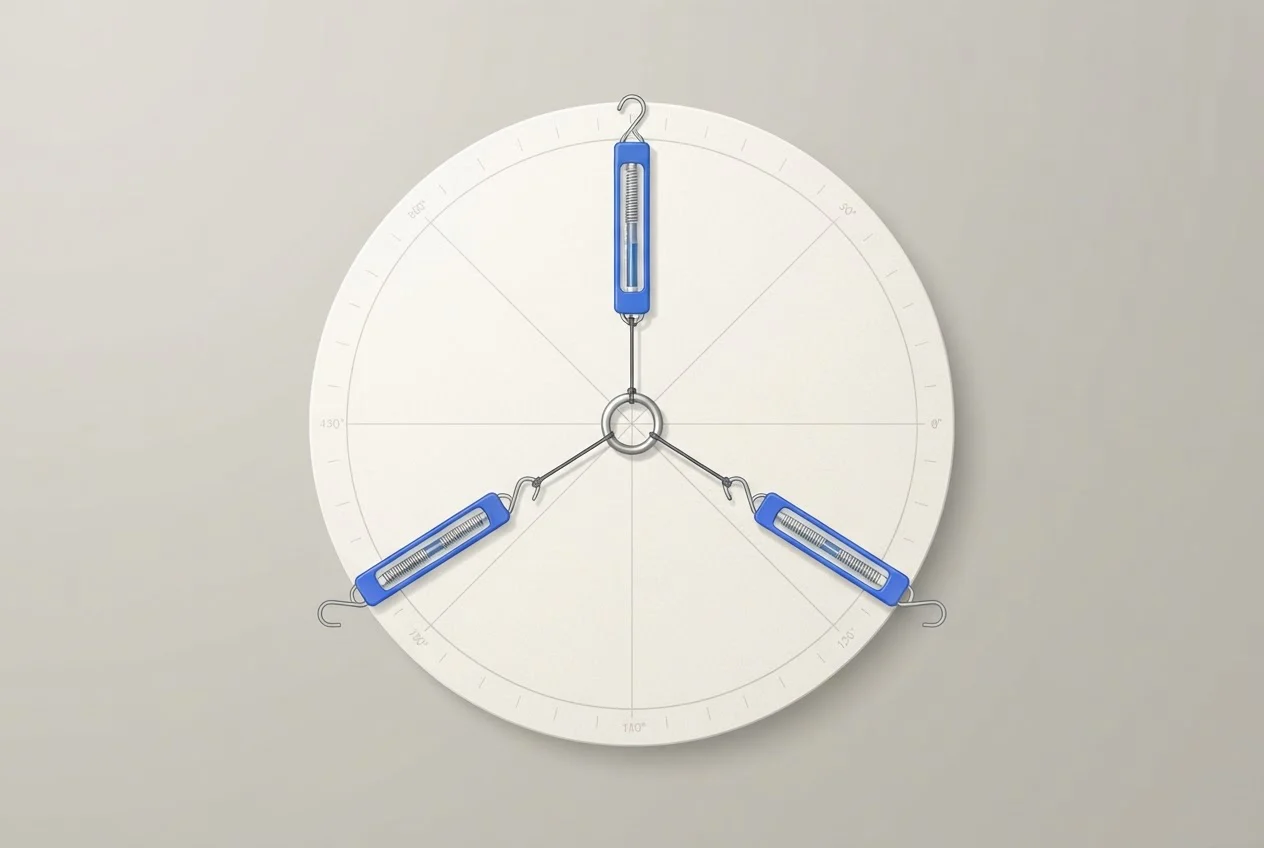
- Count the arrows.Pass: exactly three forces act on the body. Fail: four or more. A crate on a rough floor pulled by two ropes has five (weight, normal reaction, friction, two tensions), so Lami's theorem is out.
- Extend the lines of action.Pass: all three lines cross at a single point. Fail: they do not, or two are parallel. For a rigid body such as a ladder or beam held by three non-parallel forces, the lines must meet at one point. Find that point and the test passes.
- Check the plane.Pass: every force lies in the plane of your diagram. Fail: any force points out of it, as in a tripod problem.
- Check equilibrium.Pass: the body is in equilibrium. Fail: the body accelerates, because then the forces do not sum to zero and you need F = ma.
One more trap: no two forces may lie along the same line. Then the angle between them is 0° or 180°, its sine is zero, and the ratio breaks down.
What does the wrong angle cost in Lami's theorem?
A wrong pairing is not a small slip. In the problem below, all six wrong tensions from three wrong pairings are off by 22.5% to 41.4%. We worked them out ourselves: a 10 kg lamp (weight 98 N, taking g = 9.8 m/s²) hangs from two strings at 30° and 45° to the vertical.
Correct solution. Call the 30° string T₁ and the 45° string T₂.
- Angle between T₁ and T₂: 30° + 45° = 75°.
- Angle between T₁ and the weight W: 180° − 30° = 150°.
- Angle between T₂ and W: 180° − 45° = 135°.
- These add up to 360°.
Each force goes over the sine of the angle between the other two:
T₁ / sin 135° = T₂ / sin 150° = 98 / sin 75° = 101.46
So T₁ = 101.46 × 0.7071 = 71.74 N and T₂ = 101.46 × 0.5 = 50.73 N.
Back-check by components. Horizontal: T₁ sin 30° = 35.87 N and T₂ sin 45° = 35.87 N, so they cancel. Vertical: T₁ cos 30° + T₂ cos 45° = 62.13 + 35.87 = 98.00 N, which equals W. The string closer to the vertical carries more load, as it should.
The three wrong pairings. The first uses 98 ÷ sin 90° = 98 as its base. The other two use the 101.46 base from the correct solution with a wrong angle.
| Wrong pairing | Angles put under T₁, T₂, W | T₁ (N) | T₁ error | T₂ (N) | T₂ error |
|---|---|---|---|---|---|
| Each string's own angle to the vertical, and 90° under W | 30°, 45°, 90° | 49.0 | −31.7% | 69.3 | +36.6% |
| Each string's angle to the horizontal | 60°, 45°, 75° | 87.9 | +22.5% | 71.7 | +41.4% |
Pairing swapped (the angle each force sits next to) | 150°, 135°, 75° | 50.7 | −29.3% | 71.7 | +41.4% |
Errors are measured against the correct 71.74 N and 50.73 N. Using g = 9.81 instead of 9.8 raises both correct tensions by about 0.1%, to 71.8 N and 50.8 N. Both are right, so use the g your question gives.
How do you write a Lami's theorem answer in five steps?
Write it in five steps, each with a pass or fail you can check on paper. This is the routine to copy into an exam.
- Draw the free body diagram.Pass: three arrows start at one point and each is labelled. Fail: any arrow is missing a label or starts away from the point.
- Mark the three angles between pairs.Pass: every angle is below 180° and the three add up to 360°. Fail: the sum is off, which means one angle is measured to the horizontal or to the wrong arm. Fix it before going further.
- Write each force over the sine of the angle between the other two.Pass: in every fraction, the force on top is not one of the two arms of the angle underneath. Fail: it is. That test catches the "adjacent angle" slip in the table above.
- Substitute the known force and solveFor the two unknowns. Pass: the known force's ratio (for example 98 ÷ sin 75°) is calculated once and both unknowns use that same value. Fail: two different ratio values appear.
- Back-check with components.Pass: horizontal components cancel and vertical components add up to the known load, within rounding. Fail: either sum is off by more than rounding.
Our Engineering Mechanics study plan shows where this routine fits in the wider subject.
Should you use Lami's theorem or resolve into components?
Resolve into components when you are unsure, and use Lami's theorem when exactly three forces pass all four tests and the angles are given. Components work on every equilibrium problem, including four-force and rough-surface ones. Lami's theorem works on fewer problems but gives each unknown in one line.
Our recommendation: if the question says "using Lami's theorem", use it and show the angle sum. If it does not, use whichever you can finish without an arithmetic slip, and use the other as your back-check. Components cost two equations, but they have no usage conditions beyond equilibrium.
What are three practice problems on Lami's theorem, with answers?
Try these, then check the answers. All take g = 9.8 m/s².
- A 100 N weight hangs from two strings making 30° and 60° with the ceiling. Find both tensions.
- A 6 kg board hangs from two equal strings, each at 45° to the ceiling. Find the tension in each.
- A 20 kg crate is pulled across a rough floor by two ropes and stays in equilibrium. Can you use Lami's theorem?
Answers.
- The angle between the strings is 90°, so T = 100 × sin 150° / sin 90° = 50 N for the string at 30° to the ceiling and 100 × sin 120° / sin 90° = 86.6 N for the string at 60° to the ceiling.
- The strings are 90° apart and each is 135° from the weight, so T = 58.8 × sin 135° / sin 90° = 41.6 N each.
- No. Five forces act on the crate (weight, normal reaction, friction, two tensions), so fall back on components.

How do you get the rest of Engineering Mechanics equilibrium right?
Lami's theorem is one tool in a subject where the free body diagram, component resolution and moments carry most of the marks. A correct diagram makes every tool work, which is why our free body diagram routine is worth reading next.
If you want the whole subject taught from the basics, our Engineering Mechanics (All Universities) course is taught by Rahul Jewaani (RG Sir) in Hindi, with concept-first explanations in simple Hinglish (a Hindi-English mix). We started in May 2018. The course is built around content common to Maharashtra universities, including Mumbai and Pune, and covers roughly 80% of the syllabus at Nagpur, Kolhapur, Amravati, Dr. Babasaheb Ambedkar Technological University (DBATU) and autonomous colleges. It is self-paced video lectures. As of October 2026 it costs ₹1,699 against a listed ₹1,999, and access runs to 30 June 2027.
Learn Engineering Mechanics in simple Hinglish
Frequently asked questions
Sources
- 1.SPPU First Year of Engineering (2024 Pattern) syllabus, Engineering Mechanics ESC-104-CVL, for the six-hour Equilibrium unit (copy of the Savitribai Phule Pune University syllabus hosted by a Pune engineering college)
- 2.Wikipedia: Lami's theorem, for the statement, the 360° angle sum and the force-triangle derivation
- 3.RG Lectures: Engineering Mechanics (All Universities), for the course language, scope, instructor, price and access date as of October 2026
- 4.RG Lectures store: Mix Universities category, for the ₹1,999 and ₹1,699 prices
- 5.Our own calculations: lamp of 10 kg (98 N at g = 9.8 m/s²) on strings at 30° and 45° to the vertical; every figure follows from the Lami ratio 98 ÷ sin 75° shown in the working.