Raw Marks Cannot Guarantee an MHT-CET Percentile
MHT-CET marks cannot guarantee a percentile. See the session-level formula, why calculators estimate, and what to trust after results.

By Rahul Jeewani, Founder · Updated 30 Sept 2026

In brief
MHT-CET marks do not convert to one guaranteed percentile because the Maharashtra State CET Cell calculates percentile within each test session. A calculator can estimate a range, but the official percentile also needs the session’s candidate counts and score distribution.
In this article
The missing session data prevents a fixed conversion
No fixed MHT-CET marks-to-percentile conversion exists. Raw marks are only one input. The official percentile also depends on the candidate’s test session, the number of candidates who appeared in that session, and how many scored equal to or below that raw score.
The Maharashtra State CET Cell’s MHT-CET 2026 normalisation methodology defines percentile as a session-relative result, not as a percentage of marks. That is why a marks-only calculator should give a range, never guarantee your final percentile.
For PCM, the raw-score scale is 200 marks: Physics and Chemistry questions carry one mark each, Mathematics questions carry two marks each, and there is no negative marking. See the MHT-CET exam format before using a mock score as an estimate.
What marks alone leave out
The official method first works within a session. It uses the number of candidates who appeared there and the number at or below a particular raw score. Only then can it calculate that session’s percentile and merge the session percentiles into the CET score.
The data a marks-only calculator does not have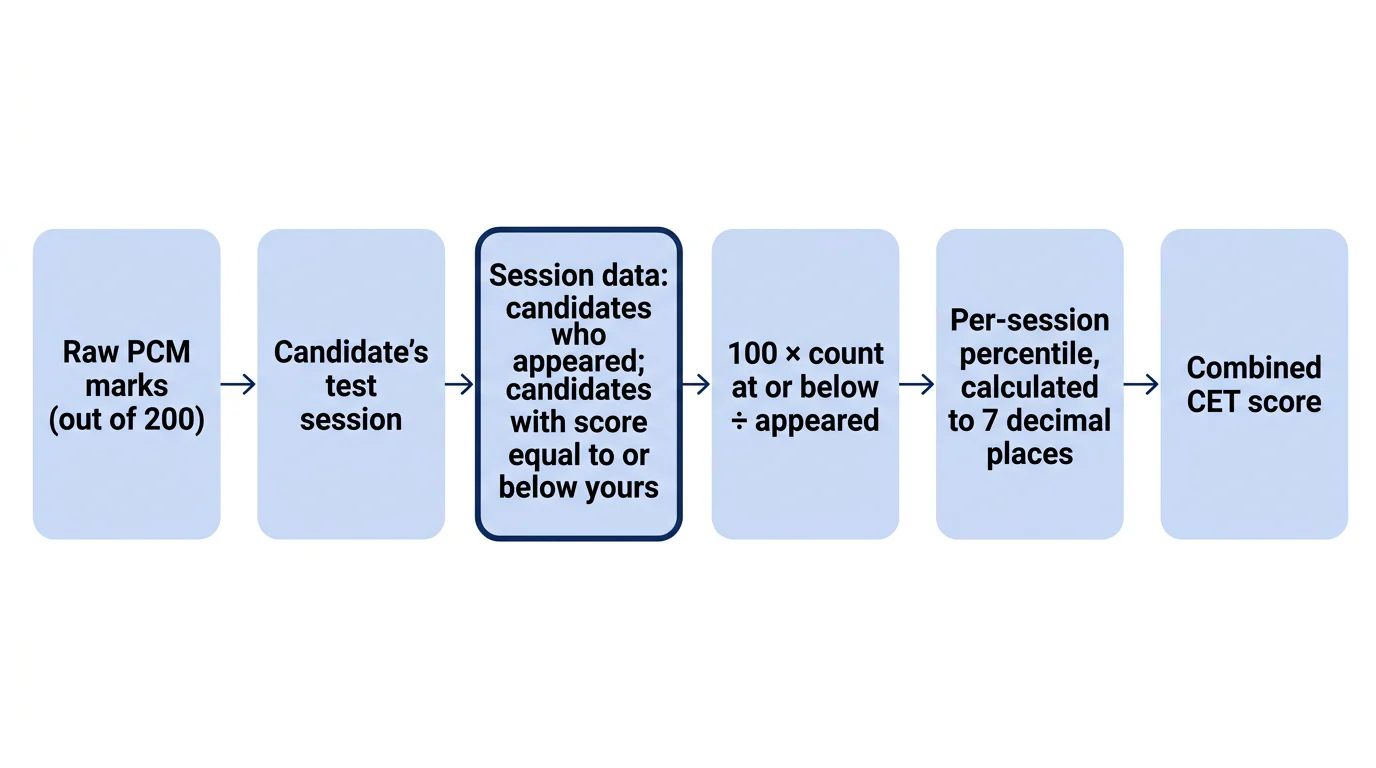
Three checks before you read a predictor result
| Check | Why it matters | What to do |
|---|---|---|
| PCM or PCB group | The two groups have different question structures and raw-score totals. | Use a predictor and past context for your own group only. |
| Your test session | Percentile is calculated relative to candidates in a session. | Do not assume a marks table from another shift will repeat in yours. |
| Total versus subject percentile | Total percentile is not the average of Physics, Chemistry and Mathematics percentiles. | Read the total percentile as its own result. |
Use an estimate to decide what to revise next
Before results, use your raw score to identify the next study decision, not to lock in a college or rank expectation. A range estimate can help you decide whether your next mock needs more Physics, Chemistry or Mathematics correction work.
After results, use the official percentile for decisions that require a final score. If you are still improving your mock performance, switch from broad score watching to an error-led review using chapter tests and full mocks.
A table can describe a past pattern, not promise your result
Treat any table as dated context, label it by exam year and group, and keep its uncertainty visible. For a marks-based range rather than a false exact answer, use our MHT-CET percentile calculator.