How Should You Prepare for MHT-CET? A Physics-First PCM Plan


TL;DR
We prepare MHT-CET students by diagnosing every PCM chapter before adding more mocks, then repairing gaps through syllabus-aligned practice and reviewed tests. This guide gives you a Physics-first recovery method, a chapter-status system, mock-test error log, flexible revision templates, and criteria for choosing useful support.
MHT-CET PCM is a large, competitive exam: the 2026 first attempt recorded 454,069 appeared candidates in the State CET Cell’s official result note. We built this plan for students who need a clear way to turn that pressure into daily decisions.
Prepare for MHT-CET by mapping chapter-level accuracy, completing the current official syllabus, practising topic-wise PYQs, and then progressing to timed mixed sets and full mocks. Review every test before the next one. If Physics fundamentals are weak, rebuild prerequisites before chasing speed because repeated unit, calculation, or interpretation errors need targeted repair.
We cover the exam rules to verify, a chapter-status matrix, a Physics recovery workflow, a mock-analysis system, and flexible templates for the time you have left.
How Does an MHT-CET Preparation Strategy Work?
A useful MHT-CET preparation strategy does not begin with a huge timetable. We start with evidence: what you can solve, what you understand, what breaks under time pressure, and what is still untouched. That prevents a strong chapter from hiding a weak one, especially in Physics.
| Stage | Entry Criterion | Work Completed | Exit Criterion |
|---|---|---|---|
| Diagnostic | Official syllabus is available | Sample questions and chapter-status tagging | Every PCM chapter has a status and evidence |
| Syllabus Build | Status matrix is complete | Relearn prerequisites and create concise recall notes | Each chapter has a worked example and first check |
| Chapter Practice | Concepts can be explained without notes | Textbook questions, then chapter PYQs | Errors are tagged and reattempted |
| Mixed Practice | Most chapters have chapter-level evidence | Interleaved PCM question sets | Weakness is identified by error type |
| Full Mocks | Mixed sets are stable | Locked CBT-style papers | Every mock has a completed review |
| Final Revision | New learning has stopped | Error-log reattempts and recall checks | Revision buffer remains intact |
We move forward only when the previous stage gives us usable evidence. A mock test is not a graduation certificate, it is a diagnostic tool. Our Physics coaching guide can help you decide whether structured support fits the kind of gap your matrix reveals.
What Official MHT-CET Rules Should You Verify First?
We verify the latest State CET Cell notice before planning dates, syllabus, registration, or exam-day rules. As of 23 September 2026, the next year’s final schedule had not been published on the official notices, so we would not build a study plan around an assumed exam date.
The most recently published PCM pattern gives you 150 questions in 180 minutes, with no negative marking. Physics and Chemistry run in the first 90-minute group, then Mathematics opens for the second 90-minute group. That locked sequence matters because a student cannot carry unused Physics time into Mathematics.
| PCM Component | Questions | Marks Per Question | Marks | Time |
|---|---|---|---|---|
| Physics | 50 | 1 | 50 | Shared first 90 minutes |
| Chemistry | 50 | 1 | 50 | Shared first 90 minutes |
| Mathematics | 50 | 2 | 100 | Second 90 minutes |
| Total | 150 | Varies | 200 | 180 minutes |
The current official scheme gives approximately 20% weightage to Std. XI and 80% to Std. XII. In the published PCM plan, each subject has 10 Std. XI and 40 Std. XII questions, according to the marking scheme. We use that split to sequence work, not as an excuse to skip the selected Std. XI foundations.
For a fuller explanation of the locked sections, refer to the official brochure before each new exam cycle. If your results show a deeper foundation problem, our Physics support guide explains when focused help can be more useful than another generic resource.
How Do You Diagnose Every PCM Chapter?
We classify every chapter before deciding what to study next. “Weak at Physics” is too broad to fix. A chapter may be weak because the concept is missing, because calculation habits are shaky, or because the method disappears only when time is running.
What Does Each Chapter Status Mean?
Use five statuses across Physics, Chemistry, and Mathematics:
| Status | What It Means | Next Move |
|---|---|---|
| Unstarted | No recent evidence exists | Learn the chapter scope and attempt a short baseline |
| Concept Gap | The principle, condition, diagram, or formula meaning is unclear | Rebuild prerequisites before more MCQs |
| Practice Gap | The method is known but execution is unreliable | Use graded questions and reattempts |
| Timing Gap | Untimed work is sound, timed work is not | Add short timed sets |
| Exam Ready | Recent mixed-set evidence is reliable | Maintain through spaced review |
Your matrix should include the chapter, official class level, latest evidence, accuracy, time observation, error tags, next action, status, and recheck date. That turns revision from a memory game into a visible system.
How Should You Sequence Physics, Chemistry, and Mathematics?
We begin with dependencies. In Physics, the official Std. XI list includes vectors, error analysis, motion in a plane, laws of motion, gravitation, thermal properties, sound, optics, electrostatics, and semiconductors. If vectors or units are weak, later chapters can look harder than they really are.
In Chemistry, we repair basic concepts, atomic structure, bonding, redox, states of matter, and organic foundations before asking a student to memorise disconnected reactions. In Mathematics, we check functions, trigonometry, coordinate geometry, and algebraic fluency before treating calculus as a separate island.
When Should You Change Priorities?
We change a chapter’s priority when the evidence changes. A chapter with repeated conceptual errors moves backward into recovery. A chapter that is correct without time pressure but slow in a mixed set becomes a timing problem. A chapter that performs well once but fails later is not fully secure yet.
We do not treat historic chapter-frequency claims as official weightage. Current official syllabus, prerequisite value, and your own error pattern are more dependable ways to choose the next task. Students weighing a short revision route against a deeper rebuild can use our Physics crash course guide.
How Can You Rebuild Weak Physics Before Chasing Speed?
Weak Physics rarely improves because a student takes more full mocks. If the formula has no physical meaning, the unit check is missing, or the diagram is never drawn, speed practice simply repeats the same mistake faster.
We rebuild the smallest missing layer first. That may be vectors before force questions, sign convention before optics, a circuit sketch before current electricity, or a unit check before numerical substitution. Each repaired layer makes later MCQs easier to interpret.
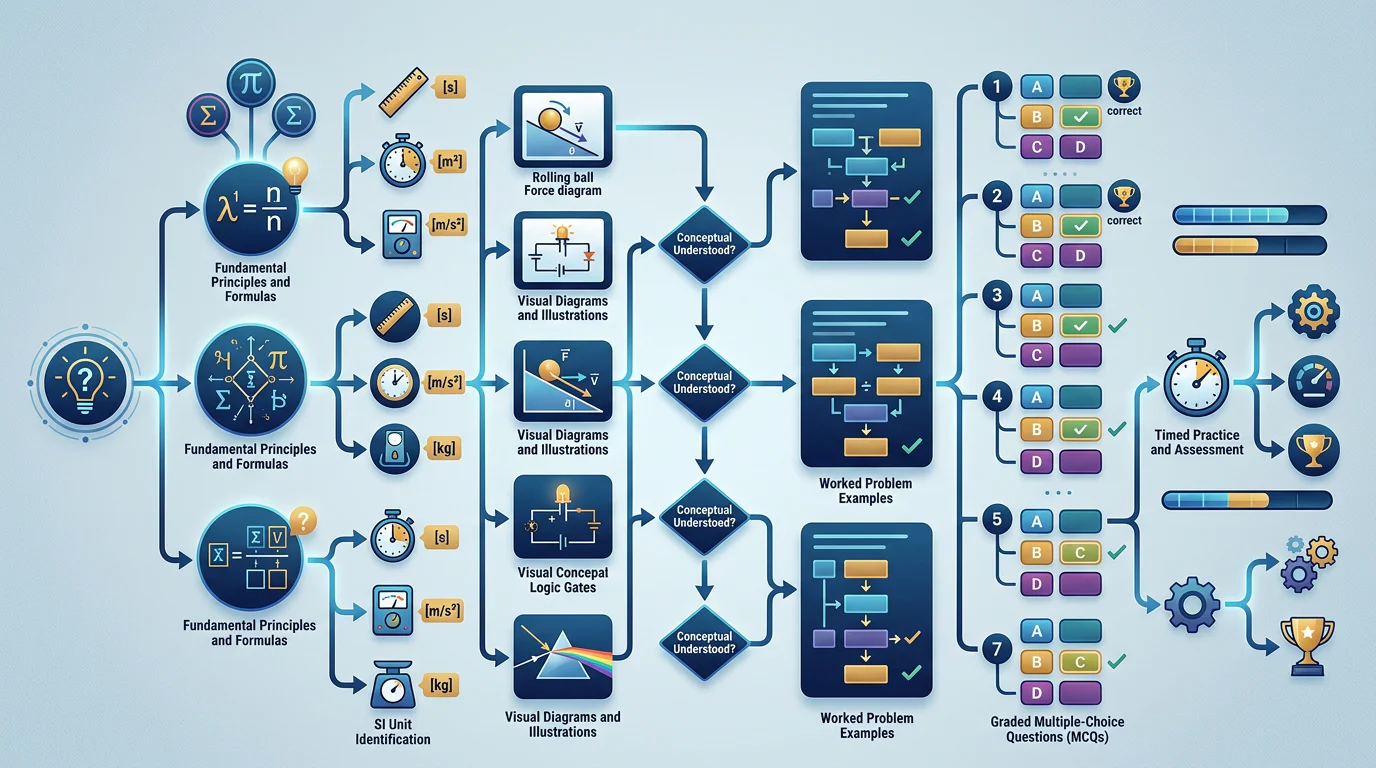
Use This Physics Recovery Loop
- State what each formula quantity means and write its SI unit.
- Draw the force diagram, ray path, circuit, graph, or physical situation.
- Check the conditions under which the formula applies.
- Follow one worked example slowly enough to explain every step.
- Attempt graded MCQs, starting with recognition and ending with mixed application.
- Record the first error, then reattempt the question later without the solution.
Our teaching approach starts from the assumption that a learner may have no basics. We explain each MCQ through the underlying concept, not only through the option that happens to be correct.
If you want a baseline before committing to a longer plan, use our free chapter report. The useful result is not “good” or “bad.” It is knowing whether your next move should be a prerequisite lesson, a worked numerical, or a timed set.
How Do You Turn Practice and Mocks into Better Decisions?
We use practice in a ladder. First come textbook examples and direct concept checks. Next come chapter PYQs, then mixed sets, sectional tests, and full mocks. Each rung changes the question you are asking: Can I understand it? Can I execute it? Can I select the method? Can I do it under exam conditions?
Research on learning techniques rates practice testing and distributed practice as high-utility approaches, which supports our choice to revisit and reattempt rather than endlessly reread notes. The learning review does not replace subject teaching, but it reinforces why reviewed retrieval should sit inside the plan.
What Should Your Error Log Track?
| Error Category | Diagnostic Question | Correction Action |
|---|---|---|
| Conceptual | Did I choose the wrong principle? | Relearn the prerequisite and solve a parallel example |
| Calculation | Did arithmetic, algebra, sign, unit, or conversion fail? | Write the failed step and practise similar numericals |
| Interpretation | Did I misread a graph, diagram, condition, or wording? | Annotate the stem and redraw the situation |
| Recall | Did I fail to retrieve a formula, fact, or reaction? | Use short spaced recall prompts |
| Time Management | Did I know the method but stay too long? | Use a targeted timed set and a stop rule |
We reattempt the question before reading a full solution. Then we count the error categories by subject. A score may rise or fall with paper difficulty, but repeated calculation or interpretation errors still tell us exactly what to repair.
How Should You Choose a Test Series or Course?
The best test series is not the most advertised one. We look for current-syllabus alignment, realistic section timing, explained solutions, and analytics that identify chapter, time, and error patterns. A beginner in Chemistry should use the same logic: choose teaching that explains core ideas, provides syllabus-matched examples, and makes doubts answerable.
| Criterion | What We Check |
|---|---|
| Syllabus Alignment | Current State CET Cell scope and PCM format |
| Teaching Depth | Formula meaning, diagrams, conditions, and worked examples |
| Doubt Support | Feedback on the exact step that failed |
| Solution Quality | Reasoning, not only an answer option |
| Test Analytics | Chapter, subject, timing, and error-category visibility |
Use our mock review method after every serious paper. A test without review is evidence collected and then ignored.
How Should You Adapt the Plan by Time Remaining?
With 16 or more weeks, we give syllabus build and chapter practice most of the attention while retaining a recurring review block. With 8 to 15 weeks, we divide effort among unfinished foundations, chapter PYQs, mixed sets, and reviewed tests.
With 4 to 7 weeks, we stop expanding resources and focus on the errors most likely to repeat. With fewer than 4 weeks, we protect revision sessions, reattempt logged questions, practise the 90-minute sections, and avoid opening large new topics unless they unlock an urgent prerequisite. In every version, we reserve the final part of the plan for revision rather than assuming every day will go perfectly.
For a more detailed short-window plan, use our eight-week score plan. We keep the priority on the specific error that is recurring, not on adding study tasks simply because they look productive.
Prepare with RG Lectures
At RG Lectures, we built our Physics support for students who do not need another pile of questions, but a way to find the step that keeps breaking. We teach the meaning behind formulas, units, diagrams, assumptions and MCQ options before asking you to race through them. That approach is useful when a weak foundation makes every new chapter feel unrelated, or when mock scores hide the reason answers are going wrong.
We can help you turn your chapter matrix into a practical route: identify the prerequisite, work through examples, practise graded questions, bring the exact doubt, then test the repaired skill. Our aim is not to promise a percentile. It is to make your next study decision evidence-led and specific. If you want structured Physics preparation that respects your school schedule and your starting point, explore our courses here!
FAQs on MHT-CET Preparation Strategy
How Should I Prepare for MHT-CET If Physics Is Weak?
Start by classifying each Physics chapter. Rebuild any prerequisite gap, practise graded MCQs, then use timed sets only after diagrams, units, and setup are reliable.
What Is the Current MHT-CET PCM Pattern?
Use the latest official brochure, not a past calendar. The 2026 PCM format had 150 questions in 180 minutes, split into 90-minute subject groups for planning.
Which MHT-CET Test Series Is Best?
Do not choose on popularity alone. Choose a test series that follows the current syllabus and section timing, supplies explained solutions, and shows actionable chapter, timing, and error information.
Which MHT-CET Chemistry Provider Suits Beginners?
Start with core ideas, not shortcut lists. Choose Chemistry teaching that uses syllabus-matched examples, answers doubts clearly, and provides graded practice that exposes what has not stuck.
Which MHT-CET Physics Course Is Best?
Choose for your gap, not a generic label. The right Physics course diagnoses prerequisites, explains formulas and diagrams, offers detailed solutions and doubt support, then tracks graded MCQs.
How Should I Adjust My Plan When Mock Scores Stall?
When scores stall, stop adding random mocks. Count error categories, repair the repeated weakness, reattempt those questions, then return to a timed mixed set again.