

TL;DR
We recommend one-to-one JEE Physics doubt clearing for persistent misconceptions and line-by-line solution review, while group sessions suit shared questions and routine revision. This guide compares human and automated support, shows a five-step doubt workflow, explains mock-error tracking, and gives a practical test for deciding when paid help is worthwhile.
JEE Advanced preparation rewards students who can identify why an approach failed, not only find the correct answer. In 2026, 56,880 candidates qualified JEE Advanced, which makes efficient error correction especially valuable during serious preparation.
One-to-one JEE Physics doubt clearing is usually best for a persistent misconception or a solution needing line-by-line review. Group sessions are more efficient for common questions and routine revision. In every mode, demand a review of your attempted reasoning, the first incorrect step, and a follow-up problem, not just a video link.
Below, we compare the main support formats, build a repeatable doubt workflow, and show when structured help can genuinely earn its cost.
Which JEE Physics Doubt Clearing Mode Fits This Problem?
The useful platform types are not defined by an app name or a promise of instant answers. They are defined by what happens when you submit a difficult problem: whether someone can inspect your diagram and assumptions, challenge the method you chose, and check that you can solve a related question independently.
Use the table as a mode-selection tool. A routine question can often be resolved efficiently in a group or chat. A recurring conceptual error, a multi-step derivation, or a mock-test mistake usually needs more of your own reasoning to be visible.
| Decision Factor | One-to-One Live Help | Group Doubt Session | Teacher Chat Or Asynchronous Reply | Automated Solution Tool |
|---|---|---|---|---|
| Doubt Complexity | Persistent or multi-step | Common or routine | Clearly bounded | First-pass check |
| Interaction Type | Live dialogue | Shared discussion | Short exchange or delayed annotation | Prompt and response |
| Reasoning Review | Can inspect each step | Limited by shared time | Depends on full-attempt review | Usually limited to visible prompt |
| Follow-Up Testing | Easy to assign live | Can be shared with group | Must be promised | Student must self-test |
| Turnaround | Scheduled | Scheduled | Immediate to provider-defined window | Near-instant |
| Best-Fit Use | Misconceptions, derivations, mock errors | Revision and shared questions | Formula use or one stuck step | Definitions and basic checks |
| Teacher Continuity | Possible with the same teacher | Usually variable | Variable | None |
| Privacy | Highest in a private session | Lower because peers attend | Check data and image policy | Check data handling |
| Cost Transparency | Ask about session and package limits | Ask about batch size and inclusions | Ask about reply caps and expiry | Check paid feature limits |
A one-to-one session is not automatically superior just because it is private. It becomes useful when the teacher can see the first wrong assumption, test an alternative method, and return you to independent work. That is the standard behind our mentoring quality guide.
Good feedback is more than a final answer. A large feedback meta-analysis covering 435 studies found a medium overall effect on learning, while also showing that feedback quality and information content matter greatly. For JEE Physics, that means asking for reasoning review, not merely speed.
How Should You Solve and Track a Physics Doubt?
A good doubt process starts before you contact anyone. If you send only a cropped question and ask for “solution,” you make it difficult for a teacher, chat responder, or automated tool to identify whether the real issue is a missed condition, incorrect free-body diagram, wrong principle, or algebraic slip.
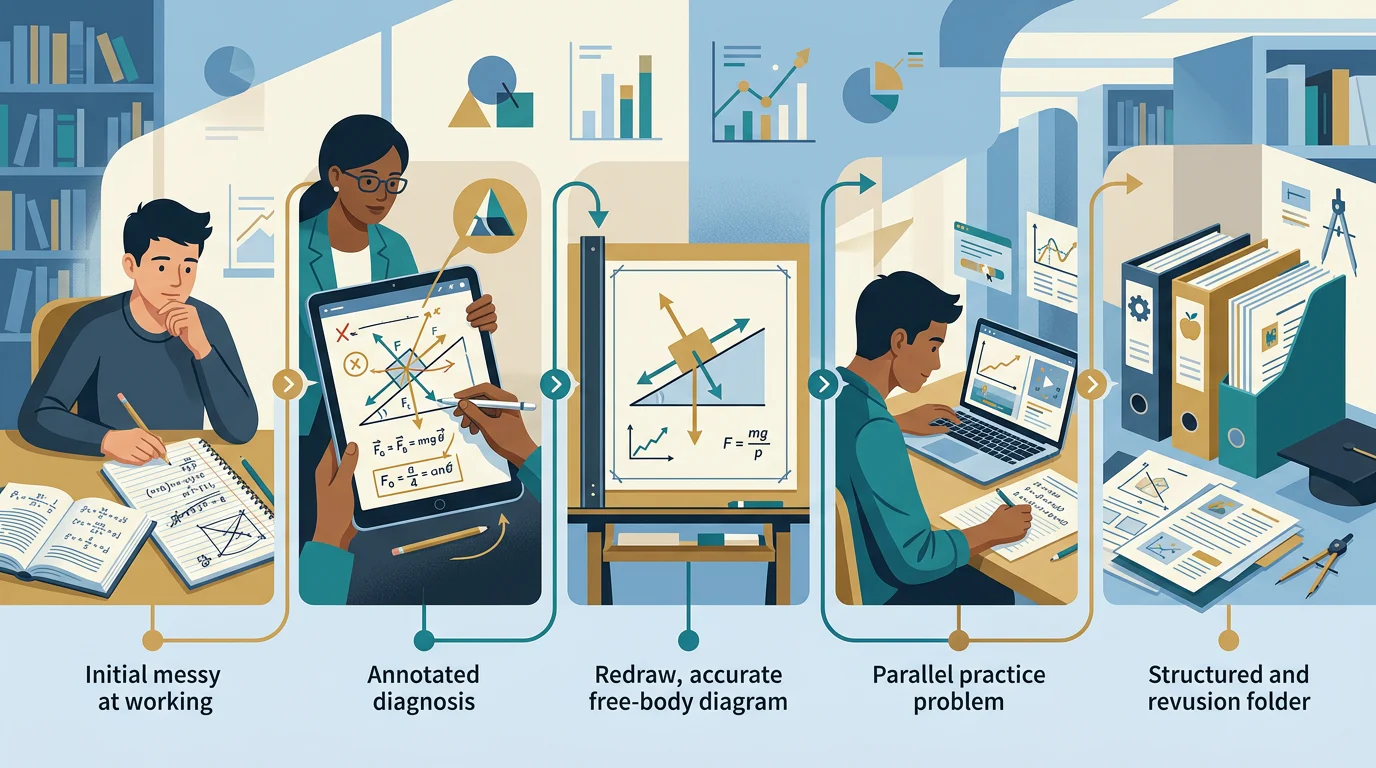
Start with Your Attempt
Use this five-step workflow whenever a doubt takes more than a few minutes to resolve:
-
Attempt: Write the diagram, known values, relevant principle, and the step where you became uncertain.
-
Add Context: Include the chapter, question source, time spent, and whether the problem came from practice or a mock.
-
Diagnose: Find the first incorrect step, rather than correcting only the final numerical answer.
-
Repair: Rewrite the solution with the relevant condition, representation, or method choice made explicit.
-
Transfer: Solve one similar question without prompts, then log the result for revision.
Trying before receiving a solution matters. Research on solution videos found that an attempt can help learning when a problem is just beyond current ability, while very difficult attempts can create overconfidence if students simply watch the answer afterward.
Ask for a Reasoning Diagnosis
For multi-step derivations, ask the responder to explain why a principle applies before asking them to continue calculations. In Physics, a correct equation can still conceal an incorrect model, such as assuming constant acceleration, omitting a force, or using conservation where the stated conditions do not allow it.
A useful response should distinguish the model from the mathematics. A Physics self-explanation study identifies the principle, setup, and conditions of application as important parts of a strong explanation. That makes these useful questions to ask:
- Principle Choice: Which law governs this situation, and what condition makes it applicable?
- Representation: What should the diagram, sign convention, or coordinate axis show?
- Method Choice: Is there a shorter valid route, and when would that route fail?
- Transfer Check: Can I solve a changed-context version without copying this method?
If the issue is limited to one clearly identified step, start with instant Physics help. Escalate only when the same gap keeps returning.
Build a Doubt Folder and Mock Queue
A doubt folder prevents solved questions from disappearing into screenshots and chat history. We recommend saving each meaningful doubt by chapter and error type, then returning to the same tag during revision.
JEE-Physics-Doubts/
  Mechanics/
    Rotation/
      Question-Source.jpg
      My-Attempt.jpg
      Error-Tag_Principle-Selection.md
      Corrected-Reasoning.md
      Transfer-Question.md
      Retry-Date.md
  Electrodynamics/
  Modern-Physics/
  Mock-Error-Queue/
Use error tags such as principle selection, free-body diagram, sign convention, units, algebra, question reading, and time decision. Three doubts carrying the same tag should trigger a focused review block or personal session. An isolated slip should usually be corrected, logged, and revisited without turning into a subscription decision.
Mock-test analysis belongs in that same queue. Add the question number, time spent, confidence level, selected method, and error tag, then use our mock-test diagnosis to separate a genuine Physics gap from a timing or reading mistake.
How Can You Verify Online JEE Doubt Support Before Paying?
Before paying, test the provider’s learning process rather than its promotional language. “Unlimited doubts” is not meaningful if responses are automated, a teacher cannot view your attempt, complex questions cannot be escalated, or the access window is unclear.
Who Answers the Doubt?
Ask whether a named Physics teacher, a subject-moderation team, or automation handles the first response. Also ask whether the same teacher can follow recurring mistakes over time. Continuity matters more for misconceptions than for a one-off formula check.
What Does Access Actually Include?
Ask about response windows, live-session duration, doubt limits, batch size, expiry, recordings, missed-session rules, and the full price before payment. A provider should state these conditions clearly enough for you to compare it with live doubt options.
What Form Does the Response Take?
A credible service should let you upload a full attempt, including a diagram or handwritten calculation. It should explain the first incorrect step, give a correction in an understandable format, and offer a route from chat to live subject help when the question is too complex for a short reply.
| Platform Claim | Question To Ask | Useful Evidence |
|---|---|---|
| Personalised Support | Will someone review my own attempt? | Annotated sample response |
| Fast Doubt Solving | What is the stated response window? | Written access terms |
| Expert Faculty | Who answers JEE Advanced Physics questions? | Named role and relevant experience |
| Unlimited Access | What limits, expiry dates, or fair-use rules apply? | Complete plan details |
| Human Guidance | Can a difficult chat doubt escalate to live help? | Clear escalation process |
| Safe Uploads | What happens to answer-sheet images and recordings? | Plain-language privacy policy |
Automated tools can be useful, especially for a quick explanation or a basic check, but they require verification. UNESCO guidance recommends a human-centred approach to educational AI and highlights the need to address privacy and meaningful use.
When Is Paid JEE Doubt Solving Worth It?
Paid support is justified when a recurring misconception, delayed resolution, or repeated mock-test error is disrupting your planned study. It is rarely necessary for a single problem you can diagnose from your notes, textbook, peer discussion, or a reliable free explanation and then solve again independently.
The best test is not “Was the answer fast?” It is “Did this help me identify, explain, and avoid the same error on the next problem?” Use our paid-support framework before committing to structured help.

Scenario One: The Repeating Derivation Error
You keep losing the same step in rotational motion despite reviewing solutions. Your notes show different numbers but the same principle-selection error. One-to-one help is likely worthwhile because a teacher can inspect your setup, identify the first wrong assumption, and give a parallel numerical.
Scenario Two: The Shared Revision Question
Several students are unsure when a standard electrostatics shortcut applies. A group session is efficient because the concept is common, the explanation benefits everyone, and you can each reattempt a similar question afterward. Personal support may add little here.
Scenario Three: The Mock-Test Outlier
You understood the method but copied a value incorrectly or lost a sign during calculation. Log the error, redo it under time, and check units. Buying ongoing help for isolated slips is usually unnecessary, though repeated slips may indicate a review-routine problem.
Paid help should create independence, not dependency. If a service repeatedly sends answers without asking for your attempt or testing transfer, use the cost-benefit guide before renewing.
What Can RG Lectures Help You Build?
At RG Lectures, we help JEE students turn unresolved Physics work into a visible pattern they can act on. Our approach starts with the student’s attempt, not with a pasted solution: we look for the first mistaken assumption, missing representation, or unreliable method choice. We then help students organise recurring issues by chapter and error type, so mock-test review becomes a revision plan instead of a pile of screenshots. We believe personal support earns its place only when it makes a learner more independent on the next problem. That means asking better questions, checking units and conditions, choosing a method deliberately, and reattempting a parallel numerical without prompts. If you are deciding between a quick answer, a group discussion, or focused support, use the workflow and verification questions in this guide first. Explore study resources and preparation support with RG Lectures
FAQs on JEE Physics Doubt Clearing
These short answers use the same test: match the support format to the error, require reasoning review, then reattempt independently. This keeps doubt solving focused on learning.
Is One-to-One JEE Physics Doubt Clearing Better Than a Group Session?
One-to-one support works best when a mentor must inspect your diagram, assumptions, and calculations. Choose a group session when the doubt is common and revision need is shared.
What Should I Send with an Online Physics Doubt?
Send the full question, your diagram or equations, attempted steps, chapter, and exact point where you became uncertain. This lets the responder diagnose your first error.
What Should I Check Before Paying for Doubt Support?
Before paying, confirm in writing who answers, whether attempts are reviewed, response limits, scheduling, escalation to live help, data handling, recordings, and the complete price before you pay.
When Should I Use Free Physics Resources Instead?
Pay when recurring errors or delayed answers repeatedly disrupt your study plan and the service tests understanding afterward. Use free resources for isolated questions you can re-solve independently.