How to Rescue HSC Physics in Six Weeks: A Maharashtra HSC Physics Six-Week Study Plan

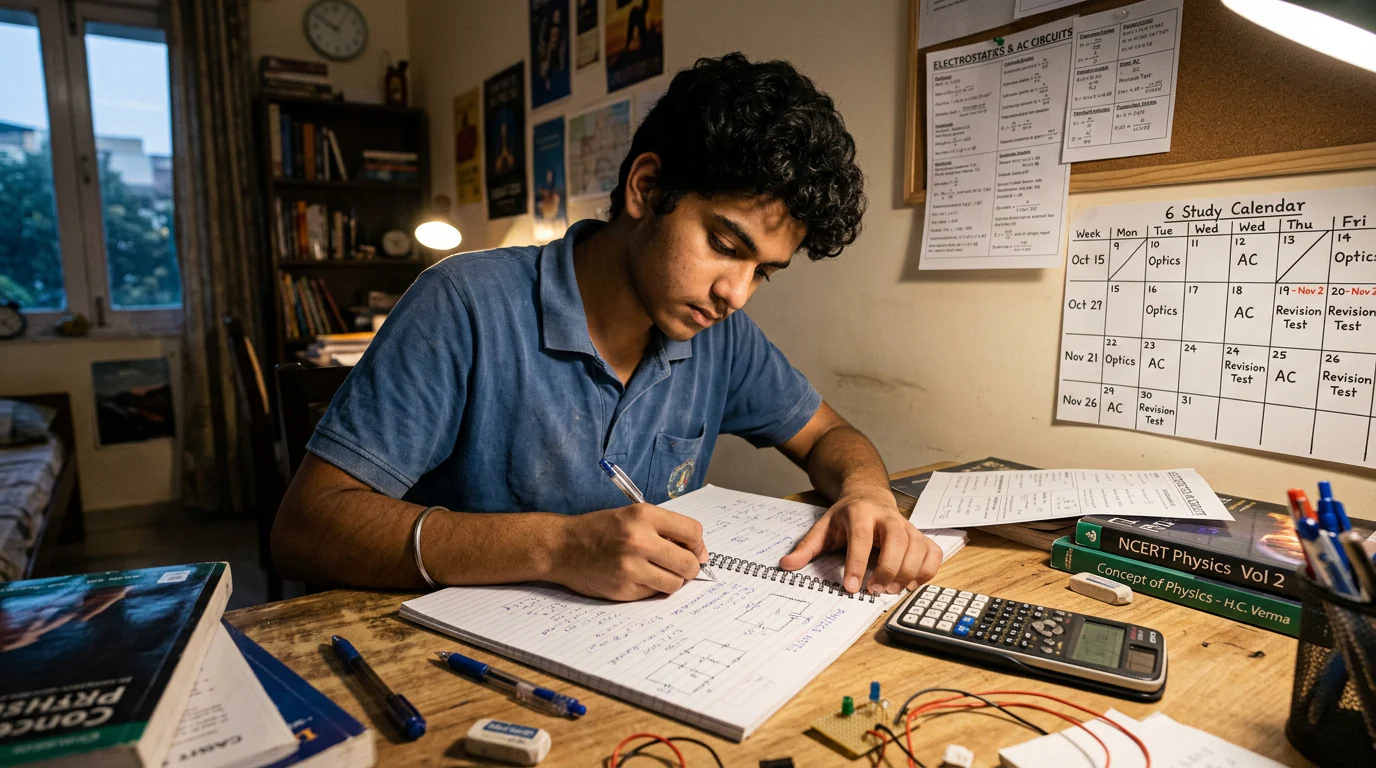
TL;DR
We built this Maharashtra HSC Physics six-week study plan for students who need to finish Modern Physics and Semiconductor Devices while protecting revision time. It uses a first-day audit, daily written practice, board-only boundaries, and a timed-paper error loop, then shows when structured help is worth considering.
How to Rescue HSC Physics in Six Weeks: A Maharashtra HSC Physics Six-Week Study Plan
Maharashtra HSC Physics leaves little room for unfocused revision: the official Class XII text places Dual Nature of Radiation and Matter on pages 306 to 323, Structure of Atoms and Nuclei on 324 to 343, and Semiconductor Devices on 344 to 364. See the official textbook before choosing what to study or skip.
A Maharashtra HSC Physics six-week study plan can rescue your preparation if unfinished chapters and exam execution are planned together. Finish Modern Physics and Semiconductor Devices through short concept blocks, then immediately write derivations, diagrams, numericals, and verified Board questions while older chapters stay active through mixed revision.
We will show you how to audit the syllabus, use 42 days well, set a Board-only boundary, and turn timed papers into a practical error-repair system.
Your Maharashtra HSC Physics Six-Week Study Plan
The first rule is simple: do not label a chapter complete because you watched a lecture or read a summary. A chapter is complete only when you can produce the output the paper demands, including a formula, a labelled diagram where relevant, a written explanation or derivation, and a correctly worked question.
On Day 1, sort every chapter into three categories. Untouched: you cannot explain the core idea or begin a standard question. Fragile: you recognise the topic but make formula, diagram, or working errors. Revision-ready: you can solve representative questions without notes. Our Board-only resource stack can help you keep those resources focused on the HSC syllabus.
The Board syllabus specifically includes photoelectric effect, atomic and nuclear physics, semiconductor devices, and logic gates, alongside an emphasis on SI units and problem solving. Use the Board syllabus as the final scope check when you update this plan.
| Week | Main Priority | Daily Cumulative Work | Timed Practice |
|---|---|---|---|
| 1 | Audit plus Dual Nature | Recall one older chapter daily | One chapter test |
| 2 | Atoms and Nuclei | Formula and derivation recall | One mixed section |
| 3 | Semiconductor Devices | Diagrams, I-V curves, logic gates | One mixed section |
| 4 | Repair all unfinished units | Mixed numericals and answer writing | Two timed sections |
| 5 | Repair weak older chapters | Error-log reattempts | Three timed papers |
| 6 | No major new theory | Formula, diagram, and derivation repair | Four timed papers or targeted sections |
This calendar protects the first 21 days for closing content gaps and the final 21 days for retrieving, writing, and repairing. If school work limits your hours, reduce fresh topics, not the daily mixed revision block.
What Must I Finish in Modern Physics and Semiconductor Devices?
Modern Physics becomes manageable when you stop treating it as one large chapter. Break it into answerable units, then make one written proof of completion for each unit before moving on.
The aim is not to memorise every paragraph. It is to recognise the question type, select the right principle, show enough working, and finish with a clear result. Our worked-example guide is useful when you need to see that transition from concept to written answer.
Dual Nature of Radiation and Matter
Complete photoelectric-effect observations, Einstein’s photoelectric equation, particle nature of light, de Broglie wavelength, and standard numerical substitutions. Practise explaining what changes with frequency, intensity, stopping potential, and threshold frequency instead of memorising isolated statements.
Structure of Atoms and Nuclei
Finish Rutherford and Bohr models, hydrogen spectrum, radioactivity and decay law, mass-energy relation, mass defect, binding energy per nucleon, fission, and fusion. For each derivation or explanation, write the steps in the order an examiner can follow.
Semiconductor Devices
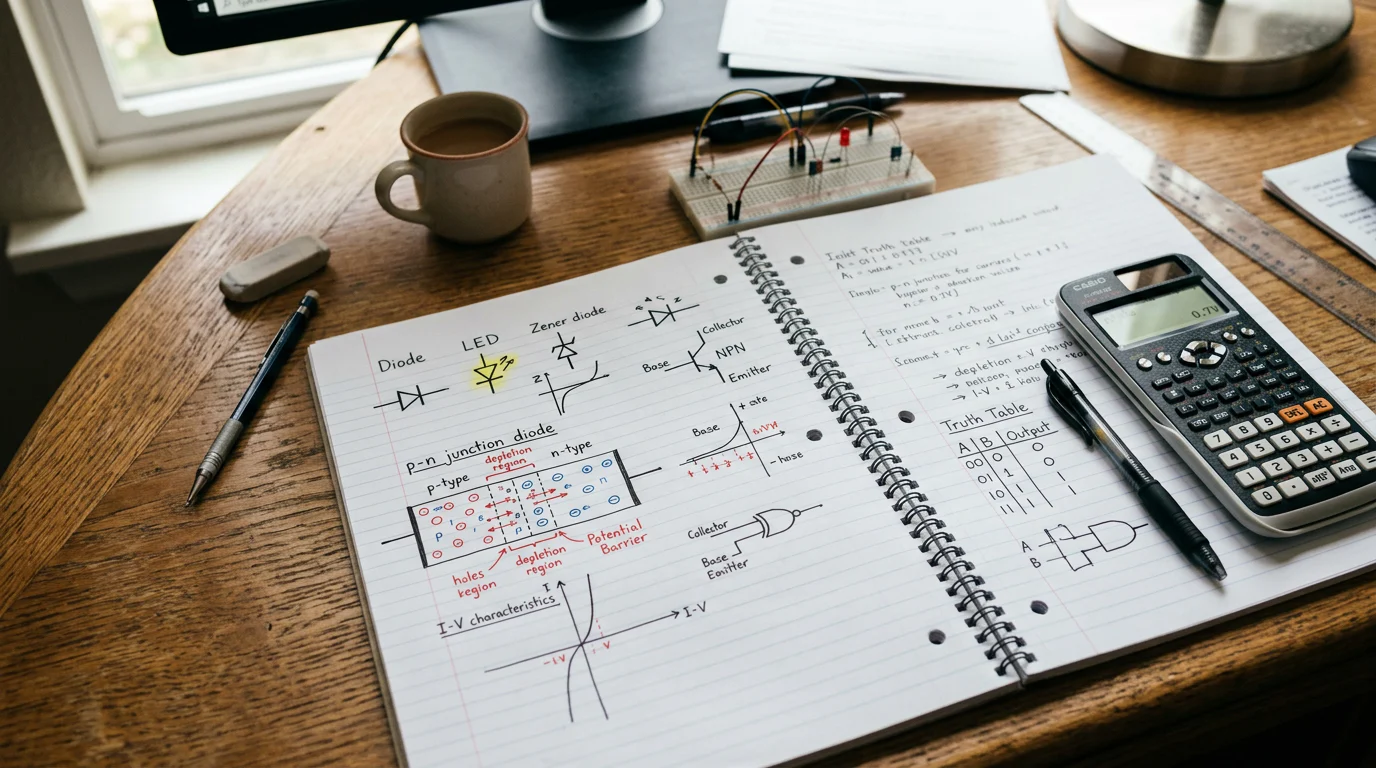
Cover energy bands, intrinsic and extrinsic semiconductors, p-type and n-type material, p-n junctions, forward and reverse bias, rectifiers, Zener regulation, photodiodes, solar cells, LEDs, transistor applications, and AND, OR, NOT, NAND, and NOR gates.
Use This Completion Checklist
| Unit | Concept | Derivation Or Explanation | Diagram | Numerical | Verified PYQ |
|---|---|---|---|---|---|
| Dual Nature | Photoelectric effect and de Broglie relation | Einstein equation and interpretation | Photoelectric graph where required | One formula-based question | One official past question |
| Atoms and Nuclei | Bohr model, decay, binding energy | Model limitations or decay working | Atomic or binding-energy diagram | Mass defect or decay calculation | One official past question |
| Semiconductor Devices | Junctions, devices, logic gates | Device working and bias explanation | Circuit, I-V curve, or symbol | Device-based calculation where relevant | One official past question |
| Logic Gates | Gate purpose and combinations | Explain the selected output | Gate symbols | Input-output evaluation | One verified question |
If a cell in this checklist is blank, the chapter is still in progress. That standard prevents the common trap of feeling prepared after passive review, then freezing when a paper asks for a labelled graph or a line-by-line explanation. If that keeps happening after several attempts, our support cost guide can help you judge whether structured help is worthwhile.
How Should I Study Each Day Without Forgetting Older Chapters?
A rescue plan works when each day has a predictable purpose. Long theory sessions feel productive, but they often leave no time to test whether you can reproduce the idea under paper conditions.
Use four study blocks. Learn: spend about 75 minutes on one defined concept and one worked derivation. Apply: use 60 minutes for numericals, diagrams, or truth tables without notes. Retrieve: spend 35 minutes on mixed questions from older chapters. Repair: use 20 minutes to correct your error log and choose tomorrow’s first task.
The retrieval block matters because it keeps revision-ready chapters from quietly becoming fragile again. A 2024 study involving 438 undergraduates across four experiments supports practice testing as a learning tool, especially when students receive feedback. It does not predict an HSC score, but it supports testing yourself instead of repeatedly rereading.
Keep one compact error log with four labels: concept, missing step, unit or sign, and calculation. When the same label appears twice, it becomes a scheduled repair task, not a vague promise to “revise later.” Our online-resource decision guide can help you decide whether your current material actually supports this cycle.
Which Questions Belong in a Board-Only Plan?
In six weeks, the right question sequence matters more than the biggest question bank. Start with the prescribed textbook, move to verified past questions, then use timed mixed practice only after you can write the core answer without help.
Use the official paper source whenever possible, rather than anonymous scans or question lists with unclear origins. The Board paper portal is the safer place to identify genuine past-paper material.
| Keep In The Six-Week Plan | Treat As Optional Depth |
|---|---|
| Prescribed textbook concepts and definitions | Extra theory beyond textbook requirements |
| Required derivations and labelled diagrams | Multi-chapter competitive-style puzzles |
| I-V curves, transistor applications, and truth tables | Speed tricks that replace written working |
| Textbook examples and verified Board questions | New formulae not needed for the current text |
| SI units, substitutions, and final-answer presentation | Advanced extensions that delay core practice |
A HSC Physics crash course without JEE content should make this boundary obvious. It should show what a student must write, what to practise first, and what can wait until the Board-level work is reliable. Our board-only comparison gives you a useful checklist for judging that fit.
How Do I Turn Timed Papers into Marks?
Timed papers are not mainly a score test. They are a way to discover where your marks are leaking: unclear presentation, skipped steps, missing units, wrong signs, weak question selection, or slow recall.
Simulate the Real Task
Sit the paper without notes, record when you start and finish, and mark questions that felt uncertain even if the final answer looks correct. That uncertainty list often reveals more than the total score.
Review the Paper by Error Type
| Review Check | Mark It When | Next Action |
|---|---|---|
| Presentation | The answer or diagram is difficult to scan | Rewrite one answer with labels and spacing |
| Missing Steps | A formula or derivation jumps to the result | Add the missing line to the derivation sheet |
| Units Or Signs | The result lacks units or has a sign error | Redo three unit and sign checks |
| Calculation | Arithmetic or substitution is incorrect | Rework without looking at the solution |
| Concept Choice | The wrong principle or formula was selected | Return to one targeted textbook example |
Repair Before You Attempt Another Paper
Reattempt logged errors within the next two days, then bring persistent errors into the following timed paper. That makes every paper part of preparation instead of a one-off performance. Our past-paper decision guide can help you balance revision lessons with genuine paper practice.

Can RG Lectures Help You Close the Right Gap?
At RG Lectures, we built our HSC support for students who need an accountable board-focused routine, not another pile of theory. We help students turn an audit into a daily sequence of concepts, worked examples, written derivations, numericals, and paper review. Our role is most useful when you can identify the chapter but cannot close the loop between a lesson and a correct Board-style answer. Before choosing us or any structured option, compare the syllabus coverage, example quality, doubt feedback, paper-review process, and time it demands each day. A self-study comparison explains the decision, while a cost-benefit framework helps you judge whether paid help matches the gap you actually have. We also show our current learning resources clearly, so you can decide whether our teaching style, examples, and schedule suit your remaining six-week period right now online with RG Lectures.
FAQs on Maharashtra HSC Physics Six-week Study Plan
These answers address the decisions students usually face after an audit: what to finish, what to practise, and whether they need additional structure.
Can I Finish Modern Physics and Semiconductor Devices in Six Weeks?
Yes. Finish each topic through written recall, diagrams, derivations, numericals, and verified Board questions, while keeping older chapters active through daily mixed revision until the final paper phase.
What Should I Study First If I Have Not Started HSC Physics?
Audit every chapter first. Begin with unfinished textbook topics, then complete one written output per session before adding mixed revision and timed practice in later weeks.
How Do I Revise Semiconductor Devices Without Extra Competitive Content?
Use prescribed text, textbook examples, labelled diagrams, standard numericals, and official past papers. Leave extra competitive-style theory until these Board outputs are consistently reliable in timed practice.
When Is Structured HSC Physics Support Worth Paying For?
Consider structured help when repeated self-checks show unresolved conceptual errors, weak written presentation, or no reliable feedback loop. Otherwise, targeted self-study may be enough for now.