Before Paying ₹2,999–₹20,000 for an MHT-CET Crash Course
Published MHT-CET crash-course prices vary because course scope, delivery mode and length vary. Compare the course contract before you compare the checkout total.
One-month multi-subject crash course, published 2025
₹2,999
One-month multi-subject crash course, published 2026
₹14,999
45-day classroom crash course, published 2025–26
₹20,000
Published MHT-CET course prices from 2025–26. These are dated configuration prices, not a market average, so confirm the live checkout terms before paying.
By Rahul Jeewani, Founder · Reviewed 16 Sept 2026
In brief
Published MHT-CET crash-course listings from 2025–26 cover short online, broad-syllabus and classroom formats. Price alone is not enough to compare them: check subject scope, course length, access, tests, recordings, doubt support and refund terms before checkout.
What’s in the price
| Item | Cost | Notes |
|---|---|---|
| Multi-subject online crash course | ₹2,999 per month | Vedantu published this one-month MHT-CET crash-course price for 2025, with live classes, in-class doubt solving, tests, assignments and notes. |
| Multi-subject online crash course | ₹14,999 for one month | Vedantu published this 2026 MHT-CET crash-course price with live classes, doubt support, study material, tests and mentorship. |
| Classroom crash course | ₹20,000 | GravIITy Academy published this 45-day, six-days-a-week 2025–26 fee, including GST and processing fee, with weekly assessments. |
| Physics Long Term Batch | ₹1,632 | RG Lectures lists this 2027 Physics batch with full syllabus coverage, Class 11 basics, recordings and access until 31 May 2027. |
What moves the price
Published course year
₹12,000 differenceVedantu's published one-month MHT-CET crash-course prices differed by ₹12,000 between its 2025 and 2026 listings. Do not treat an earlier offer as a lasting market rate.
Delivery mode and course length
₹5,001 spreadThe published 2026 one-month online listing and the 45-day classroom listing differ by ₹5,001. The figures describe different providers and configurations, so they are comparison points rather than a causal price formula.
Subject configuration
+₹173RG Lectures' current Physics Long Term fee is ₹173 above its current Chemistry Long Term fee. Subject-specific checkout prices can differ even when displayed list prices match.
Broader package contents
+₹489RG Lectures' current Droppers/Advance package is ₹489 above its Physics Long Term Batch. Check whether the additional listed courses fill a real preparation gap before paying for a package.
Legitimate ways to pay less
- 1.Take a free timed Physics mock before buying so you can identify whether your gap is content, question practice, timing or error review.
- 2.Buy the subject scope you need. A Physics-only batch does not replace Chemistry or Mathematics preparation, but a broader package is unnecessary when those subjects are already covered.
- 3.Compare the access end date, recordings and test details before payment. A lower total is not a saving if the course ends before your revision plan does.
- 4.Build a self-study PYQ routine first when you can maintain timed practice and error review without external pacing.
A revision batch should match the exam clock
For PCM, the State CET Cell's 2026 information brochure specifies 150 questions in 180 minutes, with Physics and Chemistry in the first 90-minute group and no negative marking. A Physics revision purchase should therefore make its question practice, test timing and solutions visible, rather than relying on a broad promise of syllabus coverage.
A crash course is a revision option for a student who has already covered the syllabus and now needs compressed revision and MCQ-speed practice. It is not a substitute for rebuilding weak fundamentals from the beginning. If you are unsure which gap you have, start with a free Physics mock and chapter-level report before paying.
The numbers need a contract
The published figures below are different configurations, not a like-for-like market average. Use the same six checks on every checkout so a lower fee does not hide a shorter access period, narrower subject scope or missing test detail.
Six checks before a course checkout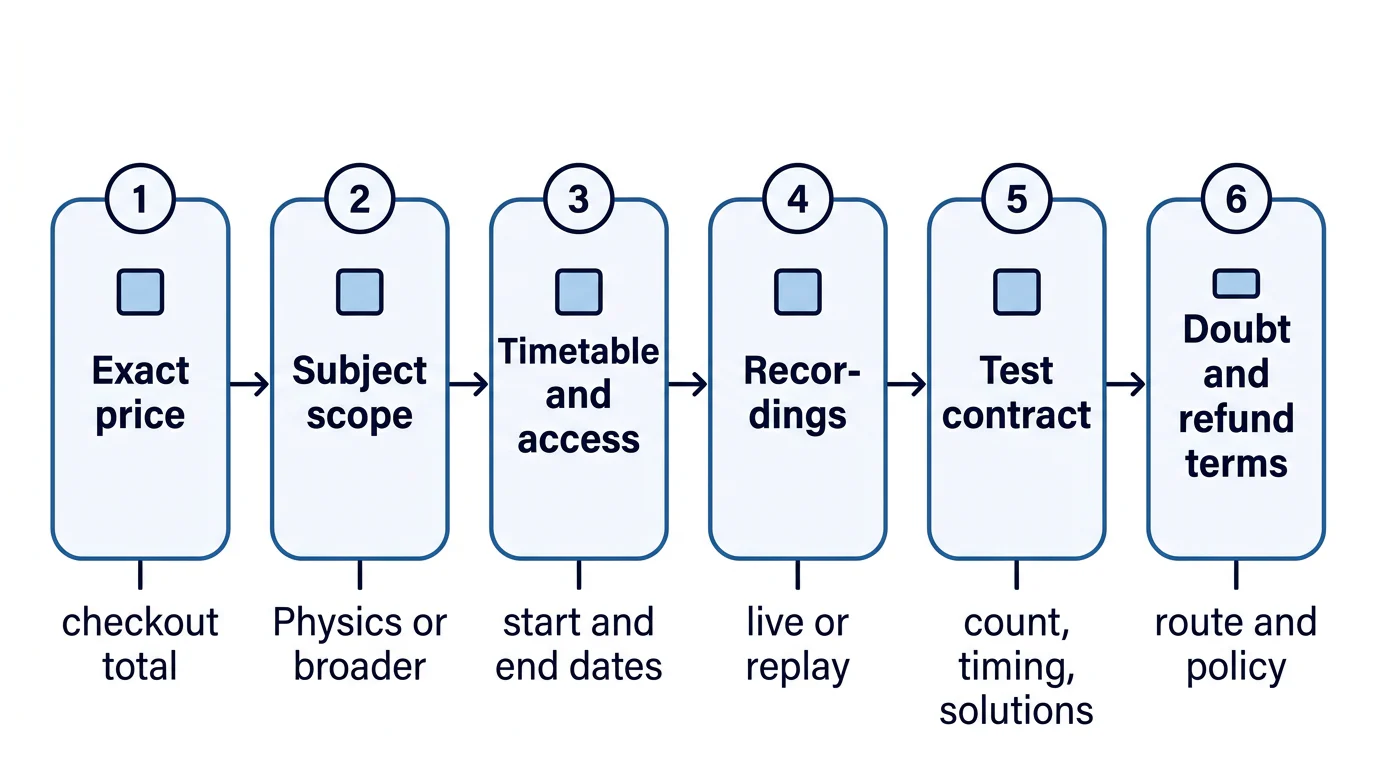
What a Physics revision checkout should state
- Exact subject scope: confirm whether you are buying Physics only or a broader PCM/PCB course.
- Revision level: confirm whether the batch assumes prior syllabus coverage or teaches foundations too.
- Class format: confirm live sessions, recordings, or both, plus the timetable where live attendance matters.
- Question practice: confirm whether PYQs, MCQs, practice papers and worked solutions are included.
- Test contract: confirm the number of tests, their scope, time limit, solutions and any analysis.
- Access and refund terms: confirm the access end date before payment and read the digital-product refund policy.
RG Lectures' current Physics Long Term Batch is a subject-specific reference point rather than a crash-course quote: its listing includes full MHT-CET syllabus coverage, Class 11 Physics basics and recordings, with access until 31 May 2027. See the dated RG Lectures batch-price guide for its current checkout details.
When self-study is the lower-cost answer
Self-study can be the better value when you can keep a revision timetable, attempt timed MCQs, review errors and return to weak chapters without external pacing. Use a chapter-wise Physics PYQ plan to make that work visible.
Paid revision support is more defensible when you need a fixed revision schedule, an organised question set, timed tests, or a stated route for doubts. The useful comparison is not "paid or free". It is whether the paid component removes a specific preparation bottleneck that you cannot reliably manage alone.
Keep reading


Frequently asked
Published 2025–26 listings reviewed here range from a short multi-subject online course to a 45-day classroom course. Treat the range as a set of dated price points, not a market average, because subject coverage, learning mode, course length and access terms differ.
A Physics-only listing can cost less because it excludes other subjects, but it is only better value when Chemistry and Mathematics are already covered elsewhere. Compare the published subject scope before treating a lower checkout total as a saving.
A buyer should be able to see the subject scope, revision level, timetable or recording access, MCQ and PYQ practice, test count and timing, solutions, doubt-support route, access end date and refund terms before completing checkout.
Yes. Self-study can work when you can follow a timetable, practise timed questions, inspect mistakes and revisit weak chapters consistently. A paid batch is most useful when it solves a specific gap such as pacing, organised practice, testing or doubt support.
The official 2026 PCM structure places Physics and Chemistry in a combined first 90-minute group before Mathematics opens. A revision plan should therefore include practice that reflects the timed Physics and Chemistry decision-making required in that first group.
Find the Physics gap before you choose support
Use a timed Physics mock and chapter-level error report to decide whether revision structure is worth paying for.
Start the free Physics mock