Newton's Rings: Fix the Ring Order and the Factor of 4
Newton's rings are dark and bright circles formed by light reflecting from a thin air film. Dark ring diameters follow D² = 4nλR, and two-ring differences protect you from miscounted order.

By Rahul Jeewani, Founder · Updated 2 Nov 2026
Key takeaways
- For dark rings in air, Dₙ² = 4nλR, where D is the ring diameter, n the ring order, λ the wavelength and R the lens's radius of curvature. Count the central dark spot as order 0. For bright rings use (n − ½) in place of n, and for a liquid divide the right side by its refractive index μ.
- A one-order counting slip shifts a single-ring wavelength by 5% to 25% between the fifth and twentieth ring (our calculation). The two-ring difference and the D²-versus-n slope cancel a constant offset in the ring order.
- The 4 belongs to diameters only. Drop it and the wavelength comes out four times too large. Put radius readings into the diameter formula and it comes out four times too small.
- In SPPU the experiment is a lab item. In Mumbai University it is in the theory module and the lab.
In this article
- 1What are Newton's rings, and why is the centre dark in reflected light?
- 2Does your university examine Newton's rings in theory or only in the lab?
- 3Which Newton's rings formula do you use for dark rings, bright rings and a liquid?
- 4How much does a miscounted ring order change the answer?
- 5Where does the factor of 4 come from, and what happens if you drop it?
- 6What six checks make a Newton's rings answer trustworthy?
- 7Reflected or transmitted light?
- 8Dark rings or bright rings?
- 9Diameter or radius?
- 10Is the ring order certain?
- 11Are the units consistent?
- 12Is the answer physically sensible?
- 13How do you solve a Newton's rings numerical step by step?
- 14Which RG Lectures course helps with SPPU Engineering Physics?
- 15Frequently asked questions
Mislabel a Newton's rings dark ring by one order and a perfect sodium lamp gives you the wrong wavelength. We computed it for a lens with a radius of curvature of 1 m. Call the tenth dark ring the eleventh and the answer drops from 589.3 nm to 536 nm. Call the fifth the sixth and it drops to 491 nm.
That slip, plus the radius-versus-diameter factor of 4, is where marks vanish in a first-year engineering physics lab or numerical. The theory is short. The bookkeeping is what needs care.
This page is for first-year students at Savitribai Phule Pune University (SPPU) and the University of Mumbai, whose syllabi both name the experiment. You get the formula for each case, the numbers behind each common slip, a six-check routine with a pass and a fail for every step, and three worked numericals you can redo on a calculator. Air sits between lens and plate unless a liquid is mentioned.
What are Newton's rings, and why is the centre dark in reflected light?
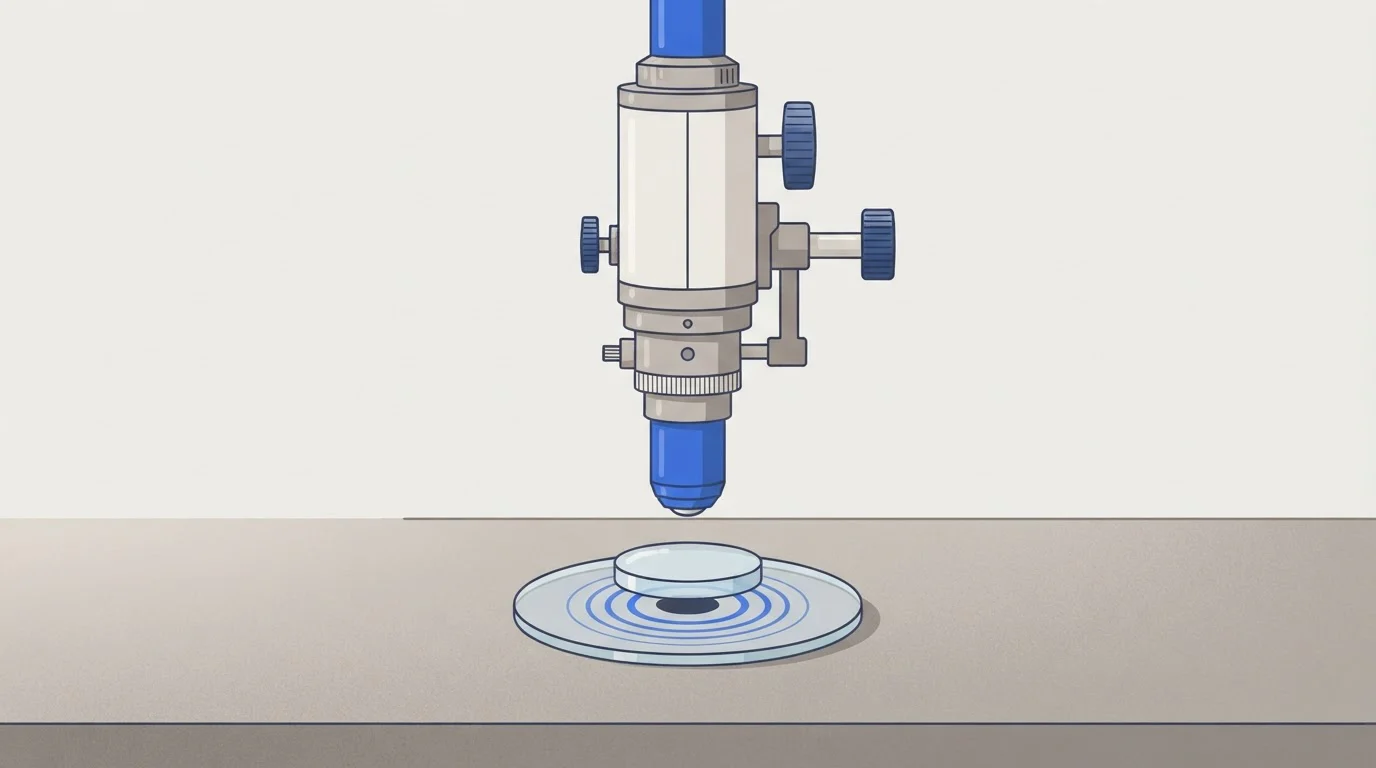
Newton's rings are concentric dark and bright circles seen when monochromatic (single-wavelength) light reflects from the thin air film between a plano-convex lens (flat on one side, curved on the other) and a flat glass plate. The centre is dark in reflected light. The ray reflected at the plate's air-to-glass surface gains a phase change of π, and where the lens touches the plate the film has zero thickness, so the two reflected rays cancel.
The rings are circular because the film thickness is t = r²/2R, where r is the distance from the contact point (Wikipedia). Every point at the same r has the same thickness.
How much of this you need depends on what your university examines.
Does your university examine Newton's rings in theory or only in the lab?
Savitribai Phule Pune University (SPPU) examines Newton's rings only in the lab, while the University of Mumbai examines it in both a theory module and the lab. SPPU's revised First Year Engineering (2024 Pattern) syllabus, effective from 2025-26, lists Newton's rings in course BSC-102-BES Engineering Physics as lab experiment 4: determine the radius of curvature of a plano-convex lens, or the wavelength of monochromatic light. Its 8-hour wave optics unit names thin film of uniform thickness and wedge-shaped film (qualitative), anti-reflection coatings and optical flatness, not Newton's rings.
Mumbai University's first-year course BSC102 Applied Physics, in the syllabus approved by its Academic Council on 28 June 2024, names Newton's rings in its 4-hour Interference in Thin Films module, for the wavelength and the refractive index of a transparent liquid. Its lab BSL101 has experiment 5, radius of curvature of a lens using a Newton's ring set-up. A different lab course, BSL2013 (Physics of Measurements and Sensors Lab), lists measuring the refractive index of a liquid with Newton's rings.
Check your own college's current copy. Our guide to Engineering Physics 1 shows how to find your syllabus and plan marks around it.

Which Newton's rings formula do you use for dark rings, bright rings and a liquid?
Use Dₙ² = 4nλR for dark rings in air and Dₙ² = 4(n − ½)λR for bright rings. Here D is the ring diameter, n the ring order, λ the wavelength and R the radius of curvature of the lens. For a liquid film, divide the right side by its refractive index μ. Count the central dark spot as order 0, so the first dark ring around it is n = 1.
| You measured | Diameter form | Radius form |
|---|---|---|
| Dark ring, air | Dₙ² = 4nλR | rₙ² = nλR |
| Bright ring, air | Dₙ² = 4(n − ½)λR | rₙ² = (n − ½)λR |
| Dark ring, liquid of index μ | Dₙ² = 4nλR/μ | rₙ² = nλR/μ |
| Wavelength from dark rings of order m and m + p | λ = (D²ₘ₊ₚ − D²ₘ)/(4pR) | λ = (r²ₘ₊ₚ − r²ₘ)/(pR) |
The dark and bright forms and the wavelength formula are those of the Amrita Virtual Labs theory page and Wikipedia. The liquid line follows because the wavelength inside the liquid is λ/μ.
You work in diameters because a travelling microscope (a microscope on a movable rail with a scale) gives you the left and right positions of a ring, and their difference is the diameter. In our judgement that beats guessing where the exact centre sits.
How much does a miscounted ring order change the answer?
Labelling a dark ring one order too high makes a single-ring wavelength 17% too low at the fifth ring, 9% at the tenth and 5% at the twentieth. One order too low makes it 25%, 11% and 5% too high. These are our figures: Dₙ = √(4nλR) with R = 1 m and λ = 589.3 nm, recomputed with n ± 1 in the denominator.
| Ring n | Dₙ (mm) | Labelled n + 1 | Labelled n − 1 |
|---|---|---|---|
| 5 | 3.433 | 491.1 nm | 736.6 nm |
| 10 | 4.855 | 535.7 nm | 654.8 nm |
| 20 | 6.866 | 561.2 nm | 620.3 nm |
The algebra explains it. A single-ring estimate equals the true wavelength multiplied by n/(n ± 1), whatever R and λ are. The error fades with n but never vanishes.
The fix is the two-ring difference. If every order is off by the same k, the subtraction cancels it, so λ = (D²ₘ₊ₚ − D²ₘ)/(4pR) is unchanged. In a D²-versus-n fit, a constant offset only changes the intercept, not the slope 4λR.
Two cautions. The difference method cures a constant offset, not a wrong p, so p is the difference of the two orders you read, not the number of rings between them. And it needs you to count rings in a row without skipping.
Where does the factor of 4 come from, and what happens if you drop it?
The factor of 4 comes from squaring the 2 in D = 2r, so Dₙ² = 4rₙ² = 4nλR. Drop it from the diameter formula and sodium light gives 2357 nm, four times too large. Feed r² readings into the diameter formula and you get 147 nm, four times too small. Both figures are ours, for R = 1 m, λ = 589.3 nm, p = 10.
A straight line proves nothing about the slope. The D² slope should be 4λR, and the r² slope λR. For sodium light and R = 1 m, predict 2.357 mm² per order for D² and 0.589 mm² per order for r², before you plot anything. If your cm² slope for R = 100 cm is near 0.0236, you are on track.
The error shows up in print as well. An undergraduate-lab study at Sri Sathya Sai Institute of Higher Learning reports a slope of 0.297 × 10⁻⁶ m² and R = 0.5 m, giving 595.3 nm, about 1% above sodium's 589.3 nm. That works only if the slope is of r², where λ = slope/R. Read as a D² slope, the same figures give about 149 nm. The figure caption says "diameter-square", but the arithmetic uses radius squared. This is one study, so treat it as an illustration.
What six checks make a Newton's rings answer trustworthy?
Run these six checks in order before you write the answer. Each one is a test with a pass and a fail.
Reflected or transmitted light?
Pass: the centre colour matches the arrangement. Reflected light has a dark centre. In transmitted light the pattern is the complement, with a bright centre, so the "dark" formula describes your bright rings. Fail: you used the dark formula on rings that are bright at the centre without swapping.
Dark rings or bright rings?
Pass: the n − ½ appears only if you measured bright rings. Fail: n − ½ in a dark-ring calculation, or plain n in a bright-ring one.
Diameter or radius?
Pass: the 4 appears only when the table holds diameters, and your D² slope matches 4λR within a few per cent. Fail: a clean straight line whose slope is 4× or ¼ of the prediction.
Is the ring order certain?
Pass: the central spot is order 0, you use the two-ring difference or the slope, and p is the difference of the two orders (15th and 5th give p = 10, not 9). Fail: single-ring estimates that disagree with each other or drift with n.
Are the units consistent?
Pass: D, R and λ share one length unit before squaring (centimetres throughout means λ = 5.893 × 10⁻⁵ cm for sodium). Fail: a result off by 100 or 10⁴.
Is the answer physically sensible?
Pass: a sodium-lamp wavelength within 3% of 589.3 nm (572 to 607 nm), and R within 5% of the spherometer reading (a spherometer is a three-legged gauge that measures a surface's curvature). The 3% and 5% limits are our recommendation. Fail: outside those limits, including 2357 nm or 147 nm.
How do you solve a Newton's rings numerical step by step?
Write the formula, check ring type and units, then use a two-ring difference when you have two readings. The three numericals below follow that routine. For the general routine on any physics numerical, see our guide to how to solve physics numericals.
Wavelength from two rings. Take D₅ = 0.336 cm, D₁₅ = 0.590 cm and R = 100 cm, so p = 15 − 5 = 10:
λ = (0.590² − 0.336²) / (4 × 10 × 100) = (0.3481 − 0.1129) / 4000 = 5.88 × 10⁻⁵ cm = 588 nm.
Using a single ring instead gives 564 nm from D₅ and 580 nm from D₁₅. Both sit below the difference answer and climb with n. That is the pattern a small zero error (a constant offset in the measured diameters or ring order) produces, and it is our inference, not a measurement.
Radius of curvature from one ring. Take D₁₀ = 0.5 cm and λ = 590 nm = 5.9 × 10⁻⁵ cm:
R = D²/(4nλ) = 0.25 / (4 × 10 × 5.9 × 10⁻⁵) = 105.9 cm ≈ 1.06 m.
This relies on the order being right, so check it before trusting it.
Air-film thickness at a dark ring. For λ = 500 nm at the 10th dark ring, t = nλ/2 = 10 × 500 / 2 = 2500 nm = 2.5 µm. It follows from rₙ² = nλR and t = r²/2R.

Which RG Lectures course helps with SPPU Engineering Physics?
If you are at SPPU, our Engineering Physics – Pune University (2026-27) course is pre-recorded video lectures in Hindi, with study notes, taught by Rahul Jewaani (RG Sir). It costs ₹1,299 as of 30 October 2026. Check its module titles against your syllabus before you buy, since SPPU's theory unit and its lab list are not the same thing.
For Young's slits, diffraction and polarisation, which this page leaves out, use our wave optics formulas page. If you are deciding between a degree course, NPTEL and a paid batch, read Engineering Physics: Degree, NPTEL or a Paid Batch? first. Padhna aasaan hai, once the method is clear.
Learn SPPU Engineering Physics with RG Sir
Frequently asked questions
Because Dₙ² = 4nλR/μ for the liquid, the ratio of the same ring's D² in air to that in the liquid equals μ (our derivation). University College Cork's lab sheet describes repeating the experiment with water between lens and plate. Rings shrink by 1/√μ, to 0.867 of their air size for μ = 1.33 (our calculation).
Sources
- 1.Newton's Rings theory, Amrita Virtual Labs
- 2.Newton's rings, Wikipedia
- 3.Newton's Rings experiment, University College Cork Physics
- 4.First Year Engineering (2024 Pattern) - Revised, Savitribai Phule Pune University
- 5.University of Mumbai syllabus circular, Item 6.23(N), Academic Council of 28 June 2024
- 6.Revisiting Fizeau's Observations: Spectral study of Na source using Newton's rings, K. S. Umesh et al., arXiv
- 7.Our own calculations: Dₙ = √(4nλR) with R = 1 m and λ = 589.3 nm (the mean wavelength of the sodium D lines) for n = 1 to 20; single-ring estimates recomputed with n ± 1; the three numericals worked above
- 8.RG Lectures course details, as of 30 October 2026: Engineering Physics – Pune University (2026-27)