

TL;DR
We help students diagnose Physics academic support by separating isolated doubts, recurring misconceptions, missed plans, and broad syllabus gaps. This guide provides a support matrix, self-study evidence checklist, scenario routes, and service-quality tests so you can reduce, continue, or escalate help based on documented need.
Diagnose the Physics Academic Support You Need
Physics support is easy to overbuy when a few difficult questions feel like a larger problem. An evidence review of 62 studies finds small-group tuition works best when targeted to a learner’s specific needs, and we use that principle to sort self-study, doubt solving, mentoring, and fuller teaching.
Choose Physics academic support by diagnosing the obstacle, not by counting unsolved questions. Use self-study for correctable gaps, targeted doubt solving for isolated technical blocks, mentoring for recurring errors or missed plans, and fuller coaching when broad coverage gaps and exam timing make a structured system necessary.
What Physics Academic Support Do You Need Right Now?
Start with the failure point. A student who cannot apply one sign convention after an otherwise solid attempt needs something different from a student who repeats the same misconception across tests, or one who knows what to study but cannot complete a plan. The right route should solve that precise problem and give you a reason to reassess it.

| Roadblock | What It Looks Like | Self-Regulation | Exam Timeline | Best First Route |
|---|---|---|---|---|
| Isolated technical doubt | One method or step blocks progress | Stable | Manageable | Self-study, then targeted doubt solving |
| Recurring misconception | The same wrong model appears in varied questions | Mostly stable | Manageable | Subject mentoring or diagnostic teaching |
| Strategy gap | Time, question choice, or review process breaks down | Uneven | Tightening | Mentoring with a revised practice system |
| Consistency problem | Plans, practice, and revision are repeatedly missed | Low | Tight or broad syllabus gap | Accountability support, then fuller coaching if needed |
| Broad coverage gap | Multiple chapters remain unclear or untouched | Variable | Compressed | Structured course-level support |
If your mock results stall, use a mock score diagnosis before treating every wrong answer as a teaching problem. Some errors come from concept gaps, while others come from timing, recall, question selection, or a review process that never identifies the actual cause.
How Do Doubt Solving, Subject Mentoring, Accountability, and Full Coaching Differ?
The labels overlap, but the jobs should not. The useful question is not which format sounds most comprehensive. It is which person or system can identify the reason your Physics work is failing and help you test whether the fix worked. A feedback review covering 155 studies found that useful feedback is specific and actionable, rather than simply marking an answer right or wrong.
| Support Role | Best Fit | What You Should Bring | What Good Support Produces |
|---|---|---|---|
| Doubt Solver | One defined obstacle | Your attempt and exact stuck step | A clear explanation and a fresh similar question |
| Subject Mentor | Repeated concept or method errors | Error log and recent work | Diagnosis, reteaching route, and follow-up check |
| Accountability Mentor | Missed plans and inconsistent practice | Planned versus completed work | Smaller targets, review, and course correction |
| Full-Course Teacher | Broad coverage gaps | Syllabus status and exam timeline | Sequenced teaching, practice, testing, and feedback |
What Should a Doubt-Solving Interaction Include?
A useful doubt interaction begins with your attempt. We recommend asking for the principle behind the method, the precise decision point where your approach changed direction, and one similar question you solve independently afterwards. An answer-only reply can remove discomfort without proving that the learning transferred.
What Does a Subject Mentor Add?
A subject mentor should spot patterns that individual answers hide. If you repeatedly misuse free-body diagrams, choose the wrong conservation rule, or lose marks in the same algebraic transition, the work is no longer a one-question issue. It needs diagnosis, targeted practice, and a later check for recurrence.
What Can Accountability Support Not Replace?
Accountability can turn an impossible weekly plan into a workable one, expose a growing backlog, and make review non-negotiable. It cannot replace subject teaching when you lack the underlying Physics model. Explore doubt support options when you need to separate fast clarification from ongoing academic guidance.
Can You Prove Self-Study Has Been Properly Tested Before You Pay?
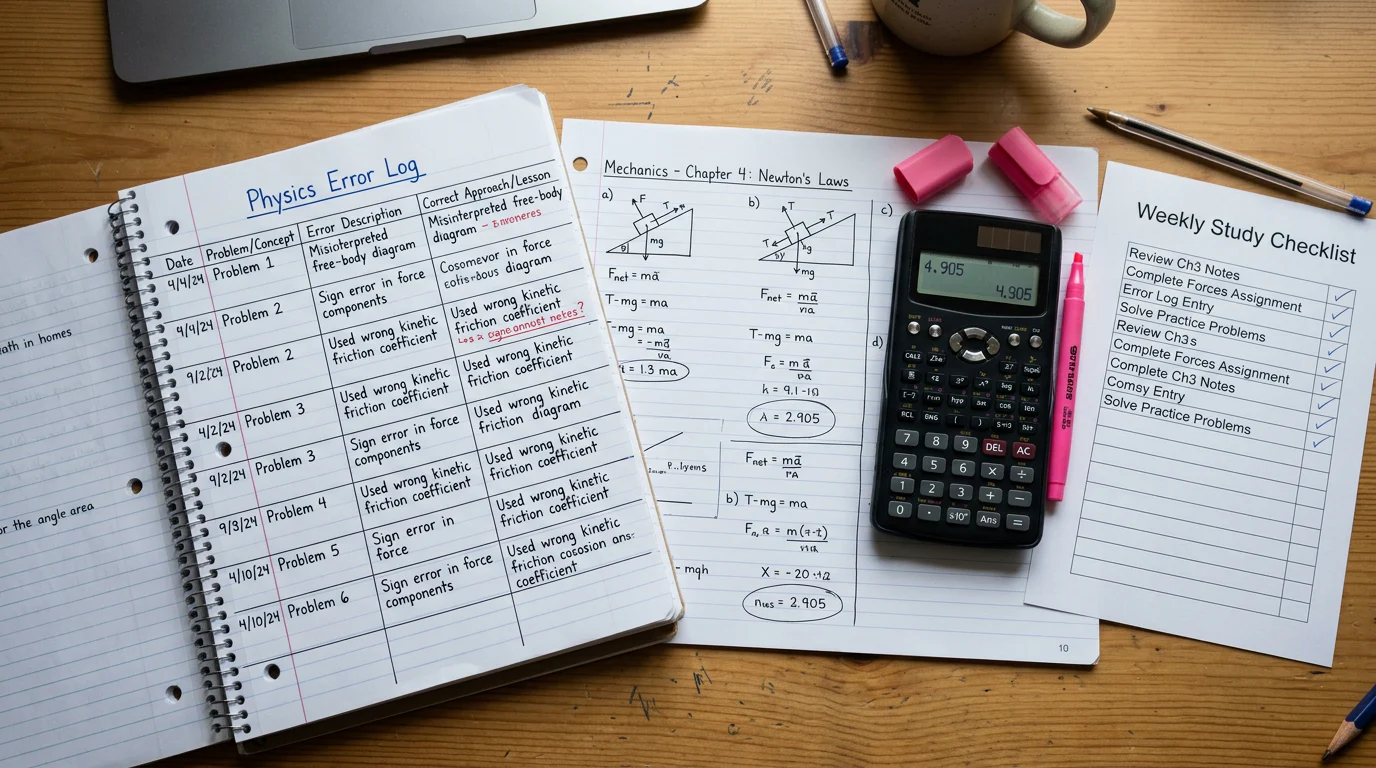
Before buying help, run an honest self-study trial. Choose a narrow chapter segment, work through explanations and examples, attempt mixed questions without notes, record your errors, and retry a related question after a break. The point is not to prove that you should cope alone. It is to collect enough evidence to buy only the support you actually need.
A federal study guide recommends approaches such as spacing learning, combining worked examples with independent problem solving, and using quizzes to revisit material. Those habits give your error log more value than a vague feeling that a chapter is difficult.
- Attempt Record: Keep your first method, not only the corrected answer.
- Error Type: Label the issue as concept, representation, formula choice, algebra, units, timing, or careless execution.
- Transfer Check: Solve a fresh related problem after reviewing the explanation.
- Plan Evidence: Record whether you completed the practice you planned, not merely whether you watched a lecture.
- Reassessment Note: Write whether the gap is shrinking, repeating, or spreading into other chapters.
If you can correct the issue, transfer the method, and complete your plan, stay with self-study. If the same error returns despite those checks, it is reasonable to consider a narrower paid intervention before committing to a large programme. Our paid coaching framework can help you assess that value decision.
Which Route Fits These Three Common Physics Scenarios?
The same service can be helpful for one student and wasteful for another. These scenarios show why the deciding factor is the pattern of evidence, not anxiety before an exam or the number of messages a student sends for help.
Scenario One: “I Usually Study Independently but Get Stuck on a Few Numericals”
You complete your schedule, understand most chapters, and can identify the exact step where a numerical stalls. Start with self-study and use occasional doubt solving when a focused explanation unlocks the next attempt. Do not upgrade to ongoing mentoring unless the same type of obstacle starts repeating.
Scenario Two: “I Understand the Lesson, but Make the Same Mistakes in Tests”
You may recognise the formula but choose the wrong model, skip a condition, or repeat a familiar error under test pressure. This is a subject-mentoring case because the support must inspect patterns across work, then check whether the correction survives a new question.
Scenario Three: “My Backlog and Missed Plan Keep Growing Before the Exam”
You may know what to do but fail to complete it often enough for practice and review to compound. Begin with an accountability route that rebuilds the plan around realistic output. Escalate to broader teaching only when the backlog also reveals unresolved coverage gaps. For exam-specific context, compare your MHT CET support choice with your current syllabus position.
How Do You Choose a Paid Support Service Worth Paying For?
A paid service is worth considering only when it addresses a documented problem more effectively than your current approach. Ask what happens after you submit a doubt, how earlier errors are remembered, who handles a problem that becomes a broader misconception, and how you will know whether support is still needed.
- Explanation Depth: Ask whether explanations include the principle, your mistake, and a transfer question.
- Continuity: Check whether prior work and recurring errors can be reviewed by the same support path.
- Response Process: Confirm where questions are submitted, how they are handled, and what happens when a doubt needs escalation.
- Mentor Match: Ensure the person guiding you understands your level, syllabus, and diagnosed gap.
- Value Test: Compare the stated inclusions with the problem you need solved, not with the broadest package available.
- Claims Check: Treat guaranteed outcomes and vague promises cautiously unless the conditions and evidence are clear.
The evidence guidance behind education decisions is useful for choosing a likely fit, not for guaranteeing an individual result. That is why we favour a service that can explain its process and give you a clear reassessment point. Read our mentoring quality standard before judging whether a mentor relationship is likely to help.
When Should You Reduce, Continue, or Escalate Support?
Support should change as your evidence changes. Continuing the same level indefinitely can create dependency, while escalating too late can leave too little time for deliberate practice. Review your fresh-question performance, recurring error patterns, planned versus completed work, and remaining syllabus before deciding what to do next.
Reduce support when you can independently solve related questions, explain the method, and maintain your study plan. Continue targeted support when the error is improving but still returns in harder variants. Escalate when repeated misconceptions, missed work, or broad coverage gaps persist despite an honest trial of the current route.
A change of format can also be the right answer. If explanations remain answer-only, nobody reviews your earlier patterns, or a recurring problem never reaches a teaching plan, the service is mismatched even if individual replies are technically correct. Use our targeted mentoring comparison to decide whether your next step should remain narrow or become more structured.
Get a Clearer Physics Support Decision with RG Lectures
At RG Lectures, we think good Physics help begins with a diagnosis, not a package label. Bring us your attempt, your error log, your exam date, and the study pattern that is breaking down. We can help you decide whether your next move should be independent repair, a focused doubt conversation, a mentoring routine, or a more structured learning plan. That distinction matters because paying for more support than the problem needs can waste time, while paying too little for a recurring gap can prolong it. Our useful starting point is a short, honest review of what you have already tried and what evidence shows. Use the diagnostic in this article before comparing options, then choose support that gives you a clear explanation, a workable next action, and a date to reassess. Start with our courses and study resources at RG Lectures.
FAQs on Physics Academic Support
Do I Need Mentoring If I Can Solve Most Physics Questions?
Not usually. If you can correct the issue, solve a fresh similar problem, and keep your plan, use self-study with occasional targeted doubt solving before buying ongoing mentoring.
When Is Paid Physics Support Justified?
We recommend paid support when a specific, documented problem survives an honest self-study trial and the service can explain how it will diagnose, address, and review that problem.
What Should I Send Before Asking a Physics Doubt?
We recommend sending the question, your full working, the exact stuck step, chapter name, source attempted, and any earlier similar errors from your log so support can diagnose the cause.
Should I Choose Self-Study, Doubt Solving, or Full Coaching?
Choose self-study for correctable gaps, doubt solving for isolated obstacles, mentoring for recurring patterns, and fuller coaching when broad coverage gaps and exam timing need a structured system.
How Often Should I Reassess My Support Route?
Review fresh-question results, error patterns, and plan completion. Then reduce, continue, or escalate support based on whether the original documented problem is shrinking over time.