What Makes Physics Mentoring Actually Work? A Standard for Physics Mentoring Quality


TL;DR
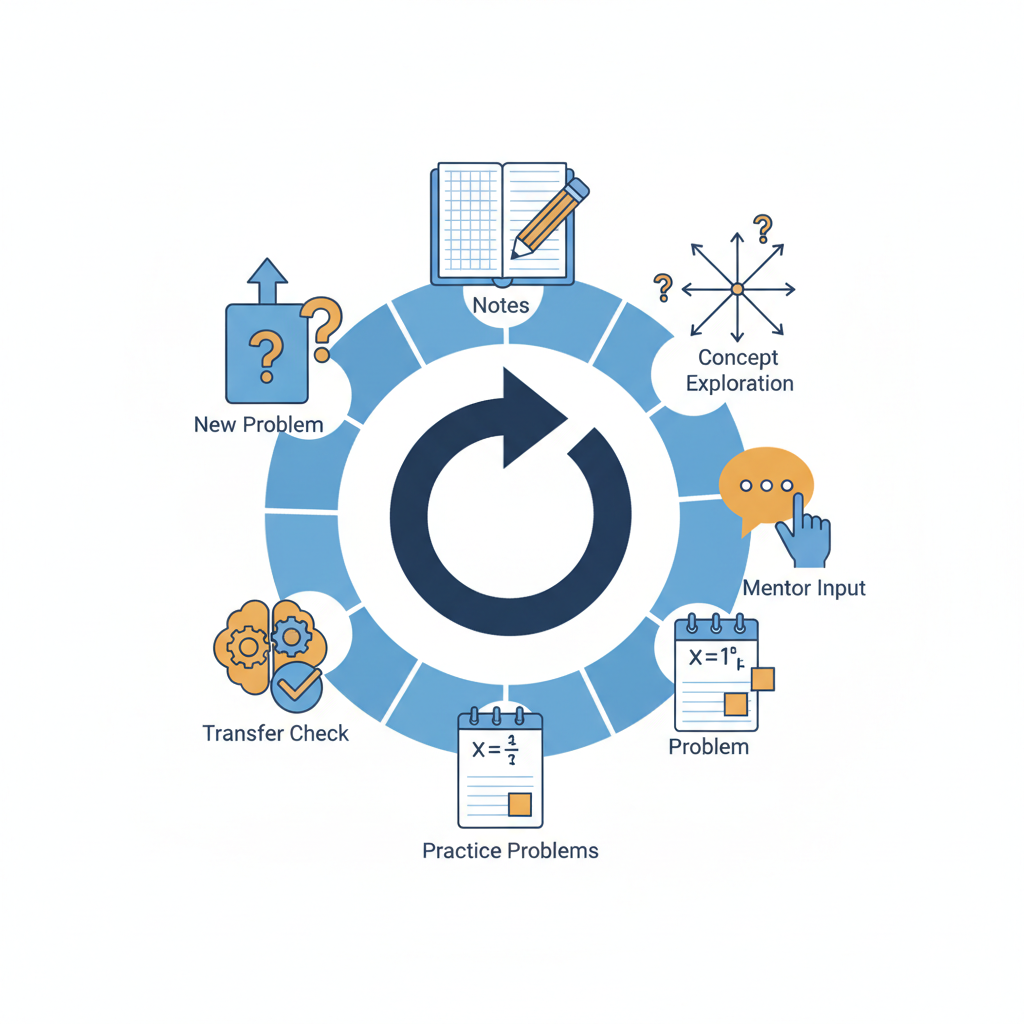
High physics mentoring quality makes the student do the reasoning while the mentor diagnoses misconceptions, asks guiding questions, models only the missing step, and checks transfer on a new problem. Paid support becomes worthwhile when it repeatedly resolves confusion and builds independence rather than dependence on answer delivery. We show six standards to look for, how a productive doubt session sounds, and how to evaluate a mentor.
One to one tuition has delivered about five months of additional progress on average in a major evidence synthesis. That average does not make every physics session good, it makes quality worth examining.
High physics mentoring quality makes the student do the reasoning while the mentor diagnoses misconceptions, asks guiding questions, models only the missing step, and checks transfer on a new problem. Paid support becomes worthwhile when it repeatedly resolves confusion and builds independence, rather than creating dependence on answer delivery.
We will show you the six standards to look for, how a productive doubt session sounds, how to evaluate a mentor, and when occasional help should become recurring support.
What Defines Physics Mentoring Quality?
A physics doubt is rarely only about a formula. It may begin with a sign error, an unclear free body diagram, a missing assumption, or a misconception about motion. We define quality by whether the session finds that first break in reasoning and leaves the student better able to handle the next problem.
| Principle | In A Numerical Doubt | In A Conceptual Doubt | Observable Quality Signal |
|---|---|---|---|
| Psychological Safety | The student can share an unfinished calculation. | The student can make an uncertain prediction. | Wrong attempts are treated as evidence, not failure. |
| Active Student Reasoning | The student selects knowns, units, and a possible equation. | The student predicts what changes and explains why. | The student writes or speaks most of the reasoning. |
| Diagnostic Questioning | The mentor asks where a variable or sign came from. | The mentor asks which interaction causes the claimed motion. | Questions uncover the first incorrect assumption. |
| Targeted Scaffolding | The mentor supplies one missing representation or hint. | The mentor offers a counterexample, then pauses. | Help stops once the student can continue. |
| Deliberate Practice | The student completes a similar question with feedback. | The student retrieves the principle without notes. | Errors are recorded and revisited. |
| Transfer Checks | The student solves a changed-value version. | The student applies the idea to a new situation. | The student explains when the method applies. |
Good mentoring can still be direct when time is short, but directness should be precise. Feedback has value when students can act on it, especially when it identifies a misconception and gives them a chance to improve, as the EEF evidence explains. We recommend keeping attempted questions and error notes with your study resources, so each doubt starts with evidence rather than “I do not understand this chapter.”
What Should Good Physics Doubt Solving Include?
A strong session follows the student’s attempt, not the mentor’s preferred shortcut. The mentor should first establish what the student thinks is happening, then test the diagram, principle, equation, and interpretation in that order. This keeps a correct final answer from hiding an incorrect method.
Is It an Answer, an Explanation, or a Reusable Method?
| What The Student Receives | Immediate Result | What It Proves |
|---|---|---|
| An Answer | A final value or formula | Very little about independent understanding |
| An Explanation | A reason the current step works | Understanding of the immediate gap |
| A Reusable Method | A sequence for modelling, solving, checking, and transferring | Readiness for a similar unfamiliar problem |
We want the third outcome. A useful method might be: define the system, draw the representation, state the governing principle, solve with units, and test whether the result makes physical sense. The IES practice guide similarly emphasizes reflection, visual representations, multiple strategies, and articulating concepts.
How Should a Mentor Diagnose a Misconception?
For a mechanics question, a mentor should not immediately say, “Use Newton’s second law.” They should ask what object the free body diagram represents, which forces act on it, and why the student believes a continuing force is needed for constant motion. The answer reveals whether the obstacle is algebra, modelling, or the underlying concept.
This matters because conceptual confusion can persist even after conventional instruction. Use a video lesson to revisit the principle, then return to the original doubt and explain the reasoning in your own words before checking a new version.
What Does Productive Guidance Sound Like?
Here is the kind of exchange we would consider productive:
Student: “The ball keeps moving right, so there must be a force pushing it right.”
Mentor: “Before we name a force, what object are we drawing forces on?”
Student: “The ball.”
Mentor: “Good. After it leaves the hand, what horizontal interaction is still acting on the ball?”
Student: “None, if air resistance is ignored.”
Mentor: “Then what does the net horizontal force become, and what does that predict about horizontal velocity?”
Student: “Zero net force, so the horizontal velocity stays constant.”
- Diagnosis: The mentor finds the force-causes-motion misconception.
- Scaffold: The mentor asks for the system and interaction, rather than supplying a lecture.
- Transfer: The mentor should now change the context and ask the student to predict a puck’s motion on a low-friction surface.
For a broader routine that connects doubt solving with independent practice, use our home-study mentoring guide before deciding whether you need more frequent support.
How Can You Evaluate a Physics Mentor Before Committing?
We advise students to evaluate behavior, not promises. A mentor can be knowledgeable and still create dependence if they routinely solve first, explain later, or never check whether the student can use the idea independently.
What Should Preparation and Listening Look Like?
Before responding, the mentor should ask for the original question, the student’s attempted approach, the course context, and where confidence dropped. During the session, they should restate the student’s claim accurately before correcting it. That simple habit distinguishes listening from waiting to deliver a solution.
What Should Explanation and Feedback Look Like?
Good explanation links the formula to a model, diagram, assumption, unit, or limiting case. Good feedback identifies the first error, says why it matters, and sets a next action. Use our small-batch guide as a reminder that a smaller setting matters only if it creates more useful interaction.
What Should Follow-Up and Independence Look Like?
A quality mentor keeps a brief record of the misconception, the practice task, and the next transfer check. Their prompts should reduce as the student becomes more capable, not remain permanently necessary.
| Rubric Area | Weak Sign | Strong Sign |
|---|---|---|
| Preparation | Starts solving without seeing the attempt. | Reviews the exact question and attempted work. |
| Listening | Corrects before understanding the student’s claim. | Restates the reasoning before diagnosing it. |
| Explanation | Repeats formulas. | Connects representation, principle, and assumptions. |
| Feedback | Says only “wrong.” | Identifies the first error and a next action. |
| Follow-Up | Ends with the answer. | Records a practice task and transfer check. |
| Independence | Student waits for every next step. | Prompts fade as the student improves. |
The broad research case for tutoring is encouraging, but quality still determines whether time is used well. A major tutoring review found a pooled effect of 0.37 standard deviations across experimental studies, with stronger average effects for professional tutoring roles.

When Is Recurring Mentor Support Useful?
Occasional doubt solving is enough when the problem is isolated and the student can solve a changed version independently. Recurring support earns its value when confusion repeats, practice stalls, or planning and follow-up are missing across several topics.
Start by checking whether errors are actually shrinking over time. Our accuracy plan can help you record the chapter, misconception, correction, and later transfer attempt, so repeated uncertainty becomes visible instead of feeling vague.
| Signal | Occasional Doubt Solving Is Enough | Recurring Mentoring Is More Useful |
|---|---|---|
| Pattern | One isolated question or chapter gap | The same misconception returns repeatedly |
| Independence | The student starts and checks problems alone | The student needs prompts to begin or choose a principle |
| Practice | Assigned questions are completed and reviewed | Errors accumulate without a review routine |
| Time | Doubts do not disrupt the weekly plan | Unresolved doubts repeatedly consume planned study time |
| Follow-Up | One transfer check confirms understanding | Progress needs records, routines, and accountability |
We suggest beginning with the lighter option when possible: attempt the question, seek targeted help, complete a changed problem, and record the result. If that loop fails repeatedly, use the coaching value guide to assess structured help by the learning problem it solves, not by the number of messages or sessions included.
Recurring support should create a visible trail of fewer repeated errors and stronger starts on unfamiliar questions. If it does not, return to the first attempted step and ask whether the help is diagnosing that step or merely replacing it.
How RG Lectures Helps You Test Physics Mentoring Quality
At RG Lectures, we want students to judge support by what happens after a doubt, not by how quickly someone sends a formula. Start with one real question and an attempted solution. Ask for the misconception, one next step, and a changed problem you can solve alone. If that process makes your next attempt clearer, you have evidence worth building on.
We encourage you to compare clarity of feedback, continuity of the mentor, and whether your doubt log becomes shorter and more useful. Use our free learning material to practise stating the knowns, drawing the model, and explaining the chosen principle. Then choose the level of help that fits your pattern, from an occasional check to regular accountability. Our aim is not to make you wait for answers. It is to help you become the student who can start, test, and repair a physics solution independently. Explore RG Lectures.
FAQs on Physics Mentoring Quality
These questions help students apply the standard before choosing occasional doubt solving or recurring support.
What Makes Physics Mentoring Effective?
We look for mentors who identify the first mistaken assumption, protect the student’s attempt, give necessary support only, and check a fresh application before ending.
How Do I Evaluate a Physics Mentor?
We advise students to bring an attempted solution, then assess whether the mentor listens, identifies the actual blockage, explains a principle clearly, and records a concrete follow-up.
What Should Good Doubt Solving Include?
Good doubt solving asks what you tried, tests the diagram or assumption, supplies a calibrated hint, and requires you to solve a similar problem independently.
When Is Recurring Mentor Support Useful?
We see recurring support as useful when the same error returns, practice stalls, or study planning breaks down, and documented follow-up gradually reduces those patterns.
Is Occasional Doubt Solving Enough?
Occasional help can be enough when you attempt questions independently, understand the corrected principle, and can solve a changed version without another prompt or answer.