

TL;DR
Understand NEET Physics mentorship from home: sessions, doubt support, trackers, mentor questions, and red flags before you enrol.
Physics carries 45 of the 180 compulsory NEET UG questions, worth 180 marks, according to the official bulletin. That makes a clear review system especially useful when you are preparing without a daily classroom routine.
Mentor support for home-based NEET Physics prep works when a named person turns self-study into a recurring plan, practice, feedback, and adjustment loop. Expect scheduled strategy check-ins, a documented doubt channel, and a shared tracker; confirm the mentor’s experience, active student load, response window, and test-review process before enrolling.
We will show what that workflow looks like in practice, how to judge its quality remotely, and how to avoid paying for encouragement without accountability.
How NEET Physics Mentorship from Home Works
A useful remote mentor does more than send a timetable. They help you decide what to study next, identify why a question went wrong, and change the plan when your results show that the original approach is not working.
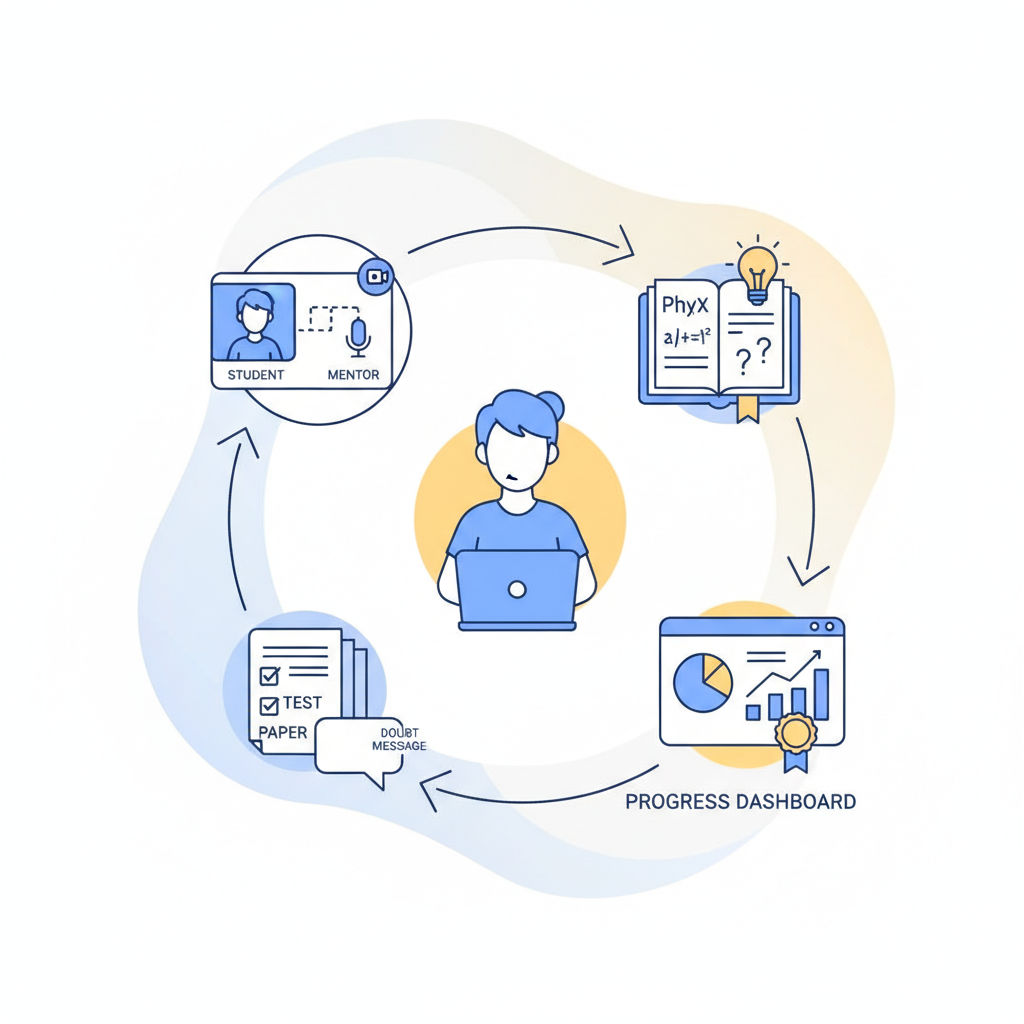
The strongest setup has three connected parts. First, you and the mentor agree on a recurring check-in, often weekly or fortnightly. Second, you have a defined way to send doubts between sessions. Third, both of you can see a shared record of work completed, test results, recurring errors, and the next action.
- Baseline Review: Start with your recent chapter tests, attempted questions, accuracy, timing, and the topics you avoid.
- Weekly Plan: Leave each session with named chapters, question targets, revision tasks, and a test deadline.
- Doubt Process: Use one agreed channel for screenshots, written questions, voice notes, or short solution videos.
- Test Review: Categorise mistakes as concept gaps, formula recall, calculation, question reading, time pressure, or guessing.
Our daily-plan guide can help you turn those weekly targets into work you can actually complete from home.
A structured loop matters because feedback is useful only when it changes the next task. A research review of 46 studies found that tools supporting regulated learning had a moderate overall effect, which supports using visible goals, monitoring, and adjustment rather than relying on motivation alone.
Make Weekly Mentor Sessions Useful
A weekly call is valuable when it produces decisions. The session should not become a retelling of how many hours you studied or a generic reminder to work harder. It should examine the evidence from your notebook, error log, and tests.
Begin with a Baseline
In the first session, map your current position against the official syllabus, then identify the few issues that cost the most marks. A student who knows formulas but loses marks through calculation errors needs a different plan from a student who cannot identify the governing concept.
Use your existing lecture notes and a consistent source of explanations. Our video lessons can support revision between check-ins, but the mentor should still decide what to prioritise based on your own performance.
Use the Same Review Agenda
A practical session starts with last week’s commitments. Did you complete the assigned questions? Which doubts remained unresolved? Which error pattern appeared most often? From there, the mentor should set the smallest useful next step, rather than adding more material to an already overloaded schedule.
For NEET Physics mentorship from home, insist on written next actions. A verbal plan is easy to forget, especially when schoolwork, family routines, and test pressure compete for attention.
Follow a Four-Week Cycle
A four-week cycle gives you enough time to detect patterns without waiting too long to correct them.
| Week | Mentor Reviews | Student Leaves With |
|---|---|---|
| 1 | Baseline score, syllabus coverage, and error categories | A seven-day Physics plan and tracker |
| 2 | Completion, doubt log, and chapter accuracy | Revised targets and focused practice |
| 3 | Timed chapter test and recurring mistakes | A repair plan for weak concepts |
| 4 | Cumulative test, timing, and error trends | Priorities for the next month |
Establish a Dependable Doubt-Support System
Daily doubt access sounds attractive, but the practical details decide whether it helps. Before starting, ask who answers your question, which channel you should use, whether screenshots are accepted, and what happens when a doubt blocks the rest of the day’s plan.
Text works well for a precise calculation or formula check. A labelled image is better for a diagram or a long numerical question. Voice notes or short videos are often more useful for misconceptions that need an explanation, not merely the final answer. What matters is that the response helps you solve the next similar question independently.
Keep a doubt log with the chapter, question type, your attempted method, the explanation received, and a follow-up question you later solve alone. This keeps the mentor from repeatedly answering the same misunderstanding and lets you see whether your doubts are becoming more specific over time.
Good support also needs an escalation rule. If a doubt remains unclear after one response, you should know whether it moves to a short call, an annotated solution, or the next scheduled session. Our study resources can provide practice material, while the mentor’s role is to identify which questions will reveal whether you truly understood the explanation.
Evidence from school settings suggests feedback can be particularly valuable in mathematics and science, but the feedback evidence also makes the point that quality and actionability matter more than simply receiving more messages.

Track Progress with a Shared Dashboard
A dashboard should help you choose tomorrow’s work, not decorate your study routine with streaks and percentages. The best trackers are simple enough to update after each study block and specific enough for a mentor to spot a pattern before the next test.
Track your planned and completed study blocks, chapter status, questions attempted, correct answers, incorrect answers, accuracy, time taken, error type, pending doubts, and next review date. You do not need a complicated app. A shared spreadsheet, a portal, or a notebook photographed before the session can work if both people use it consistently.
Use our mock-test comparison to decide how you will practise under test conditions before deciding whether timing, accuracy, or confidence is the bigger issue.
Measure Accuracy and Timing Together
A high score without timing data can hide slow solving. Fast attempts with low accuracy can hide guessing. Review both measures at chapter level, especially after timed practice, before deciding whether to move on.
Classify Errors Before Assigning More Questions
More questions do not automatically repair a concept gap. If several wrong answers come from misreading conditions, the corrective task should be careful question annotation. If the same formula is forgotten repeatedly, the next task should include recall practice before another full problem set.
Turn Data into a Next Action
Every dashboard entry should end in a decision. Low completion may mean the workload must shrink. Low accuracy may mean reteaching before volume practice. Slow but accurate work may mean timed drills. A rising number of doubts in one unit may mean that unit needs a dedicated review session.
| Useful Tracker Field | What It Helps You Decide | Vanity Metric To Avoid |
|---|---|---|
| Accuracy by chapter | Whether to revise or advance | Total study hours alone |
| Error type | What corrective task to assign | Unexplained score totals |
| Timed questions attempted | Whether speed is the issue | A completion tick without evidence |
| Mentor comment and deadline | What happens next | Generic encouragement |
A respected data guide recommends making achievement data part of an ongoing improvement cycle and teaching students to examine their own data when setting goals. That is exactly what a remote tracker should make possible.
When your score stops moving, use our score diagnostic to identify whether the problem is concept coverage, test strategy, revision quality, or an unaddressed error pattern.
Choose a Mentor and Compare Support Models
The right choice is not automatically an online mentor or a coaching institute. It is the option that can show how your personal mistakes become next week’s work. A large structure may suit students who need fixed attendance, while one-to-one support may suit students who already have materials but need diagnosis and accountability.
| Decision Factor | Remote Mentor | Coaching Institute |
|---|---|---|
| Personal Review | Confirm who checks your tests and error log | Confirm whether individual analysis is included |
| Doubt Support | Confirm channel and response window | Confirm timings and queue process |
| Accountability | Shared tracker and recurring check-ins | Attendance, tests, and batch timetable |
| Flexibility | Usually adaptable around home study | Usually follows a fixed schedule |
| Teaching Continuity | Confirm who explains and reviews Physics | Confirm faculty consistency and access |
Questions to Ask Before Starting
Ask for direct answers about NEET teaching experience, active student load, session frequency, doubt-response process, recorded solution access, and who personally reviews your test analysis. Also ask to see an anonymised example of a weekly plan or dashboard. A credible mentor should be able to explain the system clearly before you pay.
Red Flags to Watch For
Be cautious if there is no written session schedule, no stated doubt process, or no record of next actions. Generic feedback, unexplained score reports, and plans that never change after missed targets are also warning signs. If no one can tell you who answers subject doubts, you are not buying dependable academic support.
Our small-batch comparison can help you assess whether a smaller support structure genuinely provides more individual review.
What Good Accountability Looks Like
Good accountability is specific and calm. You report what happened, the mentor checks the evidence, and the next plan changes where necessary. It does not depend on shame, constant messaging, or a vague promise that somebody will “keep you motivated.”
The NEET exam scheme also uses negative marking, with correct answers worth four marks and incorrect answers losing one, as the exam scheme confirms. That is why test review should focus on decisions, not merely on attempting more questions.

Build a Clear Study System with RG Lectures
At RG Lectures, we believe a student should be able to see the support system before committing to it. Use the questions in this guide when you speak with any mentor, then ask for a sample tracker, a realistic weekly routine, and a clear explanation of who will review your Physics tests. If a program cannot show how feedback becomes next week’s work, keep looking.
We also encourage you to build an independent routine first: set chapter goals, practise under time, keep an error log, and arrive at every conversation with evidence of what is not working. That makes any mentoring conversation more useful and protects your study time. Explore our study resources, preparation guidance, and course options when you are ready to shape a plan that fits your situation, your schedule, and the revision months ahead with confidence at RG Lectures.
FAQs on NEET Physics Mentorship from Home
Can I Prepare for NEET Physics from Home Without Coaching?
Yes. Home study can work with an official-syllabus plan, timed practice, and consistent mentor review of errors, priorities, missed deadlines, and next steps each week.
How Often Should a Remote NEET Physics Mentor Meet Me?
Weekly check-ins are a practical starting point, but the right frequency depends on your backlog, test schedule, and whether between-session doubt support is genuinely available.
What Should a NEET Physics Progress Dashboard Track?
Track planned study blocks, chapter completion, questions attempted, accuracy, time, error types, doubts, and next actions. A tracker is useful only when it changes the plan.
What Should I Ask Before Choosing a Mentor?
Ask who reviews your Physics tests, how many active students each mentor supports, the doubt-response window, session frequency, escalation process, and access to recorded solutions.
Is an Online Mentor Better Than a Coaching Institute?
Choose the option that supplies personal test analysis, a realistic schedule, reliable doubt help, and visible accountability. Format matters less than whether that loop actually happens.