Vernier Caliper Least Count: Formula, Values and Zero Error
The vernier caliper least count equals 1 main scale division minus 1 vernier scale division: 0.1, 0.05 or 0.02 mm on a 1 mm main scale. Subtract zero error with its sign.

By Rahul Jeewani, Founder · Updated 7 Nov 2026

Key takeaways
- The least count of a vernier caliper is 1 main scale division (MSD) minus 1 vernier scale division (VSD). For a 1 mm main scale with 10 vernier divisions it is 0.1 mm, or 0.01 cm.
- The shortcut "1 MSD ÷ number of vernier divisions" gives the right value whenever n VSD = (n − 1) MSD or n VSD = (n + 1) MSD. For any other ratio, such as 20 VSD = 16 MSD, use MSD − VSD.
- Zero error is positive if the vernier zero sits right of the main zero, and negative if left. True reading = observed reading − (zero error, with its sign).
- For a negative zero error, count the coinciding division from the right end of the vernier: the error is −(n − k) × least count, where k is the coinciding division and n is the number of vernier divisions.
In this article
- 1What is the least count of a vernier caliper?
- 2Why is the vernier caliper least count 1 MSD minus 1 VSD?
- 3Does "1 MSD ÷ n" always give the vernier least count?
- 4Which sign does zero error take, and how do you correct for it?
- 5How do you get the true reading in four checks?
- 6Have you read the ratio and the value of 1 MSD?
- 7Does your least count pass the size test?
- 8Is the zero error signed correctly?
- 9Does the corrected reading move in the right direction?
- 10Where can you practise Physics numericals like this with us?
- 11Frequently asked questions
Ask a classmate for the least count formula and you will usually hear "1 main scale division divided by the number of vernier divisions". On the standard vernier scale it gives the right number. That is exactly why it is risky: on a scale built differently, it returns a wrong answer with no warning.
Take a vernier where 20 vernier divisions span 16 main scale divisions of 1 mm each. The shortcut says 0.05 mm. The true least count is 0.2 mm, four times larger. The formula 1 main scale division minus 1 vernier scale division gets both cases right.
Below you get that formula, the values worth memorising, a four-check routine for any diagram, and the rule for the sign of zero error, the step where a minus sign is easiest to lose. The method follows the NCERT Class 11 Physics lab manual (National Council of Educational Research and Training); the extended cases are worked out here from its principle.
What is the least count of a vernier caliper?
The least count (LC) of a vernier caliper is the smallest length it can measure. It equals 1 main scale division (MSD) minus 1 vernier scale division (VSD). For the common school caliper, with a 1 mm main scale and 10 vernier divisions, that gives 0.1 mm, or 0.01 cm, as worked in the NCERT Class 11 lab manual. NCERT also calls it the vernier constant.
Vernier caliper ka least count kitna hota hai? Standard lab caliper mein 0.1 mm, yaani 0.01 cm.
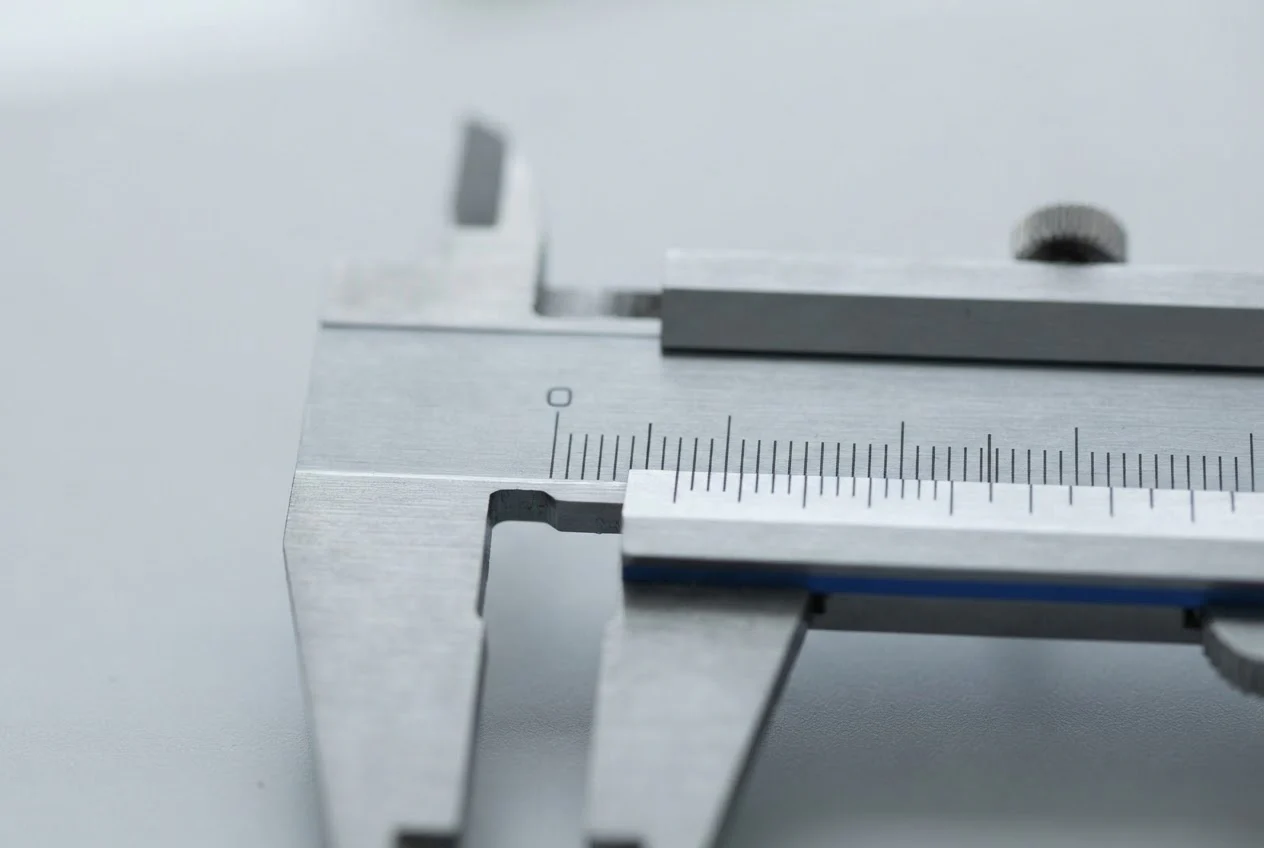
An MSD is one division of the fixed main scale. A VSD is one division of the sliding vernier scale. Through this page, n is the total number of vernier divisions, k is the number of the vernier division that coincides with a main scale line, and MSR is the main scale reading just left of the vernier zero. NCERT builds the instrument on the principle that n VSD = (n − 1) MSD. With a 1 mm main scale division, our working from that principle gives:
| Vernier divisions (n) | Length of 1 VSD | Least count (1 MSD − 1 VSD) |
|---|---|---|
| 10 | 0.9 mm | 0.1 mm = 0.01 cm |
| 20 | 0.95 mm | 0.05 mm = 0.005 cm |
| 50 | 0.98 mm | 0.02 mm = 0.002 cm |
Why is the vernier caliper least count 1 MSD minus 1 VSD?
Each vernier division is slightly shorter than a main scale division, and that shortfall is the least count. If n VSD = (n − 1) MSD, then 1 VSD = (n − 1)/n MSD. So 1 MSD − 1 VSD = 1/n MSD.
Slide the vernier along and each successive vernier line falls short of a main scale line by exactly that gap. The vernier line that coincides with a main scale line therefore tells you how many gaps the vernier zero has moved past the last main scale mark.
That is why NCERT's reading procedure is: take the main scale reading (MSR) just left of the vernier zero, find the number k of the coinciding vernier division, then add k × LC to the MSR. Convert the product into the same unit as the MSR first, usually cm. If unit conversion trips you up, our guide to units and dimensions in Class 11 Physics covers it.
Does "1 MSD ÷ n" always give the vernier least count?
No. The shortcut "1 MSD ÷ n" gives the right value whenever the vernier is built so that n VSD = (n − 1) MSD or n VSD = (n + 1) MSD, that is, when the two scales differ by one main scale division over the whole vernier length. For any other ratio, such as 20 VSD = 16 MSD, compute 1 VSD and subtract.
NCERT states the principle as n VSD = (n − 1) MSD. In the extended case, n VSD = (n + 1) MSD, 1 VSD = (n + 1)/n MSD, so the gap is 1/n MSD in size, the same as the shortcut gives.
Here is our working for five scales, applying MSD − VSD and the shortcut to each:
| Scale | 1 MSD − 1 VSD | 1 MSD ÷ n |
|---|---|---|
| 10 VSD = 9 MSD, MSD = 1 mm | 0.1 mm | 0.1 mm |
| 20 VSD = 19 MSD, MSD = 1 mm | 0.05 mm | 0.05 mm |
| 50 VSD = 49 MSD, MSD = 1 mm | 0.02 mm | 0.02 mm |
| 20 VSD = 19 MSD, MSD = 0.5 mm | 0.025 mm | 0.025 mm |
| 20 VSD = 16 MSD, MSD = 1 mm | 0.2 mm | 0.05 mm (wrong) |
In the last row, 1 VSD = 16/20 = 0.8 mm, so MSD − VSD = 1 − 0.8 = 0.2 mm. The shortcut is four times too small. Four of the five rows agree, which is exactly why the shortcut feels safe.
Our recommendation: whenever a question gives a ratio, compute 1 VSD first and subtract. It always works, and the shortcut is only a time-saver for the standard ratios. Also check the main scale: if "1 cm is divided into 20 parts", then 1 MSD is 0.5 mm, not 1 mm.
Which sign does zero error take, and how do you correct for it?
Zero error is what the caliper reads with its jaws closed. It is positive if the vernier zero sits to the right of the main scale zero, and negative if it sits to the left. Then true reading = observed reading − (zero error, with its sign), as the NCERT lab manual sets out.
NCERT's positive example: the 5th vernier division coincides, so zero error = +5 × least count = +0.05 cm. The caliper over-reads, so you subtract. In its negative example the error is −0.05 cm. The caliper under-reads, so subtracting the negative error adds 0.05 cm to the observed value.
Read k differently depending on the direction of the shift. With the jaws closed, let k be the vernier division that coincides with a main scale line and n the number of vernier divisions.
- Vernier zero right of main zero: error = +k × LC.
- Vernier zero left of main zero: error = −(n − k) × LC.
For the left-shift case, count k from the left and you get the wrong error. The reason, from n VSD = (n − 1) MSD: the vernier zero lies left of the main zero by the distance still missing to reach the next main scale line, which is (n − k) steps of the least count. NCERT's negative example uses the 5th of 10 divisions, where k and n − k are both 5, so it cannot show the difference. Any other k does.
How do you get the true reading in four checks?
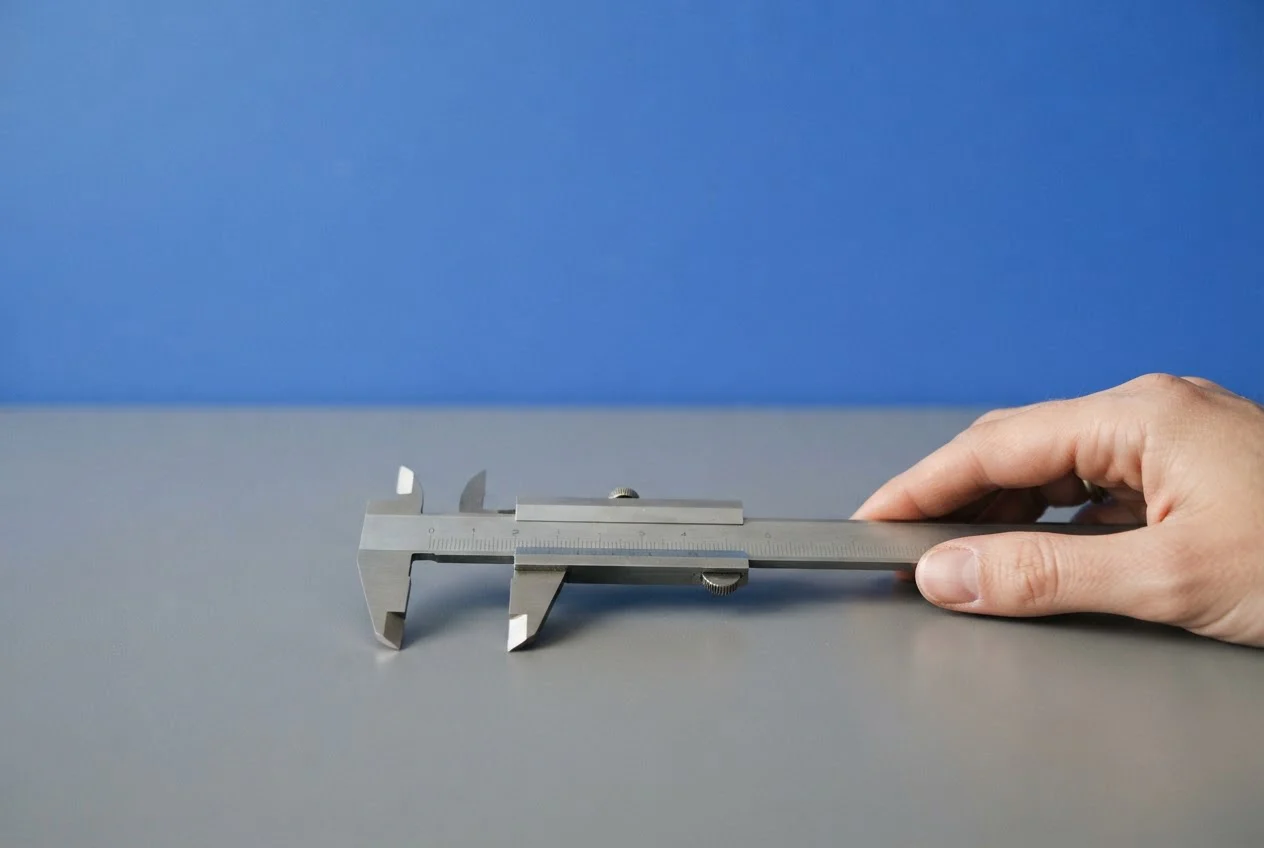
Run four checks, in order, on every diagram or numerical. Before them, do what NCERT's precautions require: close the jaws and look at the zero marks, keep your eye directly over each mark to avoid parallax (the apparent shift of a mark when you view it from the side), and grip the object lightly, without gaps or undue pressure.
Have you read the ratio and the value of 1 MSD?
Pass: you can write the ratio, such as 20 VSD = 19 MSD, with both numbers, and 1 MSD in mm. Fail: you wrote only the vernier count, or left a main scale division in cm while the rest is in mm.
Does your least count pass the size test?
Compute LC = 1 MSD − 1 VSD. Pass: it is smaller than 1 MSD, and if n VSD = (n − 1) MSD it also equals 1 MSD ÷ n. Fail: you used the shortcut on a ratio such as 20 VSD = 16 MSD.
Is the zero error signed correctly?
Pass: right shift gives +k × LC, left shift gives −(n − k) × LC, written with its sign. Fail: no sign, or k counted from the left for a left shift.
Does the corrected reading move in the right direction?
Pass: a negative zero error makes the true value larger than the observed one, and a positive error makes it smaller. Fail: your answer moved the other way.
Worked example (our numbers). n = 10, 1 MSD = 1 mm, so LC = 0.1 mm.
- Closed jaws: the vernier zero is left of the main zero and the 7th division coincides (k = 7). Zero error = −(10 − 7) × 0.1 = −0.3 mm.
- Sphere: MSR = 24 mm and the 6th division coincides (k = 6), so observed = 24 + 6 × 0.1 = 24.6 mm.
- True = 24.6 − (−0.3) = 24.9 mm = 2.49 cm.
- If the same closed-jaw check had instead shown a right shift with the 3rd division coinciding, the error would be +0.3 mm and the true reading 24.3 mm.
Copy this table, which follows NCERT's observation layout. The readings are illustrative:
| S. No. | MSR (mm) | k | V = k × LC (mm) | MSR + V (mm) |
|---|---|---|---|---|
| 1 | 24 | 6 | 0.6 | 24.6 |
| 2 | 24 | 7 | 0.7 | 24.7 |
| 3 | 24 | 6 | 0.6 | 24.6 |
The mean is 73.9 ÷ 3 = 24.63 mm. Corrected with zero error −0.3 mm, it is 24.93 mm. Report 24.9 mm: NCERT's Class 11 Physics Chapter 1 says significant figures indicate precision, which depends on the instrument's least count. Our recommendation is to give your answer to the decimal place of the least count.
Where can you practise Physics numericals like this with us?
If you are preparing for MHT-CET, the Maharashtra engineering entrance exam, our MHT CET 2027 Long Term Batch is taught by Rahul Jewaani (RG Sir). It covers Physics and Chemistry with live classes and recordings, notes, previous year questions and mock tests. As of November 2026 it is priced at ₹1,632.
The routine on this page, read first, check the unit, apply the formula, then sanity-check the direction, works on any numerical. Our guide to how to solve physics numericals applies the same read, check, calculate, sanity-check order. Padhna Aasaan Hai when the method is the same each time.
Practise Physics numericals with RG Lectures
Frequently asked questions
Sources
- 1.NCERT Class 11 Physics Laboratory Manual, Experiment 1: Vernier Callipers (2025-26 edition): least count as 1 MSD − 1 VSD with n VSD = (n − 1) MSD, the 10-division example (0.1 mm = 0.01 cm), the zero-error sign rules, the reading procedure, the observation table layout and the precautions., NCERT
- 2.NCERT Class 11 Physics Part I, Chapter 1: Units and Measurement (reprint 2026-27): significant figures indicate the precision of a measurement, which depends on the least count of the instrument., NCERT
- 3.Our own working: the 20 and 50 division values, the five-scale comparison, the extended-vernier case, the (n − k) rule for a left-shifted zero and the worked example are derived by us from the NCERT principle n VSD = (n − 1) MSD, with algebra shown in the sections above.