Heisenberg Uncertainty Principle: Meaning and Numericals for Engineering Physics
In simple words, the Heisenberg uncertainty principle says a particle cannot have a sharp position and a sharp momentum together, because both come from one wave: Δx·Δp ≥ ħ/2 (= h/4π), where Δx and Δp are the spreads in position and momentum.

By Rahul Jeewani, Founder · Updated 23 Oct 2026

Key takeaways
- The uncertainty principle says Δx·Δp ≥ ħ/2, which is identical to Δx·Δp ≥ h/4π. The tighter a particle's position, the wider its momentum must spread.
- It comes from the wave nature of matter. It is not caused by a photon disturbing the particle, and it is not an instrument error.
- Solve every numerical with Write, Pick, Convert, Check. Finish each sum with a unit check and a constant check that you can pass or fail.
- Check h versus ħ, units, mass in kg, ≥ versus =, and radius versus diameter for Δx before you finish any sum.
In this article
- 1What is the Heisenberg uncertainty principle in one simple line?
- 2What is the formula, and is it h/4π or ħ/2?
- 3Why does the uncertainty principle happen?
- 4The wave picture
- 5Why "the photon bumped it" is not the reason
- 6Why does the Heisenberg uncertainty principle matter for an electron but not for a cricket ball?
- 7How do you solve Heisenberg uncertainty principle numericals?
- 8Uncertainty in the velocity of an electron
- 9Minimum uncertainty in momentum from a given Δx
- 10Energy–time form
- 11Why an electron cannot live inside the nucleus
- 12Where do students lose marks in uncertainty principle numericals?
- 13Where does the uncertainty principle show up in engineering?
- 14How do we teach Engineering Physics at RG Lectures?
- 15Frequently asked questions
Most students do not lose marks on the idea. They lose them on the arithmetic. Every Heisenberg uncertainty principle numerical divides a tiny constant, ħ (h divided by 2π, where h is the Planck constant), which is 1.054 571 817… × 10⁻³⁴ J·s (NIST CODATA 2022), by something small, so a slip is easy to make.
You can write h for ħ, leave nanometres unconverted, or write a minimum as an exact answer. Each one costs marks, and each is easy to catch once you know the check.
This page is for first-year engineering students whose Engineering Physics paper includes the principle. We explain it as a property of waves, then solve four Heisenberg uncertainty principle numericals in the same four steps.
Each answer is given as Δx·Δp ≥ ħ/2 and in the “≈ ħ” form some answer keys use, so you can match your textbook. You will also see why a photon bumping an electron is not the reason the inequality holds.
What is the Heisenberg uncertainty principle in one simple line?
A particle's position and momentum cannot both be sharp at the same time. The more tightly you pin down where it is, the more its momentum spreads out, and the reverse.
Δx is the spread in position, and Δp is the spread in momentum. Momentum p is mass times velocity, so for a particle of fixed mass a wide Δp means a wide spread of velocities. The spreads belong to the particle's state. A perfect instrument would not remove them (OpenStax University Physics, Volume 3).
What is the formula, and is it h/4π or ħ/2?
The two forms, h/4π and ħ/2, are the same inequality. Because ħ = h/2π, ħ/2 = h/4π exactly. This page uses Δx·Δp ≥ ħ/2 = h/4π for every sum. Earle Kennard proved the ħ/2 bound in 1927 (Wikipedia: Uncertainty principle). Textbooks write it either way (OpenStax, Britannica).
| Form | What it reads | Where you use it |
|---|---|---|
| Position–momentum (our convention) | Δx·Δp ≥ ħ/2 = h/4π | Velocity, momentum and nucleus sums |
| Energy–time | ΔE·Δt ≥ ħ/2 = h/4π | Δt is how long a state lasts; ΔE is its energy spread |
| Estimate form | Δx·Δp ≈ ħ (= h/2π) | Some textbooks and answer keys; gives numbers exactly twice as large |
Two things to remember:
- If your answer key shows twice our value, it uses the “≈ ħ” form. The physics is the same and only the factor of 2 moves. Use the form your lecturer uses.
- Time is not a quantity like position in quantum mechanics, so treat the energy–time form as an estimate (Wikipedia).
Pro Tip: Write Δx·Δp ≥ ħ/2 (= h/4π) at the top of every answer. Stating your convention once stops you switching between h and ħ halfway through a sum.
Why does the uncertainty principle happen?
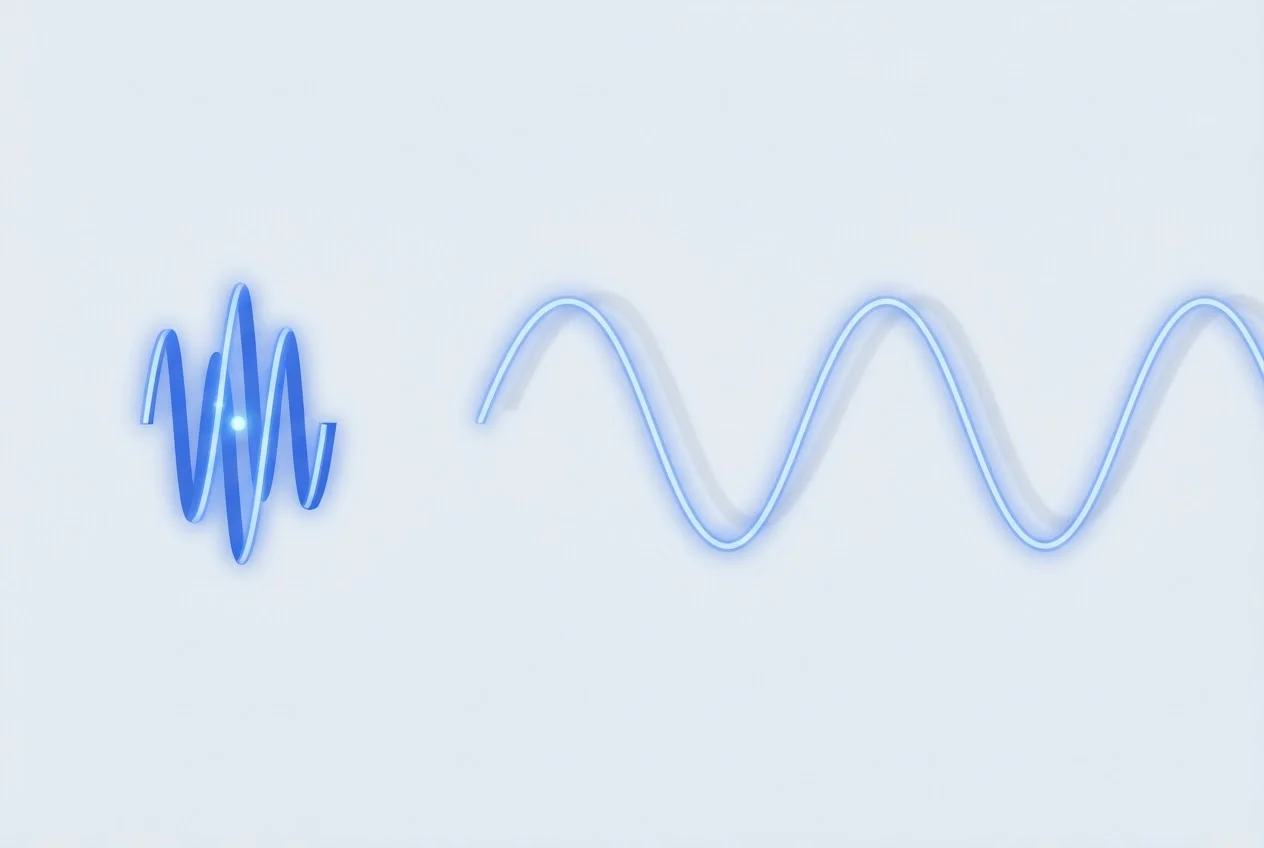
The uncertainty principle happens because a particle behaves as a wave, and a wave cannot be squeezed into a tiny region while keeping one single wavelength. Position spread and momentum spread are two descriptions of the same wave, so shrinking one grows the other.
The wave picture
A particle that is confined to a small region is modelled as a wave packet. That is a sum of many waves of different wavelengths. A narrow packet needs many wavelengths added together, and a long, nearly pure wave needs very few (OpenStax).
Momentum is tied to wavelength by p = h/λ, so many wavelengths means a wide spread of momentum. Sound works the same way. A sharp click contains a huge range of frequencies, and a steady tone contains almost one.
Why "the photon bumped it" is not the reason
Heisenberg's γ-ray microscope (1927) is the history behind the idea. It imagines a gamma-ray photon bouncing off an electron to locate it. The picture is misleading because it suggests the principle comes only from the disturbance caused by looking. That disturbance is a different effect, called the observer effect (Plus Maths).
The inequality holds for an electron on its own, with no photon involved.
Why does the Heisenberg uncertainty principle matter for an electron but not for a cricket ball?
The Heisenberg uncertainty principle matters only for very small masses, because ħ is tiny. The minimum velocity spread is Δv ≥ ħ/(2mΔx), so a large m makes it vanish.
We calculated both rows below with Δx = 1 µm (10⁻⁶ m), using ħ/2 and a round 0.16 kg for the cricket ball.
| Object | Mass | Δx | Minimum Δv |
|---|---|---|---|
| Electron | 9.109 × 10⁻³¹ kg | 1 µm | about 58 m/s |
| Cricket ball | 0.16 kg | 1 µm | about 3.3 × 10⁻²⁸ m/s |
The electron’s minimum spread is about 10²⁹ times larger than the ball’s. The ball’s figure is far below anything measurable, so the principle never shows up for it.
How do you solve Heisenberg uncertainty principle numericals?
Use the same four steps every time: Write, Pick, Convert, Check, from our four-step method for physics numericals. Here the Check step is a pass or fail test, and the unit test follows the replace, simplify, compare routine in our units and dimensions guide. The convention is Δx·Δp ≥ ħ/2 = h/4π throughout.
| Constant | Value we use | Use |
|---|---|---|
| ħ | 1.055 × 10⁻³⁴ J·s (NIST) | In ħ/2 |
| h = 2πħ | 6.626 × 10⁻³⁴ J·s (NIST) | Only as h/4π |
| Electron mass mₑ | 9.109 × 10⁻³¹ kg (NIST) | Always in kg |
| Speed of light c | 3.00 × 10⁸ m/s (NIST) | Nucleus sum |
| 1 MeV (million electron-volts) | 1.602 × 10⁻¹³ J (NIST) | Energy conversion |
| Electron rest energy mₑc² | 0.511 MeV | Nucleus sum |
Values are rounded from CODATA 2022 (NIST). We calculated mₑc² from the mass, speed of light and electron-volt values above.
Uncertainty in the velocity of an electron
Question: an electron's position is known to within 0.1 nm. Find the minimum uncertainty in its velocity.
- Write: Δx = 0.1 nm, mₑ = 9.109 × 10⁻³¹ kg. Required: Δv.
- Pick: Δx·Δp ≥ ħ/2 with Δp = mₑΔv, so Δv ≥ ħ/(2mₑΔx).
- Convert: Δx = 0.1 × 10⁻⁹ = 1 × 10⁻¹⁰ m. Then Δv ≥ 1.0546 × 10⁻³⁴ ÷ (2 × 9.109 × 10⁻³¹ × 10⁻¹⁰) ≈ 5.8 × 10⁵ m/s.
- Alternate form (≈ ħ, same as h/2π): Δv ≈ ħ/(mₑΔx) ≈ 1.2 × 10⁶ m/s.
- Check: J·s ÷ (kg·m) = (kg·m²/s) ÷ (kg·m) = m/s, which is a pass. Constant test: with h in place of ħ you get about 3.6 × 10⁶ m/s, which is a fail.
Minimum uncertainty in momentum from a given Δx
Question: an electron is confined to a region 0.5 Å (ångström, 10⁻¹⁰ m) wide. Find the minimum uncertainty in its momentum.
- Write: Δx = 0.5 Å. Required: Δp. The mass is not needed.
- Pick: Δp ≥ ħ/(2Δx).
- Convert: Δx = 0.5 × 10⁻¹⁰ = 5 × 10⁻¹¹ m. Then Δp ≥ 1.0546 × 10⁻³⁴ ÷ (2 × 5 × 10⁻¹¹) ≈ 1.05 × 10⁻²⁴ kg·m/s.
- Alternate form (≈ ħ): Δp ≈ 2.1 × 10⁻²⁴ kg·m/s.
- Check: J·s ÷ m = kg·m/s, which is a pass. Constant test: with h in place of ħ you get 6.6 × 10⁻²⁴ kg·m/s, which is a fail.
Energy–time form
Question: an excited state lasts about 1 ns. Find the minimum uncertainty in the energy of that state.
- Write: Δt = 1 ns. Required: ΔE.
- Pick: ΔE·Δt ≥ ħ/2, used as an estimate (see the formula section).
- Convert: Δt = 10⁻⁹ s. Then ΔE ≥ 1.0546 × 10⁻³⁴ ÷ (2 × 10⁻⁹) ≈ 5.3 × 10⁻²⁶ J. Dividing by 1.602 × 10⁻¹⁹ J/eV gives about 3.3 × 10⁻⁷ eV.
- Alternate form (≈ ħ): ΔE ≈ ħ/Δt ≈ 1.05 × 10⁻²⁵ J, about 6.6 × 10⁻⁷ eV.
- Check: J·s ÷ s = J, which is a pass. Constant test: with h in place of ħ you get about 3.3 × 10⁻²⁵ J, which is a fail. A value near 5 × 10⁻⁴⁴ J means you multiplied ħ/2 by Δt instead of dividing.
Why an electron cannot live inside the nucleus
Question: use the uncertainty principle to show that an electron cannot exist inside a nucleus of diameter 10⁻¹⁴ m.
- Write: Δx ≈ 10⁻¹⁴ m (the full width of the nucleus). Required: the energy such an electron would need.
- Pick: Δp ≥ ħ/(2Δx). Take p ≈ Δp as the smallest momentum a confined electron can have. Then use relativistic energy (the form that holds when speed approaches c), E² = (pc)² + (mₑc²)².
- Convert:
- Δp ≥ 1.0546 × 10⁻³⁴ ÷ (2 × 10⁻¹⁴) ≈ 5.3 × 10⁻²¹ kg·m/s.
- pc = 5.27 × 10⁻²¹ × 3.00 × 10⁸ ≈ 1.58 × 10⁻¹² J ≈ 9.9 MeV.
- This is far above mₑc² = 0.511 MeV, so E = √(9.87² + 0.511²) ≈ 9.88 MeV.
- Kinetic energy = 9.88 − 0.511 ≈ 9.4 MeV.
- Alternate form (≈ ħ): Δp ≈ 1.05 × 10⁻²⁰ kg·m/s, pc ≈ 19.7 MeV, kinetic energy ≈ 19.2 MeV.
- Check: units are kg·m/s × m/s = J, then ÷ (1.602 × 10⁻¹³ J/MeV) gives MeV, which is a pass. Constant test: with h in place of ħ, pc comes to about 62 MeV, which is a fail. Speed test: p/m comes to 5.8 × 10⁹ m/s, about 19 times c, which is impossible. So the non-relativistic ½p²/m answer (about 95 MeV) is a fail, and only the relativistic route passes.
Conclusion. A confined electron would need at least about 9.4 MeV of kinetic energy. A typical beta decay releases about 1 MeV, and the electron can carry anything from zero up to that release (Wikipedia: Beta decay). Phosphorus-32 releases 1.709 MeV, and its electrons average about 0.5 MeV (Wikipedia: Beta particle). Even decays that release tens of MeV give a continuous spread of electron energies, not a fixed minimum of 9.4 MeV.
So the electron cannot be a permanent resident of the nucleus (our inference from this estimate). It is created in the decay, not stored beforehand (Wikipedia: Beta decay).
A few decays release tens of MeV, but their electrons still come out with a continuous spread of energies from zero, not a fixed minimum of 9.4 MeV. The energy a confined electron needs is several times larger than electrons from typical decays carry. So the electron cannot be a permanent resident of the nucleus (our inference from this estimate). The electron is created in the decay, not stored beforehand (Wikipedia: Beta decay).
Where do students lose marks in uncertainty principle numericals?
Students lose marks in uncertainty principle numericals on five slips: h written for ħ, units not converted, mass not in kg, ≥ written as =, and radius used as Δx. Each one fails a quick test.
| Slip | What it looks like | Pass/fail test |
|---|---|---|
| h instead of ħ | Answer 2π (about 6.3 times) too big | With h on top, 4π must sit below it. With ħ on top, only 2 sits below. |
| Units not converted | nm, Å or µm left in the sum | Every line carries units, and the last unit equals the required quantity. |
| Mass not in kg | 9.109 × 10⁻³¹ kg written in grams or with the exponent dropped | For Δx between 0.1 nm and 1 nm, an electron's Δv should be of order 10⁴ to 10⁶ m/s. |
| ≥ written as = | "Δv = 5.8 × 10⁵ m/s" | The answer line says "≥" or "minimum". |
| Radius used as Δx | Nucleus radius put in place of the width | Δx is the width of the region, so use the diameter. If a radius r is given, use Δx = 2r unless your lecturer teaches otherwise. |
One more check works for every sum: doubling Δx must halve Δp.
Where does the uncertainty principle show up in engineering?
The uncertainty principle shows up in engineering through the wave nature behind it. When an insulating layer in a transistor is only about a nanometre thick, electrons tunnel through it and leak current. This limits how small devices can be made (Wikipedia: Quantum tunnelling).
Tunnelling means the electron's wave function (the wave that describes where the electron is likely to be found) does not stop at a barrier but decays inside it. So there is a chance of finding the electron on the far side (OpenStax). Tunnelling and the uncertainty principle both follow from the wave nature of electrons. You do not calculate tunnelling with Δx·Δp.

How do we teach Engineering Physics at RG Lectures?
We teach every numerical in one routine: write the givens, pick one formula, convert to SI units, check unit and size, so the same habit works on every sum. RG Lectures started in May 2018. Rahul Jewaani, known as RG Sir, is our founder and instructor, and you can read more on our founder page and in how RG Sir teaches Physics.
To find which topics your paper has, use our syllabus and marks planning guide. If you are still choosing classes, our guide on which first-year classes to take covers that.
If you study at Mumbai University, our Engineering Physics for Mumbai University course is on the Mumbai University courses page. For other universities, browse the RG Lectures store.
What should you remember before your Engineering Physics exam?
The Heisenberg uncertainty principle is a statement about waves. A particle cannot have a sharp position and a sharp momentum together, so Δx·Δp ≥ ħ/2 (= h/4π). A photon disturbing the particle is not the cause.
In the exam, the marks sit in the routine. Write the givens, pick one formula, convert to SI, and check the unit and the constant. Keep h and ħ apart, write a minimum as ≥, and use the full width of the region for Δx. For the nucleus sum, switch to relativistic energy.
If you want these numericals taught step by step, RG Sir covers them in the Engineering Physics course for Mumbai University. Browse the Mumbai University courses page when you are ready.
Learn Engineering Physics numericals with RG Lectures
Frequently asked questions
Sources
- 1.Uncertainty principle, Wikipedia
- 2.Uncertainty principle, Britannica
- 3.The Heisenberg Uncertainty Principle, OpenStax University Physics, Volume 3
- 4.The Quantum Tunneling of Particles through Potential Barriers, OpenStax
- 5.Quantum tunnelling, Wikipedia
- 6.Beta decay, Wikipedia
- 7.Beta particle, Wikipedia
- 8.Heisenberg's uncertainty principle, Plus Maths
- 9.NIST CODATA 2022: reduced Planck constant
- 10.NIST CODATA 2022: Planck constant
- 11.NIST CODATA 2022: electron mass
- 12.NIST CODATA 2022: speed of light
- 13.NIST CODATA 2022: electron volt–joule relationship
- 14.A Textbook of Engineering Physics, Avadhanulu and Kshirsagar, S. Chand