How Should You Attempt a JEE Mock Test? A Smart JEE Mock Test Strategy


TL;DR
At RG Lectures, we treat each JEE mock test as a diagnostic cycle: simulate the paper, secure high-certainty marks, log six error types, and turn recurring losses into targeted revision. This guide shows how we separate knowledge, retrieval, timing, strategy and anxiety signals, then decide when to seek added support.
JEE Main Paper 1 gives you 180 minutes for 75 questions worth 300 marks, which makes question selection as important as subject knowledge in the official pattern. At RG Lectures, we use mocks to expose the exact habit costing marks, then replace it before the next paper.
Use a JEE mock test strategy as a diagnostic cycle, not a score check. Before the timer, choose an attempt order and checkpoints. During the paper, secure high-certainty questions, mark uncertain ones and move on. Afterward, classify every lost mark by concept, arithmetic, recall, time, strategy or anxiety, then target the most repeated loss.
We will walk through the setup, attempt timeline, error log, blanking diagnosis and next-block revision plan that make each mock useful.
How Do You Set up Your JEE Mock Test Strategy Before the Timer Starts?
Before a mock, we want one honest answer: can you use what you know under the same constraints you will face in the paper? A paused test, open formula sheet or casual phone break may feel productive, but it hides the information that a timed mock is meant to reveal.
Set up the paper at the appropriate duration, use a computer where possible and keep only the materials allowed for rough work. For JEE Advanced practice, we also recommend using the official interface because its two compulsory papers are three hours each and its marking details can differ by question type. The Advanced practice tests are useful for becoming comfortable with that format.
Use this pre-mock routine:
- Conditions: Choose a quiet space, silence notifications and do not pause the timer.
- Materials: Keep a pen, rough sheets, water and any permitted items ready before the countdown begins.
- Attempt Order: Pick the subject order you will test, rather than copying someone else’s order.
- Checkpoints: Write your planned first-pass, review-pass and final-check times before starting.
- Benchmark: Record sleep, energy and mock difficulty after the test so one unusual day does not rewrite your whole plan.
We recommend testing one attempt order for three comparable mocks before changing it. If your online environment is very different from your written practice, our online versus offline guide can help you choose the format that gives cleaner feedback.
How Should You Scan, Select, Skip and Return During the Paper?
We do not treat the first question as an instruction to begin. The first pass is for finding questions where your method starts quickly and your accuracy is likely to stay high. That protects time for the questions you genuinely can convert later.
For JEE Main Paper 1, a correct answer earns four marks, an incorrect answer loses one mark and an unanswered item earns zero. Those current marking rules make blind attempts expensive, so we prefer a visible review list over forcing every question.
| Time Window | What We Recommend Doing | What To Record Later |
|---|---|---|
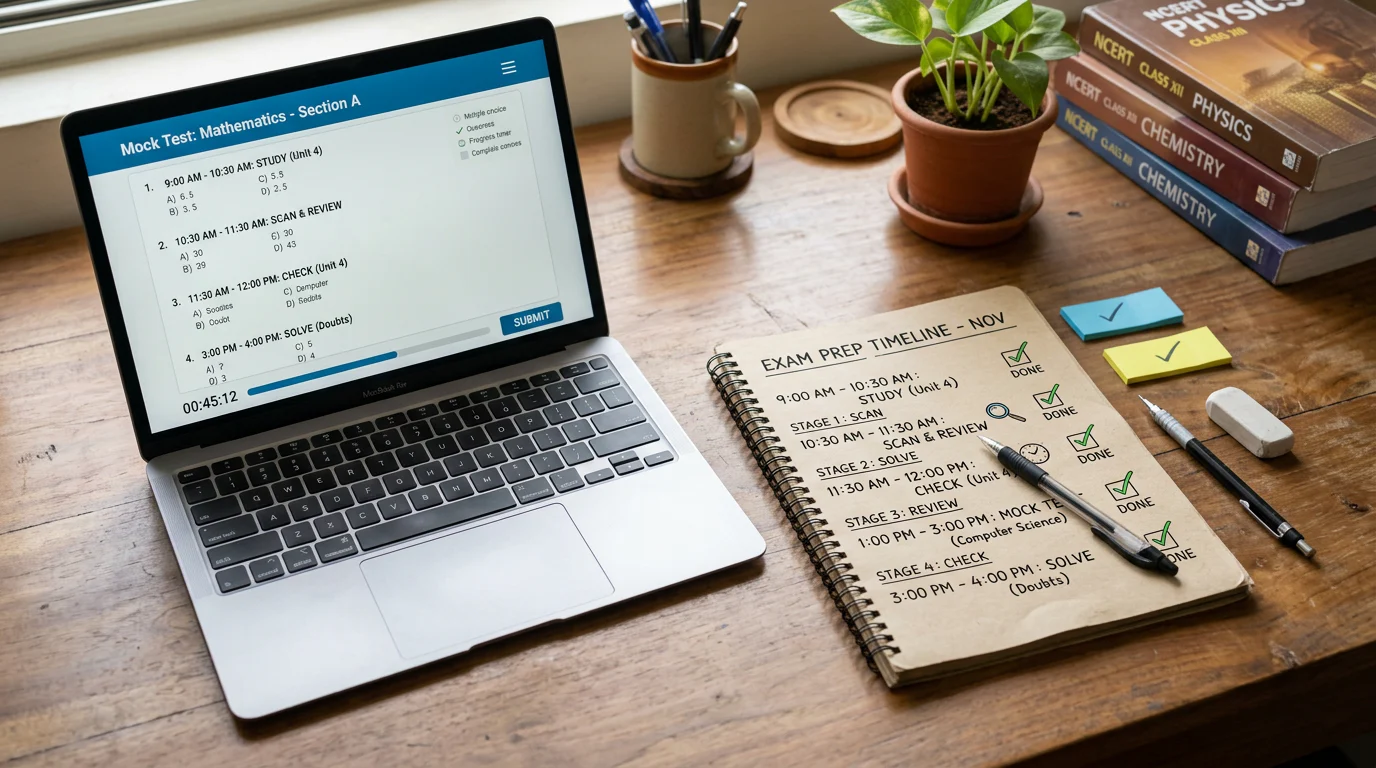
| First 8 Minutes | Scan, tag clear starts, mark uncertain questions and note subject order | Questions skipped before a method emerged |
| 8 To 130 Minutes | Solve high-certainty questions first | Accuracy by subject and question type |
| 130 To 165 Minutes | Return only to tagged questions with a plausible first step | Time spent on each return question |
| 165 To 180 Minutes | Check saved responses, numerical entries, signs, units and unintentional blanks | Preventable final-check errors |
The timings are a starting framework, not a universal rule. If Mathematics is your slowest subject but your strongest source of accurate marks, your log should decide how much time it deserves. When scores keep moving down, compare first-pass accuracy, negative marks and time spent before adding more study hours. Our mock-score diagnosis explains how to read those signals.
How Do You Analyse JEE Mock Test Mistakes Without Missing the Real Cause?
A wrong answer is not a diagnosis. We first reattempt it untimed and without a solution, because that separates a missing concept from a rushed calculation, a recall failure or an attempt decision that made no sense under negative marking.
Separate Knowledge Errors from Performance Errors
If you cannot begin the question calmly and untimed, we treat it as a knowledge or concept problem. If you can solve it after one cue, such as a formula name or a diagram, we treat it as a retrieval problem. If you solve it accurately untimed but not within the paper, we look at time management and question selection before assigning more theory.
Regular testing can improve learning, not just measure it. A 2021 review covering 222 independent studies and 48,478 students found a medium achievement benefit from quizzing in the classroom meta-analysis. That is why our review process ends with a retest, not just a highlighted solution.
If recurring mistakes leave the next action unclear, our mentoring quality guide can help you assess the academic support that improves a feedback loop.
Use a Six-Category Error Log
| Error Category | What It Looks Like | First Corrective Move |
|---|---|---|
| Conceptual | The method is unknown or applied incorrectly | Relearn one sub-concept, then solve varied basic questions |
| Arithmetic | The method is correct but calculation, sign or unit fails | Use short calculation drills and a final verification habit |
| Recall | The answer appears only after a cue | Practise closed-book formula and trigger recall |
| Time Management | The question is correct untimed but too slow in the mock | Use short timed sets and a stricter first-pass limit |
| Strategy | You chose low-certainty questions or ignored review | Adjust attempt order, tagging rule or review pass |
| Anxiety | Blanking or distress appears mainly under timed conditions | Log the trigger and repeat lower-stakes simulations |
Use one row for every wrong, skipped and guessed question. Include the mock date, subject, chapter, question type, minutes used, your chosen answer, untimed reattempt result, error category, next action and retest date. This makes the analysis subject-specific rather than turning every loss into a vague promise to “revise more.”
Calculate Chapter Yield Before Choosing Revision
For JEE Main Paper 1, we calculate the useful output of a chapter with this simple formula:
Net Marks Per Minute = ([correct] * 4 - [incorrect] * 1) / [minutes spent on that chapter]
Accuracy = [correct] / ([correct] + [incorrect]) * 100
A chapter with modest difficulty but repeated negative marks may deserve attention before a chapter that merely felt hard. For JEE Advanced, substitute the marks displayed in that specific mock, because the official instructions may vary. We use this calculation beside our blanking diagnosis, so a student can see whether the issue was knowledge, recall or the test situation.
What Does Blanking Out During a JEE Mock Test Mean?
Blanking out is not automatic proof of weak preparation or a mental-health condition. We first ask what happened before the blank: was the formula unavailable, did the question consume too long, did physical distress appear, or did the student recover on a familiar question?
Research supports treating anxiety as one possible performance factor. A 2018 review synthesised 238 studies and found test anxiety was negatively related to educational performance in the test-anxiety meta-analysis. That does not diagnose any individual, but it does justify a calmer, evidence-led review.
Use this decision process after the paper:
- Reattempt the item quietly before opening the solution.
- If you still cannot start, prioritise concept coverage.
- If one cue unlocks the method, prioritise retrieval practice.
- If you solve accurately but too slowly, prioritise timed practice and selection.
- Check whether blanking repeats mainly in full-length, timed conditions.
- If it does, record the question type, moment in the paper and physical signs without judging yourself.
- Use shorter timed sets first, then build back to full simulations.
- Escalate support when the same issue persists.
- Ask for academic help when the same knowledge or retrieval error survives several targeted retests.
- Speak with a qualified mental-health professional when anxiety repeatedly disrupts sleep, schoolwork, daily life or mock participation.
For support in India, the government lists the Tele-MANAS helpline at 14416 and 1800-89-14416 through its national programme. When the academic cause is clear but a numerical method still will not settle, focused Physics doubt support can be more useful than repeating an entire chapter.
How Do You Turn Analysis into the Next Revision Block?
We want the next study block to solve the most repeatable problem, not simply the most frustrating one. A mock becomes useful only when its evidence changes tomorrow’s revision, question practice or attempt behaviour.
Use this prioritisation formula after every three mocks:
Next-Block Priority = ([repeated lost marks] * [recurrence across last 3 mocks] * [1 + (1 - [accuracy])]) / [estimated minutes to remediate]
Choose One Primary Loss Category
If arithmetic errors are the biggest recurring loss, we assign calculation checks and short mixed numericals. If recall is the problem, we assign closed-book prompts before question practice. If strategy is the problem, we assign a shorter timed paper with the revised skip rule visible on the desk.
Build a Block That Ends in Retrieval
We do not let revision end with rereading. A useful block moves from targeted review to retrieval, then to questions under the condition that failed. For example, after a recall issue in electrostatics, we would review the trigger, write the formula from memory, solve untimed examples and finish with a timed mixed set.
Retest the Changed Habit
The next mock should test the same category. Track whether net marks, accuracy, minutes per question and avoidable negative marks changed together. If you need help deciding whether to revise a chapter or solve more past questions, our revision versus past papers guide gives a practical way to choose.
Build a Better JEE Mock Test Strategy with RG Lectures
At RG Lectures, we know that a mock result is useful only when it changes tomorrow’s work. We help online-test-preparation students turn a confusing score report into a simple routine: identify the chapter, question type, error category and time cost, then practise the exact weakness before the next paper. Our teaching is built around clearer Physics thinking, but our mock-review method also helps you protect marks across the full paper. If you are repeatedly losing time on numericals, doubting every response, or carrying the same mistakes from one test into the next, we can help you create a calmer feedback loop. Start with our free lessons, use your log beside each practice set and bring stubborn doubts into a focused support conversation. We want every mock to show you one precise improvement that you can carry forward. Explore our learning resources and preparation support at RG Lectures.
FAQs on JEE Mock Test Strategy
Should I Attempt Every Question in a JEE Mock Test?
No. We secure high-certainty questions first and return to marked questions. In a negatively marked paper, unsupported attempts reduce net marks and hide time-management problems.
Why Do My JEE Mock Scores Keep Dropping?
Look beyond total marks. Compare accuracy, negative marks, attempted questions, minutes per question and recurring error categories across three papers before changing your study plan.
Is Blanking Out Test Anxiety or a Preparation Gap?
Reattempt the question calmly before reading its solution. Failure without pressure suggests incomplete knowledge; success after a cue suggests retrieval; repeated timed distress needs qualified, supportive guidance.
How Long Should I Spend Analysing a Mock?
Reattempt wrong, skipped and guessed questions, record each cause, choose one corrective action and schedule a retest. Analysis is complete only when tomorrow’s work changes.
What Should I Practise Before the Next Mock?
Practise the category that cost the most repeatable marks, not merely the hardest chapter. Pair focused revision with retrieval or timed questions, then retest the habit.