Mirror Formula and Sign Convention: Get the Image Right
The mirror formula takes one line to write and one wrong sign to ruin. Put a plus where a minus belongs and a real image quietly becomes a virtual one, with an answer that still looks like a sensible number. Ek galat sign, aur real image virtual ban jaati hai.

By Rahul Jeewani, Founder · Updated 16 Nov 2026

In this article
- 1Mirror formula: 1/v + 1/u = 1/f and what each letter means
- 2Sign convention for mirrors: the New Cartesian rules in one table
- 3Concave vs convex mirror: sign of f and the images possible
- 4Concave mirror
- 5Convex mirror
- 6Mirror formula and magnification: reading the sign of m
- 7The 3-question sign check before you substitute
- 8Question 1: Is u written with a minus sign?
- 9Question 2: Which mirror is it, and is f's sign right?
- 10Question 3: Does the answer match the image you predicted?
- 11Worked numericals: concave and convex mirrors
- 12Numerical 1: concave mirror, object beyond F
- 13What if the sign is wrong? (Numerical 1)
- 14Numerical 2: concave mirror, object inside F
- 15What if the sign is wrong? (Numerical 2)
- 16Numerical 3: convex mirror
- 17What if the sign is wrong? (Numerical 3)
- 18Common slips: plus vs minus, dropping u's sign, f = R/2
- 19Where mirrors appear in MHT-CET (Std XI Optics)
- 20Conclusion
- 21Frequently asked questions
The mirror formula is 1/v + 1/u = 1/f. Write u negative for a real object, f negative for a concave mirror and positive for a convex one, predict real or virtual first, then check that v and m share a sign.
Mirror formula: 1/v + 1/u = 1/f and what each letter means
The mirror formula links three distances of a spherical mirror: object distance u, image distance v and focal length f. NCERT states that it is valid for all spherical mirrors and all object positions, provided you use the New Cartesian sign convention when substituting (NCERT Class 10 Science, Chapter 9).
- u is the distance from the pole to the object. The pole (P) is the centre of the mirror's surface.
- v is the distance from the pole to the image.
- f is the distance from the pole to the focus, the point where rays parallel to the principal axis meet after reflection (or seem to come from). The principal axis is the straight line through the pole and the centre of the mirror's sphere.
- R, the radius of curvature, is the distance from the pole to that centre, and f = R/2.
Measure everything in the same unit, usually cm. To find v, rearrange to 1/v = 1/f − 1/u.
Lenses use a minus sign instead (1/v − 1/u = 1/f). Their own sign trap is in our page on the lens maker's formula.
Sign convention for mirrors: the New Cartesian rules in one table
The New Cartesian sign convention takes the pole as the origin and the principal axis as the x-axis. The object always sits on the left, so light travels left to right. Distances to the right are positive and distances to the left are negative. Heights above the axis are positive and heights below are negative (NCERT Class 10 Science, Chapter 9).
| Quantity | Sign | Why |
|---|---|---|
| u (object distance) | Negative for a real object | The object is to the left of the mirror |
| v (image distance) | Negative for a real image, positive for a virtual image | A real image forms in front of the mirror (left), a virtual one behind it (right) |
| f (and R) | Negative for concave, positive for convex | The concave focus is in front of the mirror, the convex focus is behind it |
| Heights h and h′ | Above the axis positive, below negative | Object height is positive. A real image is inverted, so h′ is negative |
A real image is where reflected rays actually meet, and you can catch it on a screen. A virtual image is where rays only appear to meet, behind the mirror, and you cannot catch it on a screen.
                       +y  (heights above axis: positive)
                        |
   LEFT = NEGATIVE      |      RIGHT = POSITIVE
   object (u)           |      virtual image (v)
   real image (v)       |      convex-mirror focus (f)
   concave-mirror focus |
 -x <-------------------P-------------------------> +x
   light comes in       |      (mirror at P, reflecting side faces left)
   from this side       |
                        |
                       -y  (heights below axis: negative)
Some older books use a "real is positive" convention. Do not mix it with the signs above; stay with the New Cartesian sign convention throughout one numerical.
Concave vs convex mirror: sign of f and the images possible
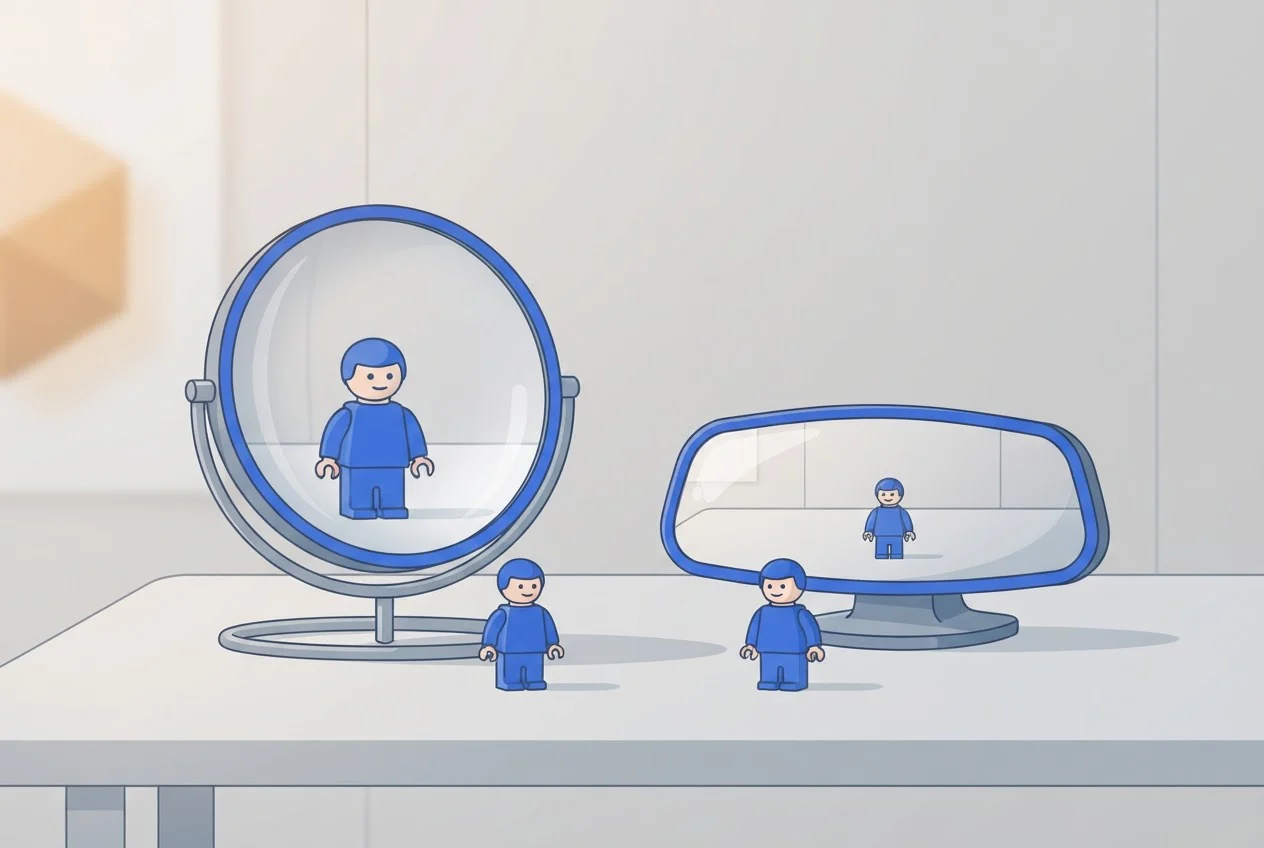
The mirror type fixes the sign of f, and the sign of f limits which images are possible. Learn both together so you know what answer to expect before you calculate.
Concave mirror
f is negative. For a real object:
- Object beyond C: the image is real, inverted and diminished, between F and C.
- Object at C: the image is real, inverted and the same size, at C.
- Object between C and F: the image is real, inverted and enlarged, beyond C.
- In all three, v is negative.
- Object between the pole and the focus: the image is virtual, erect and enlarged, so v is positive.
Convex mirror
f is positive. For a real object, the image is always virtual, erect and diminished, so v is always positive. If your convex-mirror answer shows a negative v, a sign has slipped.
Mirror formula and magnification: reading the sign of m
The magnification m equals h′/h, which equals −v/u. For a real object u is negative, so m has the same sign as v. NCERT says the same thing in words: a negative m means the image is real, and a positive m means it is virtual (NCERT Class 10 Science, Chapter 9).
This is the v-m check, and it works for the mirror formula and magnification together:
| v | m | Image |
|---|---|---|
| Negative | Negative | Real and inverted |
| Positive | Positive | Virtual and erect |
The size comes from the number: |m| above 1 means enlarged, below 1 means diminished. If v and m come out with different signs, a sign has slipped. A common slip is writing m = v/u, which flips the sign of m.
The 3-question sign check before you substitute
Yeh check har numerical pe chalao, substitute karne se pehle. Run these three questions before you put a single number into the mirror formula. Each has a pass and a fail you can test. This is the Check step of the four-step method in how to solve physics numericals, made specific to mirrors.
Question 1: Is u written with a minus sign?
For a real object in front of the mirror, u is always negative. Pass: "object 30 cm in front" is written as u = −30 cm before any other step. Fail: a bare 30.
Question 2: Which mirror is it, and is f's sign right?
Pass: concave gives f negative, convex gives f positive. If the question gives R, then f = R/2 with the same sign, so concave R = −20 cm gives f = −10 cm. Fail: any positive f for a concave mirror, or any negative f for a convex one.
Question 3: Does the answer match the image you predicted?
Predict before you calculate: concave with the object beyond F gives a real image, concave with the object inside F gives a virtual one, and convex always gives a virtual one. After solving, v must match the prediction and m must have the same sign as v. Pass: both agree. Fail: either disagrees, so go back to Questions 1 and 2.
Worked numericals: concave and convex mirrors
These three mirror formula numericals use fresh numbers, and each shows what a wrong sign does to the answer.
Numerical 1: concave mirror, object beyond F
A concave mirror has focal length 10 cm. An object is 30 cm in front of it. Find v and m.
- Check: u = −30 cm, f = −10 cm. The object is beyond F, so we expect a real image and a negative v.
- Solve: 1/v = 1/f − 1/u = −1/10 + 1/30 = −3/30 + 1/30 = −2/30, so v = −15 cm.
- Magnification: m = −v/u = −(−15)/(−30) = −0.5.
- Result: the image is real, inverted, half the size, and 15 cm in front of the mirror. v and m are both negative, so the check passes.
What if the sign is wrong? (Numerical 1)
Take f as +10 cm by mistake. Then 1/v = 1/10 + 1/30 = 4/30, so v = +7.5 cm and m = +0.25. A real, inverted image has turned into a virtual, erect one. Question 3 fails, because the prediction said real.
Numerical 2: concave mirror, object inside F
The same mirror (f = −10 cm) has an object 5 cm in front of it.
- Check: u = −5 cm, f = −10 cm. The object is inside F, so we expect a virtual image and a positive v.
- Solve: 1/v = −1/10 + 1/5 = −1/10 + 2/10 = 1/10, so v = +10 cm.
- Magnification: m = −10/(−5) = +2.
- Result: the image is virtual, erect, twice the size, and 10 cm behind the mirror.
What if the sign is wrong? (Numerical 2)
Drop the minus on u, so u = +5 cm. Then 1/v = −1/10 − 1/5 = −3/10, so v = −3.33 cm, and m = −(−3.33)/5 = +0.67. A virtual image has turned "real", but m is positive, which is erect. A real image from a mirror is always inverted, so the v-m check catches it.
Numerical 3: convex mirror
A convex mirror has focal length 10 cm. An object is 20 cm in front of it.
- Check: u = −20 cm, f = +10 cm. A convex mirror always gives a virtual image, so v must be positive.
- Solve: 1/v = 1/10 + 1/20 = 3/20, so v = +6.67 cm.
- Magnification: m = −6.67/(−20) = +0.33, about one-third.
- Result: the image is virtual, erect, diminished, and 6.67 cm behind the mirror.
What if the sign is wrong? (Numerical 3)
Give f the concave sign, f = −10 cm. Then 1/v = −1/10 + 1/20 = −1/20, so v = −20 cm and m = −1. A real, inverted, same-size image from a convex mirror is impossible for a real object, so Question 3 fails.
Common slips: plus vs minus, dropping u's sign, f = R/2
Three sign slips change what kind of image you report. Here they are on the numericals above:
| Slip | Numerical | Wrong v and m | What it looks like | Right v and m |
|---|---|---|---|---|
| f given the wrong sign | 1 (concave) | +7.5 cm, +0.25 | Virtual and erect | −15 cm, −0.5 (real, inverted) |
| u's minus dropped | 2 (concave) | −3.33 cm, +0.67 | "Real" but erect, so v and m disagree | +10 cm, +2 (virtual, erect) |
| Convex f given the concave sign | 3 (convex) | −20 cm, −1 | Real, inverted, same size | +6.67 cm, +0.33 (virtual, erect) |
Plus vs minus. The mirror formula adds, 1/v + 1/u = 1/f, and the lens formula subtracts, 1/v − 1/u = 1/f (NCERT Class 10 Science, Chapter 9). Using the lens form on Numerical 1 gives 1/v = 1/f + 1/u = −4/30, so v = −7.5 cm instead of −15 cm. The lens side of this contrast, including how R₂ gets its sign, is in our lens page.
Dropping u's sign. Writing u = 30 instead of −30 makes the object look as if it sits behind the mirror. Question 1 prevents it.
f = R/2 with the wrong sign. R follows the same convention as u, v and f. The centre of curvature of a concave mirror is in front of it, so R is negative and f = R/2 is negative too. For a convex mirror, both are positive.
This page deals only with reflection. Bending at a boundary and the critical angle belong to total internal reflection.
Where mirrors appear in MHT-CET (Std XI Optics)
As of November 2026, the 2026 rules for MHT-CET (Maharashtra Health and Technical Common Entrance Test) give approximately 20% weightage to the Std XI (Class 11) curriculum and 80% to Std XII (CET Cell Maharashtra). The same document sets Physics at 10 Std XI questions and 40 Std XII questions, 1 mark each, with no negative marking. These are 2026 rules, not a promise for 2028.
That is our reading of the numbers.
Class 10 readers: everything above works the same for you, and only this section is MHT-CET specific.
Padhna Aasaan Hai. Our MHT-CET 2028 Class 11th Physics Batch, taught by Rahul Jewaani (RG Sir), offers live classes, notes, PYQs (previous year questions) and mock tests to help you build a strong foundation early. See the MHT-CET 2028 batch on our store, or read why we suggest starting Class 11 Physics before Class 12. When mirrors feel settled, the next optics topic is wave optics formulas.
Conclusion
Seriously, the formula is the easy part. Write u negative, pick f's sign from the mirror type, predict real or virtual, solve, then confirm that v and m agree. Yeh check har numerical pe chalao, jab tak automatic na ho jaye.
Build a strong Class 11 Physics foundation early
Frequently asked questions
Sources
- 1.NCERT, Science for Class 10, Chapter 9 "Light – Reflection and Refraction" (reprint 2026-27), used as a reference for the New Cartesian sign convention, mirror formula, magnification and lens formula
- 2.MHT-CET 2026 syllabus and marking scheme: Std XI and Std XII weightage, Physics question split, marking scheme, Std XI Physics chapter list, State Common Entrance Test Cell, Government of Maharashtra
- 3.Worked numericals and wrong-sign results: our own arithmetic from the mirror formula and m = −v/u