One-to-One Doubt Solving vs Extra Classes for JEE Advanced Physics


TL;DR
We find that one-to-one doubt solving is best when JEE Advanced Physics work needs diagnosis of a student’s method, while extra classes suit shared revision. We also show how to route doubts to AI, peers, groups, or teachers, evaluate response quality, and test a service before paying.
One-to-One Doubt Solving vs Extra Classes for JEE Advanced Physics
JEE Advanced Physics rewards reasoning under pressure: the official 2026 brochure specifies two compulsory three-hour papers, with questions designed to test comprehension, reasoning, and analytical ability.
One-to-one doubt solving vs extra classes comes down to the job: a teacher-led private session is best when you need someone to diagnose your reasoning, prerequisite gap, or handwritten derivation. Extra classes work better for shared misconceptions, scheduled revision, and common problem sets. Choose by complexity, recurrence, urgency, and the feedback you need.
We compare five support formats, show what a strong solution must contain, and give you a practical way to test any service before you spend on it.
When Does One-to-One Doubt Solving vs Extra Classes Offer Better Value?
We do not think one format wins every time. A student who missed a sign convention in a common electrostatics exercise may gain more from the next batch revision class than from a private booking. A student whose original rotational-motion derivation fails at an unseen assumption needs a closer look at their exact working.
One-to-one support means a named teacher focuses on one student’s attempt. Extra classes are scheduled, teacher-led sessions that address a topic or pattern shared across a batch. Small groups sit between those options. AI answers are automated responses, while peer forums rely on other students’ explanations and should be treated as discussion, not final verification.
| Decision Factor | One-to-One Teacher Support | Extra Class | Small Group | AI Answer | Peer Forum |
|---|---|---|---|---|---|
| Personalisation | Highest | Low | Medium | Prompt-dependent | Variable |
| Depth | Diagnosis and follow-up possible | Best for shared patterns | Discussion-led | Must be checked | Depends on responder |
| Waiting Time | Booking or queue | Scheduled | Scheduled or queue | Usually immediate | Unpredictable |
| Comfort Asking Basics | Private | Variable | Medium | Private | Variable |
| Scheduling | Flexible if available | Fixed | Limited | Anytime | Anytime |
| Cost Model | Per session or package | Included or add-on | Shared fee or package | Free or subscription | Usually free |
| Accountability | Named teacher and follow-up | Instructor and batch | Facilitator and group | Provider policy | Often unverified |
Feedback matters more than speed alone. A broad evidence review covering 155 studies found feedback associated with an average of six additional months of progress, while also stressing that useful feedback gives specific information for improvement. That evidence is not a promise about any JEE service, but it is a useful quality test. See the feedback evidence before treating a fast answer as a good answer.
If several students are stuck on the same chapter-level issue, shared teaching can be efficient. Our small-batch comparison helps separate a genuine common doubt from a personal gap that needs individual diagnosis.
Before treating a group format as the cheaper choice, look at the work you will actually bring to it. A scheduled session can be excellent when you need a chapter recap, a fresh set of standard applications, or a teacher’s explanation of an error shared by the batch. It is less efficient when the whole session addresses material you already understand while your personal misconception remains untouched. Keep a short list of your unresolved questions after every class. If several can be grouped under one topic, take them to revision. If one question exposes a distinctive flaw in your approach, route that question to individual feedback instead. Our JEE revision guide can help you build that distinction into your weekly routine.
Which Physics Doubts Need Personalised Support?
The deciding factor is not whether a question looks difficult. It is whether the answer can be safely checked from reliable material, whether the error keeps returning, and whether you need a result or feedback on your method. We recommend classifying the doubt before choosing where to send it.
Separate the Doubt by Complexity
A four-level rubric prevents students from paying for private attention when a quick verification would do, or relying on a quick response when their reasoning needs to be rebuilt.
| Doubt Level | What The Student Needs | Typical Signal | Best First Route |
|---|---|---|---|
| Factual | A definition, condition, or sign check | “When is work done zero?” | Notes, verified AI, or peer check |
| Procedural | Help applying a known method | “Which force did I miss?” | Small group or checked AI response |
| Conceptual | A model choice or misconception diagnosis | “Why is tension not always equal?” | Teacher-led group or one-to-one |
| Multi-Step Reasoning | Review of an original attempt and connected ideas | “Where did my derivation first fail?” | One-to-one teacher-led support |
Ask for an Annotated Response
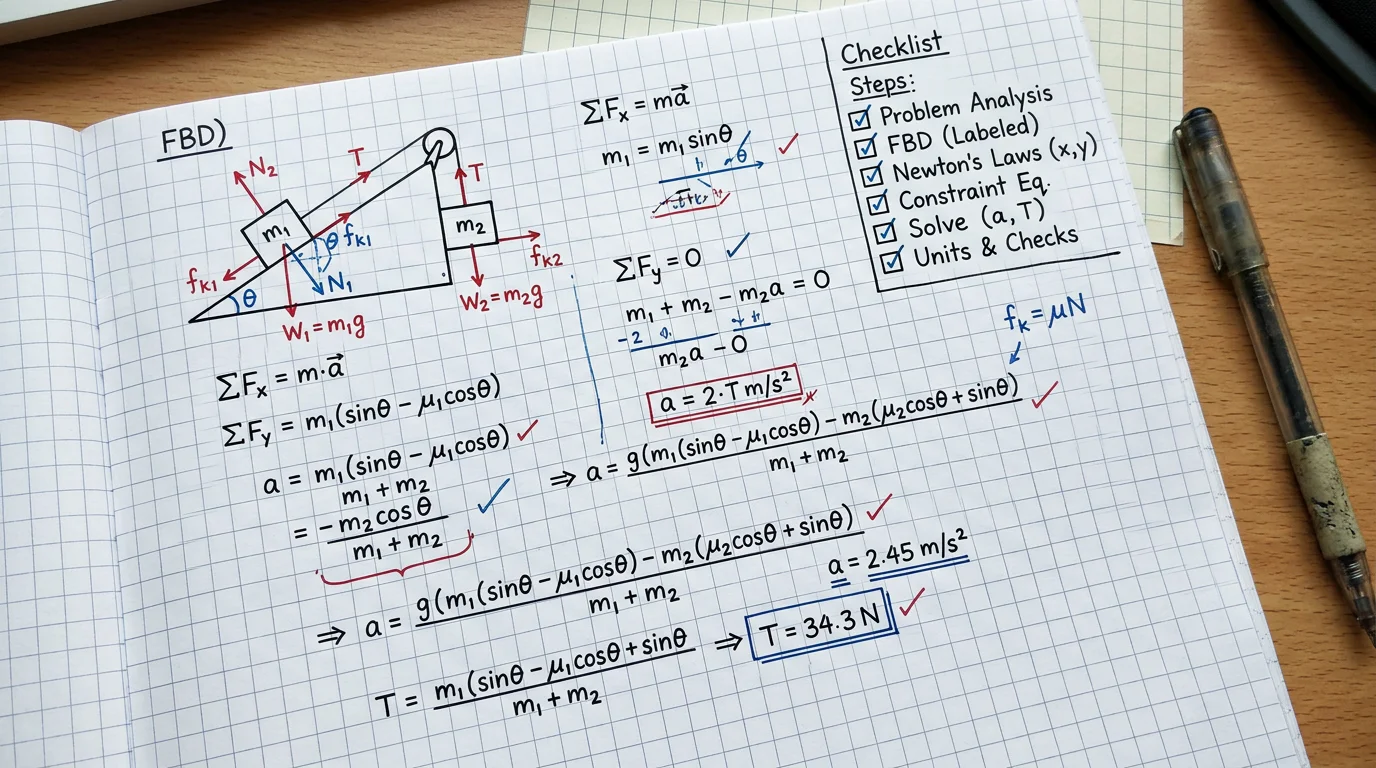
A high-quality JEE Advanced Physics response should begin with the given conditions, a relevant diagram, and the target quantity. It should then identify the faulty assumption or missing step, build the model, derive the answer, and check signs, units, limiting cases, or physical plausibility.
That standard reflects established study guidance: worked examples should be interleaved with problem solving, and students benefit from prompts that require deep explanatory questions. Read the federal study guidance, then use the same standard when judging doubt support.
- Restate the data, constraints, and diagram.
- Identify the first doubtful line in the student’s working.
- Explain the physical model and assumptions.
- Show the derivation rather than jump to an option.
- Test understanding with one related question.
Submit Original Handwritten Questions Properly
For a handwritten or original question, send the full image, identify the chapter and source, include your complete attempt, and mark the first line where your confidence broke. Ask the teacher to name the incorrect assumption, not merely replace it with a correct line. Our mentoring quality standard gives you a clearer way to judge whether that explanation actually teaches the missing idea.
Keep every corrected attempt in a chapter-wise error log. Record the topic, the physical model you selected, the first wrong step, the corrected principle, and one related question you solved afterward. This separates a one-off calculation slip from a repeatable reasoning pattern. It also gives you evidence when choosing whether to revise alone, bring the issue to an extra class, or ask for individual support. If the same model-selection error affects mock performance, diagnose the underlying cause before choosing more sessions.
Should You Use AI, Peers, a Small Group, or a Teacher?
We use AI as a starting point for low-risk clarification, not as an unquestioned authority for original multi-step Physics work. A 2025 systematic review of 28 K-12 studies involving 4,597 students found generally positive results for AI-driven tutoring systems, but also called for longer interventions and larger, more diverse studies. That is a reason to use the tool deliberately, not passively. See the 2025 review for the limits of the evidence.
The best route is usually clear once you ask two questions: can this answer be independently checked, and does my working need diagnosis?
Is the doubt factual and easy to verify against reliable material?
├─ Yes: Use AI or a peer for a quick explanation, then verify the method.
└─ No: Is it shared by several classmates or tied to this week’s lesson?
   ├─ Yes: Use an extra class or a small teacher-led group.
   └─ No: Is the question original, recurring, or multi-step?
      ├─ Yes: Use one-to-one teacher-led support.
      └─ No: Try a worked example, then escalate if the error repeats.
Peer discussion can work well for consolidation, provided it has structure and verification. The EEF’s peer tutoring review covers 145 studies and reports an average effect equivalent to about six additional months of progress, while noting that training, clear tasks, and review work matter. Read the peer tutoring review before assuming an unmoderated answer thread offers the same benefit.
For time-sensitive questions, our instant-help framework can help you decide whether quick access solves the problem or simply postpones the real diagnosis.
When Do Extra Classes or On-Demand Support Become Worth Paying For?
Integrated doubt classes tend to outperform on-demand access when the confusion is connected to the current lesson, shared by several students, or best resolved through a common worked example. They also make sense for planned revision, where the teacher can sequence questions rather than react to each one separately.
On-demand teacher support becomes more valuable when your question is original, your written attempt reveals a personal prerequisite gap, or waiting for the next class would interrupt an important practice session. It is not automatically worth paying for simply because it is available at all hours.
Use a Scenario Test Before Paying
Think about a student who has made the same mistake in two mechanics sets, can show their attempted derivation, and cannot find a trustworthy explanation for why the model fails. That is the point where structured support may justify its cost, if the teacher can diagnose the attempt and allow a follow-up question. Our paid-support framework helps turn that decision into a practical test.
Before subscribing, calculate the practical value: how many teacher-reviewed doubts are included, whether there are booking or question caps, the stated response time, and whether follow-up is part of the offer. Also consider whether the questions you need answered are likely to be shared revision doubts, or private problems involving your written work. A lower apparent cost can be poor value if the format never addresses the obstacle that is actually stopping your progress.
A good trial is one real doubt, not a large package. If the response lets you solve the next related question independently, it has done more than provide an answer. Use the same test with each format you are considering, especially when the service makes broad promises about personal support or instant answers.
How Can You Audit a Doubt-Solving Platform Before Paying?
A platform should be easy to inspect before it is easy to buy. We recommend looking for response ownership, limits, turnaround expectations, and evidence that the service can handle your actual working. A polished interface does not prove that a difficult Physics derivation will receive meaningful feedback.
Generative systems can produce confident but inaccurate or internally inconsistent content, particularly in contextual, expert tasks. That makes verification and escalation essential when an automated answer is involved. The AI risk profile explains why confidence is not the same as reliability.
Use this ten-point audit:
- Teacher Qualifications: Can we verify the teacher’s relevant Physics experience?
- Response Ownership: Is a teacher named and accountable for the explanation?
- Support Format: Is it live, annotated, asynchronous, AI-assisted, or peer-led?
- Turnaround: Is the first-response time stated clearly?
- Limits: Are question, minute, queue, and booking caps visible before payment?
- Follow-Up: Can the student ask where their own approach failed?
- Handwritten Work: Does the service accept full attempts and original questions?
- Solution Quality: Does a sample show diagrams, assumptions, derivation, and checks?
- Correction Policy: Is there a clear route if a response is wrong or incomplete?
- Terms And Privacy: Are cost, renewal, cancellation, and uploaded-work handling clear?
Try this script with a real question:
I have attached the complete question and my attempt. I think the relevant principle is __. I become unsure at line __. Please identify the first invalid assumption, show the corrected setup, explain why it applies, and give me one short check question.
Reject link-only answers, unexplained solution jumps, unverified peer claims, and replies that never check your misconception. For a deeper format choice, use our group-or-one-to-one guide.

Choose Support with RG Lectures
At RG Lectures, we want doubt support to make your next study hour more useful, not simply make a hard question disappear. Use the rubric above before you choose a format, save the trial script, and judge any response by its diagnosis, derivation, and follow-up. If an extra class solves the shared issue, use it. If your working shows a personal gap, seek feedback that examines the working itself. Our course and resource pages are a practical place to compare preparation options, revisit Physics study support, and decide what fits your schedule and budget. We recommend beginning with one real doubt, not a large commitment, then tracking whether the explanation helps you solve the next related question independently. Explore our study resources and start with the option that gives your preparation a clear practical next study step at RG Lectures.
FAQs on One-to-One Doubt Solving vs Extra Classes
What Platforms Exist for Personalised JEE Advanced Physics Doubt Clearing Beyond Video Links?
Use private teacher sessions, extra classes, small groups, AI tools, or peer forums. Choose according to question complexity, verification needs, privacy, urgency, and follow-up availability.
Is Teacher-Led Doubt Solving Better Than AI for JEE Advanced Physics?
Teacher support suits original derivations, recurring misconceptions, and reasoning feedback. AI helps with quick checks, but advanced explanations require independent verification before you use them.
Can a Teacher Help with an Original Handwritten Physics Question?
Yes. Send the complete question, your diagram or working, the source, and the exact stuck line. Request the faulty assumption, corrected setup, and a check question.
When Is Paid Doubt-Solving Support Worth It?
Pay for structured support when a doubt repeats, reliable material cannot verify it, and you need accountable feedback, follow-up access, or diagnostic review of your method.